
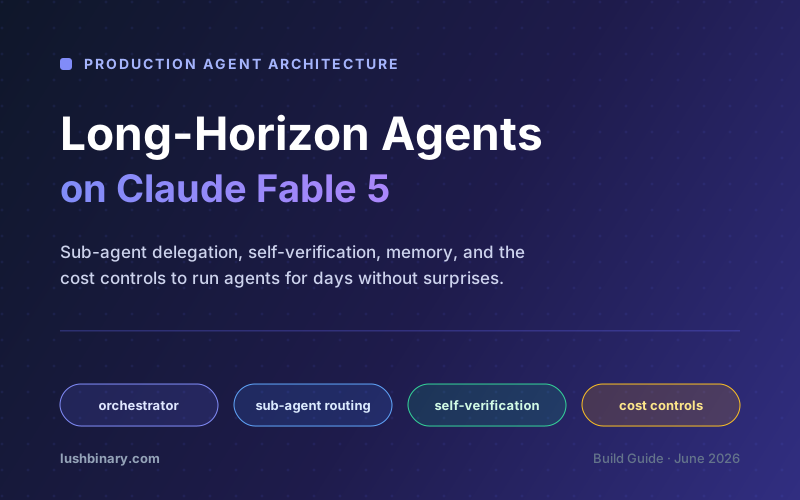
Most AI agents are sprinters. They handle a single request and stop. Claude Fable 5, released June 9, 2026, is built for the marathon. Anthropic positions it for ambitious, long-running, asynchronous tasks that previous models could not sustain: agents that plan across stages, delegate to sub-agents, and run for days, and that at the highest effort setting reflect on and validate their own work before returning it.
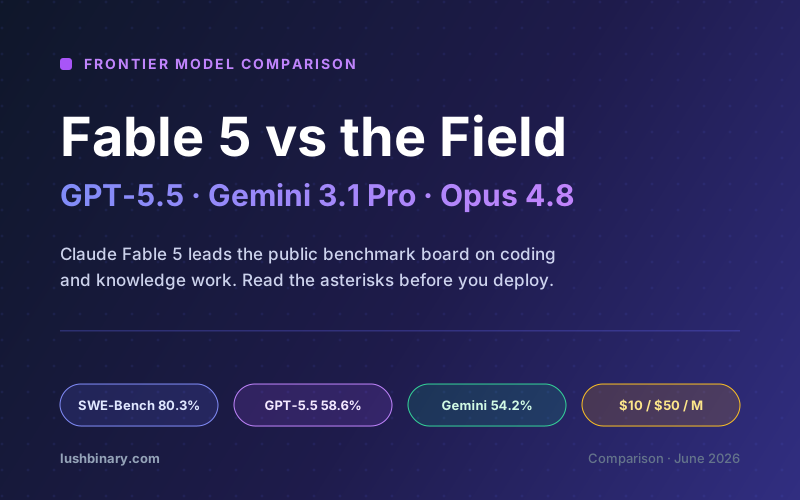
That capability is real, and so is the cost. At $10/$50 per million tokens, Fable 5 is double Opus 4.8, and a long-horizon agent that fans a single instruction into dozens of model calls can run up a bill fast. The teams that get the most out of Fable 5 are the ones that pair its reasoning with disciplined architecture: smart sub-agent delegation, explicit verification, external memory, and hard cost controls.
This guide is a practical blueprint for building a production long-horizon agent on Fable 5. For the model fundamentals, pricing, and safety split, start with our Claude Fable 5 developer guide.
📌 What This Guide Covers
1What a Long-Horizon Agent Actually Is
A long-horizon agent is one that works toward a goal across many steps and an extended time window, maintaining state, recovering from errors, and deciding for itself what to do next, with minimal human oversight. The canonical examples Anthropic points to for Fable 5 are telling:
- Large codebase migrations - moving a framework across thousands of files, where the agent plans the migration, executes it in batches, and fixes what breaks.
- Multi-day autonomous coding - building a feature end to end, including tests and iteration, over a session you would otherwise break into a sprint.
- Complex multi-stage knowledge work - research, analysis, and synthesis pipelines where a missed detail is expensive and the agent needs to check itself.
What these share is that the cost of a missed detail outweighs the token bill, and the work genuinely benefits from sustained autonomy. That is precisely where Fable 5's premium is easiest to justify against the senior-engineering hours it replaces. For routine, high-volume work, a cheaper model is the better default.
2Reference Architecture
A robust long-horizon agent is not one giant prompt. It is an orchestrator that decomposes a goal, delegates to sub-agents, verifies their output, and persists state so it can resume. Here is the shape:
The orchestrator runs on Fable 5 because planning and decomposition is where its reasoning advantage pays off. Sub-agents handle scoped workstreams. A verification pass checks the result before it is committed. And a persistent store holds state so a multi-day run survives restarts. This same fan-out-and-verify shape underpins the dynamic-workflow patterns that shipped with Opus 4.8; see our multi-agent orchestration guide for the patterns in depth.
3Sub-Agent Delegation and Model Routing
The single biggest cost lever in a long-horizon agent is which model runs each step. Fable 5's strength is planning, hard reasoning, and self-validation. Most sub-agent work, running tests, editing files, searching a codebase, summarizing a document, does not need the premium model. The pattern that works:
- Fable 5 as orchestrator - it owns the plan, decides what to delegate, and integrates results. This is the high-leverage reasoning that justifies the price.
- Opus 4.8 for routine sub-agents - mechanical or well-scoped tasks run on the half-price model. Quality is high enough for the work, and you avoid paying the Fable 5 rate dozens of times per run.
- Escalate selectively - if a sub-task turns out to be genuinely hard (a subtle bug, an ambiguous requirement), promote it to Fable 5 for that step only.
💡 Isolate sub-agent context
Give each sub-agent only the context it needs, not the full session history. This keeps token costs down, reduces context rot on long runs, and lets sub-agents run in parallel without stepping on each other. Pass back a compact summary, not the entire transcript.
4Self-Verification and Adversarial Review
Anthropic notes that at the highest effort setting Fable 5 reflects on and validates its own work. That is a strong default and one of the reasons it suits unattended operation. But for production, self-checks alone are not enough on changes that touch many files or live systems. Layer explicit verification on top:
- Deterministic checks first - run the test suite, type checker, linter, and build. These catch the majority of regressions for free and do not consume model tokens.
- Adversarial reviewer sub-agent - a separate agent whose only job is to find problems in the orchestrator's output. Give it the diff and the requirement, not the reasoning that produced the change.
- Human checkpoints on high-blast-radius steps - require approval before the agent merges to main, modifies infrastructure, or deletes data. Reversibility should gate autonomy.
The principle: trust Fable 5's self-verification for low-risk steps, and add independent verification proportional to the cost of getting it wrong. Our eval-driven development guide covers how to measure agent quality systematically.
5Memory and Context for Multi-Day Runs
A run that spans days cannot keep everything in the model's context window, and Anthropic has not published Fable 5's context limit, so do not architect around a specific number. External memory is the answer:
- Working state - persist the plan, completed steps, and open tasks to a store the agent reads at the start of each turn, so a restart resumes instead of starting over.
- Summarize aggressively - compress finished workstreams into short summaries rather than carrying full transcripts forward. This fights context rot and controls cost.
- Retrieval over recall - store artifacts (files, decisions, findings) externally and retrieve only what the current step needs. A dedicated memory layer beats stuffing the prompt.
💡 Caching and memory work together
A stable, well-structured system prompt and project context benefit from Anthropic's 90% prompt-caching discount on input. Keep the cached prefix stable across turns and put the volatile, per-step detail at the end so you maximize cache hits on a long session. See our agent memory systems guide.
6Cost Control and Safeguard Handling
At $10/$50 per million tokens, a long-horizon agent on Fable 5 needs hard cost discipline. A single agentic task using 200,000 input and 50,000 output tokens costs 0.2 * 10 + 0.05 * 50 = $4.50 before caching; multiply that across the many calls in a multi-day run and the total adds up quickly. Three controls keep it sane:
| Lever | What it does |
|---|---|
| Model routing | Fable 5 for the orchestrator and hard steps, Opus 4.8 for routine sub-agents at half the price. |
| Prompt caching | 90% discount on cached input. A stable prefix turns the $2.00 input on the example task toward $0.20 on cache hits. |
| Hard budgets | Per-task and per-day token caps that stop a runaway loop before it becomes a runaway invoice. |
⚠️ Mind the safeguard fallback
If your agent operates near cybersecurity, biology, chemistry, or model-distillation topics, Anthropic's classifier may route those turns to Opus 4.8, so you could pay the Fable 5 rate for an Opus 4.8 answer. Instrument how often this fires and route those workloads to Opus 4.8 directly. Our safety split guide explains the mechanics.
7Production Readiness Checklist
Before you let a Fable 5 agent run unattended against real systems, confirm:
- Bounded autonomy - human approval required on irreversible or high-blast-radius actions (merges, deletes, infrastructure changes).
- Deterministic verification - tests, types, lint, and build run before any change is accepted.
- State persistence - the agent can resume a run after a restart without losing progress.
- Cost caps - per-task and per-day token budgets, plus alerting on spend.
- Model routing - Fable 5 reserved for high-leverage steps, cheaper models for the rest.
- Observability - per-step logging of tokens, model used, tool calls, and safeguard fallbacks.
- Least privilege - the agent's credentials and tool access are scoped to exactly what the task needs.
8Why Lushbinary for Agent Builds
A long-horizon agent on a frontier model is powerful and unforgiving of weak architecture. Lushbinary builds production agent systems that are autonomous where it pays and controlled where it matters, across healthcare, fintech, SaaS, and e-commerce.
- Agent architecture - orchestrator and sub-agent design, verification loops, and memory systems tuned to your workflows.
- Model routing and cost control - Fable 5 and Opus 4.8 routing, prompt-cache strategy, and hard budgets so spend stays predictable.
- Safety and observability - bounded autonomy, safeguard-fallback instrumentation, and per-step logging.
- AWS infrastructure - production deployment with VPC isolation, encryption, monitoring, and autoscaling.
🚀 Free Consultation
Planning a long-running agent on Fable 5? We will design the orchestration, routing, verification, and cost controls so it ships safely and stays on budget, with no obligation.
9Frequently Asked Questions
What makes Claude Fable 5 good for long-horizon agents?
Anthropic positions Fable 5 for ambitious, long-running, asynchronous tasks that previous models could not sustain: agents that plan across stages, delegate to sub-agents, and run for days. At the highest effort setting it reflects on and validates its own output. It also leads the public benchmark board on agentic coding (SWE-Bench Pro 80.3%) and tool use, which are the capabilities long-horizon agents lean on.
How do I control costs when running long agents on Fable 5?
Fable 5 costs $10/$50 per million tokens, double Opus 4.8. Use three levers: route routine sub-tasks to Opus 4.8 and reserve Fable 5 for hard reasoning, exploit the 90% prompt-caching discount on reused context, and set hard per-task and per-day token budgets. A single agentic task using 200K input and 50K output tokens costs about $4.50 on Fable 5 before caching.
Should every sub-agent use Claude Fable 5?
No. A cost-effective pattern uses Fable 5 as the orchestrator and hard-reasoning model while delegating mechanical sub-tasks (file edits, test runs, search) to Opus 4.8 or a cheaper model. This keeps the premium model on the work that justifies its price and avoids paying the Fable 5 rate for routine sub-agent calls.
Does Fable 5 handle self-verification automatically?
Anthropic says that at the highest effort setting Fable 5 reflects on and validates its own work before returning it. That is a strong default, but production agents should still add explicit verification: a separate critic pass, tests, or an adversarial reviewer sub-agent, especially for changes that touch many files or production systems.
What context window does Claude Fable 5 support for long sessions?
Anthropic did not publish Fable 5's context-window size or maximum output tokens at launch. Do not assume a specific length. For very long sessions, lean on external memory and summarization rather than trying to hold everything in context, and verify the current limits in Anthropic's model documentation before architecting around them.
📚 Sources
- Anthropic - Claude Fable 5 and Claude Mythos 5
- Anthropic - Claude Opus 4.8 (routing baseline and pricing)
- TechCrunch - Claude Fable 5 launch coverage
Content was rephrased for compliance with licensing restrictions. Fable 5 capabilities, effort behavior, pricing, and safeguard details sourced from Anthropic's June 9, 2026 announcement and reporting by TechCrunch. Architecture recommendations are Lushbinary's own. Model capabilities and limits may change - always verify on Anthropic's website.
Building a Long-Horizon Agent?
Lushbinary designs orchestration, routing, verification, and cost controls for production agents on Claude Fable 5. Let's talk about your project.
Ready to Build Something Great?
Get a free 30-minute strategy call. We'll map out your project, timeline, and tech stack - no strings attached.
Prefer email? Reach us directly: