
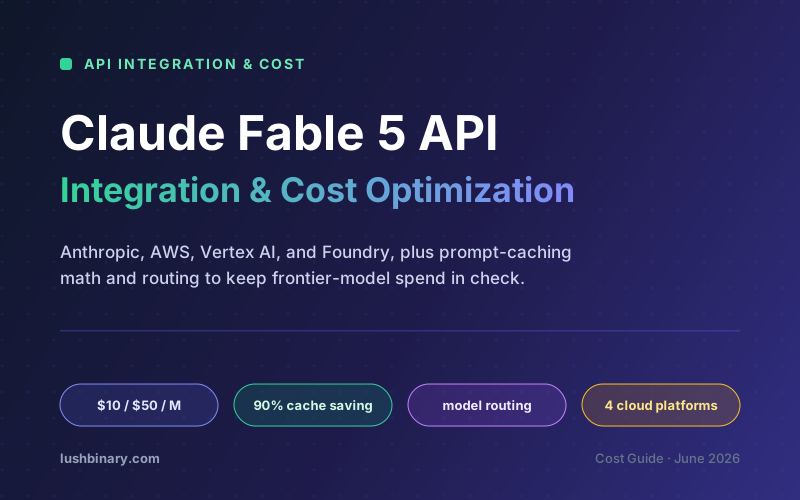
Claude Fable 5 is the most capable model Anthropic has made generally available, and at $10/$50 per million tokens it is also a premium tier, double the price of Claude Opus 4.8. Integrating it well is less about the prompt and more about the architecture around it: where you call it, how you cache, and how you route work so the bill matches the value.
The good news is that the cost levers are real and powerful. A 90% prompt-caching discount on input can be the difference between a sustainable agent and a runaway invoice, and disciplined model routing can cut spend without touching quality on the work that matters.
This guide covers Fable 5 API integration across Anthropic, AWS, Google Cloud, and Microsoft Foundry, the prompt-caching math, a model-routing strategy, and a full cost-optimization playbook. For the model fundamentals, see our Claude Fable 5 developer guide.
📌 What This Guide Covers
1Where to Access Fable 5
Fable 5 is broadly available under the API model ID claude-fable-5. You can reach it through:
- The Claude API - billed per token at $10/$50.
- claude.ai - on Pro, Max, Team, and Enterprise plans.
- AWS - through Amazon's managed Claude offering.
- Google Cloud - through Vertex AI.
- Microsoft Foundry - through the Foundry model catalog.
⚠️ The subscription credit window
On subscription plans, Fable 5 was included free from June 9 through June 22, 2026. From June 23 it draws on usage credits, with Anthropic planning to restore it as a standard inclusion once capacity allows. API and cloud usage is billed per token throughout. Do not assume the June launch pricing on subscriptions persists - budget for credits.
2API Integration Basics
On the Claude API, calling Fable 5 is a model-ID swap from any existing Claude integration. The Messages API shape is unchanged:
curl https://api.anthropic.com/v1/messages \
  -H "x-api-key: $ANTHROPIC_API_KEY" \
  -H "anthropic-version: 2023-06-01" \
  -H "content-type: application/json" \
  -d '{
    "model": "claude-fable-5",
    "max_tokens": 4096,
    "messages": [
      {"role": "user", "content": "Refactor this module for testability."}
    ]
  }'
On AWS Bedrock, Google Vertex AI, and Microsoft Foundry, use that platform's Claude invocation pattern and select the Fable 5 model identifier from the catalog. Confirm the exact regional identifier in each provider's console, since cloud model IDs sometimes differ from the raw Anthropic API ID.
💡 Confirm limits before you build
Anthropic did not publish Fable 5's context-window size or maximum output tokens at launch. Set max_tokens conservatively and verify the current limits in the official model documentation before architecting around a specific context length.
3Prompt Caching: The 90% Lever
Anthropic applies a 90% discount to cached input tokens on Fable 5. For any workload that reuses a large, stable prefix, a system prompt, a knowledge base, a codebase, or a long document, across many requests, this is usually the biggest single saving available.
The mechanics are simple: mark the stable portion of your prompt as cacheable, keep it byte-for-byte identical across calls, and put the volatile, per-request content after it. On a cache hit, the cached input is billed at one tenth the standard rate. On a task with 200,000 input tokens, that turns the 0.2 * 10 = $2.00 input cost into roughly $0.20.
- Stabilize the prefix - any change to the cached block invalidates the cache, so keep instructions and context static and pass dynamic values separately.
- Order matters - cache the large, reused content first; put the user's current message last.
- Best fit - chatbots with a big system prompt, RAG over a fixed corpus, and agents that carry a stable project context across a long session.
⚠️ Caching helps input, not output
The discount applies to input tokens only. At $50 per million, output is where verbose, reasoning-heavy responses get expensive. Control output cost by constraining response length and asking for concise results where appropriate.
4Model Routing for Cost Control
The second big lever is not using Fable 5 for everything. It is double the price of Opus 4.8, which remains the sensible default for routine, high-volume, or latency-sensitive work. A routing layer sends each request to the cheapest model that meets your quality bar:
- Fable 5 - hardest long-horizon coding, complex multi-stage knowledge work, tasks where a missed detail is expensive.
- Opus 4.8 - classification, summarization, drafting, interactive chat, and most day-to-day agentic tasks at half the price.
- Safeguarded domains - if your workload sits near cybersecurity or biology, route to Opus 4.8 directly. Fable 5 would hand those queries to Opus 4.8 anyway, so paying the premium gains nothing.
Back the routing with an eval harness so model choices are evidence, not guesswork. Our LLM gateway and model routing guide covers the gateway patterns and semantic caching that make this practical at scale.
5Detailed Cost Breakdown
Below is a worked breakdown of Fable 5 costs across common workload shapes, with and without caching, and against Opus 4.8 for comparison. Unlock the detailed table to see the per-workload math.
Get Detailed Cost Breakdown
Fill in your details to unlock pricing and cost information.
🚀 Free Consultation
Want to know what Fable 5 will actually cost for your workload? Lushbinary will model your token volume, design a caching and routing strategy, and give you a realistic monthly estimate with no obligation.
6The Cost-Optimization Playbook
Putting the levers together, here is the order of operations for keeping a Fable 5 integration affordable:
- Route first - default to Opus 4.8 and escalate to Fable 5 only for work that needs it. This is the largest structural saving.
- Cache the stable prefix - capture the 90% input discount on any reused context.
- Constrain output - output at $50/M dominates verbose responses; ask for concise results and cap
max_tokens. - Batch the non-urgent - queue work that does not need an immediate response and process it off the critical path.
- Avoid paying for fallbacks - route safeguarded-domain work to Opus 4.8 directly so you do not pay the Fable 5 rate for an Opus 4.8 answer.
- Cap and monitor - set per-day token budgets, alert on spend, and log tokens per request so a runaway loop is caught early.
7Why Lushbinary for Frontier-Model Builds
The difference between a Fable 5 integration that pays for itself and one that burns budget is the architecture around the model. Lushbinary has shipped production Claude integrations since the GPT-4 era, across healthcare, fintech, SaaS, and e-commerce.
- Cost engineering - prompt-cache strategy, routing, output control, and budgets that keep frontier-model spend predictable.
- Multi-cloud integration - Fable 5 on the Anthropic API, AWS, Vertex AI, or Foundry, wired into your existing stack.
- Evals and monitoring - proof that your routing choices hold quality, plus per-request token observability.
- AWS infrastructure - production deployment with VPC isolation, encryption, monitoring, and autoscaling.
🚀 Free Consultation
Integrating Fable 5 and worried about the bill? We will design the caching, routing, and budgeting so you get the capability without the runaway cost, with no obligation.
8Frequently Asked Questions
How much does the Claude Fable 5 API cost?
Claude Fable 5 costs $10 per million input tokens and $50 per million output tokens, double Claude Opus 4.8's $5/$25. A 90% prompt-caching discount applies to input, and US-only inference is available at a 1.1x multiplier on both input and output. The API model ID is claude-fable-5.
Where can I access the Claude Fable 5 API?
Fable 5 is available on the Claude API directly, on claude.ai across Pro, Max, Team, and Enterprise plans, and through AWS, Google Cloud, and Microsoft Foundry. Use the model ID claude-fable-5. Claude Mythos 5 is not on any of these; it is restricted to Project Glasswing partners.
How does prompt caching reduce Claude Fable 5 costs?
Anthropic applies a 90% discount to cached input tokens. For an agent or chatbot that reuses a large system prompt or document across many turns, the repeated context is billed at one tenth the rate. On a task with 200K input tokens, the $2.00 input cost drops toward $0.20 on cache hits, which is often the single largest lever on a Fable 5 bill.
Is the Claude Fable 5 subscription free?
On subscription plans, Fable 5 was included at no extra cost from June 9 through June 22, 2026. From June 23, using it on a subscription plan draws on usage credits. Anthropic says it will restore Fable 5 as a standard inclusion once capacity allows. API and cloud usage is billed per token throughout at $10/$50.
How do I keep Claude Fable 5 costs under control?
Route by task: use Opus 4.8 at half the price for routine work and reserve Fable 5 for hard, long-horizon tasks. Exploit the 90% prompt-caching discount on stable context. Batch non-urgent work, set hard per-day token budgets, and instrument the safeguard fallback so you are not paying the Fable 5 rate for Opus 4.8 answers.
📚 Sources
- Anthropic - Claude Fable 5 and Claude Mythos 5
- Anthropic - Claude Fable (pricing and availability)
- Anthropic - Claude Opus 4.8 (pricing baseline)
Content was rephrased for compliance with licensing restrictions. Pricing, prompt-caching discount, availability, and rollout timeline sourced from Anthropic's June 9, 2026 announcement. Cost figures are illustrative model math based on published rates, not vendor quotes. Pricing and availability may change - always verify on Anthropic's and each cloud provider's pricing pages.
Integrating Claude Fable 5?
From caching and routing to multi-cloud deployment, Lushbinary builds Fable 5 integrations that are fast, affordable, and production-ready. Let's talk about your project.
Ready to Build Something Great?
Get a free 30-minute strategy call. We'll map out your project, timeline, and tech stack - no strings attached.
Prefer email? Reach us directly: