
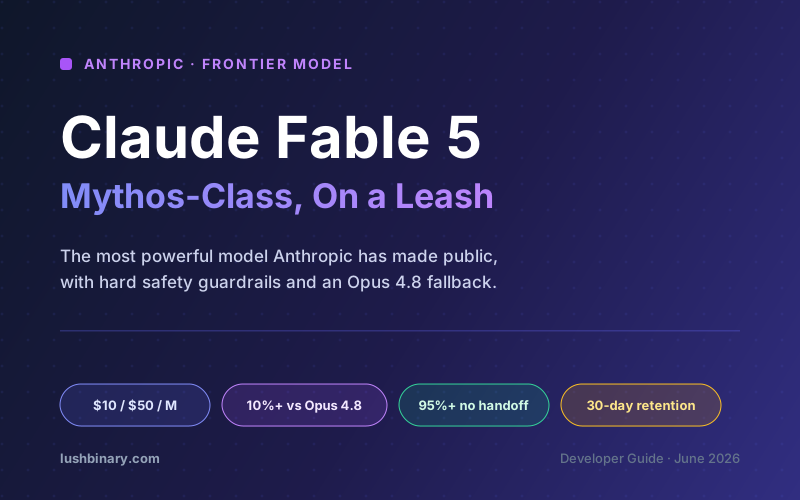
On June 9, 2026, Anthropic released Claude Fable 5, the first version of its Mythos-class technology that the general public can actually use. Until now, Mythos has lived behind tight access gates because of how capable it is at finding software security flaws. Fable 5 is the same tier of intelligence with hard safety limits bolted on: in high-risk areas like cybersecurity, biology, chemistry, and distillation, the model refuses to answer and quietly hands the request to Claude Opus 4.8 instead.
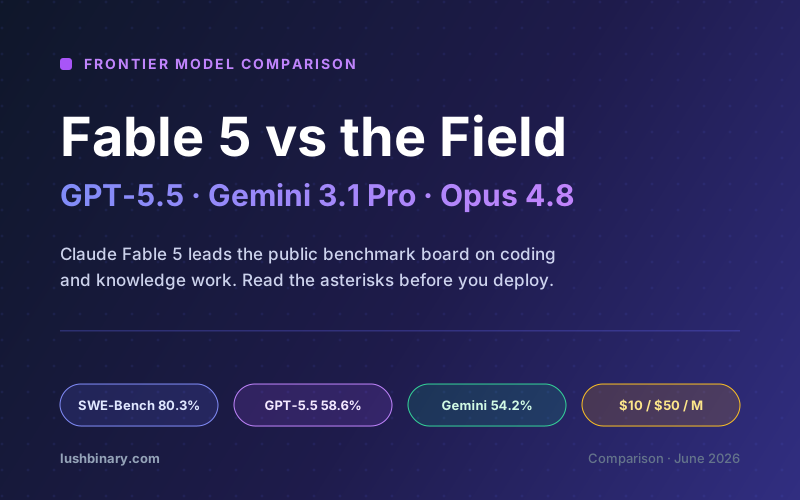
For engineering teams, Fable 5 is the most powerful model Anthropic has ever made widely available. It is state-of-the-art on nearly every benchmark the company tested, scoring more than 10% higher than Opus 4.8 on some of them. The catch is the price: $10 per million input tokens and $50 per million output tokens, double what Opus 4.8 costs. That changes the math on when reaching for the most capable model is actually worth it.
This guide breaks down what Fable 5 is, how it relates to Mythos 5 and Opus 4.8, what the benchmarks and early customer reports actually say, how the safety fallback works, the new mandatory data retention policy, and a practical framework for deciding when Fable 5 earns its price. For a refresher on the model it falls back to, see our Claude Opus 4.8 upgrade guide.
📌 What This Guide Covers
- What Claude Fable 5 Is and Where It Came From
- Fable 5 vs Mythos 5 vs Opus 4.8: The Model Family
- Benchmarks and Early Customer Reports
- Pricing: What $10/$50 Does to Your Token Budget
- The Safety Fallback: Guardrails and Opus 4.8
- The New 30-Day Data Retention Requirement
- How to Access Fable 5 (and the Rollout Timeline)
- When to Use Fable 5 vs Opus 4.8
- Why Lushbinary for Frontier-Model Builds
- FAQ
1What Claude Fable 5 Is and Where It Came From
Anthropic first unveiled Mythos as a preview in April 2026. It impressed Wall Street and government officials because it excels at identifying security flaws in software, and the company deliberately did not make it generally available. Access stayed limited to a handful of partners, then expanded last week to hundreds of organizations across 15 countries through a cybersecurity initiative Anthropic calls Project Glasswing, with a focus on groups that manage critical infrastructure.
Claude Fable 5 is how that same tier of technology finally reaches everyone else. It is, in Anthropic's framing, a Mythos-class model that is safe for the public because of safeguards and limits placed on top of it. The company describes Fable 5 as state-of-the-art on nearly all tested benchmarks of AI capability, with exceptional performance in software engineering, knowledge work, vision, and scientific research.
💡 The one-line summary
Fable 5 is Mythos on a leash: the same underlying model the government was wary of, wrapped in classifiers that block dangerous queries and route them to the safer Opus 4.8. You get the intelligence without the unrestricted capabilities.
The timing is not an accident. Anthropic confidentially filed its IPO prospectus days before the launch, after reporting a revenue run rate of roughly $47 billion (up from about $10 billion in annual revenue a year earlier) and closing a funding round at a $965 billion valuation. A higher-priced flagship that the public can buy is a logical move heading into the public markets.
2Fable 5 vs Mythos 5 vs Opus 4.8: The Model Family
Anthropic launched three relevant models in close succession, and it is easy to confuse them. Here is how they line up.
| Model | Input / Output ($/M tokens) | Who Can Use It | Role |
|---|---|---|---|
| Claude Fable 5 | $10 / $50 | Public: API, paid plans, Enterprise | Mythos-class power with guardrails active |
| Claude Mythos 5 | $10 / $50 | Approved orgs only (Project Glasswing) | Same model, safeguards lifted in some areas |
| Claude Opus 4.8 | $5 / $25 | Generally available | Default workhorse and Fable 5's safe fallback |
The key insight: Fable 5 and Mythos 5 are the same underlying model at the same price. The only difference is the safety layer. Fable 5 keeps the guardrails on for the public. Mythos 5 relaxes them for vetted organizations doing things like critical-infrastructure cyber defense.
Opus 4.8 sits one rung below in raw capability but remains the practical default for most work. It is half the price, generally available with no special access requirements, and Anthropic praised its honesty and alignment at launch. It also carries a 1M-token context window. Crucially, it is the model Fable 5 leans on whenever a request crosses into restricted territory.
3Benchmarks and Early Customer Reports
Anthropic says Fable 5 shows exceptional performance across software engineering and knowledge work, scoring more than 10% higher than Opus 4.8 on some benchmarks. For context, Opus 4.8 itself is no slouch: it posts 88.6% on SWE-bench Verified and 69.2% on the harder SWE-bench Pro set, so a double-digit jump on top of that is meaningful. Anthropic has not published a full per-benchmark table for Fable 5 at launch, so treat the headline figure as the company's own claim until independent evals land.
⚠️ Read the benchmark claim carefully
"More than 10% higher on some benchmarks" is not the same as "10% better everywhere." The gain is benchmark-specific. For routine coding and chat, the gap between Fable 5 and Opus 4.8 may be far smaller than the 2x price difference, which is exactly why the when-to-use decision matters.
The early third-party signals are more concrete than the benchmark number:
- Hex (analytics) said Fable was the first model to score 90% on its core benchmark of complex, long-running analytical tasks, praising its judgment and attention to nuance on the hardest questions.
- Base44 (vibe-coding) reported Fable is better at one-shotting full apps and has excellent tool-calling.
- Genspark (agent platform) said Fable beat every other model in its evaluations and performed significantly better on UI design and game coding.
- Rakuten (shopping rewards) noted that at the highest effort setting, Fable reflects on and validates its own work, which is what makes highly autonomous operations viable for them.
The throughline is agentic, long-horizon work: full-app generation, multi-step analysis, tool-heavy automation, and tasks where the model checks itself. That is where the extra capability shows up most clearly, and where the higher per-token cost is easiest to justify.
4Pricing: What $10/$50 Does to Your Token Budget
Fable 5 costs $10 per million input tokens and $50 per million output tokens. Opus 4.8 costs $5 input and $25 output. It is a clean 2x across the board, so any task costs exactly twice as much to run on Fable 5. A concrete example for a single agentic task that consumes 200,000 input tokens and produces 50,000 output tokens:
| Model | Input cost (200K) | Output cost (50K) | Total / task |
|---|---|---|---|
| Fable 5 | $2.00 | $2.50 | $4.50 |
| Opus 4.8 | $1.00 | $1.25 | $2.25 |
The formula is straightforward: cost = input_tokens / 1,000,000 * P_in + output_tokens / 1,000,000 * P_out. At Fable 5 rates that is 0.2 * 10 + 0.05 * 50 = 2.00 + 2.50 = $4.50. At Opus 4.8 rates it is 0.2 * 5 + 0.05 * 25 = 1.00 + 1.25 = $2.25. Output tokens dominate, so the gap widens for verbose, reasoning-heavy responses.
⚠️ Watch the agentic cost multiplier
Frontier models split a single request into many sub-tasks, so a "one" prompt can fan out into dozens of model calls. Many enterprises have been blindsided by AI bills for exactly this reason. At 2x the per-token price, Fable 5 amplifies that effect. Budget for it, cap it, and route only the work that needs it.
Anthropic's own framing is that you get a higher return on investment from more intelligent models, and that early customers have seen improved spend-per-task even at the higher rate. That can be true for hard, high-value work and false for routine work at the same time. The right answer is a routing strategy, which we cover in the decision section below. For broader cost control tactics, see our LLM gateway and model routing guide.
5The Safety Fallback: Guardrails and Opus 4.8
The whole reason Fable 5 can be public is its safety layer. Anthropic built new classifiers that watch for high-risk queries in cybersecurity, biology, chemistry, and distillation. When one trips, the model blocks its own response and falls back to Claude Opus 4.8 to deliver a safe answer. Ask it how to make ricin, for example, and you get an Opus 4.8 response, not a Fable 5 one.
The good news for normal use is that the fallback is rare. Anthropic says early data shows at least 95% of Fable sessions run entirely on the model's own responses. The cases where it has to defer to Opus 4.8 are the exception, not the rule, so most teams will rarely notice the handoff.
On hardening, Anthropic says it stress-tested the classifiers before launch. It ran an external bug bounty that produced no universal jailbreaks across more than 1,000 hours of testing, then worked with external red-teaming organizations that also failed to find universal jailbreaks. That is a stronger claim than most launches make, though security researchers note that novel attacks may still surface in the wild. Treat the model's built-in guardrails as one layer, not your only layer. For application-level defenses, see our prompt injection defense playbook.
This launch also fits Anthropic's broader "race to the top" positioning: ship powerful capability, but pair it with guardrails so the benefits outweigh the harms. It arrived shortly after the company publicly urged major AI labs to coordinate a shared brake on frontier development, warning that systems are approaching recursive self-improvement.
6The New 30-Day Data Retention Requirement
This is the detail most likely to affect your compliance review. With Fable 5 and Mythos 5, Anthropic requires a 30-day retention on all traffic, even for enterprises that previously held zero-retention agreements. The company says it will not use the data for training. The stated purpose is narrower: to defend against complex and novel attacks, including new jailbreaks, and to identify and reduce false positives in the classifiers.
⚠️ Compliance teams: read this twice
If your organization negotiated zero data retention for regulatory or contractual reasons, that exemption does not apply to Fable 5 or Mythos 5. Sensitive prompts and outputs will be retained for 30 days. Factor this into data-handling reviews, BAAs, and any privacy-sensitive workload before you route it through Fable 5.
It is worth watching as a possible industry pattern: access to the most powerful models coming bundled with mandatory retention framed as a safety control. For privacy-sensitive workloads where this is a dealbreaker, Opus 4.8 under your existing agreement remains the pragmatic choice.
7How to Access Fable 5 (and the Rollout Timeline)
Fable 5 is available through the Claude API and consumption-based Enterprise plans. Subscription access rolls out in stages, and the timeline has a catch worth planning around:
| Window | What you get |
|---|---|
| Through June 22, 2026 | Fable 5 included in Pro, Max, Team, and seat-based Enterprise plans at no extra cost |
| From June 23, 2026 | Fable 5 pulled from those plans; usage credits required going forward, with plans to restore it as a standard feature later |
| Always (since launch) | Claude API and consumption-based Enterprise plans, billed at $10/$50 per million tokens |
If you want to evaluate Fable 5 cheaply, the free window on paid plans through June 22 is the moment to do it. For anything you intend to run in production at scale, build against the API now and plan your budget around the metered $10/$50 rate, because that is what persists after the free window closes. Anthropic also said it expects demand to be very high and hard to predict, so capacity could be tight early on.
8When to Use Fable 5 vs Opus 4.8
Because Fable 5 is exactly double the price, the only sane default is a routing strategy: send most work to Opus 4.8 and escalate to Fable 5 only when the task genuinely benefits. Here is a practical split based on what Anthropic and early customers reported.
| Reach for Fable 5 when... | Stick with Opus 4.8 when... |
|---|---|
| One-shotting a full app or complex feature | Routine edits, refactors, and bug fixes |
| Long-running, multi-step analytical tasks | Short Q&A, summaries, and chat |
| Highly autonomous agents that self-validate | High-volume, cost-sensitive workloads |
| Hard UI design and game coding | Privacy-sensitive work needing zero retention |
In practice, an LLM gateway that classifies the incoming task and routes by difficulty captures most of Fable 5's upside while keeping the bill sane. Reserve the expensive model for the small slice of work where its extra judgment, self-validation, and tool-calling actually move the outcome. For everything else, Opus 4.8 at half the price is the better economic choice.
9Why Lushbinary for Frontier-Model Builds
Adopting a model like Fable 5 well is less about the prompt and more about the architecture around it: routing requests to the right model, capping runaway agentic spend, handling the safety fallback gracefully, and squaring the new retention policy with your compliance obligations. Lushbinary has been shipping production Claude and GPT integrations since the GPT-4 era, across healthcare, fintech, SaaS, and e-commerce.
Here is what we bring to a frontier-model build:
- Model routing and cost control - LLM gateways that send each task to Fable 5 or Opus 4.8 based on difficulty, with budgets and hard caps so agentic workloads do not surprise you.
- Agent architecture - tool-calling, self-validation loops, and multi-step orchestration that make the most of Fable 5's strengths.
- Safety and compliance alignment - handling the Opus 4.8 fallback, documenting the 30-day retention impact, and building the guardrails auditors expect for SOC 2 and HIPAA.
- AWS infrastructure - production deployment with VPC isolation, encryption, monitoring, and autoscaling.
🚀 Free Consultation
Weighing whether Fable 5 is worth 2x the cost for your product? We will scope your use case, design a model-routing strategy that keeps spend in check, and flag the safety and retention implications before you ship, with no obligation.
10Frequently Asked Questions
What is Claude Fable 5?
Claude Fable 5 is Anthropic's first publicly available Mythos-class model, announced June 9, 2026. It uses the same underlying model as Claude Mythos 5 but ships with guardrails that block responses in high-risk areas like cybersecurity, biology, and chemistry. In those cases it falls back to Claude Opus 4.8 to deliver a safe answer.
How much does Claude Fable 5 cost?
Claude Fable 5 is priced at $10 per million input tokens and $50 per million output tokens. That is double the price of Claude Opus 4.8, which costs $5 input and $25 output per million tokens. Pricing for Mythos 5 is the same as Fable 5.
How is Claude Fable 5 different from Mythos 5?
Fable 5 and Mythos 5 share the same underlying model and the same $10/$50 pricing. Fable 5 is the public release with guardrails active that block high-risk queries. Mythos 5 is offered only to organizations already approved for advanced access, with safeguards lifted in some areas. Mythos access has been limited through a cybersecurity initiative Anthropic calls Project Glasswing.
When does Fable 5 stop being free on Claude subscription plans?
Through June 22, 2026, Fable 5 is included in Pro, Max, Team, and seat-based Enterprise plans at no extra cost. On June 23, 2026, Anthropic plans to pull Fable 5 from those plans and require usage credits, with the stated intention to restore it as a standard subscription feature as soon as possible.
Does using Claude Fable 5 require data retention?
Yes. With Fable 5 and Mythos 5, Anthropic requires 30-day retention on all traffic, even for enterprises that previously had zero-retention agreements. Anthropic says the data is not used for training, only to defend against novel attacks and jailbreaks and to reduce false positives.
How often does Fable 5 fall back to Opus 4.8?
Rarely. According to Anthropic's early data, at least 95% of Fable 5 sessions run entirely on the model's own responses. The fallback to Opus 4.8 is triggered only when a query lands in a high-risk category the guardrails are designed to block.
📚 Sources
- Anthropic - Claude Fable 5 and Claude Mythos 5
- CNBC - Anthropic releases Mythos-like AI model to the public
- TechCrunch - Claude Fable is a version of Mythos the public can access today
- The Verge - Anthropic releases its first Mythos-class model
- WIRED - Anthropic offers a Mythos upgrade and a safe version
- Anthropic - Claude Opus 4.8 (fallback model and pricing baseline)
Content was rephrased for compliance with licensing restrictions. Pricing, availability, benchmark claims, and safety details sourced from official Anthropic announcements and reporting by CNBC, TechCrunch, The Verge, and WIRED as of June 9, 2026. Model capabilities, pricing, and rollout timelines may change - always verify on Anthropic's website.
Building With Claude Fable 5?
From model-routing and cost caps to safety fallback handling, Lushbinary builds frontier-model integrations that are fast, affordable, and compliant by design. Let's talk about your project.
Ready to Build Something Great?
Get a free 30-minute strategy call. We'll map out your project, timeline, and tech stack - no strings attached.
Prefer email? Reach us directly: