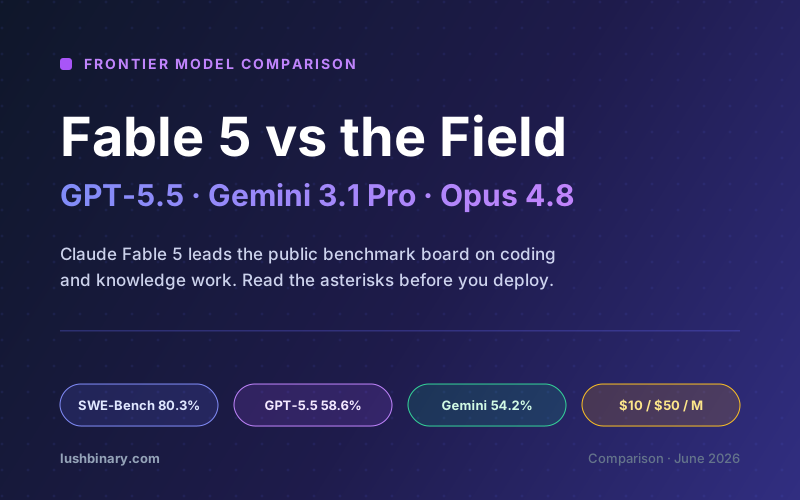

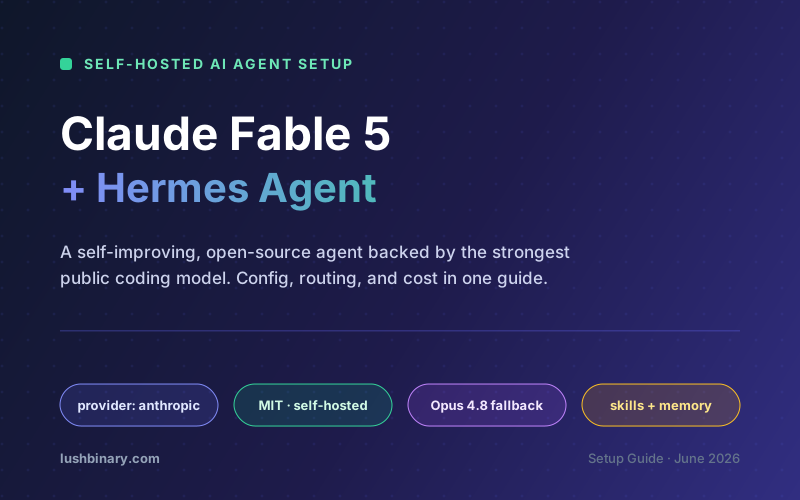
Claude Fable 5, released June 9, 2026, is the most capable model Anthropic has ever made generally available. It leads the public benchmark board on agentic coding (SWE-Bench Pro 80.3%) and is built for long-horizon work: planning across stages, delegating to sub-agents, and running for hours while validating its own output. Hermes Agent, the open-source agent from Nous Research, is the perfect host for exactly that kind of model.
Hermes Agent is self-hosted, MIT-licensed, and built around a learning loop: it creates reusable skills from experience, keeps persistent memory across sessions, and runs 24/7 as a background service reachable from Telegram, Discord, Slack, or your terminal. Point it at Fable 5 and you get a self-improving agent backed by the strongest coding model available, with full control over where it runs and what it can touch.
This guide walks through the full setup: installing Hermes Agent, wiring it to Fable 5 through the Anthropic provider, building a cost-aware fallback to Opus 4.8, understanding the safeguard fallback, and a realistic monthly cost picture. For background on the model itself, see our Claude Fable 5 developer guide.
📌 What This Guide Covers
1Why Pair Hermes Agent With Fable 5
Hermes Agent and Claude Fable 5 are a natural fit because they are built for the same thing: long-running, autonomous, multi-step work. Anthropic positions Fable 5 for ambitious asynchronous tasks that previous models could not sustain, agents that work for hours and delegate to sub-agents. Hermes Agent is the runtime that turns that capability into a persistent system instead of a one-off chat.
- Persistent memory - Hermes keeps a four-layer memory (curated MEMORY.md and USER.md files, a SQLite archive with full-text search, and a skills directory), so Fable 5 does not re-learn your project every session.
- Automated skill creation - after a complex task, Hermes writes a reusable SKILL.md document, compatible with the agentskills.io open standard, so hard-won solutions are not lost.
- Parallel sub-agents - Hermes can spawn isolated sub-agents with their own conversation and terminal, matching Fable 5's strength at delegating sub-tasks.
- Self-hosted control - everything runs on your machine or VPS with no telemetry, so you decide what the agent can execute and where your data lives.
💡 Model meets runtime
Fable 5 supplies the reasoning. Hermes supplies the loop, memory, tools, and persistence. The combination is a self-improving agent that holds context across days of work and runs on the strongest publicly available coding model.
2Step 1: Install Hermes Agent
Hermes Agent runs on Linux, macOS, and WSL2 (native Windows is experimental). The installer sets up its own Python environment and dependencies, so there are no prerequisites beyond a shell. On a VPS, run it inside Docker for an isolation boundary.
# Install Hermes Agent (sets up uv, Python 3.11, Node.js, ripgrep, ffmpeg)
curl -fsSL https://raw.githubusercontent.com/NousResearch/hermes-agent/main/scripts/install.sh | bash

# Everything lives under ~/.hermes/
The installer creates the ~/.hermes/ directory that holds your config, environment file, memory database, and skills. If you are migrating from OpenClaw, run hermes claw migrate during setup to import your settings, memories, skills, and API keys. For a deeper tour of the framework, see our Hermes Agent vs OpenClaw comparison.
3Step 2: Connect Fable 5 via the Anthropic Provider
Hermes Agent works with any OpenAI-compatible endpoint, and Anthropic is a first-class provider. Fable 5's API model ID is claude-fable-5. The fastest path is the interactive wizard:
# Interactive model setup
hermes model
# 1. Select "Anthropic" from the provider list
# 2. Paste your Anthropic API key
# 3. Choose model: claude-fable-5
Or configure it by hand. Put your key in the environment file and set the provider and model in config.yaml:
# ~/.hermes/.env
ANTHROPIC_API_KEY=sk-ant-your-key-here
# ~/.hermes/config.yaml
provider: anthropic

model:
  default: claude-fable-5
Start the agent with hermes and you have a full interactive CLI with tools, memory, and skills running on Fable 5. To make it reachable from messaging apps, run hermes gateway setup and then hermes gateway install to run it as a system service.
⚠️ Confirm the model ID and context limits
Use claude-fable-5 as the model ID. Anthropic did not publish Fable 5's context-window or max-output limits at launch, and Hermes Agent generally expects models with a 64K-plus context window. Verify the current limits in Anthropic's model documentation before you load very large codebases into a single session.
4Step 3: Cost-Aware Routing and Fallback
Fable 5 is a premium tier at $10/$50 per million tokens, twice Opus 4.8's $5/$25. Putting every turn on Fable 5 is the fastest way to a surprising bill. A smarter pattern uses Fable 5 for the hardest work and a cheaper model for the rest. Hermes Agent supports a fallback_provider, which you can use for resilience or cost control.
Pattern A: Fable 5 primary, Opus 4.8 fallback. Run the strongest model first and fall back to the cheaper Anthropic model if Fable 5 is rate-limited or unavailable:
# ~/.hermes/config.yaml
provider: anthropic

model:
  default: claude-fable-5

fallback_provider:
  provider: anthropic
  model: claude-opus-4-8
Pattern B: Opus 4.8 primary, Fable 5 for hard tasks. Default to the cheaper model and escalate to Fable 5 only when a task warrants it (for example, in a dedicated agent profile you invoke for large migrations):
# ~/.hermes/config.yaml
provider: anthropic

model:
  default: claude-opus-4-8

# Escalate to Fable 5 on demand for the hardest work
Pattern C: Fable 5 primary, local model offline fallback. For resilience, keep a local Ollama or vLLM model as the offline fallback so the agent keeps running if the API is unreachable:
# ~/.hermes/config.yaml
provider: anthropic

model:
  default: claude-fable-5

fallback_provider:
  provider: ollama
  base_url: http://localhost:11434
  model: qwen3.6:32b
5The Two Kinds of Fallback You Need to Know
When running Fable 5 inside Hermes Agent, two distinct fallback mechanisms are in play, and it helps to keep them straight.
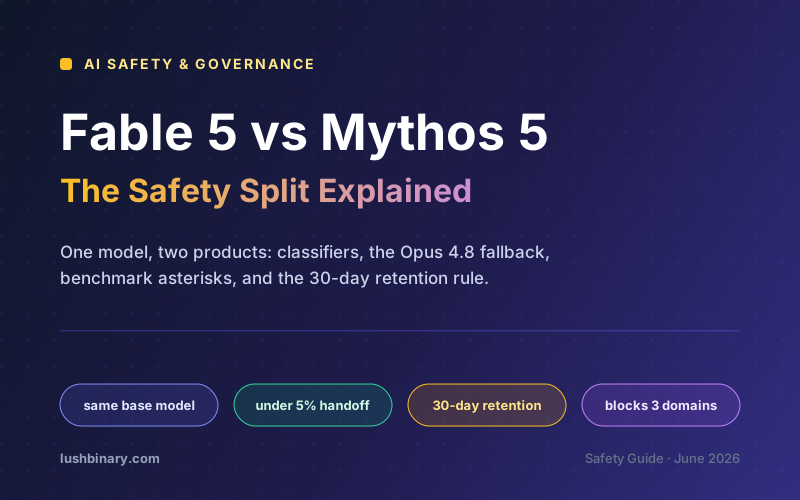
- Anthropic safeguard fallback - lives on Anthropic's side. If a query lands in cybersecurity, biology, chemistry, or distillation territory, Anthropic's classifier blocks Fable 5 and answers with Opus 4.8 instead. This is automatic, outside your control, and fires on under 5% of sessions.
- Hermes fallback_provider - lives in your
config.yaml. It handles API outages, rate limits, or cost routing by switching to a different model you choose. This is fully under your control.
For the vast majority of coding, automation, and research work the safeguard fallback never fires. If your agent operates near security or life-sciences topics, expect some responses to come from Opus 4.8, and budget for the fact that you may be paying the Fable 5 rate while receiving an Opus 4.8 answer on those specific turns. Our safety split guide covers this in depth.
6Putting It to Work: Skills, Memory, Sub-Agents
The point of running Fable 5 inside Hermes Agent is the compounding effect of the learning loop. Here is how a realistic long-horizon session plays out:
- Memory primes the model - at session start, Hermes loads MEMORY.md (environment facts) and USER.md (your preferences) into the system prompt, so Fable 5 starts with context instead of a blank slate.
- Sub-agent delegation - for a large refactor, the primary agent spawns isolated sub-agents per workstream, each with its own terminal, matching Fable 5's strength at planning and delegating.
- Self-validation - Anthropic notes that at the highest effort setting Fable 5 reflects on and validates its own work, which pairs well with Hermes running unattended for hours.
- Skill capture - after a complex task (roughly five or more tool calls), Hermes writes a SKILL.md document so the next similar task reuses the proven approach instead of rediscovering it.
# Schedule a nightly Fable 5 task with the built-in cron scheduler
hermes
> /schedule nightly "Run the test suite, triage failures, and open a draft PR with fixes"

# Connect messaging so results land in Telegram or Slack
hermes gateway setup
7What It Costs to Run
Hermes Agent itself is free and open source under the MIT license; your only cost is the model. On Fable 5 at $10/$50 per million tokens, a single agentic task using 200,000 input and 50,000 output tokens costs 0.2 * 10 + 0.05 * 50 = $4.50. The same task on Opus 4.8 costs 0.2 * 5 + 0.05 * 25 = $2.25.
Two levers keep the bill sane. First, Anthropic's 90% prompt-caching discount on input: in a long agentic session that reuses a large system prompt and codebase across turns, cached input is billed at one tenth the rate, so the $2.00 input portion of that task can drop toward $0.20 on cache hits. Second, routing: send routine turns to Opus 4.8 and reserve Fable 5 for the hard work, using the fallback patterns above.
⚠️ Cap your agentic spend
A single Hermes instruction can fan out into dozens of model calls across sub-agents and tool loops. At the Fable 5 rate that adds up fast. Set usage limits on your Anthropic key, monitor token spend per session, and prefer the Opus 4.8 default with Fable 5 escalation for unattended, long-running agents.
8Why Lushbinary for Agent Builds
Running a self-hosted agent on a frontier model is powerful and genuinely risky if you skip the guardrails. An autonomous agent with terminal access and API keys expands your attack surface, and an uncapped frontier model expands your bill. Lushbinary builds production agent systems that are fast, controlled, and safe by design.
- Agent architecture - Hermes Agent and OpenClaw deployments with model routing, sub-agent design, and skill libraries tuned to your workflows.
- Cost control - prompt-cache strategy, Fable 5 and Opus 4.8 routing, budgets, and hard caps so agentic spend stays predictable.
- Security hardening - container isolation, credential management, command allowlists, and audit logging for agents that can execute code.
- AWS infrastructure - production VPS and cloud deployment with monitoring, encryption, and autoscaling.
🚀 Free Consultation
Want a self-improving Hermes Agent running on Fable 5 without the runaway bill or the security gaps? We will scope your use case, design the routing and guardrails, and stand it up on infrastructure you control, with no obligation.
9Frequently Asked Questions
How do I connect Hermes Agent to Claude Fable 5?
Hermes Agent works with any OpenAI-compatible endpoint, including Anthropic. Set ANTHROPIC_API_KEY in ~/.hermes/.env, then in ~/.hermes/config.yaml set provider: anthropic and model default claude-fable-5. Or run 'hermes model', select Anthropic, paste your API key, and choose claude-fable-5. Restart with 'hermes' and the agent runs on Fable 5.
Should I use Claude Fable 5 or Opus 4.8 as the primary model in Hermes Agent?
Use Opus 4.8 as the default for routine work and reach for Fable 5 on the hardest long-horizon tasks. A cost-aware setup runs Fable 5 as primary with Opus 4.8 as the fallback_provider, or the reverse. Fable 5 costs $10/$50 per million tokens, double Opus 4.8's $5/$25, so route by task difficulty rather than putting everything on the premium tier.
Does Hermes Agent's Anthropic provider trigger Fable 5's safeguards?
Yes. Fable 5's safeguards live on Anthropic's side, not in Hermes Agent. If your agent issues a query in cybersecurity, biology, chemistry, or model-distillation territory, Anthropic's classifier routes it to Opus 4.8 automatically. Anthropic reports this fires on under 5% of sessions, so for normal coding and automation work it is invisible.
How much does it cost to run Hermes Agent on Claude Fable 5?
At $10 input and $50 output per million tokens, a single agentic task using 200K input and 50K output tokens costs about $4.50 on Fable 5. With Anthropic's 90% prompt-caching discount on repeated context, the input portion drops sharply across a long session. Monthly cost depends entirely on volume; route routine turns to Opus 4.8 to keep the bill down.
Can Hermes Agent fall back to a local model if the Claude API is down?
Yes. Hermes Agent supports a fallback_provider in config.yaml. You can set Fable 5 as primary and a local Ollama or vLLM model as the offline fallback, so the agent keeps running on-premise if the Anthropic API is unreachable. This is separate from Fable 5's internal safeguard fallback to Opus 4.8.
📚 Sources
- Anthropic - Claude Fable 5 and Claude Mythos 5
- Nous Research - Hermes Agent (GitHub)
- Hermes Agent Documentation
Content was rephrased for compliance with licensing restrictions. Fable 5 pricing, safeguard behavior, and benchmarks sourced from Anthropic's June 9, 2026 announcement; Hermes Agent features, install steps, and configuration sourced from official Nous Research documentation as of June 2026. Commands and config keys may change - always verify against the current Hermes Agent docs.
Building a Self-Improving Agent?
Lushbinary builds Hermes Agent and Claude Fable 5 systems with the routing, cost caps, and security guardrails production needs. Let's talk about your project.
Ready to Build Something Great?
Get a free 30-minute strategy call. We'll map out your project, timeline, and tech stack - no strings attached.
Prefer email? Reach us directly: