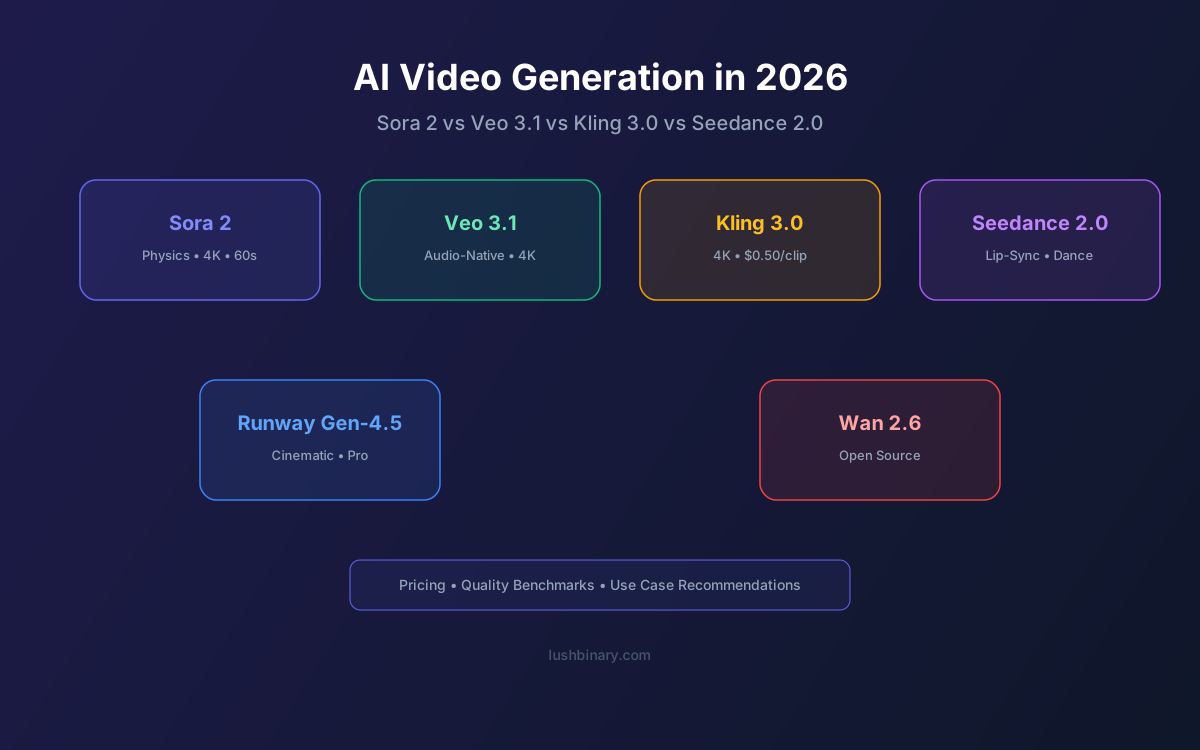
AI video generation has crossed a threshold. In 2024, you got blurry 15-second clips with melting fingers and physics that made no sense. By February 2026, we have six major models producing native 4K video with synchronized audio, multi-shot storyboards, and cinematic camera work that rivals professional production — at a fraction of the cost.
The competition between Sora 2, Veo 3.1, Kling 3.0, Seedance 2.0, Runway Gen-4.5, and Wan 2.6 is fierce. Each model has carved out a distinct niche: physics simulation, audio-native generation, open-source flexibility, or sheer value at scale. Choosing the wrong one wastes your budget and limits your creative output. Choosing the right one can transform your video production pipeline.
This isn't a surface-level roundup. We've tested all six models on real production workflows — product demos, social media content, cinematic shorts, and API integrations — and tracked quality, cost, and developer experience across each. Whether you're a content creator, a product team, or a developer building video into your app, this comparison has the data you need.
📋 Table of Contents
- 1.The State of AI Video in 2026
- 2.Kling 3.0: Multi-Shot Storyboard & Native 4K
- 3.Sora 2: Physics-First Cinematic AI
- 4.Veo 3.1: Audio-Native Cinematic Generation
- 5.Seedance 2.0: Unified Audio-Video Joint Generation
- 6.Runway Gen-4.5 & Wan 2.6: Creative Control & Open Source
- 7.Head-to-Head Comparison Table
- 8.API Pricing & Developer Integration
- 9.Choosing the Right Model for Your Use Case
- 10.Why Lushbinary for AI Video Integration
1The State of AI Video in 2026
The AI video generation landscape has undergone a fundamental shift in early 2026. What was once a novelty — short, low-resolution clips with obvious artifacts — has matured into a production-ready toolset. Four of the six major models now generate synchronized audio natively, eliminating the need for separate audio post-production pipelines entirely.
The market has split into distinct categories, and understanding this taxonomy matters because it determines what you're paying for and what you'll get:
Cinematic-First
Physics simulation, camera control, multi-subject interaction. Sora 2 and Veo 3.1 lead here — built for filmmakers and high-end production.
Audio-Native
Synchronized audio-video generation in a single pass. Seedance 2.0 pioneered unified joint generation; Veo 3.1 and Kling 3.0 followed.
Scale & Value
High volume, low cost, API-first. Kling 3.0 at ~$0.50/clip and Wan 2.6 (open-source, free) dominate this category.
The key developments driving this shift: native 4K output is now standard across most models, multi-shot storyboarding allows coherent long-form narratives, and API access has made it possible to integrate video generation directly into product workflows. The days of copy-pasting prompts into a web UI and downloading clips manually are ending.
Key milestone: As of February 2026, 4 of 6 major AI video models generate synchronized audio natively. This is up from zero in early 2025. Audio-video joint generation has gone from research paper to production feature in under 12 months.
Resolution has also leaped forward. Kling 3.0 ships native 4K output. Sora 2 and Veo 3.1 produce cinematic-grade 1080p with upscaling options. Even the free tier on most platforms now delivers 720p minimum. The quality gap between AI-generated and traditionally produced video is narrowing fast — particularly for social media, product demos, and explainer content where "good enough" is often indistinguishable from professional.
2Kling 3.0: Multi-Shot Storyboard & Native 4K
Kling 3.0, released February 4, 2026, represents the biggest leap in value-for-money in AI video generation. Its headline feature — Multi-Shot Storyboard — lets you define an entire sequence of shots with individual prompts, camera angles, and transitions, then generate them as a coherent narrative in a single batch. This is a game-changer for anyone producing multi-scene content.
What Kling 3.0 Does Well
- Multi-Shot Storyboard: Define 3-12 shots with individual prompts, camera directions, and transitions. The model maintains character consistency, lighting, and scene continuity across all shots automatically.
- Native 4K output: True 3840×2160 rendering without upscaling artifacts. This is the highest native resolution among all major AI video models as of February 2026.
- Best value at scale: At approximately $0.50 per clip, Kling 3.0 is the most cost-effective option for high-volume production. Teams generating 100+ clips per month save thousands compared to Sora 2 or Veo 3.1.
- Audio synchronization: Native audio generation with scene-aware sound design. Footsteps match walking, doors sound like doors, and ambient audio adapts to the environment.
Where Kling 3.0 Falls Short
- Physics simulation: Fluid dynamics, cloth physics, and complex particle effects still lag behind Sora 2. Fine details like hair movement and water splashes can look artificial.
- Cinematic camera work: While functional, camera movements lack the nuanced "feel" of Sora 2's physics-driven camera system. Dolly shots and rack focuses are competent but not exceptional.
- Prompt complexity ceiling: Very detailed prompts with multiple simultaneous actions can produce inconsistent results. Works best with clear, focused scene descriptions.
Best for: Teams producing high-volume content (social media, product demos, marketing campaigns) who need consistent quality at scale. The Multi-Shot Storyboard feature alone can replace manual video editing workflows for short-form narrative content.
3Sora 2: Physics-First Cinematic AI
OpenAI's Sora 2 has established itself as the benchmark for physics simulation in AI video generation. Where other models approximate physical interactions, Sora 2 simulates them — water flows realistically, objects have weight and momentum, and multi-subject interactions follow believable physics. For cinematic work that demands realism, it's the current leader.
What Sora 2 Does Well
- Physics simulation: The most realistic physical interactions of any AI video model. Fluid dynamics, rigid body collisions, soft body deformation, and particle effects all behave convincingly. A glass of water being poured looks like a glass of water being poured.
- Camera movement: Sora 2's camera system understands cinematic language — dolly zooms, tracking shots, crane movements, and rack focuses feel intentional rather than algorithmic. It's the closest any AI model gets to having a virtual cinematographer.
- Multi-subject interaction: Handles scenes with multiple characters interacting naturally. Eye contact, hand gestures, spatial awareness between subjects — these subtle details that other models struggle with are Sora 2's strength.
- Cinematic quality: Output has a filmic quality with natural depth of field, lens characteristics, and color grading that feels like it came from a real camera system.
Where Sora 2 Falls Short
- Cost: Premium pricing makes it expensive for high-volume workflows. At scale, Kling 3.0 delivers comparable results for a fraction of the cost.
- Generation speed: Physics simulation comes at a computational cost. Sora 2 clips take longer to generate than competitors, which impacts iteration speed during creative workflows.
- Audio generation: While Sora 2 supports native audio, it's not as tightly integrated as Seedance 2.0's unified joint generation or Veo 3.1's audio-native pipeline. Lip-sync accuracy lags behind Seedance 2.0.
- API availability: Access is more restricted than competitors. Enterprise API access requires approval, and rate limits are tighter than Kling 3.0 or Seedance 2.0.
Best for: Filmmakers, cinematic content creators, and production studios that prioritize visual realism and physics accuracy over volume and cost. If your output needs to look like it was shot on a real camera with real physics, Sora 2 is the choice.
4Veo 3.1: Audio-Native Cinematic Generation
Google DeepMind's Veo 3.1 has carved out a unique position as the best model for audio-native cinematic work. While Seedance 2.0 pioneered unified audio-video joint generation, Veo 3.1 delivers the most consistent scene-level audio design — every sound in the scene feels intentional and cinematic, not just synchronized.
What Veo 3.1 Does Well
- Audio-native cinematic work: Veo 3.1 generates audio as a first-class output, not an afterthought. Dialogue, ambient sound, foley effects, and music are all generated in context with the visual scene, producing a cohesive audiovisual experience.
- Scene consistency: The best in class for maintaining visual and tonal consistency across extended sequences. Characters, lighting, color palette, and mood remain stable even across complex scene transitions.
- Prompt understanding: Veo 3.1 interprets complex, nuanced prompts more accurately than any competitor. Abstract creative directions like "melancholic autumn atmosphere with fading golden light" translate into visuals that match the intent, not just the keywords.
- Google Cloud integration: Deep integration with Vertex AI and Google Cloud services makes it the easiest model to deploy in enterprise environments already on Google's stack.
Where Veo 3.1 Falls Short
- Physics realism: Physical interactions are good but don't match Sora 2's simulation quality. Complex fluid dynamics and multi-body collisions can look approximate.
- Lip-sync precision: While audio-native, Veo 3.1's lip-sync doesn't reach Seedance 2.0's phoneme-level accuracy, particularly in non-English languages.
- Platform lock-in: Deepest features are tied to Google Cloud. Teams on AWS or Azure face a less integrated experience.
Best for: Cinematic content that demands cohesive audiovisual output, brand storytelling, and teams already invested in Google Cloud. Veo 3.1 is the model you choose when the "feel" of the video matters as much as the visuals.
5Seedance 2.0: Unified Audio-Video Joint Generation
ByteDance's Seedance 2.0, released February 12, 2026, is the most technically ambitious model in this comparison. It's the first to achieve true unified audio-video joint generation — meaning audio and video are generated simultaneously in a single model pass, not as separate streams that are synchronized after the fact. The result is a level of audio-visual coherence that other models can't match.
What Seedance 2.0 Does Well
- Unified audio-video joint generation: The first model to generate audio and video in a single unified pass. This isn't audio added on top of video — it's a single model that understands both modalities simultaneously, producing tighter synchronization than any post-hoc approach.
- Phoneme-level lip-sync in 8+ languages: The most accurate lip-sync of any AI video model. Seedance 2.0 maps audio to individual phonemes (speech sounds), not just word-level timing. This works across English, Mandarin, Japanese, Korean, Spanish, French, German, Portuguese, and more.
- Multi-shot storytelling: Like Kling 3.0's storyboard feature, but with unified audio continuity across shots. Background music, ambient sound, and dialogue flow naturally across scene transitions.
- Flexible pricing: From a free tier to $167/month for professional use, Seedance 2.0 offers the widest range of pricing options. The free tier is genuinely usable for experimentation and prototyping.
Where Seedance 2.0 Falls Short
- Resolution ceiling: Currently maxes out at 1080p natively. For 4K output, you need Kling 3.0. Upscaling is available but introduces artifacts on fine details.
- Physics simulation: Physical interactions are functional but don't approach Sora 2's realism. Complex scenes with multiple interacting objects can produce inconsistencies.
- Newer ecosystem: As the newest major model (February 2026), the developer ecosystem, documentation, and community resources are still maturing compared to Sora 2 or Veo 3.1.
Key innovation: Seedance 2.0's unified audio-video architecture means the model "hears" what it's generating as it generates it. A character speaking in a large room will have natural reverb. A whisper will have appropriate proximity effect. This level of audio-visual coherence was previously only achievable in post-production.
Seedance 2.0 Pricing Tiers
| Plan | Price | Features |
|---|---|---|
| Free | $0/mo | Limited generations, 720p, watermarked |
| Creator | ~$30/mo | 1080p, no watermark, 100 clips/mo |
| Pro | ~$80/mo | Priority queue, API access, 500 clips/mo |
| Enterprise | $167/mo | Full API, custom models, unlimited queue |
6Runway Gen-4.5 & Wan 2.6: Creative Control & Open Source
While the four models above dominate the headlines, Runway Gen-4.5 and Alibaba's Wan 2.6 fill critical gaps in the ecosystem that the others don't address.
Runway Gen-4.5: Best Creative Control
Runway has been in the AI video space longer than anyone else, and Gen-4.5 reflects that maturity. It's not the most technically impressive model on any single axis, but it offers the most granular creative control over the generation process.
- Motion brushes: Paint motion paths directly onto your scene. Specify exactly where and how elements should move, with per-pixel control that no other model offers.
- Style references: Upload reference images or videos to guide the aesthetic. Gen-4.5 matches color palettes, lighting styles, and visual textures more faithfully than prompt-only approaches.
- Director mode: Frame-by-frame keyframe control for camera position, subject placement, and scene composition. This is the closest any AI model gets to traditional video editing control.
- Mature ecosystem: The most extensive plugin library, community templates, and integration options of any AI video platform.
Wan 2.6: The Open-Source King
Alibaba's Wan 2.6 is the most capable open-source video generation model available. For developers and researchers who need full control over the generation pipeline — custom training, local deployment, no per-clip costs — Wan 2.6 is the only serious option.
- Fully open-source: Model weights, training code, and inference pipeline are all publicly available. Deploy on your own infrastructure with zero API costs.
- Custom fine-tuning: Train on your own data for brand-specific styles, product-specific visuals, or domain-specific content. No other major model allows this level of customization.
- No per-clip pricing: Once deployed, your only cost is compute. For teams generating thousands of clips monthly, this can be 10-50x cheaper than API-based models.
- Privacy & compliance: All data stays on your infrastructure. Critical for healthcare, finance, legal, and government use cases where data cannot leave your environment.
Trade-off: Wan 2.6 requires significant GPU infrastructure to run locally (minimum 24GB VRAM for inference, 80GB+ for fine-tuning). Quality is competitive with commercial models from 6-12 months ago but doesn't match the latest Sora 2 or Veo 3.1 output. The value proposition is control and cost, not cutting-edge quality.
7Head-to-Head Comparison Table
Here's how all six models stack up across the features that matter most for production use. Ratings are based on our testing across real workflows as of February 2026:
| Feature | Kling 3.0 | Sora 2 | Veo 3.1 | Seedance 2.0 | Gen-4.5 | Wan 2.6 |
|---|---|---|---|---|---|---|
| Max resolution | 4K native | 1080p | 1080p | 1080p | 1080p | 1080p |
| Native audio | ✅ | ✅ | ✅ | ✅ (unified) | ❌ | ❌ |
| Physics simulation | ⭐⭐⭐ | ⭐⭐⭐⭐⭐ | ⭐⭐⭐⭐ | ⭐⭐⭐ | ⭐⭐⭐ | ⭐⭐ |
| Camera control | ⭐⭐⭐ | ⭐⭐⭐⭐⭐ | ⭐⭐⭐⭐ | ⭐⭐⭐ | ⭐⭐⭐⭐ | ⭐⭐ |
| Lip-sync accuracy | ⭐⭐⭐ | ⭐⭐⭐ | ⭐⭐⭐⭐ | ⭐⭐⭐⭐⭐ | ⭐⭐ | ⭐⭐ |
| Multi-shot | ✅ (Storyboard) | Limited | ✅ | ✅ | ✅ | ❌ |
| Scene consistency | ⭐⭐⭐⭐ | ⭐⭐⭐⭐ | ⭐⭐⭐⭐⭐ | ⭐⭐⭐⭐ | ⭐⭐⭐ | ⭐⭐⭐ |
| Prompt understanding | ⭐⭐⭐ | ⭐⭐⭐⭐ | ⭐⭐⭐⭐⭐ | ⭐⭐⭐⭐ | ⭐⭐⭐⭐ | ⭐⭐⭐ |
| Creative control | ⭐⭐⭐ | ⭐⭐⭐ | ⭐⭐⭐ | ⭐⭐⭐ | ⭐⭐⭐⭐⭐ | ⭐⭐⭐⭐ |
| API access | ✅ | Limited | ✅ (Vertex AI) | ✅ | ✅ | Self-hosted |
| Open source | ❌ | ❌ | ❌ | ❌ | ❌ | ✅ |
| Cost per clip | ~$0.50 | $$$$ | $$$ | ~$0.14/sec | $$$ | Free (self-hosted) |
The standout differentiators: Sora 2 dominates physics and camera work. Veo 3.1 leads in scene consistency and prompt understanding. Seedance 2.0 owns lip-sync accuracy with its phoneme-level approach. Kling 3.0 is the only model with native 4K. Gen-4.5 offers unmatched creative control. Wan 2.6 is the only open-source option.
No single winner: Unlike the LLM space where one model often dominates benchmarks, AI video generation in 2026 is genuinely multi-polar. The "best" model depends entirely on your specific use case, budget, and technical requirements.
8API Pricing & Developer Integration
For developers building video generation into products, API pricing and integration quality matter more than UI features. Here's the full breakdown of API access across all six models:
| Model | API Pricing | Integration | Rate Limits |
|---|---|---|---|
| Kling 3.0 | ~$0.50/clip | REST API, SDKs | High throughput |
| Sora 2 | Premium (invite-only) | OpenAI API | Restricted |
| Veo 3.1 | Vertex AI pricing | Google Cloud SDK | Enterprise-grade |
| Seedance 2.0 | ~$0.14/sec (1080p) | REST API | Generous |
| Gen-4.5 | Credit-based | REST API, SDKs | Plan-dependent |
| Wan 2.6 | Free (self-hosted) | Python SDK, HuggingFace | Your hardware |
Cost Comparison: 100 Clips at 1080p
To make pricing tangible, here's what 100 ten-second clips at 1080p would cost across each platform:
| Model | Est. Cost (100 clips) | Notes |
|---|---|---|
| Kling 3.0 | ~$50 | Best value for batch production |
| Seedance 2.0 | ~$140 | Per-second pricing (10s × 100 × $0.14) |
| Veo 3.1 | ~$200-400 | Vertex AI compute-based pricing |
| Gen-4.5 | ~$300-500 | Credit-based, varies by plan |
| Sora 2 | ~$500+ | Premium pricing, invite-only API |
| Wan 2.6 | ~$5-20 | GPU compute cost only (self-hosted) |
The cost difference is dramatic. At 100 clips per month, Kling 3.0 costs roughly $50 while Sora 2 can exceed $500. For teams producing content at scale, this 10x cost difference is the deciding factor — unless Sora 2's physics quality is a hard requirement.
Developer Experience Notes
- Kling 3.0: Clean REST API with good documentation. Webhook support for async generation. SDKs for Python, Node.js, and Go.
- Seedance 2.0: Well-documented REST API with per-second billing transparency. Supports callback URLs and batch processing. Still maturing — expect breaking changes.
- Veo 3.1: Vertex AI integration is polished if you're already on Google Cloud. Terraform support for infrastructure-as-code deployments. Less convenient for non-GCP teams.
- Wan 2.6: HuggingFace integration, Docker images, and comprehensive Python SDK. Requires GPU infrastructure management. Best documentation of any open-source video model.
- Sora 2: OpenAI API patterns (familiar if you use GPT APIs). Limited rate limits and invite-only access reduce developer velocity during prototyping.
- Gen-4.5: Mature API with the longest track record. Credit-based pricing can be unpredictable for budgeting. Extensive plugin ecosystem.
9Choosing the Right Model for Your Use Case
The "best" AI video model doesn't exist in a vacuum. It depends on what you're building, how much you're spending, and what trade-offs you can accept. Here's a decision framework based on common use cases:
| Use Case | Recommended Model | Why |
|---|---|---|
| Social media content at scale | Kling 3.0 | Best value per clip, Multi-Shot Storyboard, native 4K |
| Cinematic short films | Sora 2 | Best physics, camera work, and multi-subject interaction |
| Brand storytelling with audio | Veo 3.1 | Best scene consistency, audio-native, superior prompt understanding |
| Multilingual talking-head content | Seedance 2.0 | Phoneme-level lip-sync in 8+ languages, unified audio-video |
| Creative/artistic video | Runway Gen-4.5 | Motion brushes, style references, director mode |
| Custom/private deployment | Wan 2.6 | Open-source, self-hosted, fine-tunable, zero API costs |
| Product demos & explainers | Kling 3.0 or Seedance 2.0 | Cost-effective with good audio sync for narration |
| Enterprise with Google Cloud | Veo 3.1 | Native Vertex AI integration, enterprise SLAs |
| R&D / experimentation | Wan 2.6 + Seedance 2.0 (free tier) | Zero cost to start, full control with Wan |
Multi-Model Strategy
The smartest teams in 2026 aren't picking one model — they're using multiple models for different parts of their pipeline. A practical multi-model approach:
- Prototyping: Use Seedance 2.0's free tier or Wan 2.6 locally to iterate on concepts quickly at zero cost.
- Production volume: Switch to Kling 3.0 for final renders at scale. The $0.50/clip pricing makes high-volume production economically viable.
- Hero content: Use Sora 2 or Veo 3.1 for flagship pieces where quality justifies the premium cost — brand films, product launches, cinematic trailers.
- Multilingual content: Route all talking-head and dialogue-heavy content through Seedance 2.0 for its phoneme-level lip-sync across 8+ languages.
Cost optimization tip: A multi-model strategy using Wan 2.6 for prototyping, Kling 3.0 for volume, and Sora 2 for hero content can reduce your overall video production costs by 60-70% compared to using a single premium model for everything.
10Why Lushbinary for AI Video Integration
At Lushbinary, we help teams integrate AI video generation into their products and workflows. The landscape is moving fast — new models every few weeks, pricing changes, API deprecations — and navigating it without deep expertise wastes time and money.
We've built production video pipelines using every model in this comparison. Our approach:
- Multi-model orchestration: We build abstraction layers that route generation requests to the optimal model based on content type, quality requirements, and budget constraints. Switch models without changing your application code.
- Cost optimization: We implement intelligent routing that uses cheaper models for drafts and premium models for final output, reducing costs 40-70% without sacrificing quality where it matters.
- API integration: From webhook-based async pipelines to real-time generation for interactive applications, we handle the infrastructure complexity so your team can focus on the product.
- Custom deployment: For teams that need Wan 2.6 self-hosted or private cloud deployments, we handle GPU infrastructure, model optimization, and scaling on AWS or GCP.
Whether you're adding AI video to an existing product, building a video-first application from scratch, or optimizing an existing generation pipeline, we can help you ship faster and spend less.
Need Help Integrating AI Video Generation?
We help teams evaluate, integrate, and optimize AI video generation models for their specific workflows. Whether you're building a content pipeline, adding video generation to your product, or deploying open-source models on your own infrastructure, we'll help you get the best quality per dollar.
Build Smarter, Launch Faster.
Book a free strategy call and explore how LushBinary can turn your vision into reality.
Contact Us
❓ Frequently Asked Questions
What is the best AI video generation tool in 2026?
It depends on your use case. Sora 2 leads in physics simulation and cinematic quality. Veo 3.1 excels at audio-native cinematic work and scene consistency. Kling 3.0 offers the best value at scale with native 4K. Seedance 2.0 is the first unified audio-video joint generation model with phoneme-level lip-sync in 8+ languages.
How much does AI video generation cost in 2026?
Pricing varies significantly. Kling 3.0 costs ~$0.50 per clip (best value at scale). Seedance 2.0 API pricing starts at ~$0.14/second for 1080p. Most platforms offer free tiers with paid plans ranging from $10 to $167/month depending on resolution and volume.
Which AI video generators support native audio?
As of February 2026, 4 of 6 major models generate synchronized audio natively: Veo 3.1, Seedance 2.0, Sora 2, and Kling 3.0. Seedance 2.0 is notable for being the first unified audio-video joint generation model.
What is Seedance 2.0 and how does it compare to Sora 2?
Seedance 2.0 by ByteDance (February 12, 2026) is the first unified audio-video joint generation model with phoneme-level lip-sync in 8+ languages and pricing from free to $167/month. Sora 2 by OpenAI focuses on physics-first simulation with superior camera movement and cinematic quality.
Is there an open-source AI video generation model?
Yes. Wan 2.6 by Alibaba is the leading open-source AI video model. It allows full local deployment and customization, making it ideal for developers who need complete control without per-clip API costs.
Sources & Further Reading
- Kling AI — Official Kling 3.0 platform
- OpenAI Sora — Official Sora 2 page
- Google DeepMind Veo — Official Veo 3.1 page
- Seedance AI — Official Seedance 2.0 platform (ByteDance)
- Runway ML — Official Gen-4.5 platform
- Wan 2.6 (GitHub) — Open-source model by Alibaba
Content was rephrased for compliance with licensing restrictions. Pricing data sourced from official vendor pages as of February 2026. Prices may change — always verify on the vendor's website.