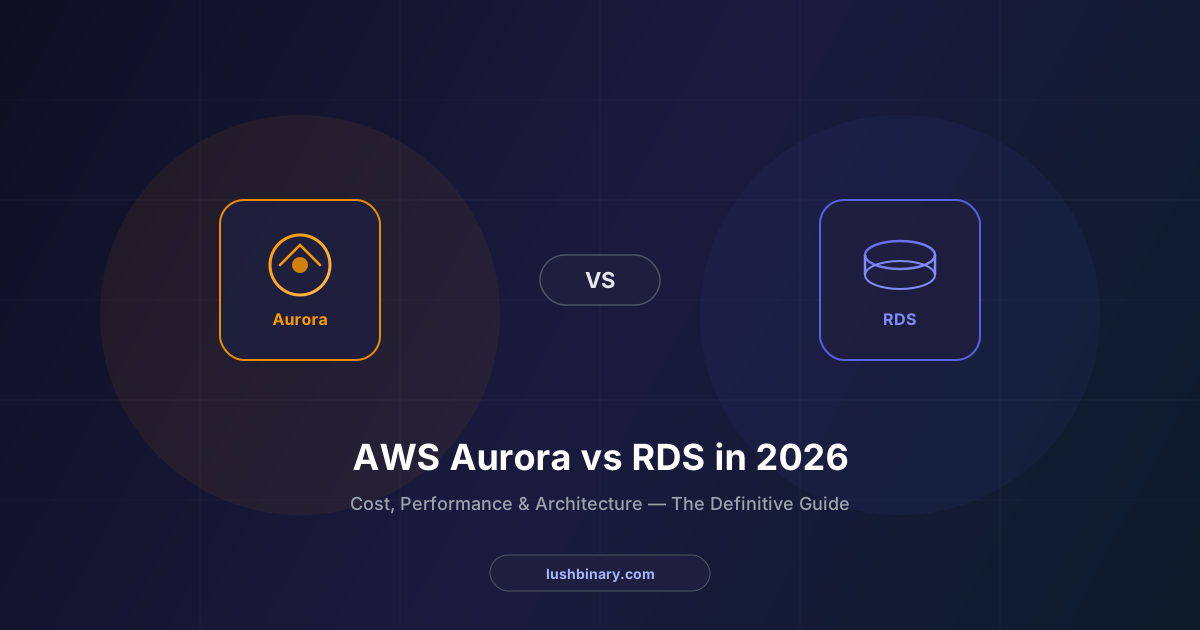
"Should we use Aurora or stick with RDS?" It's one of the most common questions teams ask when setting up a database on AWS. The marketing says Aurora is "up to 5x faster than MySQL" but marketing numbers and production reality aren't always the same thing.
Both Amazon Aurora and Amazon RDS are fully managed relational database services. Both handle provisioning, patching, backups, and recovery. But under the hood, they're architecturally different, and that difference has real implications for your performance, availability, and monthly AWS bill.
This guide breaks down everything a CEO/CTO, engineering lead, or developer needs to make the right call in 2026. We cover architecture, real-world performance, pricing models, cost optimization strategies, and when each service actually makes sense. No fluff, no vendor bias. Just the facts.
📋 Table of Contents
- 1.What Is Aurora & What Is RDS: The Quick Version
- 2.Architecture: Why Aurora Is Fundamentally Different
- 3.Performance Benchmarks: Real Numbers, Not Marketing
- 4.Pricing Models Explained (So Your CFO Gets It Too)
- 5.Cost Comparison: Aurora vs RDS at Different Scales
- 6.Aurora Serverless v2: When It Saves Money (And When It Doesn't)
- 7.Cost Optimization Strategies for Both Services
- 8.What's New from AWS re:Invent 2025 for Aurora & RDS
- 9.High Availability & Disaster Recovery Compared
- 10.Real-World Feedback: What Teams Are Actually Saying
- 11.Decision Framework: Which One Should You Pick?
- 12.How LushBinary Helps You Get AWS Databases Right
1What Is Aurora & What Is RDS: The Quick Version
Amazon RDS (Relational Database Service) is AWS's managed database platform. It supports six engines: MySQL, PostgreSQL, MariaDB, Oracle, SQL Server, and Db2. You pick an engine, choose an instance size, provision storage, and AWS handles the operational overhead: patching, backups, failover.
Amazon Aurora is a cloud-native relational database built by AWS from the ground up. It's compatible with MySQL and PostgreSQL but uses a completely different storage and replication architecture. Aurora is technically part of the RDS family, but it's a different beast under the hood.
| Feature | Amazon RDS | Amazon Aurora |
|---|---|---|
| Engines | MySQL, PostgreSQL, MariaDB, Oracle, SQL Server, Db2 | MySQL-compatible, PostgreSQL-compatible |
| Storage | EBS-based, provisioned upfront | Distributed, auto-scaling up to 128 TB |
| Replication | Traditional async replication | 6-way replication across 3 AZs |
| Read Replicas | Up to 15 (with replication lag) | Up to 15 (shared storage, minimal lag) |
| Failover | 60-120 seconds (Multi-AZ) | ~30 seconds or less |
| Serverless Option | No | Yes (Serverless v2) |
2Architecture: Why Aurora Is Fundamentally Different
The biggest difference between Aurora and RDS isn't the marketing. It's the storage layer. Standard RDS uses Amazon EBS (Elastic Block Store) volumes attached to your database instance. When you write data, it goes to a single EBS volume, and replication happens at the database engine level.
Aurora takes a completely different approach. It separates compute from storage and uses a distributed, fault-tolerant storage system that automatically replicates your data six ways across three Availability Zones. The storage layer is shared between the primary instance and all read replicas, which means replicas don't need to replicate data themselves.
Why This Matters in Practice
- Faster failover: Aurora can promote a read replica to primary in ~30 seconds because replicas already have access to the same storage. RDS Multi-AZ failover typically takes 60-120 seconds.
- No replication lag on reads: Aurora replicas share the storage layer, so replica lag is typically under 20ms. RDS replicas use async replication and can lag by seconds or more under heavy write loads.
- Storage auto-scales: Aurora storage grows automatically in 10 GB increments up to 128 TB. With RDS, you provision storage upfront and need to manually resize (or enable auto-scaling with some limitations).
- Write amplification is lower: Aurora only writes redo log records to the storage layer (not full data pages), reducing network I/O by up to 4x compared to traditional MySQL.
Key takeaway: Aurora's architecture advantage is most pronounced for write-heavy workloads and applications that need fast failover. If you're running a read-light, predictable workload on a single instance, the architectural difference matters less.
3Performance Benchmarks: Real Numbers, Not Marketing
AWS claims Aurora delivers up to 5x the throughput of standard MySQL and 3x the throughput of standard PostgreSQL. Those numbers come from specific benchmark conditions and don't always translate directly to your workload. Here's what the real-world data shows:
📊 Write Performance
Aurora's biggest performance advantage is on writes. Because it only ships redo log records to the storage layer (instead of full data pages), write throughput is significantly higher under concurrent load. In benchmarks with heavy concurrent writes, Aurora consistently outperforms RDS MySQL by 2-4x on the same instance type.
📊 Read Performance
For single-instance read performance, the difference is smaller. Aurora and RDS PostgreSQL on the same instance type show similar query latencies for simple SELECT operations. The gap widens when you add read replicas. Aurora replicas have near-zero lag, while RDS replicas can fall behind under write pressure.
📊 Failover Speed
| Scenario | RDS Multi-AZ | Aurora |
|---|---|---|
| Planned failover | 60-120 seconds | ~30 seconds |
| Unplanned failover | 1-2 minutes | ~30 seconds |
| Replica promotion | Minutes (data sync required) | Seconds (shared storage) |
"We switched from RDS PostgreSQL to Aurora PostgreSQL and saw write latency drop by about 40% on the same db.r6g.xlarge instance. The failover improvement was even more dramatic. Went from 90-second outages to barely noticeable blips." - Senior engineer on Hacker News, 2026
4Pricing Models Explained (So Your CFO Gets It Too)
This is where it gets nuanced. Both services charge for compute, storage, I/O, backups, and data transfer, but the models are structured differently.
💰 RDS Pricing Components
- Instance hours: Billed per second (10-minute minimum). Price depends on instance type, engine, and region.
- Provisioned storage: You pay for the storage you allocate (GB/month), regardless of how much you actually use. gp3 is the default and most cost-effective for general workloads.
- I/O: Included with gp3 (up to 3,000 IOPS baseline). If you need more, you provision IOPS explicitly with io1/io2 storage at additional cost.
- Backups: Free up to the size of your provisioned storage. Additional backup storage is charged per GB/month.
💰 Aurora Pricing Components
- Instance hours: Same per-second billing, but Aurora instance prices are typically 20-30% higher than equivalent RDS instances for the same instance type.
- Storage: Pay only for what you use (GB/month). No provisioning required. Auto-scales in 10 GB increments.
- I/O (Standard): Charged per million I/O requests. This is the hidden cost that catches teams off guard. High I/O workloads can see storage I/O charges exceed compute costs.
- I/O-Optimized: Higher instance and storage prices, but zero I/O charges. Typically saves money when I/O costs exceed 25% of your total Aurora bill.
- Backups: Free up to the total size of your cluster storage. Additional backup storage charged per GB/month.
⚠️ The #1 Aurora cost surprise: I/O charges on Aurora Standard. Teams that don't monitor I/O costs often see bills 2-3x higher than expected. If your workload is I/O-heavy, switch to Aurora I/O-Optimized or evaluate whether RDS with gp3 storage is cheaper.
5Cost Comparison: Aurora vs RDS at Different Scales
Let's look at realistic monthly cost estimates for three common scenarios. All prices are based on US East (N. Virginia) On-Demand pricing as of early 2026.
🏢 Scenario 1: Small SaaS App (Startup)
| Component | RDS PostgreSQL | Aurora PostgreSQL |
|---|---|---|
| Instance | db.t4g.medium (~$50/mo) | db.t4g.medium (~$60/mo) |
| Storage (50 GB) | gp3: ~$5.75/mo | ~$5.00/mo (pay-per-use) |
| I/O | Included with gp3 | ~$10-30/mo (Standard) |
| Estimated Total | ~$56/mo | ~$75-95/mo |
Winner at this scale: RDS. For a small app with predictable traffic, the Aurora premium doesn't justify itself.
🏢 Scenario 2: Mid-Size Production App
| Component | RDS PostgreSQL | Aurora PostgreSQL |
|---|---|---|
| Instance | db.r6g.xlarge (~$330/mo) | db.r6g.xlarge (~$400/mo) |
| Storage (500 GB) | gp3: ~$57.50/mo | ~$50/mo |
| I/O | Included with gp3 | ~$80-200/mo (Standard) |
| Read Replica | +$330/mo (separate storage) | +$400/mo (shared storage) |
| Estimated Total | ~$720/mo | ~$930-1,050/mo |
At this scale, Aurora costs more on paper, but the faster failover, near-zero replica lag, and auto-scaling storage start to justify the premium for production workloads where downtime costs real money.
🏢 Scenario 3: High-Traffic Enterprise App
| Component | RDS PostgreSQL | Aurora PostgreSQL (I/O-Optimized) |
|---|---|---|
| Instance | db.r6g.4xlarge (~$1,320/mo) | db.r6g.4xlarge (~$1,720/mo) |
| Storage (2 TB) | io2: ~$250/mo + IOPS | ~$450/mo (I/O included) |
| Provisioned IOPS | 10K IOPS: ~$650/mo | Included |
| 3 Read Replicas | +$3,960/mo | +$5,160/mo (shared storage) |
| Estimated Total | ~$6,180/mo | ~$7,330/mo (but better HA) |
At enterprise scale with I/O-Optimized, Aurora's total cost becomes more competitive when you factor in the operational benefits: faster failover, zero replica lag, and no IOPS provisioning guesswork. The ~18% premium buys significantly better availability.
6Aurora Serverless v2: When It Saves Money (And When It Doesn't)
Aurora Serverless v2 automatically scales compute capacity based on demand, measured in Aurora Capacity Units (ACUs). One ACU provides roughly 2 GB of memory with corresponding vCPU and networking. As of 2026, Serverless v2 can scale down to 0 ACUs during idle periods, eliminating compute costs entirely (storage costs remain).
✅ When Serverless v2 Makes Sense
- Dev/staging environments: Scale to 0 when nobody is using them. This alone can save 60-80% vs provisioned instances running 24/7.
- Spiky workloads: Apps with unpredictable traffic patterns (e.g., event-driven, seasonal) where provisioning for peak means massive waste during off-peak.
- New projects: When you don't know your traffic patterns yet and want to avoid over-provisioning.
- Mixed provisioned + serverless: Use a provisioned writer for your baseline load and serverless readers for burst traffic. This hybrid approach is increasingly popular.
❌ When Serverless v2 Costs More
- Steady-state production workloads: If your database runs at consistent load 18+ hours/day, provisioned instances (especially with Reserved Instances) are significantly cheaper. One Hacker News user reported provisioned instances costing ~17% of equivalent Serverless v2 capacity for their steady workload.
- High baseline + occasional spikes: You're paying the serverless premium for the entire baseline, not just the spikes.
Pro tip: Serverless v2 now supports Reserved Instances applied to your minimum ACU capacity. Set your min ACU to cover your baseline load, buy RIs for that baseline, and let serverless handle the burst. This gives you the best of both worlds.
7Cost Optimization Strategies for Both Services
Whether you choose Aurora or RDS, there are proven strategies to reduce your database bill without sacrificing performance. Here are the ones that actually move the needle:
🔧 Strategies for RDS
Reserved Instances
Commit to 1 or 3-year terms for up to 69-72% savings vs On-Demand. Best for production databases with predictable usage.
Right-Size Instances
Use CloudWatch metrics (CPU, memory, connections) to identify over-provisioned instances. Downsizing one tier can save 30-50%.
Use gp3 Storage
gp3 is 20% cheaper than gp2 and lets you provision IOPS independently. Most teams should migrate from gp2 to gp3 immediately.
Schedule Dev/Test Databases
Stop non-production databases outside business hours using AWS Instance Scheduler or Lambda. Saves 60-70% on dev database costs.
Enable Storage Auto-Scaling
Avoid over-provisioning storage by enabling auto-scaling with a sensible max limit. Only pay for what you actually use.
Use Graviton Instances
db.r7g and db.m7g (Graviton3) instances offer ~20% better price-performance than equivalent Intel instances for most workloads.
🔧 Strategies for Aurora
Switch to I/O-Optimized
If I/O charges exceed 25% of your Aurora bill, I/O-Optimized eliminates per-request I/O fees. Can reduce total cost by 30-40% for I/O-heavy workloads.
Database Savings Plans
New in 2025/2026: commit to a $/hour spend for up to 35% savings. More flexible than RIs. Applies across instance families, sizes, and regions.
Hybrid Provisioned + Serverless
Use provisioned instances (with RIs) for baseline load and Serverless v2 readers for burst traffic. Optimizes cost across the entire demand curve.
Monitor ACU Usage
For Serverless v2, track actual ACU consumption vs your min/max settings. Adjust min ACU to avoid paying for unused baseline capacity.
Use Aurora Global Database Wisely
Global Database replicates across regions with <1s lag. But you pay for storage in each region. Only enable for regions with actual read traffic.
Graviton Instances
Same as RDS. Graviton-based Aurora instances deliver ~20% better price-performance. Always default to Graviton unless you have a specific reason not to.
💡 Quick win for both: Enable AWS Cost Explorer's right-sizing recommendations for RDS. It analyzes 14 days of CloudWatch data and suggests instance changes. We've seen teams save 20-40% just from this one step.
8What's New from AWS re:Invent 2025 for Aurora & RDS
AWS re:Invent 2025 (December 2025) dropped several announcements that directly impact how you should think about Aurora and RDS going into 2026. Here are the ones that matter most:
💰 Database Savings Plans (New)
The headline announcement for database users. AWS launched Database Savings Plans, a commitment-based discount model that applies across Aurora, RDS, DynamoDB, ElastiCache, DocumentDB, Neptune, Keyspaces, Timestream, and DMS. You commit to a fixed $/hour spend for a 1-year term (no 3-year option yet) and get automatic discounts:
| Service Type | Discount | Examples |
|---|---|---|
| Serverless | Up to 35% | Aurora Serverless v2 |
| Provisioned Instances | Up to 20% | RDS, Aurora provisioned, ElastiCache |
The key advantage over Reserved Instances: Database Savings Plans automatically apply across engines, instance families, sizes, deployment options, and regions. You can change from Aurora to RDS, switch instance types, or move regions without losing your discount. This is a game-changer for teams that need flexibility.
Our take: If you're currently using Reserved Instances for databases, evaluate Database Savings Plans immediately. The discount is lower (20% vs up to 72% for 3-year RIs), but the flexibility to change engines, instance types, and regions without penalty makes it the better choice for most growing teams.
⚡ Aurora Serverless v2: ML-Driven Scaling & Scale-to-Zero
AWS enhanced Aurora Serverless v2 with ML-driven scaling optimizations that deliver up to 30% better performance through improved query processing, smarter data caching, and predictive capacity adjustments. The scaling engine now anticipates demand patterns rather than just reacting to them, reducing latency spikes during scale-up events.
The scale-to-zero capability (0 ACU minimum) is now fully production-ready, making Serverless v2 viable for dev/staging environments where you previously had to keep paying for idle capacity. Combined with the new Database Savings Plans (up to 35% off serverless), this makes Aurora Serverless v2 significantly more cost-competitive.
🌍 Aurora DSQL: The New Distributed Option
Aurora DSQL went GA in mid-2025. It's a fully serverless, distributed SQL database with PostgreSQL compatibility. It's designed for applications that need active-active multi-region deployments with strong consistency. Key specs: 99.99% single-region availability, 99.999% multi-region availability, and 4x faster reads/writes compared to other distributed SQL databases.
DSQL is a different product from Aurora. It's not a drop-in replacement. But if you're building a globally distributed application that needs strong consistency across regions, it's worth evaluating alongside Aurora Global Database.
🔵 Blue/Green Deployments for Aurora Global Database
A major operational improvement: you can now use Blue/Green Deployments with Aurora Global Database. This enables safer major version upgrades, schema changes, and parameter group updates with minimal downtime across your entire global fleet. Previously, Global Database upgrades required careful manual orchestration. Now AWS handles the switchover.
📊 Performance Wins from re:Invent DAT312 Session
The re:Invent session "Boost Performance and Reduce Costs in Amazon Aurora and Amazon RDS" (DAT312) shared concrete optimization results that are worth noting:
- Migrating from R6G to Graviton4-based (R8G) instances delivered a 46% cost reduction while maintaining the same performance.
- Offloading reporting queries to read replicas improved API response times by 50% on the primary instance.
- Using RDS Optimized Reads (R6GD instances with local NVMe SSD) improved dashboard load times by 2x compared to vertical scaling.
- Aurora Optimized Reads reduced I/O costs by 90% by storing temporary objects on local NVMe storage instead of the shared storage layer.
- Aurora Fast Clones cut storage costs for test environments by 90% compared to full volume restores.
📈 Aurora PostgreSQL Limitless Database
Aurora Limitless Database is now production-ready for demanding workloads. It automatically shards your PostgreSQL data across multiple Aurora instances while maintaining a single-database experience, no application-level sharding logic required. If you're hitting write throughput limits on a single Aurora instance, Limitless Database lets you scale horizontally without re-architecting your application.
🎯 Bottom line from re:Invent 2025: The Aurora ecosystem is expanding fast. DSQL for distributed workloads, Limitless for horizontal scaling, Serverless v2 with ML-driven scaling, and Database Savings Plans for cost flexibility. RDS got meaningful improvements too (Optimized Reads, Graviton4 support, better observability). The gap between Aurora and RDS is widening in Aurora's favor for complex workloads, but RDS remains the smarter choice for simpler, cost-sensitive deployments.
9High Availability & Disaster Recovery Compared
For production workloads, HA and DR capabilities often matter more than raw performance. Here's how the two stack up:
| Capability | RDS | Aurora |
|---|---|---|
| Multi-AZ | Synchronous standby in another AZ | 6-way replication across 3 AZs (built-in) |
| Failover Time | 60-120 seconds | ~30 seconds |
| Data Durability | 99.999999999% (EBS) | 99.999999999% (distributed storage) |
| Self-Healing Storage | No | Yes, automatically detects and repairs corrupt data |
| Cross-Region Replication | Read replicas (async, higher lag) | Global Database (<1s replication lag) |
| Backtrack (Point-in-Time) | Restore to new instance (slow) | In-place backtrack in seconds (MySQL only) |
| Survive AZ Failure | Yes (with Multi-AZ) | Yes (can lose 2 of 6 copies and still read) |
Aurora's HA story is stronger out of the box. The 6-way replication means Aurora can tolerate the loss of an entire AZ without any data loss and with minimal impact on read availability. It can even lose 2 copies and continue serving reads, or lose 3 copies and still maintain write availability.
For RDS, you get solid HA with Multi-AZ deployments, but failover is slower and cross-region DR requires more manual setup. The newer RDS Multi-AZ Cluster deployment (available for MySQL and PostgreSQL) improves on this with two readable standbys and faster failover (~35 seconds), but it's still not as seamless as Aurora.
10Real-World Feedback: What Teams Are Actually Saying
We pulled insights from Hacker News, Reddit, AWS re:Post, and engineering blogs to see what teams are experiencing in production:
"Provisioned Aurora instances were about 17% of the cost of equivalent Serverless v2 for our steady workload. Serverless only makes sense if you have less than 4 hours of heavy usage followed by mostly idle time."
- Hacker News discussion, 2026
"We migrated from RDS PostgreSQL to Aurora and the I/O costs blindsided us. Our bill went up 40% until we switched to I/O-Optimized. Now it's about 10% more than RDS was, but the failover and replica performance is worth it."
- Reddit r/aws, 2025
"For our multi-tenant SaaS, Aurora's shared storage architecture was a game-changer. Read replicas with near-zero lag meant we could route tenant queries to replicas without worrying about stale data."
- Engineering blog, SaaS company, 2025
"Nitpick, but there is no Serverless for RDS, only Aurora. The two are wildly different in their architecture and performance characteristics."
- Hacker News, clarifying a common misconception
"We saved 35% on our Aurora bill by switching to Database Savings Plans instead of Reserved Instances. The flexibility to change instance families without losing the discount was huge for us."
- AWS community discussion, 2026
11Decision Framework: Which One Should You Pick?
Here's a straightforward decision framework based on what we've seen work across dozens of production deployments:
✅ Choose RDS When:
- You need an engine other than MySQL or PostgreSQL (SQL Server, Oracle, MariaDB, Db2)
- Your workload is small, predictable, and cost-sensitive (startups, internal tools)
- You're running dev/test environments where HA isn't critical
- Your team is comfortable managing storage provisioning and capacity planning
- You want the simplest possible pricing model with fewer variables
- Your application doesn't need sub-minute failover
✅ Choose Aurora When:
- You need high write throughput and can benefit from Aurora's storage architecture
- Fast failover (<30 seconds) is a business requirement
- You use read replicas heavily and need near-zero replication lag
- Your storage needs are unpredictable and you want auto-scaling without manual intervention
- You need cross-region replication with sub-second lag (Global Database)
- You're building a multi-tenant SaaS where read consistency across replicas matters
- You want serverless scaling for variable or spiky workloads
🎯 The Quick Decision Matrix
| Your Situation | Recommendation |
|---|---|
| Early-stage startup, <$100/mo budget | RDS (or Aurora Serverless v2 with 0 ACU min) |
| Growing SaaS, need reliability | Aurora Provisioned |
| Enterprise, strict SLA requirements | Aurora with Global Database |
| Variable traffic, cost-conscious | Aurora Serverless v2 (hybrid) |
| Need SQL Server or Oracle | RDS (only option) |
| Dev/staging environments | Aurora Serverless v2 (scale to 0) or RDS with scheduling |
12How LushBinary Helps You Get AWS Databases Right
At LushBinary, we've designed, migrated, and optimized AWS database infrastructure for startups, SaaS companies, and enterprises. We don't just pick Aurora or RDS and call it a day. We architect the entire data layer around your actual workload patterns, growth trajectory, and budget constraints.
Our DevOps and cloud infrastructure team has deep, hands-on experience with both Aurora and RDS across MySQL and PostgreSQL. We've helped teams cut database costs by 40-60% through right-sizing, Reserved Instance planning, I/O-Optimized migrations, and hybrid serverless architectures. And we've built production-grade HA setups with automated failover, cross-region replication, and zero-downtime migration pipelines.
What We Deliver
Database Architecture Design
We analyze your workload, query patterns, and growth projections to recommend the right service (Aurora vs RDS), instance type, storage configuration, and HA setup.
Cost Optimization & FinOps
Reserved Instance planning, Savings Plan analysis, I/O-Optimized evaluation, right-sizing recommendations, and ongoing cost monitoring with alerts.
Zero-Downtime Migrations
Migrate from RDS to Aurora (or vice versa), from on-prem to AWS, or between engine versions with minimal downtime using DMS, logical replication, and blue-green deployments.
HA & Disaster Recovery
Multi-AZ deployments, Aurora Global Database setup, automated failover testing, backup verification, and cross-region DR with defined RPO/RTO targets.
Performance Tuning
Query optimization, connection pooling (PgBouncer/RDS Proxy), index analysis, slow query identification, and Performance Insights configuration.
Infrastructure as Code
Full Terraform/CloudFormation modules for your database infrastructure. Reproducible, version-controlled, and ready for CI/CD pipelines.
Whether you're a startup choosing your first managed database, a growing company migrating from RDS to Aurora, or an enterprise optimizing a multi-region database fleet, we bring the expertise to get it right the first time, and keep it optimized as you scale.
🚀 Book a free 30-minute database architecture review. We'll analyze your current setup, identify cost savings, and provide a clear recommendation on Aurora vs RDS for your specific workload. No sales pitch, just engineering advice.
Related reading: How to Optimize AWS RDS Costs in 2026 · MCP Developer Guide 2026
Need Help Choosing Between Aurora and RDS?
Let LushBinary design your AWS database architecture, optimize costs, and handle the migration. From FinOps to failover testing, we've got your data layer covered.
Build Smarter, Launch Faster.
Book a free strategy call and explore how LushBinary can turn your vision into reality.