The self-hosted AI agent landscape has exploded in 2026. What started with OpenClaw proving the concept has spawned an entire ecosystem of frameworks, each optimized for different use cases — from personal productivity to enterprise security to research.
If you're evaluating which agent to deploy, the choice isn't just about features. It's about your security requirements, budget, team skills, and whether you need an agent that stays static or one that learns. This guide compares the six leading self-hosted AI agents as of April 2026, with honest assessments of each.
We've deployed most of these platforms for clients at Lushbinary. Here's what we've learned from real production use.
📑 What This Guide Covers
1The 2026 Agent Landscape
Self-hosted AI agents share a common pattern: a persistent process that connects to messaging apps, calls LLMs, executes tools, and maintains state. But the implementations diverge sharply on learning capability, security model, ecosystem size, and deployment complexity.
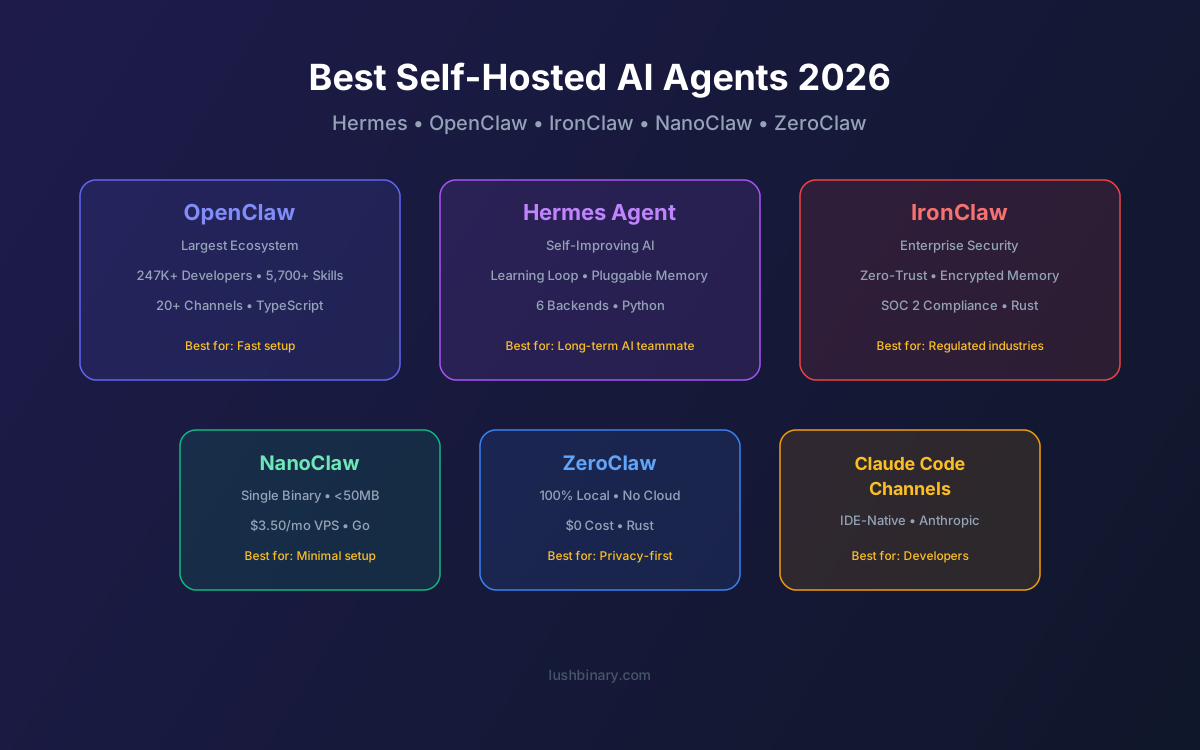
Here's a quick overview before we dive into each:
| Agent | Best For | Min Cost |
|---|---|---|
| OpenClaw | Largest ecosystem, fast setup | ~$5/mo + LLM |
| Hermes Agent | Self-improving, research | ~$5/mo + LLM |
| IronClaw | Enterprise security | ~$20/mo + LLM |
| NanoClaw | Lightweight, minimal | ~$3.50/mo |
| ZeroClaw | Privacy-first, local-only | $0 (local) |
| Claude Code Channels | Developer workflows | $20/mo (Claude Pro) |
2OpenClaw
OpenClaw is the category creator. Released in late 2025, it proved that autonomous AI agents could manage real business workflows. With 247,000+ developers and 5,700+ community skills on ClawHub, it has the largest ecosystem by far.
Strengths:
- Largest skill marketplace (5,700+ on ClawHub)
- 20+ messaging channels (Telegram, Discord, Slack, WhatsApp, QQ, LINE, Feishu, Teams)
- Fast setup (
npx openclaw) - Active community and frequent updates (v2026.3.2 as of April 2026)
- Streaming responses, Discord voice, iOS/Apple Watch support
Weaknesses:
- Multiple critical CVEs in 2026 (CVE-2026-25253, CVE-2026-27001, CVE-2026-30741)
- 1,467 malicious skills found in ClawHub (Snyk report)
- Weak default security settings with deep system access
- Static skills — no learning or self-improvement
- Cross-session memory requires manual setup
For a deep dive, see our OpenClaw architecture guide and latest updates breakdown.
3Hermes Agent
Hermes Agent from Nous Research is the first agent with a built-in self-improving learning loop. Released February 2026, it's quickly becoming the go-to for developers who want an agent that compounds through use.
Strengths:
- Self-improving closed learning loop (autonomous skill creation and refinement)
- Layered memory with pluggable backends (v0.7.0)
- 6 terminal backends including serverless (Modal, Daytona)
- Safer-by-default security (prompt injection scanning, credential filtering)
- MCP Server Mode — expose Hermes as an MCP server
- Atropos RL training and trajectory export for research
- Built-in OpenClaw migration tool
Weaknesses:
- Smaller ecosystem (launched February 2026)
- Fewer messaging channels than OpenClaw (5 vs 20+)
- Python-based (some teams prefer Node.js)
- Still pre-1.0 (v0.7.0)
For a detailed comparison, see our Hermes vs OpenClaw guide.
4IronClaw
IronClaw is the enterprise-grade option. It sacrifices ecosystem size for zero-trust security, making it the only self-hosted agent suitable for regulated industries.
Strengths:
- Zero-trust sandboxing with encrypted memory
- SOC 2 compliance tooling
- Audit logging and access controls
- Suitable for healthcare, finance, and legal
- Enterprise support available
Weaknesses:
- Smaller skill ecosystem
- Higher infrastructure requirements (~$20/mo minimum)
- More complex setup and configuration
- No self-improving learning loop
5NanoClaw
NanoClaw is the minimalist option — a single binary under 50MB that does one thing well: run an AI agent with minimal overhead.
Strengths:
- Single binary, no dependencies
- Runs on a $3.50/month VPS
- Extremely low resource usage
- Fast startup and low latency
Weaknesses:
- Limited skill ecosystem
- Fewer messaging channels
- Basic memory system
- No learning loop or advanced features
6ZeroClaw
ZeroClaw is the privacy-first option. It runs entirely locally with no cloud dependencies, making it ideal for users who want complete data sovereignty.
Strengths:
- 100% local execution — no data leaves your machine
- Works with Ollama for zero-cost LLM inference
- No API keys or cloud accounts needed
- Strong privacy guarantees
Weaknesses:
- Limited to local LLM quality (depends on your hardware)
- No cloud model fallback
- Smaller feature set than OpenClaw or Hermes
- Requires decent hardware (16GB+ RAM recommended)
For a comprehensive comparison of all Claw-family agents, see our personal AI agents comparison.
7Claude Code Channels
Launched in March 2026 by Anthropic, Claude Code Channels lets developers control their local Claude Code sessions directly from Telegram and Discord. It's not a general-purpose agent framework — it's specifically designed for developer workflows.
Strengths:
- Deep IDE integration (VS Code, Kiro)
- Claude model quality (Opus 4.6, Sonnet 4.5)
- Code-aware context and project understanding
- Backed by Anthropic's safety research
Weaknesses:
- Developer-only use case (not general-purpose)
- Requires Claude Pro subscription ($20/mo)
- Limited to Telegram and Discord channels
- No custom skill ecosystem
- Tied to Claude models only
8Full Comparison Table
| Feature | OpenClaw | Hermes | IronClaw | NanoClaw | ZeroClaw |
|---|---|---|---|---|---|
| License | MIT | MIT | BSL 1.1 | MIT | MIT |
| Language | TypeScript | Python | Rust | Go | Rust |
| Learning Loop | ❌ | ✅ | ❌ | ❌ | ❌ |
| Skills Ecosystem | 5,700+ | Growing | 200+ | 50+ | 100+ |
| Channels | 20+ | 5+CLI | 10+ | 3 | Local only |
| Security | Weak defaults | Safer defaults | Zero-trust | Basic | Local isolation |
| Memory | Markdown | Layered+pluggable | Encrypted | SQLite | Local files |
| Serverless | ❌ | ✅ | ❌ | ❌ | ❌ |
| MCP Support | ✅ | ✅+Server | ✅ | ❌ | ❌ |
| Min Cost | ~$5/mo | ~$5/mo | ~$20/mo | ~$3.50/mo | $0 |
| Best For | Fast setup | Long-term AI | Enterprise | Minimal | Privacy |
9Decision Framework
Use this framework to pick the right agent for your situation:
I want the fastest path to a working agent
→ OpenClaw
Largest ecosystem, most tutorials, npx openclaw gets you running in minutes
I want an agent that gets smarter over time
→ Hermes Agent
Only agent with a self-improving learning loop and procedural memory
I handle sensitive data (healthcare, finance, legal)
→ IronClaw
Zero-trust sandboxing, encrypted memory, SOC 2 compliance tooling
I want the cheapest possible setup
→ NanoClaw or ZeroClaw
NanoClaw runs on $3.50/mo VPS; ZeroClaw is free (local only)
I need complete data privacy with no cloud
→ ZeroClaw
100% local execution, no data leaves your machine
I'm a developer who wants agent access from chat
→ Claude Code Channels
Deep IDE integration, code-aware context, Claude model quality
I want serverless deployment (pay only when active)
→ Hermes Agent
Only agent supporting Modal and Daytona serverless backends
I'm migrating from OpenClaw
→ Hermes Agent
Built-in migration tool (hermes claw migrate) imports everything
10How Lushbinary Can Help
Choosing an agent framework is just the first step. At Lushbinary, we handle the full lifecycle:
- Platform assessment: We evaluate your workflows, security requirements, and budget to recommend the right agent
- Custom deployment: Production-grade infrastructure on AWS with monitoring, auto-scaling, and cost optimization
- Skill development: Purpose-built skills and MCP integrations for your specific business processes
- Security hardening: Proper isolation, credential management, and compliance configuration
- Migration support: Smooth transitions between agent platforms with zero downtime
🚀 Free Agent Assessment
Not sure which agent fits? Book a free 30-minute call. We'll review your use case and give you an honest recommendation with a deployment plan.
❓ Frequently Asked Questions
What are the best self-hosted AI agents in 2026?
OpenClaw (largest ecosystem), Hermes Agent (self-improving), IronClaw (enterprise security), NanoClaw (lightweight), ZeroClaw (privacy-first), and Claude Code Channels (developer workflows).
Which is most secure?
IronClaw offers zero-trust sandboxing and SOC 2 compliance. Hermes Agent has safer defaults than OpenClaw with prompt injection scanning.
What's the cheapest to run?
NanoClaw on a $3.50/mo VPS, or ZeroClaw for free (local only). OpenClaw and Hermes start at ~$5/mo plus LLM costs.
Should I use OpenClaw or Hermes?
OpenClaw for fast setup and 5,700+ skills. Hermes for self-improving skills, serverless deployment, and safer defaults.
📚 Sources
Content was rephrased for compliance with licensing restrictions. Feature comparisons sourced from official documentation as of April 2026. Features and pricing may change — always verify on vendor websites.
Need Help Choosing & Deploying an AI Agent?
We've deployed OpenClaw, Hermes, and IronClaw in production. Let us help you pick the right platform and build it out.
Build Smarter, Launch Faster.
Book a free strategy call and explore how LushBinary can turn your vision into reality.