
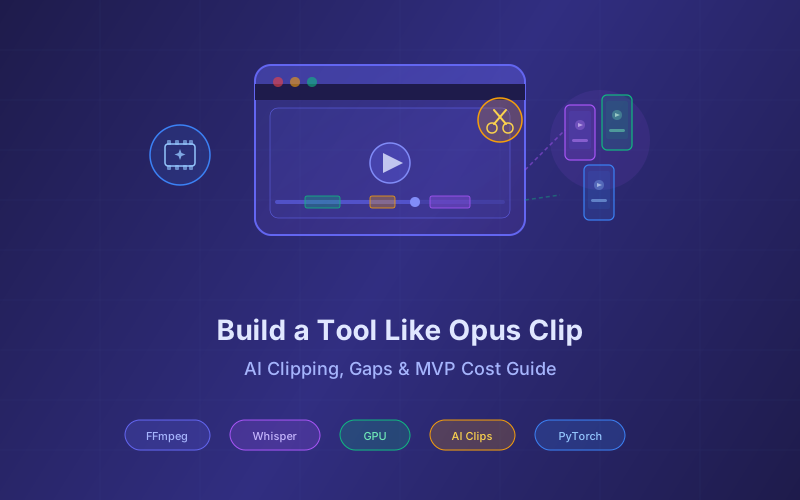
Opus Clip turned long-form video into a clip-generation machine and raised $20M to prove it. With over 12 million users and $5M+ in annual recurring revenue, the platform showed that creators and marketers will pay for AI that turns a single podcast or YouTube video into dozens of short-form clips. Castmagic, a competitor focused on audio repurposing, hit $30K+ MRR in its first year — proving the market extends well beyond video.
But Opus Clip's model has cracks. The per-minute credit system gets expensive fast for power users. Between 20-40% of auto-generated clips need manual rework before they're usable. On Trustpilot, 22% of reviews are 1-star — citing processing failures, cancellation difficulties, and poor support. Free-tier clips come watermarked and expire in just 3 days, pushing users toward paid plans before they've seen real value.
This guide breaks down what makes Opus Clip work, the specific gaps you can exploit, the features you need for an MVP, the tech stack, AI capabilities that can differentiate your product, how much it costs, and how Lushbinary can help you ship it fast.
📋 Table of Contents
- 1.What Makes Opus Clip Successful
- 2.Opus Clip’s Revenue Model & Pricing Breakdown
- 3.User Complaints & Market Gaps You Can Exploit
- 4.Core Features for a Content Repurposing MVP
- 5.System Architecture & Tech Stack
- 6.AI-Powered Features That Differentiate
- 7.Development Cost & Timeline Breakdown
- 8.Why Lushbinary for Your Content Repurposing MVP
1What Makes Opus Clip Successful
Opus Clip didn't invent video editing. It invented the workflow of dropping in a long video and getting back a batch of ready-to-post short clips. That shift — from manual editing to AI-powered repurposing — is what turned a simple tool into a $20M-funded company. The product identifies viral moments, adds captions automatically, and formats clips for every platform in one pass.
AI-Powered Viral Moment Detection
Opus Clip's core innovation is using AI to scan long-form video and identify the segments most likely to perform well as short-form content. It analyzes speech patterns, emotional peaks, topic shifts, and engagement signals to rank potential clips by "virality score." This saves creators hours of manual scrubbing through footage.
Auto-Captions & Multi-Platform Formatting
Every clip gets auto-generated captions with customizable styles — a feature that's become essential since 85% of social media video is watched without sound. Opus Clip also reformats clips for TikTok (9:16), YouTube Shorts (9:16), Instagram Reels (9:16), and LinkedIn (1:1 or 16:9) automatically.
Creator-First Positioning
Opus Clip positioned itself as a tool for creators and marketers who produce long-form content but need short-form distribution. Podcasters, YouTubers, course creators, and agencies are the core audience. This focus on a specific workflow — rather than general video editing — is what made the product sticky.
| Metric | Opus Clip |
|---|---|
| Funding Raised | $20M |
| Total Users | 12M+ |
| ARR (est.) | $5M+ |
| Pro Plan | $14.50/month (annual) |
| Business Plan | $37/month (annual) |
| Free Tier | Watermarked clips, 3-day expiry |
| Core Use Case | Long-form → short-form video clips |
| Key Markets | Creators, podcasters, agencies, marketers |
2Opus Clip's Revenue Model & Pricing Breakdown
Opus Clip runs a freemium model with per-minute credit-based pricing. The free tier hooks users with watermarked clips that expire in 3 days, creating urgency to upgrade. Here's the current pricing breakdown:
| Plan | Price | Key Features |
|---|---|---|
| Free | $0 | Watermarked clips, 3-day expiry, limited processing |
| Pro | $14.50/month (annual) | 300 minutes/month, no watermark, caption styles, 1080p export |
| Business | $37/month (annual) | 1,000 minutes/month, priority processing, brand kits, team seats |
The per-minute credit system is the core monetization lever. Users who process a lot of content burn through minutes quickly, and overage charges or plan upgrades follow. This model works well for Opus Clip but creates frustration for power users — especially agencies processing dozens of videos per week. For your alternative, the opportunity is offering more generous limits or flat-rate pricing that removes the anxiety of watching credits drain.
3User Complaints & Market Gaps You Can Exploit
We analyzed hundreds of reviews on Trustpilot, Reddit (r/podcasting, r/NewTubers, r/videography), X, and Product Hunt. Here are the most consistent pain points — each one is a feature opportunity for your alternative.
💸 Per-Minute Credits Get Expensive
Heavy users burn through 300 Pro minutes in a week. Agencies processing client content hit limits fast, and overage costs add up. Users want flat-rate or unlimited plans.
✂️ 20-40% of Clips Need Rework
AI-generated clips frequently cut mid-sentence, miss context, or pick low-quality segments. Users spend significant time manually fixing what was supposed to be automated.
⚠️ Processing Failures
Longer videos (60+ minutes) frequently fail to process or produce corrupted output. Users report losing credits on failed jobs with no automatic refund.
🚫 Cancellation Difficulties
Multiple Trustpilot reviews cite difficulty cancelling subscriptions. Users report being charged after cancellation and slow support response times.
🔧 Limited Editing Tools
Once clips are generated, editing options are basic. No timeline editor, no B-roll insertion, no audio mixing. Users export to CapCut or Premiere for final touches.
🎙️ No Podcast/Audio-First Support
Opus Clip is video-only. Podcasters and audio creators have to convert audio to video first, losing quality and adding friction. The audio repurposing market is underserved.
💡 The Opportunity
The biggest gap is clip quality and editing control. Creators want AI that generates clips they can actually post without rework — and when rework is needed, they want real editing tools built in, not a basic trimmer. An alternative that combines better AI accuracy with a proper clip editor, flat-rate pricing, and audio-first support would capture frustrated Opus Clip users immediately.
4Core Features for a Content Repurposing MVP
Phase 1: Lean MVP (8-10 weeks)
- Video Upload & Ingestion — Support MP4, MOV, and WebM up to 2 hours. URL import from YouTube, Vimeo, and direct links
- AI Scene Detection — Analyze video for topic shifts, emotional peaks, and natural break points using speech and visual analysis
- Auto-Clipping Engine — Generate 5-15 clips per video ranked by predicted engagement, with configurable duration (15s, 30s, 60s, 90s)
- Auto-Captions — Whisper-powered transcription with word-level timing, customizable caption styles, and support for 10+ languages at launch
- Multi-Format Export — One-click export to 9:16 (TikTok/Reels/Shorts), 1:1 (Instagram/LinkedIn), and 16:9 (YouTube) with smart cropping
- Clip Preview & Trim — Review generated clips, adjust start/end points, reorder, and delete before export
- User Dashboard — Project management, clip history, usage tracking, and account settings
- Basic Billing — Stripe integration with free tier and one paid plan
Phase 2: Differentiation (6-8 weeks)
- Batch Processing — Upload multiple videos and process them in parallel with queue management
- Clip Templates — Pre-built visual templates with branded intros, outros, lower thirds, and progress bars
- Social Scheduling — Connect TikTok, YouTube, Instagram, and LinkedIn accounts. Schedule clips directly from the dashboard
- Timeline Editor — Full clip editor with trim, split, text overlays, audio mixing, and transition effects
- Team Collaboration — Shared workspaces, approval workflows, and role-based access for agencies
- Analytics Dashboard — Track clip performance across platforms with engagement metrics and best-posting-time recommendations
Phase 3: AI & Scale (8-12 weeks)
- AI Virality Scoring — Predict clip performance using engagement data from connected social accounts and trending content analysis
- Custom Brand Kits — Save brand colors, fonts, logos, caption styles, and watermarks. Apply consistently across all clips with one click
- Podcast & Audio Support — Upload audio files directly. AI generates audiogram videos with waveform visualizations, speaker detection, and chapter markers
- AI B-Roll Suggestions — Automatically suggest and insert relevant stock footage or generated visuals during talking-head segments
- Multi-Language Dubbing — AI-powered voice cloning to dub clips into multiple languages while preserving the speaker's voice characteristics
5System Architecture & Tech Stack
A content repurposing platform has three critical requirements: reliable video processing at scale (GPU-intensive workloads that can't fail silently), fast transcription and AI inference (users expect clips in minutes, not hours), and efficient storage and delivery (video files are large and CDN costs add up). Here's the architecture we recommend.
Recommended Tech Stack
| Layer | Technology | Why |
|---|---|---|
| Frontend | Next.js 15 (App Router) | Dashboard UI, SSR for SEO, real-time job status via Server-Sent Events |
| Video Processing | Python + FFmpeg | Industry standard for transcoding, clipping, format conversion |
| AI / ML | PyTorch + Whisper + custom models | Scene detection, transcription, virality scoring |
| Database | PostgreSQL | Video metadata, user data, clip relationships, job tracking |
| Queue / Cache | Redis (BullMQ) | Job queues for async processing, caching, rate limiting |
| Storage | S3 + CloudFront | Scalable video storage with global CDN delivery |
| GPU Compute | AWS EC2 (g5 instances) or RunPod | On-demand GPU workers for AI inference and video processing |
| Payments | Stripe | Usage-based billing, subscriptions, metered credits |
| Monitoring | Datadog or Grafana | GPU utilization, job success rates, processing latency |
6AI-Powered Features That Differentiate
AI is the core of any content repurposing tool, but Opus Clip's implementation leaves room for improvement. Here are the features that would make your alternative genuinely better, not just cheaper.
📊 Virality Prediction
Go beyond basic clip ranking. Analyze trending formats, hook patterns, and platform-specific engagement signals to predict which clips will actually perform. Train on real performance data from connected social accounts.
💬 Auto-Captions in 50+ Languages
Whisper-powered transcription with word-level timing accuracy. Customizable caption styles (animated, karaoke, static), font choices, and positioning. Support 50+ languages with automatic language detection.
🎬 Smart B-Roll Insertion
AI detects talking-head segments and suggests relevant stock footage, screen recordings, or AI-generated visuals to insert automatically. Keeps viewers engaged during long monologue sections.
🎨 Brand Consistency Engine
Save brand colors, fonts, logos, intro/outro templates, and caption styles. AI applies them consistently across every clip. Agencies can manage multiple brand kits for different clients.
🎯 Audience-Specific Clips
Generate different clip versions optimized for different platforms and audiences. A LinkedIn clip emphasizes professional insights while a TikTok version leads with the hook and adds trending audio.
📈 Trend-Aware Editing
AI monitors trending formats, transitions, and audio on TikTok, Reels, and Shorts. Suggests edits that match current trends — like specific caption animations or cut patterns that are performing well right now.
7Development Cost & Timeline Breakdown
| Scope | Cost | Timeline | Team |
|---|---|---|---|
| MVP | $60K - $140K | 8-10 weeks | 3-4 devs |
| Full Platform | $180K - $400K | 5-9 months | 5-7 devs |
| Enterprise + AI | $400K - $700K | 10-16 months | 7-12 devs |
Video processing platforms are significantly more expensive to build than typical SaaS products because of GPU infrastructure requirements. The core cost drivers are AI model training and inference, video transcoding at scale, and storage/CDN for large media files. Using managed GPU services like RunPod or Replicate can reduce initial infrastructure costs by 40-60% compared to self-hosted GPU clusters.
💡 Cost Optimization Tip
Start with spot GPU instances for non-urgent processing and reserved instances for real-time jobs. Use S3 Intelligent-Tiering to automatically move older videos to cheaper storage classes. Your GPU costs can drop 60-70% by processing during off-peak hours and using spot pricing — most creators don't need clips in real-time.
8Why Lushbinary for Your Content Repurposing MVP
At Lushbinary, we've built video processing pipelines, GPU-accelerated AI products, and scalable media platforms for startups and enterprises. Here's what we bring to a content repurposing project:
- Video processing expertise — We've built FFmpeg-based pipelines that handle transcoding, clipping, caption rendering, and multi-format export at scale with 99.5%+ job success rates
- GPU infrastructure — We design auto-scaling GPU worker architectures on AWS that handle bursty video processing workloads without overspending on idle compute
- AI/ML integration — We integrate Whisper, PyTorch, and custom models for transcription, scene detection, virality scoring, and content analysis
- Next.js & React dashboards — We build real-time dashboards with job progress tracking, clip previews, and drag-and-drop editors using modern React patterns
- AI-accelerated development — We use AI coding tools to ship MVPs 30-40% faster without sacrificing code quality or test coverage
🚀 Free Consultation
Want to build a content repurposing platform that actually competes with Opus Clip? Lushbinary specializes in AI-powered video processing MVPs. We'll scope your project, recommend the right GPU infrastructure, and give you a realistic timeline — no obligation.
❓ Frequently Asked Questions
How much does it cost to build a content repurposing tool like Opus Clip?
An MVP with video upload, AI clipping, captions, and multi-format export costs $60,000-$140,000 and takes 8-10 weeks. A full platform with batch processing, templates, scheduling, and AI virality scoring ranges from $180,000-$400,000 over 5-9 months.
What are the biggest complaints about Opus Clip?
Per-minute credits that get expensive for heavy users, 20-40% of clips needing manual rework, processing failures on longer videos, difficult cancellation process, limited editing tools, and no support for podcast or audio-first content.
What tech stack should I use to build an Opus Clip alternative?
Next.js 15 for the dashboard, Python with FFmpeg for video processing, PyTorch and Whisper for AI/ML, PostgreSQL for data, Redis for job queues, S3 and CloudFront for storage and delivery, and GPU workers on AWS or RunPod.
How does Opus Clip make money?
Freemium subscriptions with per-minute credit pricing. Free tier has watermarked clips that expire in 3 days. Pro is $14.50/month (annual) with 300 minutes, Business is $37/month with 1,000 minutes. Estimated ARR is $5M+ with 12M+ users.
Can I build an Opus Clip alternative as a solo developer?
A basic clipping tool, yes. But a production-ready platform requires GPU infrastructure, reliable video processing pipelines, and AI model integration. A solo developer could ship a lean MVP in 12-16 weeks using managed GPU services, but scaling requires a team of 3-5 engineers.
📚 Sources
- Opus Clip Official Website — Pricing and feature data
- Trustpilot Reviews — Opus Clip — User feedback and ratings
- Castmagic — Competitor reference for audio repurposing
- Crunchbase — Opus Clip — Funding and company data
Content was rephrased for compliance with licensing restrictions. Pricing data sourced from official Opus Clip website as of 2025. Revenue, user counts, and funding estimates from public reporting and Crunchbase. All figures may change — always verify on the vendor's website.
Build a Content Repurposing Tool That Outperforms Opus Clip
Better AI clipping, flat-rate pricing, real editing tools, and podcast support. Let Lushbinary build your Opus Clip alternative with the features creators actually need.
Build Smarter, Launch Faster.
Book a free strategy call and explore how LushBinary can turn your vision into reality.