
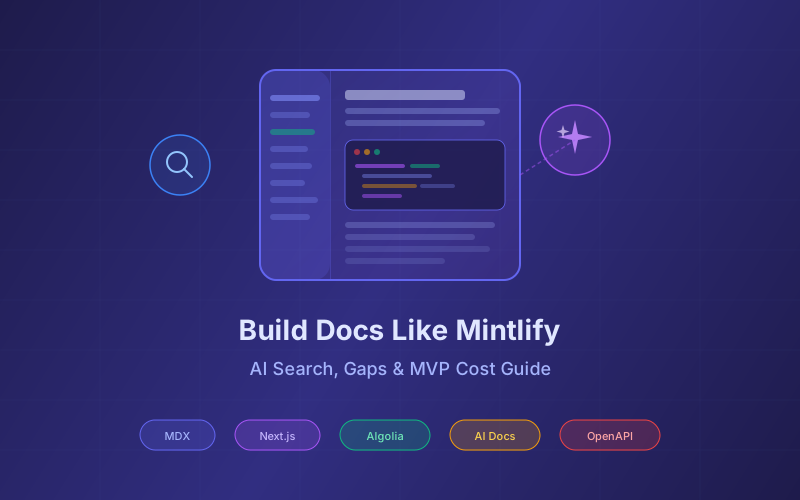
Mintlify raised $18.5M to make developer documentation beautiful and intelligent. The platform now serves thousands of dev teams — from early-stage startups to public companies — all betting on the idea that great docs drive adoption. Developer tools carry 80-90% gross margins, and documentation platforms sit at the center of every developer experience strategy.
But Mintlify's pricing is pushing teams away. The Pro plan jumped from $180 to $300/month, per-message AI charges add up fast, setup requires significant developer resources, and there's no affordable tier for small teams or open-source projects. On Reddit, GitHub Discussions, and X, developers are asking the same question: can we build something better for less?
This guide breaks down what makes Mintlify work, the specific gaps you can exploit, the features you need for an MVP, the tech stack, AI capabilities that can differentiate your product, how much it costs, and how Lushbinary can help you ship it fast.
📋 Table of Contents
- 1.What Makes Mintlify Successful
- 2.Mintlify's Revenue Model & Pricing Breakdown
- 3.User Complaints & Market Gaps You Can Exploit
- 4.Core Features for a Documentation Platform MVP
- 5.System Architecture & Tech Stack
- 6.AI-Powered Features That Differentiate
- 7.Development Cost & Timeline Breakdown
- 8.Why Lushbinary for Your Documentation Platform
1What Makes Mintlify Successful
Mintlify didn't invent developer documentation. It invented the expectation that docs should be beautiful by default. Before Mintlify, most developer docs looked like they were designed in 2012 — plain markdown rendered with minimal styling. Mintlify proved that polished, interactive documentation drives developer adoption and reduces support tickets.
Docs-as-Code Workflow
Mintlify treats documentation like source code. Teams write MDX files, push to GitHub, and docs deploy automatically. This fits perfectly into existing developer workflows — no separate CMS, no WYSIWYG editor, no context switching. Your alternative needs to embrace this same docs-as-code philosophy or you'll lose developer trust immediately.
API Playground & Interactive Components
Mintlify's API playground lets developers test endpoints directly from the docs page. Combined with auto-generated API references from OpenAPI specs, this turns static documentation into an interactive developer experience. It's the feature that sells enterprise contracts.
AI Search & Beautiful Defaults
Mintlify's AI-powered search understands natural language queries and returns contextual answers, not just keyword matches. Combined with beautiful default themes that make any docs site look professional out of the box, Mintlify lowered the bar for creating great documentation while raising the standard for what "good docs" look like.
| Metric | Mintlify |
|---|---|
| Total Funding | $18.5M raised |
| Customers | Thousands of dev teams |
| Pro Plan | $300/month |
| License | AGPL (open-source core) |
| Content Format | MDX (Markdown + JSX) |
| Key Feature | AI-powered search & API playground |
| Target Market | Developer tools & API companies |
| Deployment | Git-based, auto-deploy on push |
2Mintlify's Revenue Model & Pricing Breakdown
Mintlify runs a freemium SaaS model targeting developer-focused companies. The free tier gets teams started, but meaningful features — custom domains, team collaboration, and AI — are locked behind aggressive paywalls. Here's the current pricing:
| Plan | Price | Key Features |
|---|---|---|
| Free (Hobby) | $0 | Limited pages, basic components, Mintlify branding |
| Pro | $300/month | Custom domains, team collaboration, API playground, analytics |
| Enterprise | $600+/month | SSO, SLAs, dedicated support, custom integrations, white-label |
On top of subscription fees, Mintlify charges per-message fees for AI-powered features like smart search and chat. These usage-based costs can add hundreds of dollars monthly for high-traffic docs sites. For your alternative, the opportunity is offering transparent, predictable pricing without surprise AI surcharges — especially for small teams and open-source projects that can't justify $300/month for documentation.
3User Complaints & Market Gaps You Can Exploit
We analyzed feedback on GitHub Discussions, Reddit (r/webdev, r/devtools), X, and Hacker News. Here are the most consistent pain points — each one is a feature opportunity for your alternative.
💰 Expensive Pro Plan
The Pro plan jumped from $180 to $300/month with little warning. For early-stage startups and small dev teams, that's a significant chunk of budget just for documentation hosting.
🤖 Per-Message AI Costs
AI search and chat features charge per message on top of the subscription. High-traffic docs sites report AI costs exceeding their base subscription, making total costs unpredictable.
🔧 Complex Setup Requiring Devs
Despite marketing simplicity, getting Mintlify configured properly requires developer resources. Custom components, API reference setup, and CI/CD integration aren't plug-and-play.
🚫 Limited Free Tier
The Hobby plan is too restrictive for real use. Page limits, missing features, and Mintlify branding make it a demo, not a viable option for small teams or open-source projects.
🔒 Vendor Lock-in
Mintlify uses a proprietary configuration format and custom components. Migrating away means rewriting your entire docs structure. The AGPL license adds complexity for self-hosting.
🐌 Slow Build Times
Large documentation sites with hundreds of pages report slow build and deploy times. Incremental builds help but don't fully solve the problem for enterprise-scale docs.
💡 The Opportunity
The biggest gap is affordable, predictable pricing with AI included. Teams want beautiful docs with AI search, API playgrounds, and analytics — but they don't want to pay $300/month plus per-message fees. An alternative that offers transparent pricing, easy setup, and standard MDX without vendor lock-in would capture a massive segment of frustrated teams.
4Core Features for a Documentation Platform MVP
Phase 1: Lean MVP (6-8 weeks)
- MDX-Based Docs Engine — Write docs in standard MDX, render with custom components, support frontmatter metadata for navigation and SEO
- API Reference Generation — Auto-generate interactive API docs from OpenAPI/Swagger specs with try-it-now functionality
- Full-Text Search — Fast, typo-tolerant search across all docs pages with highlighted results and keyboard navigation
- Custom Themes — Brand-matched color schemes, typography, and layout options with live preview
- Git-Based Deployment — Push to GitHub and docs deploy automatically with preview environments for PRs
- Navigation Builder — Sidebar, tabs, and breadcrumb navigation generated from file structure with manual overrides
- Code Blocks — Syntax highlighting, copy button, multi-language tabs, and line highlighting out of the box
- Custom Domains — Connect your own domain with automated SSL provisioning from day one
Phase 2: Differentiation (4-6 weeks)
- AI Chat — Conversational AI that answers questions using your docs as context, with source citations
- Versioning — Maintain multiple doc versions tied to product releases with easy version switching
- Analytics Dashboard — Page views, search queries, popular paths, and drop-off points to identify docs gaps
- OpenAPI Integration — Deep integration with OpenAPI specs for auto-updating API references when specs change
- Feedback Widgets — "Was this helpful?" buttons and inline feedback collection on every page
- Team Collaboration — Role-based access, review workflows, and edit suggestions for docs teams
Phase 3: AI & Scale (6-8 weeks)
- AI Doc Generation from Code — Point at a codebase and generate documentation automatically from comments, types, and function signatures
- Auto-Update Detection — Monitor code changes and flag docs that may be outdated based on API or schema changes
- Multi-Language Support — AI-powered translation of docs into multiple languages with human review workflows
- Custom AI Training — Fine-tune the AI search and chat on your specific product terminology and use cases
- Enterprise SSO & Audit Logs — SAML/OIDC authentication, activity logging, and compliance features
5System Architecture & Tech Stack
A documentation platform has three critical requirements: fast page loads (developers abandon slow docs), powerful search (the primary navigation method), and seamless git integration (docs must live alongside code). Here's the architecture we recommend.
Recommended Tech Stack
| Layer | Technology | Why |
|---|---|---|
| Frontend | Next.js 15 (App Router) | SSR/SSG for fast docs, React Server Components for MDX |
| Content | MDX + next-mdx-remote | Standard markdown with JSX components, no vendor lock-in |
| Search | Algolia or Meilisearch | Sub-50ms search with typo tolerance and faceted filtering |
| Database | PostgreSQL (Neon or Supabase) | Project config, user data, analytics, feedback storage |
| Storage | S3 / Cloudflare R2 | Static assets, generated docs, OpenAPI spec files |
| Auth | Clerk or Auth.js | Team management, SSO for enterprise, API keys |
| AI | OpenAI GPT-4o / Claude 4 Sonnet | Doc generation, smart search, chat, translation |
| CDN | CloudFront or Cloudflare | Edge caching, custom domain SSL, global distribution |
| CI/CD | GitHub Actions + Vercel | Auto-deploy on push, preview environments for PRs |
6AI-Powered Features That Differentiate
AI is the wedge that lets a new entrant leapfrog Mintlify. Here are the features that would make your alternative genuinely better, not just cheaper.
🤖 AI Doc Generation from Code
Point at a codebase and generate documentation automatically from function signatures, type definitions, and inline comments. What takes hours of manual writing happens in minutes.
🔍 Smart Search with RAG
AI-powered search that understands natural language queries and returns contextual answers with source citations. Goes beyond keyword matching to understand developer intent.
🔄 Auto-Update Detection
Monitor code repositories for API changes, schema updates, and new endpoints. Automatically flag outdated docs and suggest updates based on code diffs.
📝 API Example Generation
AI generates working code examples for every API endpoint in multiple languages (cURL, Python, JavaScript, Go). Examples stay in sync with the actual API spec.
🔗 Broken Link Detection
AI crawls docs continuously to find broken internal links, outdated external references, and orphaned pages. Suggests fixes automatically instead of just flagging issues.
🌍 AI-Powered Translation
Translate entire docs sites into multiple languages while preserving code blocks, technical terminology, and formatting. Human review workflows ensure accuracy.
7Development Cost & Timeline Breakdown
| Scope | Cost | Timeline | Team |
|---|---|---|---|
| Lean MVP | $25K - $60K | 6-8 weeks | 2-3 devs |
| Full Platform | $80K - $200K | 4-7 months | 3-5 devs |
| Enterprise + AI | $200K - $400K | 8-14 months | 5-8 devs |
Documentation platforms are moderately complex to build. The core product is an MDX renderer with search — the complexity comes from API playground interactivity, AI-powered features, versioning, and multi-tenant custom domain routing. Using AI-assisted development tools like Cursor, Claude Code, or Kiro can reduce these timelines by 30-40%.
💡 Cost Optimization Tip
Start with Meilisearch (self-hosted, free) instead of Algolia to save $500+/month on search costs. Use Vercel's free tier for hosting and Neon's free PostgreSQL tier. Your infrastructure costs can be under $100/month until you hit thousands of docs projects. The biggest cost driver is AI — use caching and embeddings to minimize per-query LLM calls.
8Why Lushbinary for Your Documentation Platform
At Lushbinary, we've built developer tools, docs-as-code platforms, and AI-powered products for startups and enterprises. Here's what we bring to a documentation platform project:
- Developer tools expertise — We understand the developer experience space deeply, from API design to documentation workflows and CLI tooling
- Docs-as-code infrastructure — We've built MDX-based content systems with git integration, custom components, and automated deployment pipelines
- AI integration — We integrate OpenAI, Claude, and open-source models for RAG-powered search, doc generation, and intelligent content suggestions
- Search & performance — We've implemented Algolia and Meilisearch integrations with sub-50ms response times and faceted filtering
- AI-accelerated development — We use AI coding tools to ship MVPs 30-40% faster without sacrificing code quality
🚀 Free Consultation
Want to build a documentation platform that competes with Mintlify? Lushbinary specializes in developer tools and AI-powered SaaS MVPs. We'll scope your project, recommend the right tech stack, and give you a realistic timeline — no obligation.
❓ Frequently Asked Questions
How much does it cost to build a documentation platform like Mintlify?
A lean MVP costs $25,000-$60,000 and takes 6-8 weeks. A full-featured platform with AI chat, versioning, and analytics ranges from $80,000-$200,000 over 4-7 months.
What are the biggest complaints about Mintlify?
Expensive Pro plan at $300/month (up from $180), per-message AI charges, complex setup requiring developer resources, limited free tier, vendor lock-in with proprietary format, and slow build times for large docs sites.
What tech stack should I use to build a Mintlify alternative?
Next.js 15 for frontend/SSR, MDX for content, PostgreSQL for data, Algolia or Meilisearch for search, S3 for assets, and OpenAI or Claude for AI-powered features.
How does Mintlify make money?
Freemium subscriptions: free Hobby tier, Pro at $300/month, Enterprise at $600+/month. Plus per-message AI charges on top of subscriptions for smart search and chat features.
Can I build a Mintlify alternative with open-source tools?
Yes. Docusaurus, Nextra, and Starlight provide solid foundations. But a production-ready platform with AI search, API playground, analytics, and team collaboration takes 6-8 weeks minimum.
📚 Sources
- Mintlify Official Website — Pricing and feature data
- Mintlify GitHub — Open-source repositories and AGPL license
- Crunchbase — Mintlify — Funding history and company data
Content was rephrased for compliance with licensing restrictions. Pricing data sourced from official Mintlify website as of 2025. Funding and customer estimates from public reporting. All figures may change — always verify on the vendor's website.
Build a Documentation Platform That Outperforms Mintlify
AI-powered search, beautiful defaults, transparent pricing. Let Lushbinary build your Mintlify alternative with the features dev teams actually need.
Build Smarter, Launch Faster.
Book a free strategy call and explore how LushBinary can turn your vision into reality.