
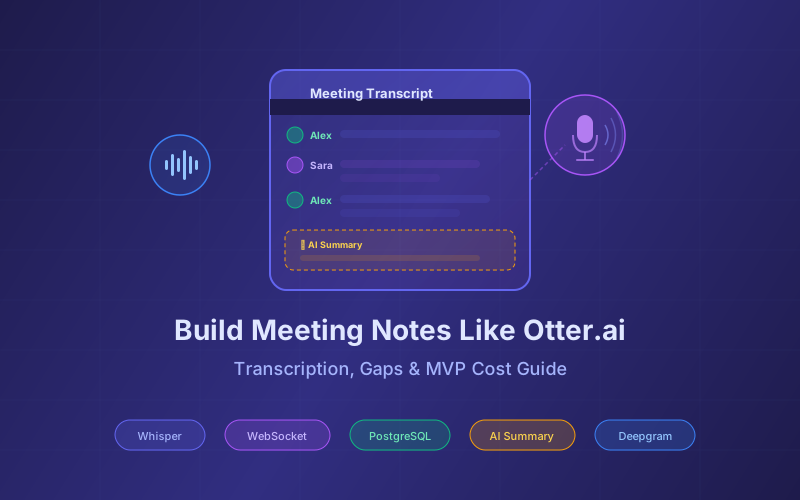
Otter.ai raised $65M to turn meetings into searchable text. Fireflies.ai hit $10M+ ARR doing the same thing. AI-powered meeting notes have gone from novelty to essential infrastructure for remote teams — the market is projected to reach $5.5 billion by 2028. If your team runs more than three meetings a day, someone is already paying for transcription software.
But Otter's dominance is under pressure. In August 2025, a class-action privacy lawsuit alleged the platform recorded and processed conversations without proper consent. Users report transcription accuracy of just 93.8% — meaning roughly 1 in 16 words is wrong, which is unacceptable for legal, medical, or financial meetings. Speaker recognition struggles with more than 3-4 participants, customer support is slow, and the free plan keeps shrinking.
This guide breaks down what makes Otter successful, the specific gaps you can exploit, the features you need for an MVP, the tech stack, AI capabilities that can differentiate your product, how much it costs, and how Lushbinary can help you ship it fast.
📋 Table of Contents
- 1.What Makes Otter.ai Successful
- 2.Otter.ai’s Revenue Model & Pricing Breakdown
- 3.User Complaints & Market Gaps You Can Exploit
- 4.Core Features for a Meeting Notes MVP
- 5.System Architecture & Tech Stack
- 6.AI-Powered Features That Differentiate
- 7.Development Cost & Timeline Breakdown
- 8.Why Lushbinary for Your Meeting Notes MVP
1What Makes Otter.ai Successful
Otter.ai didn't invent transcription. It invented the habit of having an AI assistant silently join every meeting, transcribe in real time, and deliver a searchable summary before you've closed the Zoom tab. That behavioral shift — training millions of knowledge workers to expect instant meeting notes — is Otter's real moat.
Real-Time Transcription
Otter transcribes meetings as they happen, not after. Users see words appear on screen in real time, can highlight key moments, and add comments while the conversation is still fresh. This live experience is what separates Otter from batch transcription tools — and it's the baseline your alternative needs to match.
Auto-Join Meetings
Connect your calendar and Otter's bot automatically joins Zoom, Google Meet, and Microsoft Teams calls. No manual recording, no forgetting to hit "start." This zero-friction capture is why teams adopt Otter — it works without anyone thinking about it.
CRM & Workflow Integration
Otter pushes meeting summaries and action items directly into Salesforce, HubSpot, and Slack. For sales teams, this means every customer call is automatically logged with key takeaways. This integration layer is what turns a transcription tool into a productivity platform.
| Metric | Otter.ai |
|---|---|
| Founded | 2016 (Los Altos, California) |
| Total Funding | $65M raised |
| Users | Millions of users globally |
| Accuracy | 93.8% reported accuracy |
| Integrations | Zoom, Google Meet, Microsoft Teams |
| Free Plan | 300 minutes/month |
| Paid Plans | $16.99 - $30/month |
| Key Feature | Real-time transcription + auto-join |
2Otter.ai's Revenue Model & Pricing Breakdown
Otter runs a freemium per-minute pricing model. The free tier hooks users with enough minutes to see the value, then usage limits push them toward paid plans. Here's the current pricing:
| Plan | Price | Key Features |
|---|---|---|
| Free | $0 (300 min/mo) | Basic transcription, limited exports, Otter branding |
| Pro | $16.99/month (1,200 min) | Advanced search, custom vocabulary, priority processing |
| Business | $30/month (6,000 min) | Admin controls, CRM integration, team analytics |
| Enterprise | Custom pricing | SSO, dedicated support, custom data retention, SLA |
The per-minute model creates predictable revenue but also predictable frustration. Users who run 5+ meetings a day burn through free minutes in a week. The jump from free to $16.99/month is steep for individual users, and $30/month per seat adds up fast for teams. For your alternative, the opportunity is offering more generous free limits or flat-rate pricing that doesn't penalize heavy users.
3User Complaints & Market Gaps You Can Exploit
We analyzed hundreds of reviews on G2, Reddit (r/productivity, r/remotework), Trustpilot, and X. Here are the most consistent pain points — each one is a feature opportunity for your alternative.
⚖️ Privacy Lawsuit Concerns
A class-action lawsuit filed in August 2025 alleges Otter recorded and processed conversations without proper consent. Enterprises with compliance requirements are reconsidering the platform entirely.
🎯 Accuracy Issues with Accents & Jargon
93.8% accuracy sounds good until you realize it means ~1 in 16 words is wrong. For medical, legal, or technical meetings with specialized vocabulary and non-native speakers, error rates climb significantly higher.
🗣️ Poor Speaker Diarization
Speaker identification breaks down with more than 3-4 participants. In large team meetings, Otter frequently misattributes quotes to the wrong person — a dealbreaker for meeting minutes that need to be accurate.
🐌 Slow Customer Support
Multiple reviews cite response times of days or weeks for support tickets. When transcription fails during a critical meeting, waiting 72 hours for help is unacceptable for paying customers.
📉 Increasingly Limited Free Tier
300 minutes per month covers roughly 5 one-hour meetings. Power users burn through the free tier in a single day. The free plan has been quietly reduced over time, frustrating long-time users.
🔒 No Self-Hosting for Enterprises
Regulated industries (healthcare, finance, government) need meeting data to stay on-premises. Otter offers no self-hosted or private cloud deployment, locking out a massive enterprise segment.
💡 The Opportunity
The biggest gap is trust and accuracy. Teams need meeting notes they can rely on without manual correction. An alternative that offers higher accuracy through domain-specific models, transparent privacy practices, self-hosting options, and responsive support would capture the enterprise segment Otter is losing.
4Core Features for a Meeting Notes MVP
Phase 1: Lean MVP (8-10 weeks)
- Real-Time Transcription — Live speech-to-text using Whisper or Deepgram with sub-second latency, streaming results as words are spoken
- Speaker Diarization — Identify and label who said what, even with 5+ participants, using voice embeddings and clustering
- Meeting Recording — Capture audio and video from Zoom, Google Meet, and Teams via bot or browser extension
- Summary Generation — AI-generated meeting summaries with key decisions, action items, and follow-ups delivered within minutes of meeting end
- User Accounts & Workspaces — Email/social login, team workspaces, role-based access control
- Search & Playback — Full-text search across all transcripts with click-to-play audio at any point in the conversation
Phase 2: Differentiation (6-8 weeks)
- CRM Push — Auto-sync meeting notes, summaries, and action items to Salesforce, HubSpot, and Pipedrive
- Action Item Extraction — AI identifies commitments, deadlines, and owners from conversation context and creates tasks automatically
- Cross-Meeting Search — Search across all meetings by topic, speaker, date range, or keyword with semantic search capabilities
- Calendar Integration — Auto-join scheduled meetings, attach notes to calendar events, send summaries to attendees
- Export & Sharing — Export to PDF, Notion, Google Docs, Confluence with formatted summaries and timestamps
Phase 3: AI & Scale (8-12 weeks)
- AI Meeting Assistant — Ask questions about past meetings in natural language: "What did Sarah say about the Q3 budget?"
- Real-Time Translation — Live transcription and translation for multilingual teams, supporting 50+ languages
- Custom Vocabulary — Train the model on company-specific terms, product names, and industry jargon for higher accuracy
- Meeting Analytics — Track talk-time ratios, sentiment trends, topic frequency, and participation metrics across teams
- Self-Hosted Deployment — Docker/Kubernetes deployment for enterprises that need data to stay on-premises
5System Architecture & Tech Stack
A meeting notes platform has three critical requirements: real-time audio processing (latency kills the live transcription experience), reliable speaker diarization (wrong attribution is worse than no attribution), and scalable storage (audio files are large and accumulate fast). Here's the architecture we recommend.
Recommended Tech Stack
| Layer | Technology | Why |
|---|---|---|
| Frontend | Next.js 15 (App Router) | SSR for SEO, real-time UI updates, React Server Components |
| Transcription | Python (Whisper / Deepgram) | Best-in-class STT accuracy, streaming support, GPU acceleration |
| Real-Time | WebSocket (Socket.io / ws) | Live transcription streaming, sub-second latency to clients |
| Database | PostgreSQL | Structured transcript data, full-text search, JSONB for metadata |
| Cache / Queue | Redis | Audio chunk queuing, session state, real-time pub/sub |
| Storage | S3 (AWS / MinIO) | Audio and video file storage, presigned URLs for playback |
| AI / LLM | OpenAI GPT-4o / Claude 4 Sonnet | Meeting summarization, action item extraction, Q&A |
| Auth | Clerk or Auth.js | SSO, team management, role-based access |
| Infra | AWS ECS / GCP Cloud Run | Auto-scaling GPU instances for transcription workloads |
6AI-Powered Features That Differentiate
AI is the wedge that lets a new entrant leapfrog Otter. Here are the features that would make your alternative genuinely better, not just cheaper.
🌍 Multi-Language Transcription
Support 50+ languages with automatic language detection. Multilingual teams can speak in their native language and get transcripts in any target language — a massive gap in Otter’s English-first approach.
📖 Custom Vocabulary Training
Let teams upload glossaries of company-specific terms, product names, and acronyms. The model learns that “K8s” means Kubernetes and “PRD” means product requirements document, pushing accuracy above 98% for domain-specific content.
😊 Sentiment Analysis
Detect emotional tone throughout meetings — identify when discussions get heated, when consensus is reached, or when participants disengage. Surface sentiment trends across team meetings over time.
📧 Automated Follow-Up Emails
AI drafts follow-up emails with meeting summaries, action items, and deadlines assigned to specific people. One click to send to all attendees or selectively to action item owners.
🎓 Meeting Coaching
Analyze talk-time ratios, interruption patterns, and question frequency. Give managers insights like “You spoke 70% of the time in 1:1s — try asking more open-ended questions.”
🧠 Knowledge Base from Meetings
Automatically build a searchable knowledge base from all meetings. Ask “What was decided about the pricing strategy?” and get answers sourced from specific meetings with timestamps and speaker attribution.
7Development Cost & Timeline Breakdown
| Scope | Cost | Timeline | Team |
|---|---|---|---|
| MVP | $50K - $120K | 8-10 weeks | 3-4 devs |
| Full Platform | $150K - $350K | 5-8 months | 4-6 devs |
| Enterprise + Self-Hosted | $350K - $600K | 10-16 months | 6-10 devs |
Meeting notes platforms are more complex than typical SaaS products because of the real-time audio processing pipeline. The biggest cost drivers are GPU infrastructure for transcription, WebSocket architecture for live streaming, and meeting bot development for Zoom/Teams/Meet integration. Using AI-assisted development tools like Cursor, Claude Code, or Kiro can reduce these timelines by 30-40%.
💡 Cost Optimization Tip
Start with Deepgram's API instead of self-hosting Whisper to avoid GPU costs during the MVP phase. At $0.0043/minute, you can process 10,000 meeting minutes for under $50. Switch to self-hosted Whisper when volume justifies dedicated GPU infrastructure — typically around 50,000+ minutes per month.
8Why Lushbinary for Your Meeting Notes MVP
At Lushbinary, we've built real-time systems, AI-powered products, and WebSocket architectures for startups and enterprises. Here's what we bring to a meeting notes project:
- Real-time systems expertise — We've built live streaming, WebSocket-based collaboration tools, and event-driven architectures that handle thousands of concurrent connections
- AI & ML integration — We integrate Whisper, Deepgram, OpenAI, and Claude for transcription, summarization, and intelligent meeting analysis
- WebSocket architecture — We design and implement low-latency audio streaming pipelines with Redis pub/sub, chunked processing, and graceful reconnection handling
- Enterprise infrastructure — We deploy on AWS and GCP with auto-scaling GPU instances, S3 storage pipelines, and SOC 2-ready security configurations
- AI-accelerated development — We use AI coding tools to ship MVPs 30-40% faster without sacrificing code quality
🚀 Free Consultation
Want to build a meeting notes platform that outperforms Otter.ai? Lushbinary specializes in real-time AI systems and WebSocket architectures. We'll scope your project, recommend the right tech stack, and give you a realistic timeline — no obligation.
❓ Frequently Asked Questions
How much does it cost to build a meeting notes app like Otter.ai?
A lean MVP costs $50,000-$120,000 and takes 8-10 weeks. A full-featured platform with CRM integration, AI assistant, and enterprise features ranges from $150,000-$350,000 over 5-8 months.
What are the biggest complaints about Otter.ai?
A class-action privacy lawsuit (August 2025), 93.8% accuracy that fails for critical meetings, poor speaker diarization with multiple participants, slow customer support, shrinking free tier, and no self-hosting option for enterprises.
What tech stack should I use to build an Otter.ai alternative?
Next.js 15 for the frontend, Python with Whisper or Deepgram for speech-to-text, PostgreSQL for data, Redis for real-time queuing, S3 for audio storage, WebSocket for live streaming, and OpenAI or Claude for summarization.
How does Otter.ai make money?
Freemium per-minute pricing: Free (300 min/mo), Pro $16.99/month (1,200 min), Business $30/month (6,000 min), and Enterprise with custom pricing. Revenue comes from subscriptions and enterprise contracts.
Can I build a meeting notes app with better accuracy than Otter.ai?
Yes. Using Whisper large-v3 or Deepgram Nova-2 with domain-specific fine-tuning, custom vocabulary lists, and LLM post-processing, you can achieve 96-98% accuracy for specific industries like legal, medical, or technical meetings.
📚 Sources
- Otter.ai Official Website — Pricing and feature data
- G2 Reviews — Otter.ai — User feedback and accuracy reports
- Fireflies.ai — Competitor pricing and feature comparison
- Deepgram — Speech-to-text API pricing and benchmarks
Content was rephrased for compliance with licensing restrictions. Pricing data sourced from official Otter.ai website as of 2025. Revenue and funding estimates from public reporting. All figures may change — always verify on the vendor's website.
Build a Meeting Notes Platform That Outperforms Otter.ai
Real-time transcription, speaker diarization, AI summaries, and self-hosting options. Let Lushbinary build your Otter.ai alternative with the accuracy and privacy teams actually need.
Build Smarter, Launch Faster.
Book a free strategy call and explore how LushBinary can turn your vision into reality.