
Headway turned 15-minute book summaries into a $720 million business. Founded in 2019 by Ukrainian entrepreneur Anton Pavlovsky with just three people, the app now serves over 160 million users across five products and generates an estimated $160 million in annual revenue (source). It's the most downloaded book summary app in the world.
The microlearning market is booming — valued at $3.83 billion in 2026 and projected to reach $8.64 billion by 2032 at a 14.35% CAGR (Research and Markets). People want to learn faster, and they want to do it on their phones. If you're thinking about building a microlearning app like Headway, the timing couldn't be better.
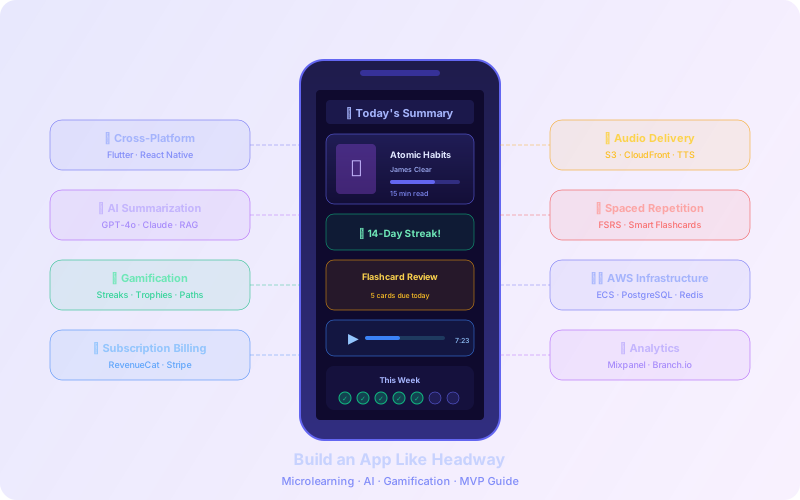
This guide breaks down exactly what makes Headway work, the features you need for an MVP, the tech stack decisions, AI capabilities that can differentiate your product, how much it costs, and how Lushbinary can help you ship it.
📋 Table of Contents
- 1.What Makes Headway So Successful
- 2.Headway's Revenue Model & Business Strategy
- 3.Core Features You Need for an MVP
- 4.System Architecture & Tech Stack
- 5.AI-Powered Features That Differentiate
- 6.Content Pipeline: The Hidden Challenge
- 7.Gamification & Retention Mechanics
- 8.Subscription Billing & Monetization
- 9.Development Cost & Timeline Breakdown
- 10.Why Lushbinary for Your Microlearning MVP
1What Makes Headway So Successful
Headway isn't just a book summary app — it's a habit-formation engine disguised as a learning platform. Understanding why it works is essential before you build a competitor. Here's what sets it apart from Blinkist, Shortform, and dozens of other summary services.
Behavioral Psychology at the Core
Headway uses gamification, streaks, challenges, and spaced repetition flashcards to turn passive reading into an active daily habit. The app doesn't just deliver content — it uses behavioral nudges to make users come back every day. This is the single biggest reason Headway outperforms competitors on retention.
Content Quality & Format
With over 2,500 book summaries available in both text and professionally narrated audio formats, Headway covers categories from productivity and business to psychology and relationships. Each summary is designed to be consumed in 15 minutes — short enough for a commute, long enough to deliver real value. The content is produced in-house by a global team of writers, editors, and voice actors.
Multi-Product Portfolio
Headway expanded beyond book summaries into a "house of brands" strategy with five products: the flagship Headway app, Impulse (brain games), Nibble (STEM lessons for older adults), AddMile (life coaching), and Skillsta (social skills). This diversification reduces churn risk and increases lifetime value per user.
Aggressive Growth Loops
Headway's onboarding quiz is a conversion machine. New users answer questions about their goals, reading habits, and interests before seeing any content. This serves two purposes: it personalizes the experience (increasing activation) and it creates a sunk-cost effect that makes users more likely to subscribe. Combined with dynamic pricing that adjusts based on user signals, this funnel drives industry-leading conversion rates.
| Metric | Headway |
|---|---|
| Founded | 2019 (Kyiv, Ukraine) |
| Total Users | 160M+ across portfolio |
| Book Summaries | 2,500+ |
| Revenue (est.) | $160M annually |
| Valuation (est.) | $720M (late 2025) |
| Team Size | 170+ people |
| Products | 5 (Headway, Impulse, Nibble, AddMile, Skillsta) |
| Languages | English, Spanish, Portuguese, French, Italian, German |
2Headway's Revenue Model & Business Strategy
Understanding how Headway monetizes is critical for building your own version. Their revenue engine has three pillars.
Freemium Subscription Model
The free tier gives users one book summary per day — enough to build the habit, not enough to satisfy the appetite. Premium unlocks the full library, offline downloads, and interactive features. Current pricing as of April 2026 (source):
| Plan | Price | Best For |
|---|---|---|
| Monthly | $12.99/month | Short-term flexibility |
| Quarterly | $29.99/3 months | Testing the app for a season |
| Annual | $89.99/year (~$7.50/mo) | Maximum value |
| Free | Always available | One summary per day |
Dynamic Pricing & Personalized Onboarding
Headway doesn't show the same price to every user. Their onboarding quiz collects data about goals, reading habits, and willingness to invest in self-improvement. This data feeds into a dynamic pricing algorithm that adjusts offers based on user signals — a strategy that significantly boosts conversion rates compared to static pricing pages.
Headway for Business (B2B)
Headway also offers a B2B product with tailored corporate summary collections and analytical dashboards. This is a smart revenue diversification play — enterprise contracts provide predictable revenue and higher lifetime value than individual subscriptions. If you're building a Headway alternative, consider B2B as a Phase 2 revenue stream.
💡 Key Takeaway
Headway's real moat isn't the content — it's the conversion funnel. The onboarding quiz, dynamic pricing, and gamification loop work together to convert free users into paying subscribers at rates that fund aggressive paid acquisition. Your MVP needs to nail this funnel from day one.
3Core Features You Need for an MVP
You don't need to replicate all 2,500 summaries and five products on day one. Here's the feature set for a viable microlearning MVP that validates your market hypothesis.
Phase 1: Lean MVP (3-4 months)
- Content Library — 50-100 book summaries in text format, covering 3-5 popular categories (productivity, business, psychology)
- Audio Summaries — Professionally narrated audio versions with playback controls (speed adjustment, skip forward/back, background playback)
- User Onboarding — Goal-selection quiz that personalizes the content feed and creates investment in the product
- Reading/Listening Interface — Clean, distraction-free reader with progress tracking, bookmarks, and highlights
- Daily Streaks — Basic gamification with streak counters and daily reminders to build the habit loop
- Push Notifications — Smart reminders based on user activity patterns to drive daily engagement
- Subscription Billing — Freemium model with free daily summary + premium unlock via Stripe or RevenueCat
- Offline Downloads — Allow premium users to download summaries for offline reading/listening
- User Accounts — Email/social login with progress sync across devices
Phase 2: Differentiation (2-3 months)
- Spaced Repetition Flashcards — Interactive flashcards that reinforce key insights using SM-2 or FSRS algorithms
- Gamification System — Challenges, trophies, leaderboards, and learning paths to boost retention
- Curated Collections — Themed collections (e.g., "Become a Better Leader," "Master Your Finances") with guided learning paths
- Daily Insights — Bite-sized wisdom cards delivered daily, separate from full summaries
- Multi-Language Support — Expand to Spanish, Portuguese, French to reach global markets
- Social Features — Share highlights, recommend summaries to friends, reading clubs
Phase 3: AI & Scale (3-4 months)
- AI-Powered Summarization — Use LLMs to accelerate content production while maintaining editorial quality
- Personalized Recommendations — ML-driven content suggestions based on reading history and goals
- Interactive Q&A — Let users ask questions about a book and get AI-generated answers grounded in the summary
- Voice Interaction — Conversational AI that discusses book concepts with the user
- B2B Dashboard — Corporate accounts with team analytics, curated collections, and admin controls
- Dynamic Pricing Engine — A/B tested pricing with personalized offers based on onboarding data
4System Architecture & Tech Stack
A microlearning app like Headway has four major technical layers: mobile clients, API backend, content delivery, and data storage. Here's the architecture we'd recommend for a production build.
Recommended Tech Stack
| Layer | Technology | Why |
|---|---|---|
| Mobile | Flutter 3.41 / React Native 0.84 | Cross-platform from a single codebase; Flutter for design-heavy UX, RN for JS teams |
| Backend API | Node.js 22 + Express or Fastify | Fast JSON APIs, excellent ecosystem, easy to hire for |
| Database | PostgreSQL 17 | Relational data for users, content, progress; JSONB for flexible metadata |
| Cache / Streaks | Redis 7 | Sub-millisecond streak checks, session storage, leaderboard sorted sets |
| Audio / Media | AWS S3 + CloudFront | Global CDN delivery for audio files; low latency, pay-per-use |
| Search | Elasticsearch or Meilisearch | Full-text search across summaries, tags, and categories |
| Auth | Clerk / Auth.js / AWS Cognito | Social login, email/password, JWT tokens, device sync |
| Billing | RevenueCat + Stripe | RevenueCat handles App Store/Play Store subscriptions; Stripe for web |
| Push Notifications | Firebase Cloud Messaging + APNs | Cross-platform push with scheduling and segmentation |
| AI Layer | OpenAI GPT-4o / Claude Opus 4.6 | Content summarization, personalization, interactive Q&A |
| Hosting | AWS ECS Fargate or Vercel | Auto-scaling containers; Vercel for Next.js web frontend |
📱 Flutter vs React Native for Microlearning
For a Headway-style app, Flutter is the stronger choice. The Impeller rendering engine in Flutter 3.41 delivers smooth 120fps animations for gamification elements, and Dart's ahead-of-time compilation gives you near-native audio playback performance. React Native 0.84 with the New Architecture (Fabric + TurboModules) is viable if your team is JavaScript-first, but Flutter's pixel-perfect control over custom UI components gives it the edge for design-heavy learning apps. Read our Flutter developer hiring guide for more.
5AI-Powered Features That Differentiate
Headway was built before the LLM revolution. A new entrant in 2026 can leverage AI capabilities that didn't exist when Headway launched in 2019. This is your biggest differentiation opportunity.
AI-Assisted Content Summarization
Headway produces all content in-house with limited AI assistance. You can use GPT-4o or Claude Opus 4.6 to generate first-draft summaries from full book text, then have human editors refine them. This hybrid approach can cut content production time by 60-70% while maintaining quality. Use structured outputs to ensure consistent formatting: key takeaways, chapter breakdowns, actionable insights, and flashcard-ready Q&A pairs.
Personalized Learning Paths
Go beyond Headway's static collections. Use embedding-based similarity search to recommend summaries based on what a user has read, highlighted, and quizzed on. Build a recommendation engine that adapts in real-time: if a user reads three productivity books, suggest a psychology book that complements those concepts rather than another productivity title.
Interactive Book Q&A
After reading a summary, let users ask questions: "How does this apply to managing a remote team?" or "What's the difference between this author's approach and the one in Atomic Habits?" Use RAG (Retrieval-Augmented Generation) with the summary content as context to generate grounded, accurate answers. This turns passive consumption into active learning.
AI-Generated Audio with Voice Cloning
Professional voice narration is expensive ($200-$500 per summary). Modern text-to-speech models like ElevenLabs and OpenAI TTS produce natural-sounding audio that's nearly indistinguishable from human narration. Use AI-generated audio for your initial library, then invest in professional narration for top-performing summaries. This can reduce audio production costs by 80-90%.
Smart Spaced Repetition
Headway uses basic spaced repetition flashcards. You can build an AI-enhanced version that generates flashcards automatically from summary content, adjusts review intervals based on individual performance patterns, and creates contextual questions that test understanding rather than rote memorization. The FSRS (Free Spaced Repetition Scheduler) algorithm, used by Anki, is open-source and significantly outperforms the older SM-2 algorithm.
AI Summarization
GPT-4o/Claude generates first drafts; human editors refine. 60-70% faster content production.
Personalized Recommendations
Embedding-based similarity search adapts to reading history and goals in real-time.
Interactive Q&A
RAG-powered conversations about book concepts. Active learning, not passive consumption.
AI Audio Narration
ElevenLabs/OpenAI TTS for 80-90% cost reduction on audio production.
Smart Flashcards
Auto-generated from content with FSRS scheduling. Contextual questions, not rote memorization.
Dynamic Pricing
ML model optimizes subscription offers based on onboarding quiz signals and user behavior.
6Content Pipeline: The Hidden Challenge
The biggest mistake founders make when building a Headway alternative is underestimating the content pipeline. The app is only as good as its library. Here's how to approach content production strategically.
Content Production Workflow
- Book Selection — Curate titles based on bestseller lists, user requests, and category gaps. Start with evergreen non-fiction that has proven demand.
- Rights & Licensing — Book summaries generally fall under fair use / fair dealing, but consult legal counsel. You're summarizing ideas, not reproducing text. Some publishers offer licensing deals for summary platforms.
- AI First Draft — Feed the full book text into GPT-4o or Claude with a structured prompt that extracts key takeaways, chapter summaries, actionable insights, and flashcard Q&A pairs.
- Human Editorial Review — Editors verify accuracy, improve readability, add context, and ensure the summary captures the book's core value proposition.
- Audio Production — Generate audio with ElevenLabs or OpenAI TTS for the initial library. Invest in professional narration for top-performing titles.
- Flashcard Generation — Auto-generate spaced repetition cards from the summary, then have editors curate the best 5-10 cards per book.
- Quality Assurance — Fact-check claims, verify attributions, test audio playback, and validate the reading experience on both iOS and Android.
Content Cost Estimates
| Item | Cost per Summary | Notes |
|---|---|---|
| AI Draft + Human Edit | $50-$150 | AI generates 80% of draft; editor refines |
| Professional Narration | $200-$500 | 15-min audio with professional voice actor |
| AI-Generated Audio | $5-$15 | ElevenLabs/OpenAI TTS; near-human quality |
| Flashcard Curation | $20-$40 | AI generates, editor curates 5-10 cards |
| Total (AI Audio) | $75-$205 | Per summary with AI-generated audio |
| Total (Pro Audio) | $270-$690 | Per summary with professional narration |
For a 100-summary MVP library using AI-generated audio, budget $7,500-$20,500 for content production. This is separate from development costs but runs in parallel with engineering work.
7Gamification & Retention Mechanics
Gamification is what separates Headway from a simple book summary website. It's the engine that turns one-time readers into daily users. Here's how to implement it properly.
Streak System
Daily streaks are the simplest and most effective retention mechanic. Track consecutive days of activity (reading a summary, completing flashcards, or listening to audio). Use Redis sorted sets for real-time streak tracking with sub-millisecond reads. Send push notifications when a streak is about to break ("You're on a 14-day streak! Don't lose it."). Offer "streak freeze" tokens as a premium feature.
Challenges & Trophies
Create time-bound challenges ("Read 5 summaries this week") and permanent achievements ("Completed 100 summaries"). Trophies provide a sense of progression and give users something to show off. Store challenge progress in PostgreSQL with a user_challenges table that tracks completion percentage and timestamps.
Learning Paths
Curated sequences of summaries around a theme ("Become a Better Negotiator" = 8 books in order). Paths give users a clear goal and a sense of completion. Track progress with a progress bar and celebrate completion with a certificate or badge.
Leaderboards
Weekly leaderboards based on summaries read, flashcards completed, or streak length. Use Redis sorted sets for real-time ranking. Keep leaderboards small (top 50 or friend-only) to avoid discouraging new users. Reset weekly to give everyone a fresh start.
Daily Insights
Short, shareable wisdom cards delivered daily — a single quote or insight from a book, designed for social sharing. These serve as both a retention hook (users open the app to see today's insight) and a growth loop (shared insights drive organic acquisition).
🎯 Retention Benchmark
Headway's gamification drives significantly higher retention than competitors like Blinkist. For your MVP, target Day 7 retention of 25-30% and Day 30 retention of 15-20%. Streaks alone can improve Day 30 retention by 40-60% compared to apps without them. Track these metrics from day one using Mixpanel or a similar analytics platform.
8Subscription Billing & Monetization
Getting billing right is critical for a subscription-based app. Mobile app stores take a 15-30% commission, so your billing architecture needs to handle both in-app purchases and web-based subscriptions.
RevenueCat for Mobile Subscriptions
RevenueCat is the industry standard for managing App Store and Google Play subscriptions. It handles receipt validation, subscription status tracking, cross-platform entitlements, and analytics. At $0 for the first $2,500/month in tracked revenue, it's free for most MVPs. Read our RevenueCat integration guide for implementation details.
Stripe for Web Subscriptions
For web-based subscriptions (which avoid the 30% App Store commission), use Stripe Billing. Offer a web checkout option that gives users a lower price — this is a common strategy to maximize revenue. Stripe's 2.9% + $0.30 fee is significantly cheaper than Apple's 15-30% cut.
Recommended Pricing Strategy
Based on Headway's pricing and the competitive landscape, here's a starting point for your MVP:
| Tier | Price | Includes |
|---|---|---|
| Free | $0 | 1 summary/day, basic streaks, limited flashcards |
| Premium Monthly | $9.99/mo | Unlimited library, offline downloads, all gamification |
| Premium Annual | $59.99/yr ($5/mo) | Everything in monthly + priority new content |
| AI Pro Monthly | $14.99/mo | Premium + interactive Q&A, AI recommendations, voice mode |
| Team / B2B | Custom | Admin dashboard, curated collections, analytics |
Price slightly below Headway ($12.99/mo) to attract price-sensitive users, then differentiate on AI features at the higher tier. The annual plan should offer at least 50% savings over monthly to drive long-term commitment. Use A/B testing from launch to optimize pricing — even small changes can have outsized impact on conversion.
9Development Cost & Timeline Breakdown
Here's a realistic cost breakdown for building a microlearning app like Headway, from lean MVP to full-featured platform. These estimates assume a dedicated development team (2-3 engineers, 1 designer, 1 PM) working with a partner like Lushbinary.
| Phase | Scope | Cost | Timeline |
|---|---|---|---|
| Discovery & Design | UX research, wireframes, visual design, content strategy | $10K-$20K | 2-3 weeks |
| MVP Core | Content library, reader/player, auth, onboarding, streaks, push notifications | $40K-$70K | 8-10 weeks |
| Subscription Billing | RevenueCat + Stripe integration, paywall, free trial flow | $8K-$15K | 2-3 weeks |
| Gamification | Challenges, trophies, leaderboards, learning paths, flashcards | $20K-$35K | 3-4 weeks |
| AI Features | AI summarization pipeline, personalized recommendations, interactive Q&A | $25K-$45K | 4-6 weeks |
| Audio System | Audio player, offline downloads, background playback, speed controls | $12K-$20K | 2-3 weeks |
| Polish & Launch | App Store optimization, performance tuning, beta testing, launch prep | $10K-$20K | 2-3 weeks |
💰 Budget MVP
$40K-$80K
3-4 months. Core library, reader/player, auth, streaks, billing. Enough to validate the market.
🚀 Full Platform
$150K-$300K
6-10 months. All features including AI, gamification, audio, multi-language, and B2B dashboard.
Ongoing Monthly Costs
| Item | Early Stage | Growth (10K users) |
|---|---|---|
| AWS Hosting | $100-$300 | $500-$1,500 |
| S3 + CloudFront (Audio CDN) | $50-$150 | $300-$800 |
| AI API Costs | $50-$200 | $500-$2,000 |
| RevenueCat | $0 (free tier) | $0-$100 |
| Push Notifications (FCM) | $0 | $0 |
| Monitoring (Datadog/Sentry) | $0-$50 | $50-$200 |
| Total | $200-$700/mo | $1,350-$4,600/mo |
Content production is an additional ongoing cost. Budget $5,000-$15,000 per month for 30-50 new summaries using the AI-assisted pipeline described in Section 6. This scales with your library growth targets.
10Why Lushbinary for Your Microlearning MVP
Building a microlearning app like Headway requires expertise across mobile development, backend architecture, AI integration, content delivery, and subscription billing. Lushbinary has shipped production apps across all of these domains.
- Cross-Platform Mobile — We build with Flutter and React Native, delivering pixel-perfect apps for iOS and Android from a single codebase. See our Flutter development expertise.
- AI Integration — We've built production AI systems with GPT-4o, Claude, and open-source models. From RAG pipelines to content summarization, we know how to make AI reliable at scale.
- Subscription Billing — We've integrated RevenueCat and Stripe for multiple production apps, handling the complexity of cross-platform entitlements, free trials, and paywall optimization. Read our RevenueCat guide.
- AWS Infrastructure — We design and deploy scalable cloud architectures on AWS, from ECS Fargate to S3 + CloudFront CDN for audio delivery. Check our AWS cost optimization guide.
- Analytics & Growth — We integrate Mixpanel, Branch.io, and custom analytics to track retention, conversion, and engagement from day one.
- App Store Launch — We handle the full iOS App Store and Google Play submission process, including ASO, screenshots, and review compliance. See our App Store submission guide.
🚀 Ready to Build Your Microlearning App?
Book a free 30-minute consultation with our team. We'll review your concept, recommend the right MVP scope, and give you a realistic timeline and budget. No commitment, no sales pitch — just honest technical advice from people who've built this before.
❓ Frequently Asked Questions
How much does it cost to build an app like Headway?
A lean MVP costs $40,000-$80,000 over 3-4 months. A full-featured platform with AI, gamification, and cross-platform mobile apps ranges from $150,000-$300,000 over 6-10 months. Content production is an additional $7,500-$20,500 for a 100-summary initial library.
What tech stack should I use to build a microlearning app like Headway?
Flutter 3.41 or React Native 0.84 for mobile, Node.js for the backend, PostgreSQL for data, Redis for caching and streaks, S3 + CloudFront for audio delivery, RevenueCat + Stripe for billing, and GPT-4o or Claude for AI features.
What are the core features needed for a Headway-like MVP?
Book summaries (text + audio), user onboarding quiz, reading/listening interface with progress tracking, daily streaks, push notifications, freemium subscription billing, and offline downloads. Start with 50-100 summaries across 3-5 categories.
How does Headway make money?
Freemium subscriptions: free tier with 1 summary/day, premium at $12.99/month or $89.99/year. They also use dynamic pricing based on onboarding quiz data and offer a B2B product for corporate teams. Estimated $160M annual revenue.
How long does it take to build an MVP for a microlearning app?
3-4 months for a lean MVP with core features. 6-8 months for a differentiated product with AI and gamification. Content production runs in parallel and is often the longest lead-time item.
📚 Sources
- Headway Plans and Pricing — Official pricing page
- How Does Headway Make Money? Revenue Model Explained — Revenue and valuation estimates
- Microlearning Market Size & Share 2026-2032 — Market size and CAGR data
- What Is the Headway App and How Does It Work? — Official feature overview
Content was rephrased for compliance with licensing restrictions. Pricing sourced from official Headway pricing page as of April 2026. Market data sourced from Research and Markets. Revenue and valuation estimates sourced from third-party analysis. All figures may change — always verify on the vendor's website.
Build Your Microlearning App With Lushbinary
From MVP to scale — we handle mobile development, AI integration, content delivery, and subscription billing so you can focus on building a library your users love.
Build Smarter, Launch Faster.
Book a free strategy call and explore how LushBinary can turn your vision into reality.