
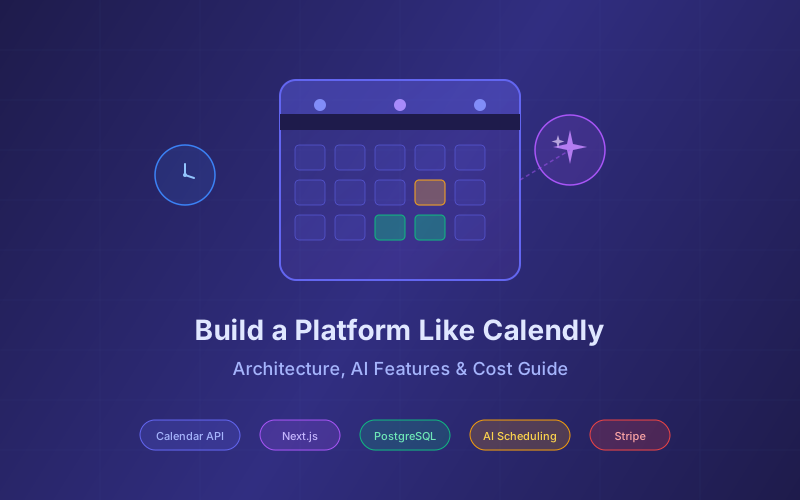
Calendly is a $3 billion company with over 20 million users and 86% Fortune 500 adoption. It turned a simple idea — "share a link, let people book time" — into a scheduling empire. But behind that simplicity lies a mountain of engineering: timezone math, calendar sync conflicts, team routing logic, payment processing, and now AI-powered scheduling assistants.
The problem? Calendly's users are increasingly vocal about its limitations. The free plan restricts you to a single event type. Per-seat pricing climbs fast for teams. The mobile app feels like a web wrapper. There's no invoicing, no CRM, no project management. And the recent UI redesigns have frustrated long-time users who find the new layout "cluttered" and "harder to navigate."
If you're a founder or product team thinking about building a scheduling platform — whether it's a Calendly competitor, a niche vertical scheduler, or an AI-native booking system — this guide covers everything: the core architecture, the features users actually want, the limitations you can exploit, the tech stack, realistic cost estimates, and how AI changes the game in 2026.
📋 Table of Contents
- 1.Calendly by the Numbers: Market & Revenue
- 2.Core Features Every Scheduling Platform Needs
- 3.What Users Actually Complain About
- 4.Most-Requested Features from Reddit, Reviews & Forums
- 5.System Architecture for a Calendly-Like Platform
- 6.Tech Stack Recommendations
- 7.Calendar Integration Deep Dive
- 8.AI-Powered Scheduling: The 2026 Differentiator
- 9.Database Design & Data Model
- 10.Development Cost & Timeline Estimates
- 11.Monetization Strategy
- 12.Why Lushbinary Is the Right Partner to Build This
1Calendly by the Numbers: Market & Revenue
Before building a competitor, you need to understand what you're up against. Calendly isn't just a scheduling tool — it's a category-defining product with serious network effects.
| Metric | Value |
|---|---|
| Valuation (2021) | $3 billion |
| Estimated ARR (2025) | $350M+ |
| Monthly active users | 20M+ across 230 countries |
| Fortune 500 adoption | 86% |
| Market share (scheduling) | ~12% |
| Total funding raised | $350M+ |
| Founded | 2013 (Atlanta, GA) |
The online appointment scheduling market is projected to reach $1.3 billion by 2028, growing at roughly 13% CAGR. Calendly holds the largest share, but the market is fragmented — Cal.com, Acuity Scheduling, SavvyCal, Doodle, SimplyBook.me, and dozens of vertical-specific tools all compete for different segments.
💡 Key Insight
Calendly's biggest moat isn't technology — it's distribution. Every time someone shares a Calendly link, the recipient sees the brand. This viral loop drove most of their early growth. Your platform needs a similar built-in distribution mechanism.
2Core Features Every Scheduling Platform Needs
Based on Calendly's feature set and what users expect from any modern scheduling tool, here are the non-negotiable features for an MVP and the features that differentiate a premium product:
🟢 MVP Features (Must-Have)
- Shareable booking links — unique URLs per event type that anyone can use to book time
- Calendar sync — two-way sync with Google Calendar, Outlook/Microsoft 365, and Apple Calendar to prevent double-booking
- Timezone detection & conversion — automatic detection of the booker's timezone with clear display of available slots
- Event types — configurable meeting durations (15, 30, 45, 60 min), buffer times, and availability windows
- Email notifications — confirmation emails, reminders (24h, 1h before), and cancellation/reschedule flows
- Availability rules — recurring weekly schedules, date-specific overrides, and minimum scheduling notice
- Video conferencing integration — auto-generate Zoom, Google Meet, or Microsoft Teams links
- Embed widget — inline or popup embed for websites
- Mobile-responsive booking page — the booking experience must work flawlessly on phones
🔵 Growth Features (Differentiation)
- Team scheduling — round-robin assignment, collective availability (find a time when all team members are free), and routing forms
- Payment collection — Stripe/PayPal integration for paid consultations, deposits, or class bookings
- Custom branding — white-label booking pages with custom colors, logos, and domains
- Workflows & automations — automated follow-up emails, SMS reminders, pre-meeting questionnaires
- CRM integration — Salesforce, HubSpot, Pipedrive sync for sales teams
- Analytics dashboard — booking rates, popular times, no-show rates, conversion funnels
- Group events — webinars, classes, or group sessions with attendee limits
- Recurring meetings — weekly 1:1s, monthly check-ins with automatic rebooking
- Single-use links — one-time booking URLs that expire after use (heavily requested by Calendly users)
- API & webhooks — developer-friendly REST API for custom integrations
🟣 AI-Era Features (2026 Differentiators)
- AI scheduling assistant — natural language booking via chat or email ("Find me 30 minutes with Sarah next week")
- Smart availability optimization — AI analyzes calendar patterns to suggest optimal meeting times and protect focus blocks
- No-show prediction — ML model that predicts likelihood of no-shows and sends targeted reminders
- Conversational booking — AI agent that negotiates times via email, Slack, or SMS without requiring a link
- Meeting prep summaries — AI-generated briefings before each meeting based on CRM data and past interactions
3What Users Actually Complain About
Understanding Calendly's pain points is your competitive advantage. We analyzed reviews from G2, Capterra, Gartner, the Calendly Community forums, Reddit, and the App Store to identify the most common frustrations:
| Complaint | Frequency | Your Opportunity |
|---|---|---|
| Free plan limited to 1 event type | Very High | Generous free tier (3-5 event types) |
| Per-seat pricing too expensive for teams | High | Team-based pricing, not per-seat |
| Mobile app is a web wrapper with limited utility | High | Native mobile app with full functionality |
| UI redesign made navigation worse | High | Clean, stable UI with user-tested changes |
| No built-in invoicing or payments on lower tiers | Medium | Stripe payments on all plans |
| Google Calendar sync issues / doesn't reflect availability | Medium | Robust real-time calendar sync |
| Single-use links are clunky (3+ clicks) | Medium | One-click single-use link generation |
| No monthly calendar view | Medium | Full calendar view with day/week/month |
| GDPR concerns (US-hosted data) | Medium | EU hosting option / self-hosted option |
| Limited customization on lower tiers | Medium | Custom branding on all paid plans |
| No client portal or project management | Low-Med | Optional client portal add-on |
⚠️ The UI Redesign Backlash
Calendly's community forums are filled with complaints about their 2025-2026 UI redesign. Users describe the new layout as "cluttered," "harder to navigate," and "a significant step backward in usability." Multiple threads with hundreds of replies show deep frustration. This is a real opening for a competitor with a cleaner, more intuitive interface.
4Most-Requested Features from Reddit, Reviews & Forums
Beyond complaints, users actively request features that Calendly hasn't delivered. These represent the highest-value opportunities for a new platform:
Scheduling Override
Ability to manually override availability rules for specific bookings without changing global settings. Heavily requested on Calendly Community.
Bulk Single-Use Links
Generate batches of 10-50 single-use booking links at once. Nonprofits and recruiting teams need this for applicant scheduling.
Multi-Calendar Booking Identity
Book meetings using different email identities (e.g., freelancers with multiple client emails) instead of always defaulting to the primary account.
AI-Powered Scheduling
Natural language scheduling via email or chat. Calendly launched an AI assistant in early 2026, but users want deeper integration.
Advanced Analytics
Booking conversion rates, optimal time analysis, no-show patterns, and revenue attribution for paid bookings.
GDPR-Compliant Hosting
EU data residency option. Calendly stores all data on US servers, which is a dealbreaker for some European businesses.
Real Native Mobile App
A fully functional mobile app — not a web wrapper. Users want to manage availability, view bookings, and create event types natively.
Invoicing & Contracts
Built-in invoicing, proposals, and contract signing. Freelancers want an all-in-one client management tool, not just scheduling.
The pattern is clear: Calendly excels at simple one-on-one scheduling but struggles with complex workflows, team coordination, and the broader business context around meetings. A platform that solves scheduling and the surrounding workflow has a real market opportunity.
5System Architecture for a Calendly-Like Platform
A production scheduling platform has more moving parts than most people expect. Here's the high-level architecture you need:
The architecture follows a service-oriented pattern where each concern is isolated. The Scheduling Engine is the heart — it manages availability computation, conflict detection, and booking creation. The Calendar Sync service handles the complexity of two-way sync with external calendars. The AI Scheduling Assistant is the 2026 differentiator that enables conversational booking.
For a startup MVP, you can start with a monolithic Node.js/Next.js application and extract services as you scale. Don't over-engineer the architecture on day one.
6Tech Stack Recommendations
Here's the tech stack we recommend at Lushbinary for building a production scheduling platform in 2026, based on our experience shipping similar products:
| Layer | Technology | Why |
|---|---|---|
| Frontend (Web) | Next.js 15 + React 19 + Tailwind CSS | SSR for SEO, App Router, server components for booking pages |
| Frontend (Mobile) | Flutter 3.41 or React Native | Cross-platform iOS/Android with native performance |
| Backend API | Node.js 22 + Express/Fastify or Next.js API Routes | TypeScript end-to-end, excellent calendar library ecosystem |
| Database | PostgreSQL 17 (via Supabase or AWS RDS) | JSONB for flexible event metadata, strong timezone support |
| Cache / Real-time | Redis 7 (via Upstash or ElastiCache) | Availability caching, session management, pub/sub for real-time updates |
| Auth | Clerk, Auth.js, or AWS Cognito | OAuth 2.0 for Google/Microsoft calendar permissions |
| Calendar Sync | Google Calendar API v3 + Microsoft Graph API | Official APIs with webhook push notifications |
| Video Conferencing | Zoom API + Google Meet API + Teams API | Auto-generate meeting links on booking |
| Payments | Stripe Connect | Marketplace payments, per-booking charges, subscriptions |
| Email / SMS | AWS SES + Twilio or Resend | Transactional emails, SMS reminders |
| AI Layer | OpenAI GPT-4o / Claude Opus 4.6 API | Natural language scheduling, meeting prep, no-show prediction |
| Hosting | AWS (ECS Fargate) or Vercel + PlanetScale | Auto-scaling, global edge for booking pages |
| CI/CD | GitHub Actions | Automated testing, deployment, and preview environments |
💡 Cal.com as a Starting Point?
Cal.com is an open-source scheduling platform (AGPL-3.0 license for the core, with commercial licenses available) built with Next.js, Prisma, and PostgreSQL. It offers self-hosting, unlimited event types on the free plan, and a robust API. If your goal is to launch quickly and customize later, forking Cal.com and building your differentiating features on top is a viable strategy. The managed cloud version starts at $15/seat/month.
7Calendar Integration Deep Dive
Calendar integration is the hardest part of building a scheduling platform. It's where most teams underestimate complexity. Here's what you need to handle:
Google Calendar API v3
- OAuth 2.0 consent — users grant access to their calendar via Google's OAuth flow. You need the
calendar.eventsandcalendar.readonlyscopes. - Push notifications (webhooks) — Google Calendar supports push notifications via
watchchannels. When a user's calendar changes, Google sends a POST to your webhook endpoint. This is how you detect external bookings in near-real-time. - FreeBusy API — query availability across multiple calendars without reading event details (privacy-friendly).
- Token refresh — OAuth tokens expire. You must handle refresh token rotation and store tokens securely (encrypted at rest).
Microsoft Graph API (Outlook / Microsoft 365)
- OAuth 2.0 with MSAL — Microsoft uses MSAL (Microsoft Authentication Library) for OAuth. The scopes are
Calendars.ReadWriteandCalendars.Read. - Change notifications (subscriptions) — similar to Google's push notifications. You create a subscription on the
/me/eventsresource and receive webhook callbacks on changes. - Batching — Microsoft Graph supports JSON batching for multiple API calls in a single request, which is critical for team scheduling.
⚠️ The Hard Parts
- Timezone handling — store everything in UTC internally. Use
Intl.DateTimeFormator libraries likedate-fns-tzorluxonfor display. Never trust the client's timezone detection alone — always confirm. - Conflict resolution — when two people try to book the same slot simultaneously, you need database-level locking (PostgreSQL
SELECT ... FOR UPDATE) or optimistic concurrency control. - Recurring events — Google and Microsoft represent recurring events differently. You need to expand recurrence rules (RRULE) into individual instances for availability calculation.
- Multi-calendar aggregation — users often have 3-6 calendars (work, personal, shared team calendars). You must aggregate availability across all of them.
- Webhook reliability — Google and Microsoft webhooks can be delayed or missed. Implement periodic polling as a fallback (every 5-10 minutes).
// Simplified availability computation (pseudocode)
async function getAvailableSlots(userId, date, duration) {
  // 1. Fetch user's availability rules
  const rules = await getAvailabilityRules(userId);

  // 2. Generate candidate slots from rules
  const candidates = generateSlots(rules, date, duration);

  // 3. Fetch busy times from all connected calendars
  const busyTimes = await Promise.all([
    getGoogleBusyTimes(userId, date),
    getMicrosoftBusyTimes(userId, date),
    getInternalBookings(userId, date),
  ]);

  // 4. Merge and flatten busy periods
  const merged = mergeBusyPeriods(busyTimes.flat());

  // 5. Filter out conflicting slots + buffer times
  return candidates.filter(slot =>
    !hasConflict(slot, merged, bufferMinutes)
  );
}8AI-Powered Scheduling: The 2026 Differentiator
AI is the single biggest opportunity to differentiate from Calendly in 2026. While Calendly recently launched a basic AI assistant for conversational scheduling, the technology is still early and there's massive room for innovation. Here are the AI features that matter:
🤖 Conversational Scheduling Agent
Instead of sharing a link, users can tell their AI assistant: "Schedule a 30-minute call with [name] next Tuesday afternoon." The agent checks both parties' availability, proposes times, handles back-and-forth negotiation via email or Slack, and books the meeting — all without either person visiting a booking page.
// AI scheduling agent with function calling
const tools = [
  {
    name: "check_availability",
    description: "Check available time slots for a user",
    parameters: {
      userId: "string",
      dateRange: { start: "ISO8601", end: "ISO8601" },
      duration: "number (minutes)",
    },
  },
  {
    name: "create_booking",
    description: "Book a meeting slot",
    parameters: {
      hostId: "string",
      guestEmail: "string",
      startTime: "ISO8601",
      duration: "number",
      title: "string",
    },
  },
  {
    name: "send_scheduling_email",
    description: "Send time proposals to a guest",
    parameters: {
      to: "string",
      proposedTimes: "ISO8601[]",
      context: "string",
    },
  },
];
🧠 Smart Availability Optimization
AI analyzes a user's calendar patterns over time and makes intelligent suggestions:
- Focus time protection — automatically blocks deep work periods based on historical patterns
- Meeting clustering — groups meetings together to create longer uninterrupted blocks
- Energy-aware scheduling — suggests high-stakes meetings during peak energy hours (morning for most people)
- Travel time buffers — adds automatic buffers for in-person meetings based on location
📉 No-Show Prediction & Prevention
A machine learning model trained on booking data can predict no-show likelihood based on factors like:
- Time between booking and meeting (longer gaps = higher no-show risk)
- Day of week and time of day patterns
- Guest's historical no-show rate
- Whether the guest opened the confirmation email
- Free vs. paid bookings (paid bookings have 3-5x lower no-show rates)
High-risk bookings trigger additional reminders, require confirmation 24 hours before, or prompt the host to send a personal message.
📝 Meeting Prep Summaries
Before each meeting, the AI generates a brief with: who the guest is (LinkedIn data, CRM notes), what was discussed in previous meetings, relevant documents or emails, and suggested talking points. This turns your scheduling tool into a productivity platform.
9Database Design & Data Model
The data model is the foundation of your scheduling platform. Here's a simplified schema for the core entities:
-- Core tables for a scheduling platform

CREATE TABLE users (
  id            UUID PRIMARY KEY DEFAULT gen_random_uuid(),
  email         VARCHAR(255) UNIQUE NOT NULL,
  name          VARCHAR(255) NOT NULL,
  timezone      VARCHAR(50) DEFAULT 'UTC',
  slug          VARCHAR(100) UNIQUE NOT NULL,  -- calendly.com/slug
  plan          VARCHAR(20) DEFAULT 'free',
  created_at    TIMESTAMPTZ DEFAULT NOW()
);

CREATE TABLE event_types (
  id            UUID PRIMARY KEY DEFAULT gen_random_uuid(),
  user_id       UUID REFERENCES users(id),
  title         VARCHAR(255) NOT NULL,
  slug          VARCHAR(100) NOT NULL,
  duration      INTEGER NOT NULL,  -- minutes
  buffer_before INTEGER DEFAULT 0,
  buffer_after  INTEGER DEFAULT 0,
  color         VARCHAR(7),
  is_active     BOOLEAN DEFAULT true,
  max_per_day   INTEGER,
  min_notice     INTEGER DEFAULT 60,  -- minutes
  scheduling_window INTEGER DEFAULT 60,  -- days ahead
  location_type VARCHAR(50),  -- zoom, google_meet, phone, etc.
  questions     JSONB DEFAULT '[]',  -- custom intake questions
  UNIQUE(user_id, slug)
);

CREATE TABLE availability_rules (
  id            UUID PRIMARY KEY DEFAULT gen_random_uuid(),
  user_id       UUID REFERENCES users(id),
  name          VARCHAR(100) DEFAULT 'Working Hours',
  rules         JSONB NOT NULL,  -- weekly schedule + overrides
  is_default    BOOLEAN DEFAULT false
);

CREATE TABLE bookings (
  id            UUID PRIMARY KEY DEFAULT gen_random_uuid(),
  event_type_id UUID REFERENCES event_types(id),
  host_id       UUID REFERENCES users(id),
  guest_email   VARCHAR(255) NOT NULL,
  guest_name    VARCHAR(255),
  guest_timezone VARCHAR(50),
  start_time    TIMESTAMPTZ NOT NULL,
  end_time      TIMESTAMPTZ NOT NULL,
  status        VARCHAR(20) DEFAULT 'confirmed',
  meeting_url   VARCHAR(500),
  payment_id    VARCHAR(255),
  answers       JSONB DEFAULT '{}',
  cancelled_at  TIMESTAMPTZ,
  cancel_reason TEXT,
  created_at    TIMESTAMPTZ DEFAULT NOW(),
  CONSTRAINT no_overlap EXCLUDE USING gist (
    host_id WITH =,
    tstzrange(start_time, end_time) WITH &&
  )
);

CREATE TABLE calendar_connections (
  id            UUID PRIMARY KEY DEFAULT gen_random_uuid(),
  user_id       UUID REFERENCES users(id),
  provider      VARCHAR(20) NOT NULL,  -- google, microsoft, apple
  access_token  TEXT NOT NULL,  -- encrypted
  refresh_token TEXT NOT NULL,  -- encrypted
  calendar_id   VARCHAR(255),
  is_primary    BOOLEAN DEFAULT false,
  sync_enabled  BOOLEAN DEFAULT true,
  last_synced   TIMESTAMPTZ
);

-- Index for fast availability queries
CREATE INDEX idx_bookings_host_time
  ON bookings(host_id, start_time, end_time)
  WHERE status = 'confirmed';
Key design decisions:
- PostgreSQL exclusion constraint — the
EXCLUDE USING gistconstraint on the bookings table prevents double-booking at the database level. This is your last line of defense against race conditions. - JSONB for flexibility — availability rules, custom questions, and booking answers use JSONB columns. This avoids schema migrations every time you add a new field.
- TIMESTAMPTZ everywhere — all times stored in UTC with timezone awareness. Never use
TIMESTAMPwithout timezone. - Encrypted tokens — OAuth tokens for calendar connections must be encrypted at rest. Use AES-256-GCM with a KMS-managed key.
10Development Cost & Timeline Estimates
Here's a realistic breakdown of what it costs to build a Calendly-like platform, based on our experience at Lushbinary building similar products:
| Phase | Scope | Timeline | Cost |
|---|---|---|---|
| Discovery & Design | Requirements, wireframes, data model, API design | 2-3 weeks | $10K-$20K |
| MVP Core | Booking links, calendar sync, event types, email notifications, embed widget | 8-10 weeks | $50K-$90K |
| Team Features | Round-robin, collective scheduling, routing forms, admin dashboard | 4-6 weeks | $30K-$50K |
| Payments & Integrations | Stripe Connect, Zoom/Meet/Teams, CRM webhooks | 3-4 weeks | $20K-$35K |
| AI Features | Conversational scheduling, smart availability, no-show prediction | 4-6 weeks | $25K-$45K |
| Mobile App | Flutter/React Native app for iOS and Android | 6-8 weeks | $35K-$60K |
| Polish & Launch | Performance optimization, security audit, load testing, documentation | 2-3 weeks | $10K-$20K |
| Total (Full Platform) | 7-11 months | $180K-$320K | |
💰 Budget-Friendly MVP Option
If you're bootstrapping, a focused MVP with just booking links, Google Calendar sync, email notifications, and a basic embed widget can be built for $40K-$80K in 3-4 months. Start with a single-user product, validate demand, then add team features and AI. Using AI-assisted development tools (like Cursor, Claude Code, or Kiro) can reduce development timelines by 30-40%.
Ongoing Monthly Costs
| Resource | Early Stage | Growth (10K users) |
|---|---|---|
| Cloud hosting (AWS/Vercel) | $100-$300 | $500-$1,500 |
| PostgreSQL (RDS/Supabase) | $25-$100 | $200-$500 |
| Redis (Upstash/ElastiCache) | $10-$50 | $100-$300 |
| Email (SES/Resend) | $5-$20 | $50-$200 |
| SMS reminders (Twilio) | $20-$100 | $200-$800 |
| AI API costs (OpenAI/Claude) | $50-$200 | $500-$2,000 |
| Monitoring (Datadog/CloudWatch) | $0-$50 | $100-$300 |
| Total | $210-$820/mo | $1,650-$5,600/mo |
11Monetization Strategy
Calendly's pricing is straightforward: Free, Standard ($12/seat/month), Teams ($20/seat/month), and Enterprise (custom). Here's how to compete:
| Plan | Price | Key Features |
|---|---|---|
| Free | $0 | 3 event types, 1 calendar, basic notifications, embed widget |
| Pro | $8/seat/mo | Unlimited events, 6 calendars, payments, custom branding, workflows |
| Team | $15/seat/mo | Round-robin, collective scheduling, routing, analytics, API access |
| AI Pro | $25/seat/mo | Everything + AI scheduling assistant, no-show prediction, meeting prep |
| Enterprise | Custom | SSO, SCIM, SLA, dedicated support, custom integrations, data residency |
The key differentiators from Calendly's pricing:
- Generous free tier — 3 event types instead of Calendly's 1. This removes the #1 complaint and drives adoption.
- Payments on Pro — Calendly gates Stripe integration behind the $12/month plan. Including it at $8/month captures freelancers and consultants.
- AI as a premium tier — AI features justify a higher price point and create a clear upgrade path.
- Team pricing undercuts Calendly — $15/seat vs. Calendly's $20/seat for team features.
12Why Lushbinary Is the Right Partner to Build This
Building a scheduling platform that competes with Calendly requires deep expertise across calendar APIs, real-time systems, AI integration, and scalable cloud architecture. At Lushbinary, we've built exactly these kinds of systems — from real-time bidding platforms to health & performance apps to full-stack e-commerce platforms.
Here's what we bring:
Calendar API Expertise
Deep experience with Google Calendar API, Microsoft Graph, and OAuth token management at scale
AI Integration
Production AI features using GPT-4o, Claude, and custom ML models for scheduling intelligence
AWS Architecture
Cost-optimized cloud infrastructure with auto-scaling, monitoring, and 99.9% uptime SLAs
Cross-Platform Mobile
Native-quality Flutter and React Native apps for iOS and Android with offline support
Payment Systems
Stripe Connect marketplace payments, subscription billing, and revenue analytics
Rapid MVP Delivery
AI-assisted development workflow that ships production-quality MVPs 30-40% faster
🎯 Free Consultation
Have an idea for a scheduling platform, booking system, or AI-powered appointment tool? We offer a free 30-minute consultation to discuss your requirements, validate your approach, and provide a detailed estimate. No commitment, no sales pitch — just honest technical advice from engineers who've built this before.
❓ Frequently Asked Questions
How much does it cost to build a scheduling platform like Calendly?
A full-featured platform costs $120K–$280K for MVP with calendar sync, timezone handling, team scheduling, and payments. A basic single-user MVP can be built for $40K–$80K. Ongoing costs run $200–$1,500/month for hosting and APIs.
What tech stack should I use to build a Calendly alternative?
Next.js or React for the frontend, Node.js for the backend, PostgreSQL for the database, Redis for caching, and Google Calendar API + Microsoft Graph API for calendar sync. Flutter or React Native for mobile.
What are the biggest limitations of Calendly according to users?
The free plan only allows 1 event type, per-seat pricing is expensive ($12–$20/seat/month), the mobile app has limited functionality, there’s no built-in invoicing or CRM, and GDPR compliance is a concern with US-hosted data.
How long does it take to build a scheduling app like Calendly?
A basic MVP takes 3–4 months with 3–4 developers. A full platform with team scheduling, payments, analytics, and AI takes 8–12 months. AI-assisted development can reduce timelines by 30–40%.
Should I build from scratch or use Cal.com?
Cal.com is a strong starting point for basic scheduling with self-hosting. Build from scratch if you need deep AI integration, custom booking flows, or industry-specific features. Many teams fork Cal.com for the calendar engine and build custom layers on top.
📚 Sources
- Calendly Official Website — pricing plans and feature comparison
- Calendly Help Center — Subscription Plans
- Calendly Community Forums — feature requests and user feedback
- Cal.com — open-source scheduling platform
- Calendly iOS App Store Reviews
- Calendly G2 Reviews — 2,500+ verified reviews
- Content was rephrased for compliance with licensing restrictions. Market data sourced from official company reports and verified review platforms as of April 2026. Pricing and features may change — always verify on the vendor's website.
Ready to Build Your Scheduling Platform?
Whether you're building a Calendly competitor, a niche vertical scheduler, or an AI-native booking system — we'll help you ship it fast and ship it right.
Build Smarter, Launch Faster.
Book a free strategy call and explore how LushBinary can turn your vision into reality.