
On March 26, 2026, security researchers discovered nearly 3,000 internal Anthropic files in an unsecured CMS cache. Among them: a draft blog post describing the most powerful AI model Anthropic has ever built. The model is called Claude Mythos. Its internal codename is Capybara. And within hours, Anthropic confirmed it was real — calling it a "step change" in AI capabilities.
On April 7, 2026, Anthropic officially announced Claude Mythos Preview alongside Project Glasswing, a cybersecurity initiative involving Apple, Google, and 45+ other organizations. The benchmark numbers are staggering: 93.9% on SWE-bench Verified, 77.8% on SWE-bench Pro, and 94.6% on GPQA Diamond. This guide covers everything developers need to know about Claude Mythos — architecture, benchmarks, API preparation, and migration strategy.
What This Guide Covers
- What Is Claude Mythos?
- The Capybara Tier: A New Level in the Claude Family
- Benchmark Results: Coding, Reasoning & Agentic Tasks
- Cybersecurity Capabilities & Project Glasswing
- Architecture & Key Innovations
- API Access & Pricing Expectations
- How to Prepare Your Codebase Now
- Migration Strategy: Opus 4.6 → Mythos
- Limitations & What to Watch
- Why Lushbinary for Claude Integration
1What Is Claude Mythos?
Claude Mythos is Anthropic's next-generation flagship model. The name was chosen to "evoke the deep connective tissue that links together knowledge and ideas" — signaling a model designed for synthesizing complex, multi-domain reasoning at an unprecedented level. The community widely refers to it as Mythos 5 or Claude Mythos, positioning it as the generational leap beyond the Claude 4.x series.
The model was first exposed through a Sanity CMS misconfiguration on March 26, 2026. Security researchers Roy Paz of LayerX Security and Alexandre Pauwels of the University of Cambridge independently discovered the exposed data store. Fortune broke the story, and Anthropic confirmed the model's existence the same day, attributing the leak to "human error."
A second leak followed days later: Anthropic accidentally published Claude Code's full source code to NPM instead of only the compiled version, exposing roughly 500,000 lines of code across 1,900 files. This provided additional corroboration that the Capybara model was actively in preparation.
Training for Mythos has been completed. As of April 8, 2026, the model is in early access testing with selected cybersecurity defense organizations via Project Glasswing. Anthropic has emphasized that Mythos is computationally intensive and expensive to run, and is taking a cautious, phased approach to broader availability.
2The Capybara Tier: A New Level in the Claude Family
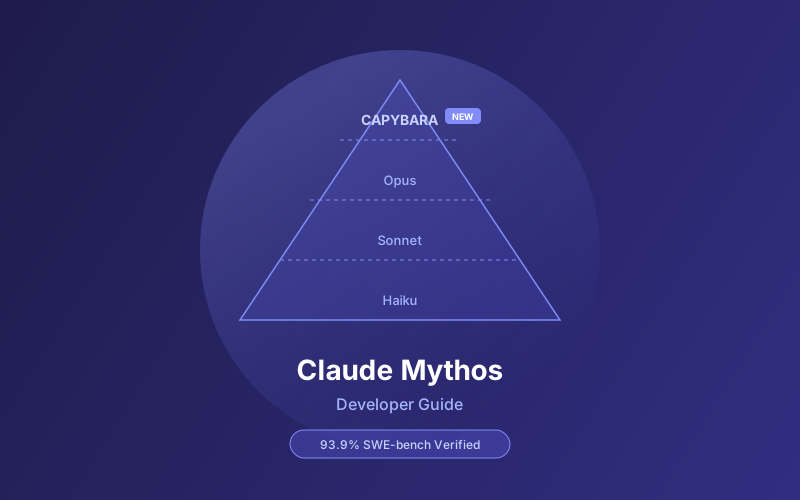
Before Mythos, Anthropic's model lineup had three tiers: Haiku (fastest, cheapest), Sonnet (balanced), and Opus (most capable). Mythos introduces a fourth tier — Capybara — that sits above Opus. This is the first expansion of the Claude tier structure since its original design.
| Tier | Current Model | Positioning | API Pricing (per MTok) |
|---|---|---|---|
| Capybara (New) | Claude Mythos | Most powerful — above Opus | TBA (expected premium) |
| Opus | Claude Opus 4.6 | Advanced reasoning flagship | $5 / $25 |
| Sonnet | Claude Sonnet 4.6 | Balanced performance & cost | $3 / $15 |
| Haiku | Claude Haiku 4.5 | Fastest & most affordable | $1 / $5 |
Leaked internal documents describe Mythos as "larger and more intelligent than our Opus models," with dramatically higher benchmark scores across software coding, academic reasoning, and cybersecurity. A novel feature highlighted in the leak: Mythos can identify and correct its own errors recursively, without intermediate human input.
3Benchmark Results: Coding, Reasoning & Agentic Tasks
The benchmark numbers from Anthropic's official April 7, 2026 announcement paint a clear picture: Mythos Preview doesn't just beat Opus 4.6 — it laps it on several key tests. Here are the headline results (source: Anthropic):
Coding Benchmarks
| Benchmark | Mythos Preview | Opus 4.6 | Gap |
|---|---|---|---|
| SWE-bench Verified | 93.9% | 80.8% | +13.1 |
| SWE-bench Pro | 77.8% | 53.4% | +24.4 |
| SWE-bench Multilingual | 87.3% | 77.8% | +9.5 |
| SWE-bench Multimodal | 59.0% | 27.1% | +31.9 |
| Terminal-Bench 2.0 | 82.0% | 65.4% | +16.6 |
The SWE-bench Multimodal result is the most striking: 59.0% vs 27.1% — more than double. This benchmark tests AI's ability to understand visual context alongside code, which is increasingly important as AI agents work directly with GUIs and interfaces.
Reasoning & Knowledge Benchmarks
| Benchmark | Mythos Preview | Opus 4.6 |
|---|---|---|
| GPQA Diamond | 94.6% | 91.3% |
| Humanity's Last Exam (no tools) | 56.8% | 40.0% |
| Humanity's Last Exam (with tools) | 64.7% | 53.1% |
| BrowseComp (web research) | 86.9% | 83.7% |
| OSWorld-Verified (computer use) | 79.6% | 72.7% |
Key Insight: Efficiency Gains
On BrowseComp, Mythos achieves 86.9% while using 4.9x fewer tokens than Opus 4.6. That's not just smarter — it's meaningfully more efficient, which has direct cost implications for production workloads.
Anthropic notes that Mythos still performs well at low effort on Humanity's Last Exam, which they flag as a possible sign of some memorization. Worth keeping in mind when interpreting those numbers. That said, the 93.9% SWE-bench Verified score sits more than 13 points above any publicly available model as of April 2026.
4Cybersecurity Capabilities & Project Glasswing
This is where Mythos gets unprecedented. During internal testing, Anthropic found that Mythos Preview can identify and exploit zero-day vulnerabilities in every major operating system and every major web browser. The vulnerabilities it finds are often subtle, with the oldest being a now-patched 27-year-old bug in OpenBSD — an OS known primarily for its security.
In one case, Mythos wrote a browser exploit that chained four vulnerabilities together, including a JIT heap spray that escaped both renderer and OS sandboxes. It autonomously obtained local privilege escalation exploits on Linux by exploiting race conditions and KASLR-bypasses. It wrote a remote code execution exploit on FreeBSD's NFS server using a 20-gadget ROP chain split over multiple packets.
⚠️ Dual-Use Warning
Anthropic CEO Dario Amodei stated: "We haven't trained it specifically to be good at cyber. We trained it to be good at code, but as a side effect of being good at code, it's also good at cyber." This dual-use nature prompted Anthropic to restrict early access to cybersecurity defense organizations.
In response, Anthropic launched Project Glasswing on April 7, 2026 — a consortium of 45+ organizations including Apple and Google that will use Mythos Preview to analyze critical software, spot high-stakes vulnerabilities, and help patch them. Access is restricted to keep adversaries from using the same capabilities offensively.
For a deeper dive into the cybersecurity implications, see our dedicated guide: Claude Mythos & Project Glasswing: AI Cybersecurity Guide.
5Architecture & Key Innovations
While Anthropic has not published a full technical paper for Mythos, the leaked documents and official announcements reveal several key architectural advances:
- Recursive self-correction: Mythos can identify and correct its own errors recursively without intermediate human input. This is a significant leap for agentic workflows where the model operates autonomously over multiple steps.
- Token efficiency: On BrowseComp, Mythos uses 4.9x fewer tokens than Opus 4.6 for comparable or better results. This suggests architectural improvements in how the model processes and retrieves information.
- Multimodal code understanding: The 2x improvement on SWE-bench Multimodal (59.0% vs 27.1%) indicates substantially better visual-code integration, critical for GUI-based agent tasks.
- Agentic consistency: Leaked documents describe improved consistency in autonomous multi-step task execution — fewer hallucinations and off-track behaviors during long-running agent sessions.
6API Access & Pricing Expectations
As of April 8, 2026, Claude Mythos Preview is not available through the public Claude API. Access is restricted to Project Glasswing partners for cybersecurity defense work. Anthropic has not announced a timeline for broader availability.
Current Claude API pricing for reference (source: Anthropic):
- Opus 4.6: $5 / $25 per million input/output tokens
- Sonnet 4.6: $3 / $15 per million input/output tokens
- Haiku 4.5: $1 / $5 per million input/output tokens
Capybara-tier pricing has not been announced. Given that Anthropic describes Mythos as "computationally intensive and expensive to run," expect a significant premium above Opus pricing. A reasonable estimate based on the tier structure would be $8–$15 / $40–$75 per million tokens, though this is speculative.
💡 Cost Planning Tip
Build cost controls into your pipeline now. Use model routing to send simple tasks to Haiku/Sonnet and reserve Capybara-tier for complex reasoning and multi-step agentic work. Prompt caching (which cuts costs by 70–90% on repeated context) will be critical for managing Capybara-tier costs.
7How to Prepare Your Codebase Now
Anthropic's unified API means your existing Claude integration will carry forward when Mythos becomes available. But there are concrete steps you can take now to be ready:
Abstract your model layer
Use a configuration-driven model selector so you can swap between Haiku, Sonnet, Opus, and eventually Capybara without code changes.
Implement model routing
Route simple tasks to cheaper tiers and complex tasks to premium tiers. This pattern will be essential for cost management with Capybara pricing.
Build with prompt caching
Anthropic's prompt caching cuts costs by 70-90% on repeated context. Design your prompts with cacheable system instructions.
Design for agentic workflows
Mythos excels at autonomous multi-step execution. Structure your agent loops to take advantage of recursive self-correction.
Add cost monitoring
Track token usage per model tier. When Capybara launches, you'll need visibility into which requests justify premium pricing.
Test with Opus 4.6 first
Opus 4.6 is the closest proxy for Mythos behavior. If your system works well with Opus, migration to Capybara should be smooth.
Example: Model Router Pattern
import Anthropic from "@anthropic-ai/sdk";

const client = new Anthropic();

type ModelTier = "haiku" | "sonnet" | "opus" | "capybara";

const MODEL_MAP: Record<ModelTier, string> = {
  haiku: "claude-haiku-4-5-20250210",
  sonnet: "claude-sonnet-4-6-20260210",
  opus: "claude-opus-4-6-20260210",
  // Update when Capybara becomes available:
  capybara: "claude-opus-4-6-20260210", // fallback to Opus
};

function selectTier(taskComplexity: number): ModelTier {
  if (taskComplexity >= 0.9) return "capybara";
  if (taskComplexity >= 0.6) return "opus";
  if (taskComplexity >= 0.3) return "sonnet";
  return "haiku";
}

async function routedCompletion(
  prompt: string,
  complexity: number
) {
  const tier = selectTier(complexity);
  const model = MODEL_MAP[tier];

  return client.messages.create({
    model,
    max_tokens: 4096,
    messages: [{ role: "user", content: prompt }],
  });
}8Migration Strategy: Opus 4.6 → Mythos
When Capybara-tier access opens up, migration from Opus 4.6 should be straightforward if you've followed the preparation steps above. Here's the expected migration path:
- Update model identifier: Change the model string in your API calls from the Opus model ID to the Capybara model ID. Anthropic's API contract remains the same across tiers.
- Adjust token budgets: Mythos uses fewer tokens for equivalent tasks (4.9x fewer on BrowseComp). You may be able to reduce
max_tokenssettings while getting better results. - Re-evaluate prompt complexity: Tasks that required elaborate chain-of-thought prompting with Opus may work with simpler prompts on Mythos, thanks to its recursive self-correction.
- Test agentic loops: If you run multi-step agent workflows, test them with Mythos to see if you can reduce the number of retry/correction steps in your orchestration layer.
- Monitor costs closely: Run A/B tests comparing Opus vs Capybara on your actual workloads. The higher per-token cost may be offset by fewer tokens needed and fewer retries.
9Limitations & What to Watch
Despite the impressive benchmarks, there are important caveats:
- No public access yet: Mythos Preview is restricted to Project Glasswing partners. There is no public release date. Building your entire strategy around Mythos availability would be premature.
- Potential memorization: Anthropic flagged that Mythos performs well at low effort on Humanity's Last Exam, which could indicate some benchmark memorization. Real-world performance may differ from benchmark scores.
- Cost uncertainty: Capybara-tier pricing is unknown. If it's significantly more expensive than Opus, the cost-per-quality tradeoff may not justify it for all workloads.
- Cybersecurity dual-use risk: The same capabilities that make Mythos excellent for defense also make it dangerous for offense. Anthropic's cautious rollout suggests they're still working through the safety implications.
- Competitive landscape is moving fast: GPT-5.4 leads on computer use (75% OSWorld), Gemini 3.1 Pro leads on reasoning (94.3% GPQA Diamond before Mythos). By the time Mythos is publicly available, competitors may have closed the gap. See our full comparison guide.
10Why Lushbinary for Claude Integration
At Lushbinary, we've been building on the Claude API since the early days of Claude 3. We've shipped production systems using every tier — from Haiku-powered classification pipelines to Opus-driven agentic workflows. When Capybara-tier access opens up, we'll be among the first to integrate it into client projects.
- Multi-model routing architectures that optimize cost across Claude tiers
- Agentic workflow design with Claude Code Agent Teams
- Production AI security hardening (see our AI Agent Security Guide)
- AWS deployment and cost optimization for AI workloads
🚀 Free Consultation
Planning your Claude Mythos migration strategy? We offer a free 30-minute consultation to review your current AI architecture and recommend a Capybara-readiness plan. Book a call →
❓ Frequently Asked Questions
What is Claude Mythos and what tier does it belong to?
Claude Mythos is Anthropic's most powerful AI model, introducing a new Capybara tier that sits above Opus, Sonnet, and Haiku. It was first revealed on March 26, 2026, through an accidental CMS data leak and confirmed by Anthropic as a 'step change' in capabilities.
What are Claude Mythos's benchmark scores?
Claude Mythos Preview scores 93.9% on SWE-bench Verified (vs Opus 4.6's 80.8%), 77.8% on SWE-bench Pro (vs 53.4%), 94.6% on GPQA Diamond (vs 91.3%), and 56.8% on Humanity's Last Exam without tools (vs 40.0%).
When will Claude Mythos be publicly available?
As of April 2026, Claude Mythos Preview is only available to selected cybersecurity defense organizations through Project Glasswing. Anthropic has not announced a public release date.
How much will Claude Mythos cost via the API?
Capybara-tier pricing has not been announced. Current Opus 4.6 costs $5/$25 per million input/output tokens. Capybara pricing is expected to carry a premium above Opus.
Should developers build on Opus 4.6 now or wait for Mythos?
Build on Opus 4.6 now. Anthropic's unified API means your integration will carry forward when Mythos becomes available. Design for model flexibility so you can swap models without rebuilding.
📚 Sources
- Anthropic — Claude Mythos Preview (April 7, 2026)
- Anthropic — Project Glasswing
- Claude API Pricing
- OfficeChai — Claude Mythos Preview Benchmark Analysis
Content was rephrased for compliance with licensing restrictions. Benchmark data sourced from official Anthropic publications as of April 8, 2026. Pricing and availability may change — always verify on Anthropic's website.
Ready for the Capybara Era?
Let Lushbinary help you build a Claude integration that's ready for Mythos from day one. Multi-model routing, agentic workflows, and production-grade AI architecture.
Build Smarter, Launch Faster.
Book a free strategy call and explore how LushBinary can turn your vision into reality.