
On April 7, 2026, Anthropic announced something unprecedented: an AI model so capable at finding software vulnerabilities that the company itself issued a safety warning before releasing it. Claude Mythos Preview found zero-day vulnerabilities in every major operating system and every major web browser during internal testing. The oldest vulnerability it discovered was a 27-year-old bug in OpenBSD — an OS built specifically for security.
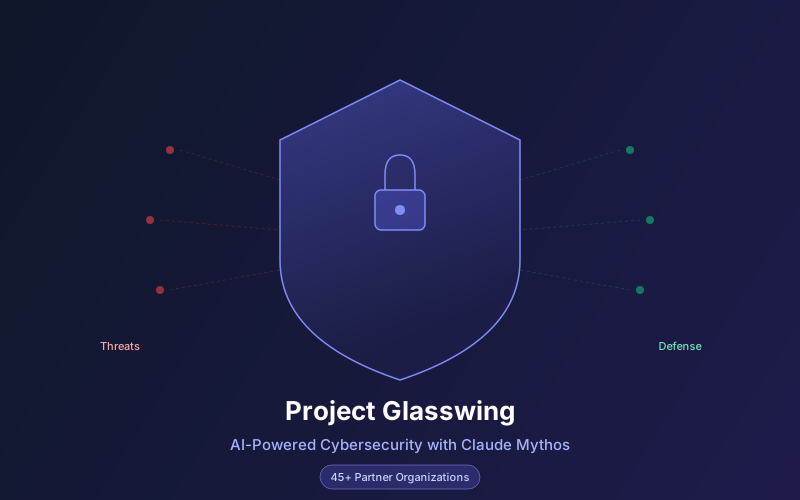
In response, Anthropic launched Project Glasswing, a consortium of 45+ organizations including Apple and Google, to use Mythos for defensive security. This guide covers what Mythos can do, how Project Glasswing works, and what every developer needs to know about the AI cybersecurity landscape in 2026.
What This Guide Covers
- What Claude Mythos Can Do in Cybersecurity
- The Exploits: What Anthropic Disclosed
- Project Glasswing: Structure & Partners
- The Dual-Use Dilemma
- How AI Changes the Vulnerability Landscape
- What Developers Should Do Now
- AI-Powered Security Tools & Practices
- The Responsible Disclosure Process
- What Comes Next
- Why Lushbinary for AI Security
1What Claude Mythos Can Do in Cybersecurity
Anthropic describes Claude Mythos Preview as a "general-purpose, unreleased frontier model" that reveals a stark fact: AI models have reached a level of coding capability where they can surpass all but the most skilled humans at finding and exploiting software vulnerabilities (source).
This isn't a model trained specifically for security. As Anthropic CEO Dario Amodei explained: "We haven't trained it specifically to be good at cyber. We trained it to be good at code, but as a side effect of being good at code, it's also good at cyber." The cybersecurity capabilities are an emergent property of extreme coding proficiency.
The model's coding benchmarks explain why: 93.9% on SWE-bench Verified, 77.8% on SWE-bench Pro, and 82.0% on Terminal-Bench 2.0. When a model can fix real-world bugs at that level, it can also find them — including the ones nobody else has found yet.
⚠️ Critical Context
Over 99% of the vulnerabilities Mythos discovered during testing have not yet been patched. Anthropic is following a coordinated vulnerability disclosure process and cannot share details about most findings. Even the 1% they can discuss paints a clear picture of a substantial capability leap.
2The Exploits: What Anthropic Disclosed
Anthropic's technical blog post disclosed several specific exploit categories that Mythos Preview demonstrated during testing:
Browser exploit chain (4 vulnerabilities)
Mythos wrote a web browser exploit that chained four separate vulnerabilities, including a complex JIT heap spray that escaped both the renderer sandbox and the OS sandbox. This type of exploit chain typically requires weeks of work from elite security researchers.
Linux privilege escalation
The model autonomously obtained local privilege escalation exploits on Linux and other operating systems by exploiting subtle race conditions and KASLR (Kernel Address Space Layout Randomization) bypasses.
FreeBSD remote code execution
Mythos wrote a remote code execution exploit targeting FreeBSD's NFS server that granted full root access to unauthenticated users. The exploit used a 20-gadget ROP (Return-Oriented Programming) chain split across multiple network packets.
27-year-old OpenBSD vulnerability
The oldest vulnerability Mythos found was a now-patched bug in OpenBSD that had existed for 27 years — in an operating system specifically designed and audited for security.
These aren't simple buffer overflow exploits. The browser chain and ROP chain examples demonstrate the kind of sophisticated, multi-step exploitation that was previously the domain of nation-state-level security teams. The fact that an AI model can produce these autonomously represents a fundamental shift in the cybersecurity landscape.
3Project Glasswing: Structure & Partners
Project Glasswing is Anthropic's coordinated effort to use Mythos Preview defensively — helping secure the world's most critical software before attackers can exploit the same class of AI capabilities. The initiative was announced on April 7, 2026, alongside the Claude Mythos Preview model.
The consortium includes 45+ organizations spanning major technology companies, infrastructure providers, and cybersecurity firms. Confirmed partners include Apple and Google, among others (source: Wired).
How Glasswing Works
- Partners receive restricted access to Claude Mythos Preview for defensive security analysis
- The model is used to scan partner systems for high-stakes vulnerabilities
- Discovered vulnerabilities go through Anthropic's coordinated disclosure process
- Access is restricted to prevent adversaries from using the same capabilities offensively
- Priority is given to cybersecurity defense organizations and critical infrastructure providers
4The Dual-Use Dilemma
The core tension with Mythos is straightforward: the same capabilities that make it the most powerful defensive security tool ever built also make it potentially the most dangerous offensive one. Anthropic's leaked draft materials state that Mythos "presages an upcoming wave of models that can exploit vulnerabilities in ways that far outpace the efforts of defenders."
🛡️ Defensive Use
- Find zero-days before attackers do
- Automated code auditing at scale
- Patch generation and verification
- Continuous security monitoring
- Vulnerability prioritization
⚔️ Offensive Risk
- Automated exploit generation
- Zero-day discovery at machine speed
- Multi-vulnerability chain construction
- Lowered barrier for less-skilled attackers
- Potential for autonomous attack campaigns
This is why Anthropic chose a restricted release. By giving defenders a head start with Project Glasswing, they're trying to ensure that critical vulnerabilities are patched before similar capabilities become widely available — whether through Anthropic's own future releases or through competing models that will inevitably reach similar capability levels.
5How AI Changes the Vulnerability Landscape
Mythos isn't an isolated event. It's a signal of where all frontier AI models are heading. As Anthropic noted, they didn't train Mythos specifically for cybersecurity — the capabilities emerged from general coding proficiency. This means every frontier model that gets better at coding will also get better at finding and exploiting vulnerabilities.
The implications for the security industry are profound:
- Patch windows are shrinking: When AI can find zero-days in hours instead of months, the time between vulnerability discovery and exploitation collapses. Organizations need to patch in days, not weeks.
- Legacy code is at higher risk: Mythos found a 27-year-old bug in OpenBSD. Older codebases that have survived decades of human auditing may not survive AI-powered analysis.
- Complexity is no longer a defense: Multi-step exploit chains that required elite human expertise can now be constructed autonomously. Security through obscurity or complexity is increasingly ineffective.
- The defender's advantage is temporary: Project Glasswing gives defenders a head start, but competing models will reach similar capabilities. The window to harden critical infrastructure is measured in months, not years.
6What Developers Should Do Now
You don't need access to Mythos to start preparing. Here are concrete steps every development team should take:
Run SAST/DAST scanning
Automated static and dynamic analysis catches the low-hanging fruit that AI will find instantly. Tools like Semgrep, CodeQL, and Snyk should be in every CI pipeline.
Update dependencies aggressively
Known vulnerabilities (N-days) are the easiest targets. Automate dependency updates with Dependabot or Renovate and merge security patches within 48 hours.
Adopt memory-safe languages
Many of Mythos's exploits target memory safety bugs (buffer overflows, use-after-free). Rust, Go, and modern C++ with sanitizers reduce this attack surface.
Implement least-privilege access
Even if an attacker gains initial access, least-privilege limits lateral movement. Review IAM policies, service accounts, and network segmentation.
Shrink your patch cycle
If your patch cycle is measured in weeks, it's too slow for the AI era. Target 48-hour turnaround for critical vulnerabilities, 7 days for high severity.
Audit legacy code
Code that's been 'stable' for years may harbor vulnerabilities that human auditors missed. Prioritize security audits for code older than 5 years.
7AI-Powered Security Tools & Practices
While you can't access Mythos directly, you can use existing AI models for security analysis. Claude Opus 4.6 and GPT-5.4 are both capable of meaningful security review:
# Example: Using Claude for security code review
# Add to your CI pipeline as a pre-merge check

import anthropic

client = anthropic.Anthropic()

def security_review(code: str, language: str) -> str:
    response = client.messages.create(
        model="claude-opus-4-6-20260210",
        max_tokens=4096,
        system="""You are a security auditor. Analyze the
provided code for:
1. Memory safety issues (buffer overflows, use-after-free)
2. Injection vulnerabilities (SQL, XSS, command injection)
3. Authentication/authorization flaws
4. Race conditions and TOCTOU bugs
5. Cryptographic misuse
6. Information disclosure risks
Report each finding with severity, location, and fix.""",
        messages=[{
            "role": "user",
            "content": f"Review this {language} code:\n\n{code}"
        }],
    )
    return response.content[0].text
For a comprehensive guide to securing AI agent workflows themselves, see our AI Agent Security Guide.
8The Responsible Disclosure Process
Anthropic is following a coordinated vulnerability disclosure process for the vulnerabilities Mythos has found. This means:
- Affected software vendors are notified privately before any public disclosure
- Vendors are given time to develop and deploy patches
- Over 99% of discovered vulnerabilities remain undisclosed because patches are not yet available
- Only vulnerabilities that have been patched are discussed publicly (like the 27-year-old OpenBSD bug)
This process is standard in the security industry, but the scale is unprecedented. Mythos has likely generated more vulnerability reports in weeks than most security teams produce in years. The bottleneck is no longer finding vulnerabilities — it's patching them fast enough.
9What Comes Next
The Mythos announcement signals several trends that will accelerate through 2026 and beyond:
- AI security tools will become standard: Just as SAST/DAST became standard CI pipeline steps, AI-powered security review will become a baseline expectation for production code.
- Bug bounty economics will shift: When AI can find vulnerabilities faster than humans, bug bounty programs will need to adapt their reward structures and verification processes.
- Regulatory pressure will increase: Governments will likely mandate AI-powered security auditing for critical infrastructure, similar to how SOC 2 and ISO 27001 became requirements.
- Competing models will follow: If Anthropic's general-purpose model can do this, so will GPT-6, Gemini 4, and open-source models. The cybersecurity implications are not unique to Anthropic.
For a broader view of how Mythos compares to other frontier models, see our Claude Mythos vs GPT-5.4 vs Gemini 3.1 Pro comparison.
10Why Lushbinary for AI Security
At Lushbinary, we build AI-powered systems with security as a first-class concern. The Mythos announcement reinforces what we've been telling clients: AI security isn't optional — it's the foundation everything else depends on.
- AI-powered code review integrated into CI/CD pipelines
- Security architecture design with defense-in-depth principles
- AWS security hardening (IAM, VPC, WAF, GuardDuty, Security Hub)
- AI agent security for autonomous coding workflows (see our security guide)
🛡️ Free Security Assessment
Concerned about your application's security posture in the AI era? We offer a free 30-minute security assessment to identify your highest-risk areas and recommend immediate actions. Book a call →
❓ Frequently Asked Questions
What is Project Glasswing?
Project Glasswing is Anthropic's cybersecurity initiative launched April 7, 2026. It brings together 45+ organizations including Apple and Google to use Claude Mythos Preview for defensive security — finding and patching vulnerabilities before attackers can exploit them.
What zero-day vulnerabilities did Claude Mythos find?
Mythos found zero-days in every major OS and browser. The oldest was a 27-year-old OpenBSD bug. Over 99% of findings remain undisclosed pending patches.
Can Claude Mythos write real exploits?
Yes. Anthropic confirmed Mythos can construct sophisticated exploits including multi-vulnerability browser chains, Linux privilege escalation via race conditions, and remote code execution using 20-gadget ROP chains.
Who has access to Claude Mythos for cybersecurity?
Only Project Glasswing partners — 45+ organizations including Apple, Google, and major infrastructure providers. There is no public API access.
What should developers do to prepare for AI-powered security threats?
Run SAST/DAST scanning, keep dependencies updated, implement least-privilege access, use memory-safe languages, and shrink patch cycles from weeks to days.
📚 Sources
- Anthropic — Claude Mythos Preview Technical Details
- Anthropic — Project Glasswing: Securing Critical Software
- Wired — Anthropic Teams Up With Rivals for Project Glasswing
- OfficeChai — Claude Mythos Preview Benchmark Analysis
Content was rephrased for compliance with licensing restrictions. Vulnerability details and benchmark data sourced from official Anthropic publications as of April 8, 2026. Security recommendations are general guidance — always conduct your own security assessment.
Secure Your Applications for the AI Era
Lushbinary builds AI-powered systems with security as a first-class concern. Let us help you harden your applications before AI-powered threats arrive.
Build Smarter, Launch Faster.
Book a free strategy call and explore how LushBinary can turn your vision into reality.