
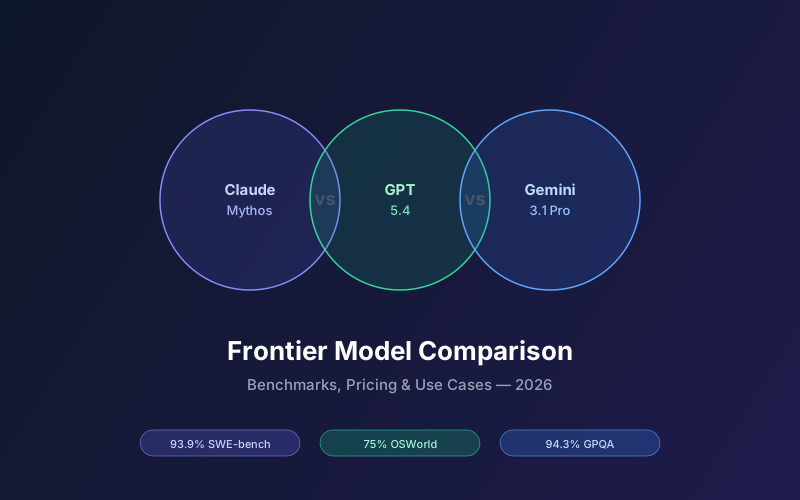
April 2026 has reshaped the frontier AI landscape. Anthropic's Claude Mythos Preview dropped benchmark numbers that make the current generation look like a previous era — 93.9% on SWE-bench Verified, 77.8% on SWE-bench Pro. Meanwhile, OpenAI's GPT-5.4 leads computer use at 75% OSWorld and professional knowledge at 83% GDPval. Google's Gemini 3.1 Pro delivers top-tier reasoning at 94.3% GPQA Diamond for nearly half the price.
The uncomfortable truth: none of them is universally the best. Each leads in specific domains. This guide breaks down exactly where each model wins, what it costs, and which one you should choose for your use case.
What This Guide Covers
- The Three Contenders: Quick Overview
- Coding Benchmarks: Head-to-Head
- Reasoning & Knowledge Benchmarks
- Agentic Tasks & Computer Use
- Pricing & Cost Comparison
- Context Windows & Multimodal Support
- Availability & Access
- Use-Case Decision Matrix
- Multi-Model Routing Strategy
- Why Lushbinary for AI Model Strategy
1The Three Contenders: Quick Overview
| Claude Mythos | GPT-5.4 | Gemini 3.1 Pro | |
|---|---|---|---|
| Company | Anthropic | OpenAI | Google DeepMind |
| Tier | Capybara (new) | Flagship | Pro |
| Public Access | Restricted (Glasswing only) | Generally available | Generally available |
| Top Strength | Coding & cybersecurity | Computer use & professional tasks | Reasoning & price-performance |
2Coding Benchmarks: Head-to-Head
Coding is where Mythos creates the widest gap. The SWE-bench family of benchmarks tests real-world software engineering tasks — fixing actual bugs in open-source repositories. Here's how the three models compare:
| Benchmark | Mythos | GPT-5.4 | Gemini 3.1 Pro |
|---|---|---|---|
| SWE-bench Verified | 93.9% | ~72% | ~68% |
| SWE-bench Pro | 77.8% | ~56.8% | ~50% |
| Terminal-Bench 2.0 | 82.0% | ~65% | ~60% |
Key Takeaway
Mythos Preview's 93.9% on SWE-bench Verified sits more than 13 points above any publicly available model. On SWE-bench Pro — the hardest tier — the 77.8% score exceeds GPT-5.3-Codex's previous best of 56.8% by 21 points. This is a qualitative shift, not an incremental one.
For context, when Gemini 3.1 Pro launched, GPT-5.3-Codex led SWE-bench Pro at 56.8%. Mythos now exceeds that by more than 21 points. Among publicly available models, Claude Opus 4.6 (80.8% SWE-bench Verified) and Claude Sonnet 4.6 (79.6%) remain the coding leaders.
3Reasoning & Knowledge Benchmarks
Reasoning is where the competition is tightest. All three models perform at near-expert level on graduate-level scientific reasoning:
| Benchmark | Mythos | GPT-5.4 | Gemini 3.1 Pro |
|---|---|---|---|
| GPQA Diamond | 94.6% | ~90% | 94.3% |
| ARC-AGI-2 | N/A | ~60% | 77.1% |
| Humanity's Last Exam (no tools) | 56.8% | ~45% | ~42% |
| GDPval (professional tasks) | N/A | 83% | ~75% |
Gemini 3.1 Pro's 77.1% on ARC-AGI-2 is the standout reasoning result among publicly available models. GPT-5.4's 83% GDPval score — matching or exceeding professionals in 83% of tasks across 44 occupations — is the most impressive real-world capability benchmark published by any lab in 2026. Mythos leads on GPQA Diamond and Humanity's Last Exam, but those scores come with the memorization caveat Anthropic flagged.
4Agentic Tasks & Computer Use
Agentic AI — where models autonomously navigate interfaces, run terminal commands, and complete multi-step workflows — is the fastest-growing use case in 2026. Here's how they compare:
| Benchmark | Mythos | GPT-5.4 | Gemini 3.1 Pro |
|---|---|---|---|
| OSWorld (computer use) | 79.6% | 75% | ~65% |
| BrowseComp (web research) | 86.9% | ~80% | ~75% |
GPT-5.4 was the first model to beat humans on OSWorld at 75%, making it the leader for desktop automation and computer use tasks among publicly available models. Mythos Preview's 79.6% on OSWorld-Verified surpasses this, but it's not publicly available. On BrowseComp, Mythos achieves 86.9% while using 4.9x fewer tokens than Opus 4.6 — a significant efficiency advantage.
5Pricing & Cost Comparison
Cost is where Gemini 3.1 Pro creates the most compelling argument. Here's the current pricing landscape:
| Model | Input (per MTok) | Output (per MTok) | Context |
|---|---|---|---|
| Claude Mythos (Capybara) | TBA | TBA | TBA |
| Claude Opus 4.6 | $5 | $25 | 1M tokens |
| GPT-5.4 | ~$5 | ~$25 | 128K tokens |
| Gemini 3.1 Pro | $2 | $12 | 1M tokens |
Price-Performance Winner
Gemini 3.1 Pro delivers 94.3% GPQA Diamond reasoning at $2/$12 per MTok — roughly 60% cheaper than Opus or GPT-5.4 for comparable reasoning quality. For teams where cost matters, Gemini 3.1 Pro is the clear value pick.
6Context Windows & Multimodal Support
Context window size matters for large codebases, document analysis, and long-running agent sessions:
- Claude Opus 4.6: 1M token context at standard pricing. Prompt caching cuts costs by 70–90% on repeated context.
- GPT-5.4: 128K token context. Smaller than competitors but sufficient for most single-task workflows.
- Gemini 3.1 Pro: 1M token context. Combined with lower pricing, this makes Gemini the best option for context-intensive workloads.
All three models support multimodal input (text + images). Mythos Preview's 59.0% on SWE-bench Multimodal (vs Opus 4.6's 27.1%) suggests a major leap in visual-code understanding. GPT-5.4 and Gemini 3.1 Pro both handle image analysis well, but neither has published comparable multimodal coding benchmarks.
7Availability & Access
This is the critical practical consideration. Having the best benchmarks means nothing if you can't use the model:
Claude Mythos
Restricted to Project Glasswing partners (45+ orgs including Apple, Google). No public API access. No release date announced.
GPT-5.4
Generally available via OpenAI API and ChatGPT. Pro tier available for deeper reasoning. Enterprise plans available.
Gemini 3.1 Pro
Generally available via Google AI Studio and Vertex AI. Free tier available. Enterprise plans with SLAs.
8Use-Case Decision Matrix
Here's our recommendation based on specific use cases. Since Mythos isn't publicly available, we include the best available alternative:
| Use Case | Best Model | Why |
|---|---|---|
| Complex coding / bug fixing | Claude Opus 4.6 | 80.8% SWE-bench Verified, best public coding model |
| Desktop automation / computer use | GPT-5.4 | 75% OSWorld, first to beat humans |
| Scientific reasoning | Gemini 3.1 Pro | 94.3% GPQA Diamond at half the price |
| Long-context analysis | Gemini 3.1 Pro | 1M context at $2/$12 per MTok |
| Professional knowledge work | GPT-5.4 | 83% GDPval across 44 occupations |
| Multi-step agentic workflows | Claude Opus 4.6 | Best agentic consistency, 1M context |
| Budget-conscious teams | Gemini 3.1 Pro | 60% cheaper than Opus/GPT-5.4 |
| Cybersecurity defense | Claude Mythos (if accessible) | Zero-day detection in every major OS/browser |
9Multi-Model Routing Strategy
The smartest approach in 2026 isn't picking one model — it's routing tasks to the right model based on complexity, cost sensitivity, and domain. Here's a practical routing strategy:
This routing pattern lets you optimize costs while maintaining quality. When Capybara-tier becomes available, you add it as the top tier for your most complex, highest-value tasks. For a detailed implementation guide, see our Claude Mythos Developer Guide.
10Why Lushbinary for AI Model Strategy
Choosing the right model — or the right combination of models — is one of the highest-leverage decisions in AI engineering. At Lushbinary, we help teams design multi-model architectures that balance performance, cost, and reliability across providers.
- Multi-provider routing across Claude, GPT, and Gemini APIs
- Cost optimization with model-tier selection and prompt caching
- Production AI deployment on AWS with auto-scaling and monitoring
- Capybara-readiness planning for when Mythos becomes publicly available
🚀 Free Consultation
Not sure which model is right for your use case? We offer a free 30-minute consultation to evaluate your workloads and recommend an optimal model strategy. Book a call →
❓ Frequently Asked Questions
Which AI model is best for coding in 2026?
Claude Mythos Preview leads with 93.9% SWE-bench Verified, but it's not publicly available. Among public models, Claude Opus 4.6 (80.8%) and GPT-5.3-Codex lead for coding tasks.
How does Claude Mythos compare to GPT-5.4?
Mythos leads coding (93.9% vs ~72% SWE-bench Verified) and reasoning (94.6% vs ~90% GPQA Diamond). GPT-5.4 leads computer use (75% OSWorld) and professional tasks (83% GDPval).
Is Gemini 3.1 Pro better than Claude Mythos for reasoning?
Gemini 3.1 Pro scores 94.3% on GPQA Diamond vs Mythos's 94.6% — nearly identical. But Gemini costs $2/$12 per MTok vs Opus's $5/$25, making it the price-performance leader.
Which frontier model is cheapest?
Gemini 3.1 Pro at $2/$12 per MTok is roughly 60% cheaper than Claude Opus 4.6 or GPT-5.4 at $5/$25 per MTok. Capybara-tier pricing is expected to be even higher.
Should I use one AI model or multiple?
Multi-model routing is the recommended approach. Use cheaper models for simple tasks, mid-tier for balanced work, and premium models for complex reasoning and agentic tasks.
📚 Sources
- Anthropic — Claude Mythos Preview Benchmarks
- Claude API Pricing
- SpectrumAI Lab — GPT-5.4 vs Claude Opus 4.6 vs Gemini 3.1 Pro
- OfficeChai — Claude Mythos Preview Benchmark Analysis
Content was rephrased for compliance with licensing restrictions. Benchmark data sourced from official publications and independent analysis as of April 8, 2026. Pricing and benchmarks may change — always verify on vendor websites.
Need Help Choosing the Right AI Model?
Lushbinary builds multi-model AI architectures that optimize for performance, cost, and reliability. Let us help you pick the right model for your use case.
Build Smarter, Launch Faster.
Book a free strategy call and explore how LushBinary can turn your vision into reality.