
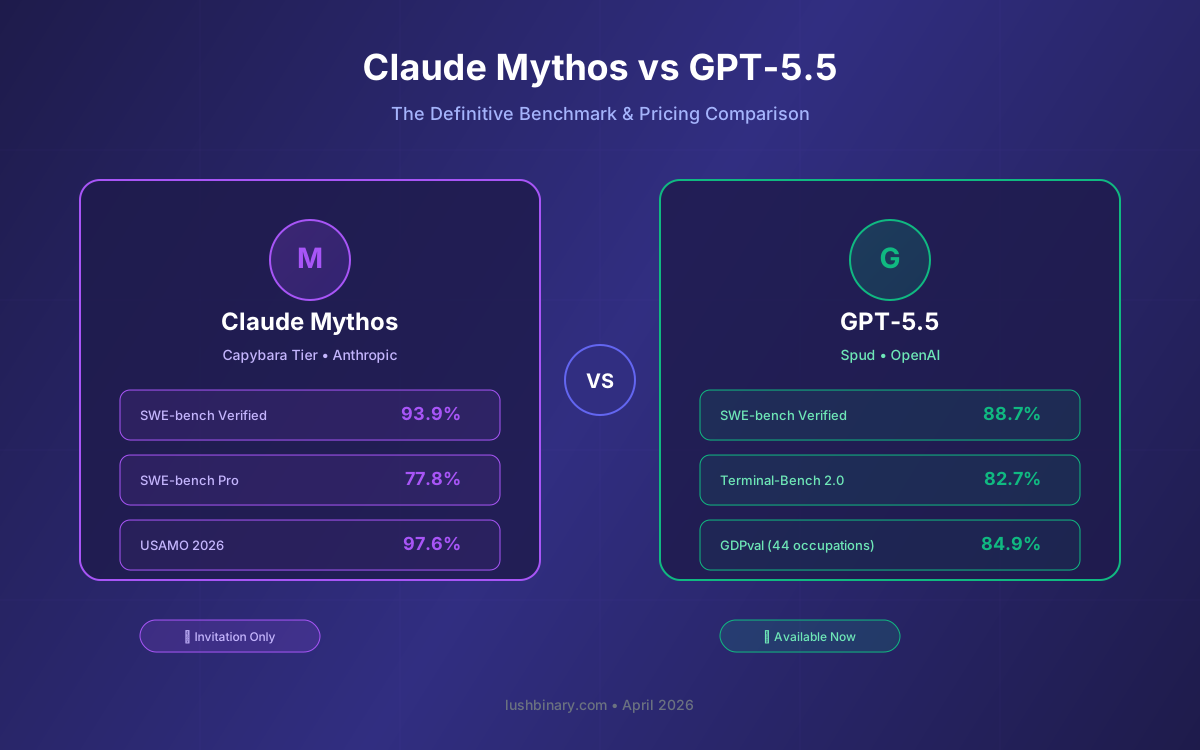
April 2026 delivered two seismic events in AI: Anthropic published the system card for Claude Mythos Preview on April 7, revealing a model that scores 93.9% on SWE-bench Verified - the highest ever recorded. Then on April 23, OpenAI shipped GPT-5.5 (codenamed "Spud"), scoring 88.7% on the same benchmark with full public availability from day one.
The catch? Mythos is locked behind Project Glasswing - an invitation-only program for defensive cybersecurity organizations. GPT-5.5 is live in ChatGPT, Codex CLI, and the API. So the real question isn't just "which model is better?" - it's "which model can you actually use, and what does the gap mean for your work?"
This guide compares every published benchmark, breaks down pricing and access, analyzes where each model excels, and gives you a practical decision framework for choosing the right model for your stack today.
📋 What This Guide Covers
- Background: How We Got Here
- Benchmark Comparison: The Full Table
- Coding Performance Deep Dive
- Reasoning & Mathematics
- Agentic Capabilities & Computer Use
- Long-Context & Multimodal Performance
- Pricing & Access Comparison
- Architecture & Design Philosophy
- Which Model Wins for Your Use Case
- The Practical Choice: What to Use Today
1Background: How We Got Here
On March 26, 2026, an accidental data leak from Anthropic's content management system revealed the existence of Claude Mythos - described internally as "by far the most powerful AI model we've ever developed." Anthropic confirmed the model within hours, calling it a "step change" in capabilities. The model introduces a new tier called Capybara, sitting above Opus in the Claude family hierarchy.
On April 7, Anthropic published the full system card for Mythos Preview, revealing benchmark scores that shattered every existing record. But they also made an unprecedented decision: Mythos would not be made generally available. Instead, it powers Project Glasswing - a coalition of twelve major technology and finance companies (including Apple, Google, Microsoft, and Amazon) using the model to find and fix vulnerabilities in critical infrastructure.
Meanwhile, OpenAI shipped GPT-5.5 on April 23 - just six weeks after GPT-5.4. Codenamed "Spud," it launched with immediate availability across ChatGPT Plus, Pro, Business, Enterprise, and the Codex CLI. OpenAI positioned it as "a new class of intelligence for real work," emphasizing agentic coding, computer use, and knowledge work over raw benchmark scores.
The result is a fascinating split: the most capable model ever benchmarked (Mythos) is locked away, while the most capable publicly available model (GPT-5.5) is accessible to anyone with a paid plan. Let's see how they compare on the numbers.
2Benchmark Comparison: The Full Table
Here's the head-to-head comparison using published scores from Anthropic's Mythos System Card and OpenAI's GPT-5.5 launch materials. We've included Claude Opus 4.7 (the best publicly available Anthropic model) for context.
| Benchmark | Claude Mythos | GPT-5.5 | Opus 4.7 | Winner |
|---|---|---|---|---|
| SWE-bench Verified | 93.9% | 88.7% | 87.6% | 🟣 Mythos |
| SWE-bench Pro | 77.8% | 58.6% | 64.3% | 🟣 Mythos |
| Terminal-Bench 2.0 | 82.0% | 82.7% | - | 🟢 GPT-5.5 |
| GPQA Diamond | 94.5% | 93.6% | - | 🟣 Mythos |
| USAMO 2026 | 97.6% | - | - | 🟣 Mythos |
| OSWorld-Verified | 79.6% | 78.7% | - | 🟣 Mythos |
| HLE (with tools) | 64.7% | 52.2% | 54.7% | 🟣 Mythos |
| GDPval (44 occupations) | - | 84.9% | - | 🟢 GPT-5.5 |
| BrowseComp | 86.9% | 90.1% (Pro) | - | 🟢 GPT-5.5 |
| MRCR v2 @ 1M tokens | - | 74.0% | - | 🟢 GPT-5.5 |
| GraphWalks BFS (256K–1M) | 80.0% | - | - | 🟣 Mythos |
📊 Key Takeaway
Claude Mythos leads on 7 of 11 benchmarks where both models have published scores. GPT-5.5 wins on Terminal-Bench 2.0 (by 0.7 points), GDPval, BrowseComp (Pro variant), and MRCR v2. The pattern: Mythos dominates coding and reasoning; GPT-5.5 excels at agentic workflows and knowledge work.
3Coding Performance Deep Dive
Coding is where the gap between these models is most dramatic - and most consequential for developers choosing a daily driver.
SWE-bench Verified: The Gold Standard
SWE-bench tests whether a model can resolve real GitHub issues from popular open-source repositories. Each problem requires reading a codebase, understanding the bug report, and producing a correct patch.
- Claude Mythos: 93.9% - the highest score ever recorded. A 13.1-point jump over Opus 4.6 (80.8%).
- GPT-5.5: 88.7% - a massive 14.7-point jump over GPT-5.4 (~74%). The largest single-generation improvement OpenAI has achieved.
- Gap: Mythos leads by 5.2 percentage points.
SWE-bench Pro: The Hardest Coding Test
SWE-bench Pro uses more complex, multi-step problems designed to resist benchmark gaming. This is where the gap widens dramatically:
- Claude Mythos: 77.8%
- GPT-5.5: 58.6%
- Gap: Mythos leads by 19.2 points - nearly a 33% relative improvement.
This is the most significant number in the entire comparison. A 19-point lead on the hardest coding benchmark suggests Mythos handles interconnected, multi-file codebases with a qualitative advantage that GPT-5.5 cannot match.
Terminal-Bench 2.0: Autonomous Engineering
Terminal-Bench evaluates whether a model can autonomously operate a terminal - installing dependencies, running tests, debugging failures, and shipping working code. This is the closest benchmark to real agentic coding workflows.
- Claude Mythos: 82.0% (92.1% with extended 4-hour timeout)
- GPT-5.5: 82.7%
- Gap: GPT-5.5 leads by 0.7 points - essentially a tie.
The Terminal-Bench result is interesting because it's the one coding benchmark where GPT-5.5 edges ahead. This suggests GPT-5.5 may be slightly better at the operational aspects of coding (running commands, managing environments) even if Mythos is better at the intellectual aspects (understanding complex codebases, generating correct patches).
4Reasoning & Mathematics
Both models push the frontier on reasoning, but Mythos holds a clear edge on the hardest tests.
USAMO 2026: Competition Mathematics
The USA Mathematical Olympiad is one of the hardest math competitions in the world. Mythos scores 97.6% - near-perfect on problems that require multi-step proofs and creative insight. For context, Opus 4.6 scored just 42.3% on the same test. GPT-5.4 scored 95.2%. OpenAI has not published a GPT-5.5 USAMO score, but given the model's focus on practical work over academic benchmarks, it likely falls in a similar range to 5.4.
GPQA Diamond: PhD-Level Science
GPQA Diamond tests graduate-level scientific reasoning with questions written by domain experts. Both models are in the 93-95% range - this benchmark is approaching saturation:
- Claude Mythos: 94.5%
- GPT-5.5: 93.6%
- Gap: Less than 1 point - effectively tied.
HLE (Humanity's Last Exam)
HLE is designed to be the test AI cannot pass - crowd-sourced questions at the frontier of human knowledge. Mythos scores 64.7% with tools vs GPT-5.5's 52.2% - a 12.5-point lead. This is a meaningful gap on the hardest reasoning benchmark available, suggesting Mythos has a genuine advantage in deep, multi-step reasoning that goes beyond pattern matching.
5Agentic Capabilities & Computer Use
This is where GPT-5.5 makes its strongest case. OpenAI explicitly designed 5.5 for agentic workflows - multi-step tasks where the model plans, picks tools, executes, and checks its own output.
GDPval: Knowledge Work Across 44 Occupations
GPT-5.5 scores 84.9% on GDPval, which tests autonomous task completion across 44 knowledge work occupations. Anthropic has not published a Mythos GDPval score, but this benchmark plays to GPT-5.5's strengths: document creation, spreadsheet generation, data analysis, and multi-tool workflows.
OSWorld: Desktop Computer Use
OSWorld tests whether a model can operate a full desktop environment - clicking buttons, navigating menus, filling forms, and completing multi-step computer tasks:
- Claude Mythos: 79.6%
- GPT-5.5: 78.7%
- Gap: Mythos leads by 0.9 points - essentially tied.
BrowseComp: Web Navigation
BrowseComp measures how well a model navigates and extracts information from the web:
- Claude Mythos: 86.9%
- GPT-5.5 Pro: 90.1%
- Gap: GPT-5.5 Pro leads by 3.2 points.
GPT-5.5's BrowseComp advantage reflects OpenAI's deep integration with web browsing and research tools. The model is designed to search, synthesize, and act on web information as part of its core workflow - a capability that's immediately useful for knowledge workers.
6Long-Context & Multimodal Performance
Both models operate with 1 million token context windows, but they use that context very differently.
GraphWalks BFS: Reasoning Over Million-Token Inputs
GraphWalks BFS tests whether a model can follow graph traversal instructions across extremely long contexts (256K to 1M tokens). This isn't a synthetic needle-in-a-haystack test - it requires coherent reasoning over massive inputs.
- Claude Mythos: 80.0%
- GPT-5.4: 21.4% (GPT-5.5 score not published)
- Mythos nearly quadruples GPT-5.4's score on this test.
MRCR v2 @ 1M Tokens: Long-Context Recall
GPT-5.5 scores 74.0% on MRCR v2 at 1M tokens - more than doubling GPT-5.4's 36.6%. This is one of GPT-5.5's most impressive improvements, showing that OpenAI has made massive strides in long-context reasoning. Anthropic hasn't published a Mythos MRCR score, making direct comparison impossible on this specific test.
Multimodal: Vision & Code
Mythos scores 59.0% on SWE-bench Multimodal (which adds screenshots and UI mockups to coding tasks) - more than doubling Opus 4.6's 27.1%. GPT-5.5 is described as "natively omnimodal" with text, image, audio, and video capabilities, but OpenAI hasn't published a comparable multimodal coding score. Both models represent a significant leap in connecting visual understanding to code generation.
7Pricing & Access Comparison
This is where the comparison gets practical. The best model in the world doesn't matter if you can't use it.
| Factor | Claude Mythos | GPT-5.5 | Claude Opus 4.7 |
|---|---|---|---|
| Public Access | ❌ Invitation only | ✅ Available now | ✅ Available now |
| API Input (per M tokens) | ~$25 (leaked) | $5.00 | $5.00 |
| API Output (per M tokens) | ~$125 (leaked) | $30.00 | $25.00 |
| Context Window | 1M tokens | 1M tokens | 1M tokens |
| ChatGPT / Claude Pro | ❌ Not available | ✅ Plus ($20/mo) | ✅ Claude Pro ($20/mo) |
| Codex / CLI Access | ❌ No | ✅ All plans | ✅ Claude Code |
| GA Timeline | No date announced | Live now | Live now |
💰 Cost Reality Check
Even if Mythos were publicly available, its estimated pricing (~$25/$125 per M tokens) would make it 5x more expensive than GPT-5.5 on input and 4x on output. For most production workloads, the cost difference would outweigh the benchmark advantage. OpenAI also notes that GPT-5.5 uses ~40% fewer tokens per task than GPT-5.4, partially offsetting its 2x price increase.
8Architecture & Design Philosophy
The two models reflect fundamentally different design philosophies from their respective companies.
🟣 Claude Mythos (Anthropic)
- New "Capybara" tier above Opus
- Optimized for deep reasoning & code correctness
- Safety-first: restricted release due to cybersecurity capabilities
- 1M token context with exceptional long-context reasoning
- Trained with extensive anti-contamination measures
- Cybersecurity focus: finds zero-days in major OS/browsers
🟢 GPT-5.5 (OpenAI)
- First fully retrained base model since GPT-4.5
- Natively omnimodal (text, image, audio, video)
- Optimized for agentic workflows & tool use
- Three variants: Standard, Thinking, Pro
- 60% fewer hallucinations vs GPT-5.4
- 40% fewer tokens per task (efficiency focus)
Anthropic's approach: Build the most capable model possible, then restrict access until safety implications are understood. Mythos represents a "capability overhang" - a model that exists but isn't deployed, giving defenders time to prepare.
OpenAI's approach: Ship fast, iterate in public. GPT-5.5 arrived just six weeks after 5.4, with immediate availability across all paid tiers. The focus is on practical utility - making the model useful for real work today, not just impressive on benchmarks.
9Which Model Wins for Your Use Case
Here's the practical breakdown by workload type:
| Use Case | Best Model | Why |
|---|---|---|
| Complex bug fixing | 🟣 Mythos | 93.9% SWE-bench, 77.8% SWE-bench Pro |
| Agentic coding (Codex-style) | 🟢 GPT-5.5 | 82.7% Terminal-Bench, Codex integration |
| Mathematical reasoning | 🟣 Mythos | 97.6% USAMO 2026 |
| Knowledge work & documents | 🟢 GPT-5.5 | 84.9% GDPval across 44 occupations |
| Web research & browsing | 🟢 GPT-5.5 | 90.1% BrowseComp (Pro) |
| Cybersecurity & vuln research | 🟣 Mythos | Purpose-built for Project Glasswing |
| Large codebase analysis | 🟣 Mythos | 80.0% GraphWalks BFS at 1M tokens |
| Computer use & automation | 🤝 Tie | 79.6% vs 78.7% OSWorld - negligible gap |
| Production deployment today | 🟢 GPT-5.5 | Actually available; Mythos is not |
10The Practical Choice: What to Use Today
Let's be direct: Claude Mythos is the better model on paper. GPT-5.5 is the better model in practice. The reason is simple - you can't use Mythos.
For developers making decisions today, here's the framework:
If you need the best coding model available right now:
Use Claude Opus 4.7 ($5/$25 per M tokens) - it scores 87.6% on SWE-bench Verified and 64.3% on SWE-bench Pro, making it the strongest publicly available coding model from Anthropic. Pair it with Claude Code for agentic workflows.
Or use GPT-5.5 ($5/$30 per M tokens) - 88.7% SWE-bench Verified with immediate Codex CLI access and the Thinking variant for harder problems.
If you need agentic workflows & knowledge work:
GPT-5.5 is the clear winner. Its GDPval score (84.9%), BrowseComp (90.1% Pro), and deep integration with Codex make it the best choice for autonomous multi-step tasks. The Thinking variant handles complex research and analysis.
If you're building a multi-model strategy:
Route hard coding tasks to Opus 4.7, agentic workflows to GPT-5.5, and cost-sensitive bulk work to GPT-5.4-mini or Claude Haiku 4.5. When Mythos eventually becomes available, it slots in as the premium tier for the hardest problems.
🔮 Looking Ahead
Anthropic has stated they are "slowly expanding access" to Mythos over the coming weeks. The model may appear on AWS Bedrock or via the Claude API in Q2-Q3 2026. When it does, expect pricing in the $25/$125 range - positioning it as a premium tier for correctness-critical work, not a daily driver replacement.
Why Lushbinary for Your AI Integration
Navigating the frontier model landscape requires more than reading benchmarks - it requires production experience with multi-model architectures, cost optimization, and knowing which model to route each task to. At Lushbinary, we build AI-powered applications that leverage the right model for each workload:
- Multi-model routing: We design systems that automatically route tasks to GPT-5.5, Claude Opus 4.7, or cost-efficient models based on complexity and budget.
- Agentic coding pipelines: Production-grade CI/CD integrations with Codex, Claude Code, and custom agent frameworks.
- Cost optimization: We've helped clients reduce AI API spend by 40-60% through intelligent model selection and caching strategies.
- Future-proofing: Architectures designed to slot in Mythos-tier models the moment they become available.
🚀 Free Consultation
Want to build an AI-powered product that uses the right model for every task? Lushbinary specializes in multi-model architectures and agentic AI systems. We'll audit your current AI stack, recommend optimizations, and give you a realistic roadmap — no obligation.
❓ Frequently Asked Questions
Which is better for coding, Claude Mythos or GPT-5.5?
Claude Mythos leads coding benchmarks with 93.9% on SWE-bench Verified vs GPT-5.5's 88.7%. Mythos also dominates SWE-bench Pro (77.8% vs 58.6%). For pure code generation and bug fixing, Mythos is the stronger model - but it's not publicly available.
Can I use Claude Mythos today?
No. As of April 2026, Claude Mythos Preview is invitation-only, restricted to Project Glasswing security partners. There is no public API, no self-serve sign-up, and no confirmed general availability date.
How much does GPT-5.5 cost compared to Claude Mythos?
GPT-5.5 API pricing is $5/M input tokens and $30/M output tokens. Claude Mythos has no public pricing - leaked estimates suggest $25/M input and $125/M output. The publicly available Claude Opus 4.7 costs $5/M input and $25/M output.
What is Claude Mythos's context window?
Claude Mythos operates with a 1 million token context window and demonstrates exceptional long-context reasoning - scoring 80.0% on GraphWalks BFS (256K–1M tokens), nearly 4x GPT-5.4's score.
Should developers wait for Claude Mythos or use GPT-5.5 now?
Use GPT-5.5 now. It's publicly available, scores 88.7% on SWE-bench, and offers production-grade agentic capabilities. Claude Mythos has no public release timeline. For immediate needs, GPT-5.5 or Claude Opus 4.7 are the practical choices.
📚 Sources
- Claude Mythos Preview System Card - Anthropic
- Introducing GPT-5.5 - OpenAI
- Mythos 5 (Claude Mythos) - Community Reference
- What Is GPT-5.5? Full Breakdown - Apidog
- Claude Mythos Benchmarks Explained - NxCode
Content was rephrased for compliance with licensing restrictions. Benchmark data sourced from official system cards and launch announcements as of April 29, 2026. Pricing and availability may change - always verify on the vendor's website.
Build AI-Powered Products With the Right Model Stack
Whether you need GPT-5.5 for agentic workflows, Claude Opus for coding, or a multi-model architecture - we'll help you ship faster with the right AI foundation.
Ready to Build Something Great?
Get a free 30-minute strategy call. We'll map out your project, timeline, and tech stack - no strings attached.
Prefer email? Reach us directly: