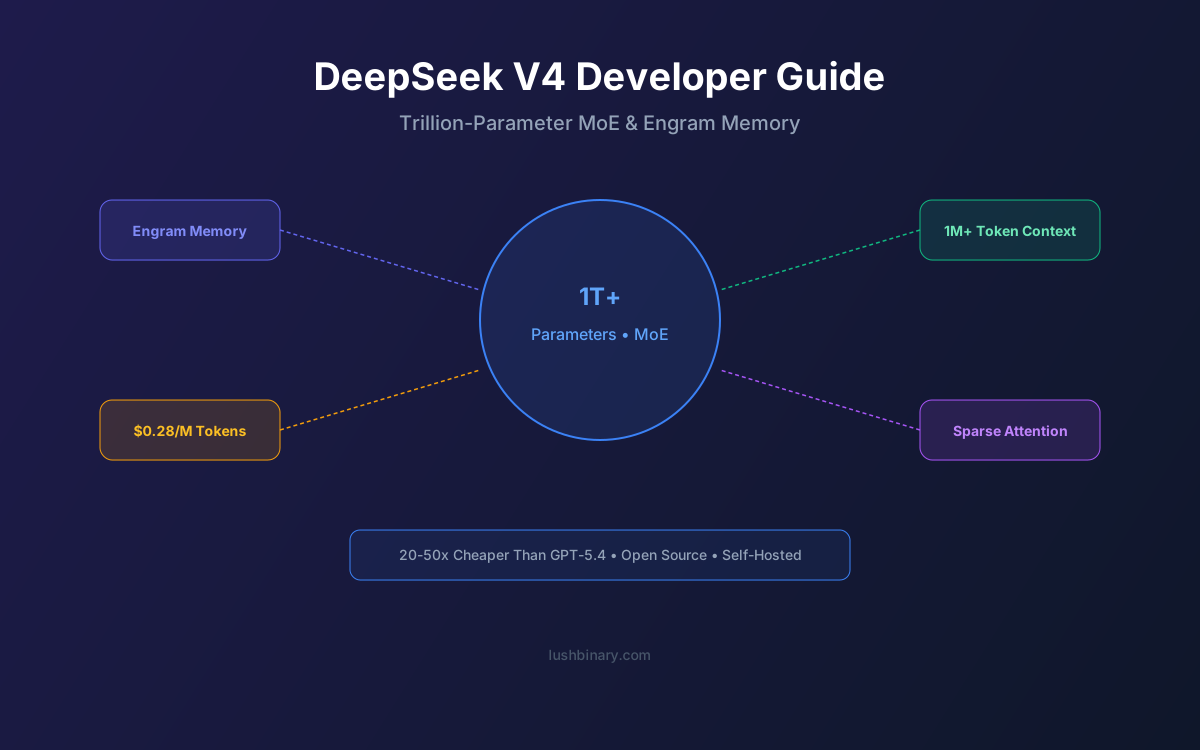
DeepSeek shook the AI industry in early 2025 with V3 and the R1 reasoning series. Now, DeepSeek V4 takes things further with a trillion-parameter Mixture-of-Experts architecture, Engram conditional memory for infinite context recall, and API pricing that makes frontier-level AI accessible to solo developers and startups alike. At roughly $0.28 per million input tokens, it's 20–50x cheaper than GPT-5.4 or Claude Opus 4.6.
In this guide, we break down V4's architecture, benchmark results, API integration, pricing, and how it stacks up against the competition. Whether you're evaluating it for production workloads or just curious about the model that's closing the gap between open-source and proprietary AI, this is everything you need to know.
What This Guide Covers
- Architecture: Trillion-Parameter MoE & Engram Memory
- Key Innovations: mHC, DSA & Lightning Indexer
- Benchmark Results & Performance
- API Access, Pricing & Free Tier
- Context Window & Caching
- Code Examples: Getting Started with the API
- DeepSeek V4 vs GPT-5.4 vs Claude Opus 4.6
- Use Cases & Production Patterns
- Limitations & What to Watch
- Why Lushbinary for AI Integration
1Architecture: Trillion-Parameter MoE & Engram Memory
DeepSeek V4 is built on a sparse Mixture-of-Experts (MoE) architecture with approximately 1 trillion total parameters. Only about 32 billion parameters are active per inference pass, routed through 8 of 256 specialized expert sub-networks per token. This gives V4 the reasoning capacity of a massive model with the inference cost of a much smaller one.
The headline innovation is Engram Memory — a conditional memory system that enables efficient retrieval from contexts exceeding 1 million tokens. Unlike traditional attention mechanisms that degrade over long contexts, Engram Memory allows V4 to instantly recall relevant information from entire codebases or knowledge bases without performance loss.
Key Architecture Stats
- ~1 trillion total parameters, ~32B active per token
- 256 expert sub-networks, 8 routed per token (~5.9% sparsity)
- 1M+ token context window with Engram Memory
- 128K max output tokens
- DeepSeek Sparse Attention (DSA) for token efficiency
2Key Innovations: mHC, DSA & Lightning Indexer
Three architectural innovations set V4 apart from previous generations and competing models:
Manifold-Constrained Hyper-Connections (mHC)
mHC provides bounded attention that prevents the model from losing coherence over extremely long contexts. It constrains the attention manifold to maintain quality even when processing documents that span hundreds of thousands of tokens.
DeepSeek Sparse Attention (DSA)
DSA reduces the computational cost of attention by selectively attending to the most relevant tokens. This is what makes the 1M context window practical — without DSA, the quadratic cost of attention would make long contexts prohibitively expensive.
Lightning Indexer
The Lightning Indexer works alongside Engram Memory to provide sub-linear retrieval from cached contexts. Instead of re-processing the entire context for each query, it indexes key information for near-instant recall.
3Benchmark Results & Performance
Internal testing and early community benchmarks suggest V4 is competitive with — and in some cases exceeds — the best proprietary models on coding and reasoning tasks. Here's how it stacks up based on available data:
| Benchmark | DeepSeek V4 | GPT-5.4 | Claude Opus 4.6 |
|---|---|---|---|
| SWE-Bench Verified | ~78% | ~75% | ~80% |
| HumanEval+ | ~92% | ~90% | ~91% |
| GPQA Diamond | ~88% | ~90% | ~94% |
| Context Window | 1M+ | 1M | 1M (beta) |
Note: DeepSeek V4 benchmarks are based on early community testing and internal reports. Official benchmarks may vary. Data sourced from community evaluations as of April 2026.
4API Access, Pricing & Free Tier
DeepSeek V4's pricing is its most disruptive feature. While GPT-5.4 charges $2.50/M input tokens and Claude Opus 4.6 charges $15/M input tokens, DeepSeek V4 comes in at a fraction of the cost:
| Tier | Input (per M tokens) | Output (per M tokens) |
|---|---|---|
| Standard (cache miss) | $0.28 | $1.10 |
| Cached (cache hit) | $0.028 | $1.10 |
| Free tier | 5M tokens (no credit card required) | |
Cost Comparison
Processing 1 billion tokens per month: DeepSeek V4 costs ~$280 (with caching, ~$28). The same workload on GPT-5.4 costs ~$2,500. On Claude Opus 4.6, ~$15,000. That's a 10–500x cost difference depending on cache hit rates.
5Context Window & Caching
DeepSeek silently upgraded from 128K to 1M tokens on February 11, 2026, with an official announcement on February 14. The 1M context window is powered by Engram Memory and DSA, making it practical for real-world use cases like processing entire codebases, long legal documents, or multi-file analysis.
Context caching is automatic — shared prompt prefixes are cached at $0.028/M tokens vs $0.28/M for cache misses. No code changes are needed. If you're sending the same system prompt or document prefix across multiple requests, you get a 90% cost reduction automatically.
6Code Examples: Getting Started with the API
DeepSeek V4's API is OpenAI-compatible, so you can use the standard OpenAI SDK with a different base URL:
import OpenAI from "openai";

const client = new OpenAI({
  baseURL: "https://api.deepseek.com",
  apiKey: process.env.DEEPSEEK_API_KEY,
});

const response = await client.chat.completions.create({
  model: "deepseek-chat", // V4 model
  messages: [
    { role: "system", content: "You are a senior engineer." },
    { role: "user", content: "Review this PR diff..." },
  ],
  max_tokens: 4096,
  temperature: 0.3,
});

console.log(response.choices[0].message.content);7DeepSeek V4 vs GPT-5.4 vs Claude Opus 4.6
The gap between open-source and proprietary AI has nearly closed in 2026. Here's a practical comparison for developers choosing between these three frontier models:
| Factor | DeepSeek V4 | GPT-5.4 | Claude Opus 4.6 |
|---|---|---|---|
| Cost (input/M) | $0.28 | $2.50 | $15.00 |
| Context Window | 1M+ | 1M | 200K (1M beta) |
| Computer Use | No | Yes (native) | Yes |
| Agent Teams | No | Codex subagents | Agent Teams |
| Self-hosting | Yes (open weights) | No | No |
| Best For | Cost-sensitive, self-hosted | Computer use, tool search | Long-horizon coding |
8Use Cases & Production Patterns
DeepSeek V4 excels in scenarios where cost efficiency and long-context processing are critical:
- Batch code review: Process hundreds of PRs daily at a fraction of the cost of GPT-5.4
- Document analysis: Ingest entire legal contracts, technical specs, or research papers in a single context
- RAG pipelines: Use as the generation model in retrieval-augmented generation with massive cost savings
- Self-hosted inference: Deploy on your own infrastructure for data sovereignty and compliance (HIPAA, SOC 2, GDPR)
- Content generation at scale: Generate marketing copy, documentation, or translations at high volume
- Codebase Q&A: Load entire repositories into context for intelligent code search and explanation
9Limitations & What to Watch
DeepSeek V4 is impressive, but it's not without caveats:
- No native computer use: Unlike GPT-5.4, V4 can't control browsers or desktop applications natively
- Latency: The MoE architecture can introduce higher latency on complex reasoning tasks compared to dense models
- Geopolitical considerations: As a Chinese AI lab, some enterprises may have compliance concerns about data routing
- Incremental rollout: V4 Lite appeared March 9, 2026, but the full model is still rolling out — availability may vary
- Benchmark verification: Some performance claims are based on internal testing and community reports, not yet independently verified at scale
10Why Lushbinary for AI Integration
At Lushbinary, we help teams evaluate, integrate, and deploy AI models like DeepSeek V4 into production systems. Whether you need a cost-optimized RAG pipeline, a self-hosted inference setup on AWS, or a multi-model architecture that routes between DeepSeek, GPT-5.4, and Claude based on task complexity, we've built it.
Our team has hands-on experience with every major LLM API and self-hosting stack. We can help you cut AI costs by 10–50x without sacrificing quality.
Free AI Architecture Consultation
Not sure which model fits your use case? Book a free 30-minute call with our AI team. We'll review your workload, estimate costs across providers, and recommend the optimal architecture.
❓ Frequently Asked Questions
What is DeepSeek V4 and how big is it?
DeepSeek V4 is a trillion-parameter Mixture-of-Experts model with ~32B active parameters per inference pass, using 256 expert sub-networks with 8 routed per token.
How much does DeepSeek V4 API cost?
Standard input costs $0.28/M tokens, cached input costs $0.028/M tokens (90% savings). New accounts get 5M free tokens. This is 20-50x cheaper than GPT-5.4 or Claude Opus 4.6.
What is Engram Memory in DeepSeek V4?
Engram Memory is a conditional memory system enabling efficient retrieval from 1M+ token contexts without performance degradation.
How does DeepSeek V4 compare to GPT-5.4?
V4 matches GPT-5.4 on most coding benchmarks while costing 10x less. GPT-5.4 has native computer use and tool search that V4 lacks.
Can I self-host DeepSeek V4?
Yes. DeepSeek V4 has open weights, so you can deploy it on your own infrastructure for data sovereignty and compliance requirements.
📚 Sources
- DeepSeek API Documentation
- DeepSeek V4 Engram Memory Research Paper
- OpenAI GPT-5.4 Announcement (for comparison data)
Content was rephrased for compliance with licensing restrictions. Pricing and benchmark data sourced from official API documentation and community evaluations as of April 2026. Pricing may change — always verify on the vendor's website.
Need Help Integrating DeepSeek V4?
Our team builds production AI pipelines with DeepSeek, GPT-5.4, and Claude. Let us help you cut costs and ship faster.
Build Smarter, Launch Faster.
Book a free strategy call and explore how LushBinary can turn your vision into reality.