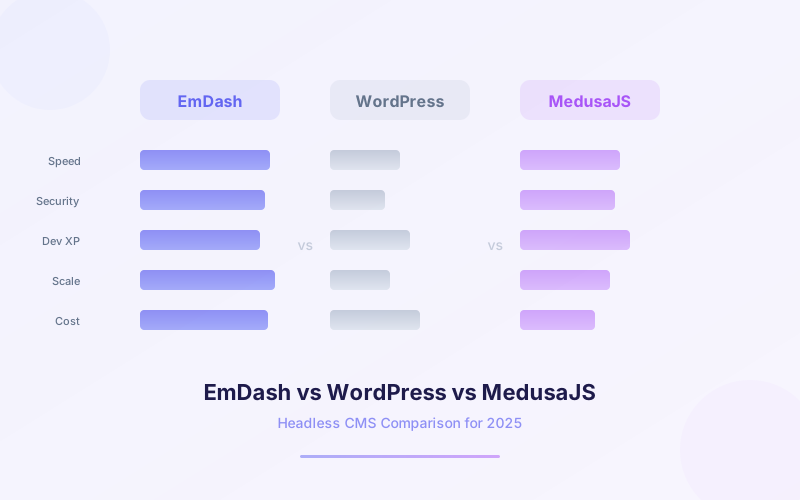
The CMS landscape just got a lot more interesting. Cloudflare's EmDash launched in April 2026 as a TypeScript-native, serverless alternative to WordPress. Meanwhile, MedusaJS continues to gain traction as the leading open-source headless e-commerce platform. And WordPress still powers 43% of the web.
So which one should you pick? The answer depends entirely on what you're building. This comparison breaks down architecture, security, hosting costs, developer experience, and ideal use cases for each platform — with real numbers and honest trade-offs.
We've built production sites on all three platforms at Lushbinary, so this isn't theoretical. These are the trade-offs we navigate with clients every week.
📋 Table of Contents
- 1.Platform Overview: What Each One Does
- 2.Architecture & Tech Stack Comparison
- 3.Security Model Deep Dive
- 4.Hosting Costs: Real Numbers
- 5.Developer Experience & Learning Curve
- 6.Plugin & Extension Ecosystem
- 7.SEO & Performance
- 8.AI & Automation Capabilities
- 9.When to Choose Each Platform
- 10.Combining Platforms: EmDash + MedusaJS
- 11.How Lushbinary Helps You Choose
1Platform Overview: What Each One Does
EmDash
Content management system for blogs, publications, and marketing sites. TypeScript + Astro. Serverless on Cloudflare Workers.
WordPress
General-purpose CMS powering 43% of the web. PHP-based. Requires provisioned servers. Massive plugin ecosystem.
MedusaJS
Headless e-commerce platform for online stores. Node.js + TypeScript. API-first with React/Next.js storefronts.
The key insight: these platforms aren't direct competitors. EmDash and WordPress compete in the CMS space. MedusaJS competes with Shopify and WooCommerce in e-commerce. The real question is which combination fits your project.
2Architecture & Tech Stack Comparison
| Aspect | EmDash | WordPress | MedusaJS |
|---|---|---|---|
| Language | TypeScript | PHP | TypeScript/Node.js |
| Framework | Astro 6 | Custom PHP | Express.js |
| Database | Cloudflare D1/KV | MySQL | PostgreSQL |
| Hosting | Serverless (CF Workers) | Server-required | Server-required |
| License | MIT | GPL v2 | MIT |
| API | REST + MCP | REST + GraphQL (plugin) | REST + GraphQL |
| Frontend | Astro (islands) | PHP templates/blocks | Headless (any) |
| Auth | Passkeys (default) | Passwords | JWT/Session |
3Security Model Deep Dive
Security is where EmDash makes its strongest case against WordPress:
- WordPress: 11,300+ new vulnerabilities in 2025 (42% increase YoY). 91% originate in plugins that have unrestricted access to the database and filesystem. The plugin review queue is 800+ deep with 2+ week wait times.
- EmDash: Plugins run in isolated Dynamic Worker sandboxes. Each plugin declares capabilities in a manifest and can only access what's explicitly granted. No direct database or filesystem access.
- MedusaJS: As a headless platform, the attack surface is smaller. Custom modules run in the same Node.js process but the API-first design limits exposure. No equivalent to WordPress's plugin security crisis.
According to Patchstack's 2026 report, more high-severity WordPress vulnerabilities were found in 2025 than in the previous two years combined. EmDash's capability-based sandbox model eliminates this entire vulnerability class.
4Hosting Costs: Real Numbers
| Traffic Level | EmDash (CF Workers) | WordPress (Managed) | MedusaJS (AWS) |
|---|---|---|---|
| Low (< 100K req/mo) | $0 (free tier) | $5-15/mo | $20-40/mo |
| Medium (1M req/mo) | $5-10/mo | $25-50/mo | $50-100/mo |
| High (10M req/mo) | $30-60/mo | $100-300/mo | $200-500/mo |
| Enterprise (100M+) | $200-500/mo | $500-2,000/mo | $1,000-3,000/mo |
EmDash's scale-to-zero model is a game-changer for cost. WordPress requires a server running 24/7 regardless of traffic. MedusaJS needs a Node.js server plus PostgreSQL, which has a higher baseline cost but is justified for e-commerce revenue.
5Developer Experience & Learning Curve
EmDash: If you know TypeScript and Astro (or any modern frontend framework), you're productive immediately. The plugin API is clean and well-documented. The learning curve is low for JavaScript/TypeScript developers but steep for PHP-only WordPress developers.
WordPress: The lowest barrier to entry of any CMS. Non-developers can build sites with themes and plugins. But the developer experience for custom work (PHP, hooks, filters, the loop) feels dated compared to modern frameworks.
MedusaJS: Requires solid Node.js and TypeScript skills. The modular architecture is elegant but has a steeper learning curve than WordPress. Best suited for teams with backend development experience.
6Plugin & Extension Ecosystem
This is WordPress's strongest advantage and EmDash's biggest gap:
- WordPress: 60,000+ free plugins, thousands of premium plugins. Whatever you need, there's probably a plugin for it.
- EmDash: Brand new (v0.1.0). The plugin ecosystem is essentially starting from zero. The MIT license and sandboxed architecture should attract developers, but it will take time to build critical mass.
- MedusaJS: Growing ecosystem of modules and integrations. Stripe, PayPal, and major payment providers are well-supported. Smaller than WordPress but focused on e-commerce needs.
7SEO & Performance
EmDash: Astro's zero-JavaScript-by-default approach means exceptional Core Web Vitals scores. Static HTML pages load instantly. This is a significant SEO advantage.
WordPress: Performance varies wildly depending on theme, plugins, and hosting. A well-optimized WordPress site can score well, but the average WordPress site loads in 2.5 seconds on desktop and 13+ seconds on mobile.
MedusaJS: As a headless platform, performance depends on your frontend. With Next.js or Astro, you can achieve excellent scores. The API response times are fast with proper caching.
8AI & Automation Capabilities
EmDash is the clear leader here with its AI-native design:
- EmDash: Built-in MCP server, CLI for programmatic management, Agent Skills for AI-assisted development. Every instance is designed to be managed by AI agents.
- WordPress: AI capabilities come through plugins (AI content generators, chatbots). No native AI integration. The REST API enables automation but wasn't designed for agent workflows.
- MedusaJS: API-first design works well with AI agents. You can build AI-powered shopping assistants, but there's no built-in MCP or agent skill system.
9When to Choose Each Platform
Choose EmDash when:
- Building a new content site, blog, or publication
- Security is a top priority and you want sandboxed plugins
- You want serverless hosting with scale-to-zero economics
- Your team knows TypeScript and modern frontend frameworks
- You want AI-native content management with MCP support
- You're comfortable with early-stage software (v0.1.0)
Choose WordPress when:
- You need a battle-tested, production-stable CMS today
- Non-technical users need to manage content
- You rely on specific WordPress plugins with no alternatives
- Your team has PHP expertise
- You need WooCommerce for e-commerce
Choose MedusaJS when:
- Building an online store or marketplace
- You need headless e-commerce with a custom frontend
- Multi-region, multi-currency support is required
- You want to avoid Shopify's transaction fees and vendor lock-in
- Your team has Node.js/TypeScript experience
10Combining Platforms: EmDash + MedusaJS
One of the most powerful patterns we're seeing is using EmDash for content and MedusaJS for commerce. EmDash handles your blog, marketing pages, and documentation. MedusaJS handles your product catalog, checkout, and order management. Both are TypeScript-native and API-first, making integration straightforward.
This gives you the best of both worlds: EmDash's serverless content delivery and security model for your marketing site, plus MedusaJS's purpose-built e-commerce engine for your store.
11How Lushbinary Helps You Choose
We've built production sites on WordPress, MedusaJS, and now EmDash. We don't push one platform over another — we help you pick the right tool for your specific needs and budget.
🚀 Free Platform Consultation
Not sure which platform fits your project? We'll review your requirements and recommend the best architecture. Book a free 30-minute call.
❓ Frequently Asked Questions
Should I choose EmDash or WordPress for a new website in 2026?
For new content-driven sites, EmDash offers better security, modern TypeScript development, and serverless hosting. WordPress is better if you need its massive plugin ecosystem or have an existing team with PHP expertise. EmDash is still v0.1.0 preview, so WordPress remains the safer choice for production sites that need stability today.
How does EmDash compare to MedusaJS?
They serve different purposes. EmDash is a content management system (blogs, publications, marketing sites). MedusaJS is a headless e-commerce platform (online stores, product catalogs, checkout flows). You could use both together: EmDash for content and MedusaJS for commerce.
Is EmDash cheaper to host than WordPress?
Yes, significantly. EmDash on Cloudflare Workers scales to zero (no traffic = no cost) with a free tier of 100,000 requests/day. WordPress requires a provisioned server running 24/7, typically $5-30/month minimum.
Can EmDash handle e-commerce like WooCommerce?
Not yet. EmDash v0.1.0 is focused on content management. For e-commerce, WordPress with WooCommerce or MedusaJS are better options.
📚 Sources
- Cloudflare Blog: Introducing EmDash
- Patchstack: State of WordPress Security 2026
- WordPress Statistics 2026
Content was rephrased for compliance with licensing restrictions. Statistics sourced from official reports as of April 2026. Pricing and features may change.
Let's Pick the Right Platform Together
Tell us about your project and we'll recommend the best CMS and architecture for your needs.
Build Smarter, Launch Faster.
Book a free strategy call and explore how LushBinary can turn your vision into reality.