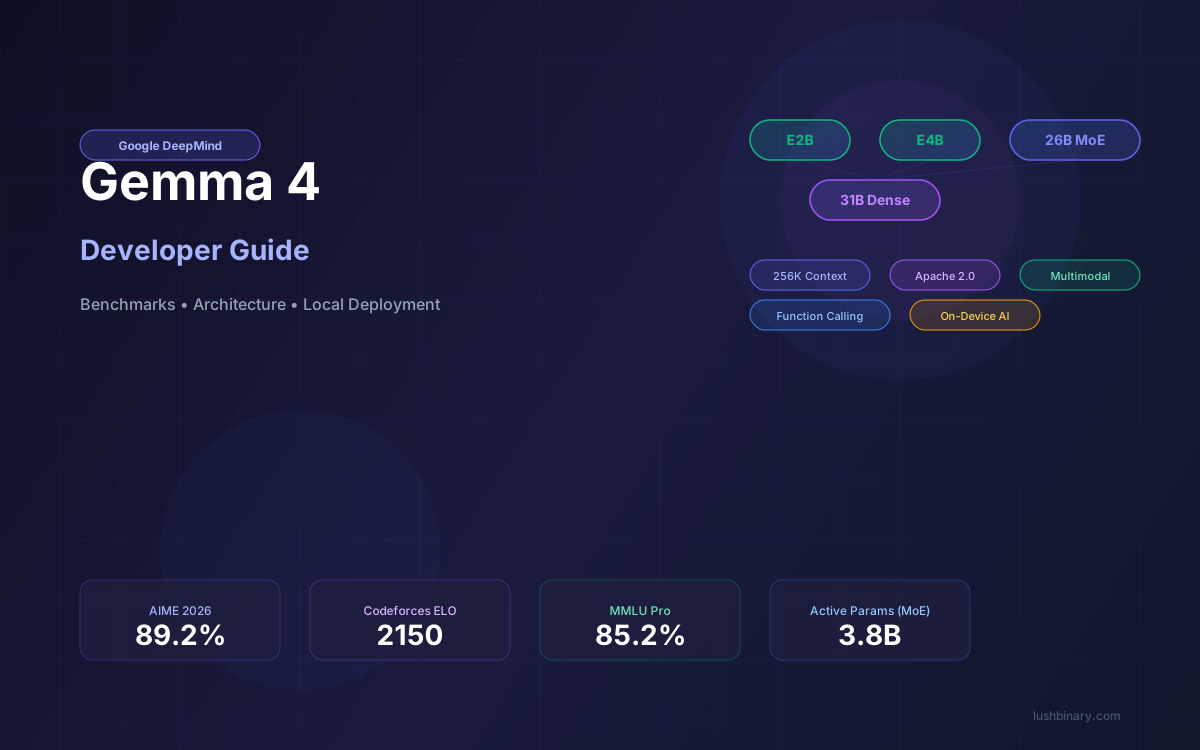
Google DeepMind released Gemma 4 on April 2, 2026, and it's a significant leap for open-weight AI. Four model sizes spanning from 2.3B effective parameters to 31B dense, all under Apache 2.0 for the first time in the Gemma family's history. Multimodal by default (text, images, video, and audio on the smaller models), context windows up to 256K tokens, native function calling, and benchmark scores that put models 20x their size to shame.
The open-weight landscape in 2026 is crowded. Llama 4, Qwen 3.5, DeepSeek V3 — all strong contenders. But Gemma 4 carves out a unique position: it delivers frontier-level intelligence at every size tier, from phones to workstations, with a truly permissive license and day-0 support across every major inference engine.
This guide covers the full Gemma 4 family: architecture innovations, benchmark breakdowns against the competition, the complete model lineup, local deployment instructions, multimodal capabilities, agentic workflows, fine-tuning options, and practical guidance on when Gemma 4 is the right choice for your project.
📋 Table of Contents
- 1.The Gemma 4 Model Family
- 2.Architecture: PLE, Shared KV Cache & Hybrid Attention
- 3.Benchmark Breakdown vs Open-Weight Rivals
- 4.Multimodal Capabilities: Vision, Video & Audio
- 5.Agentic Workflows & Function Calling
- 6.Running Gemma 4 Locally
- 7.Fine-Tuning Gemma 4
- 8.Gemma 4 on Google Cloud & NVIDIA
- 9.When to Choose Gemma 4
- 10.Why Lushbinary for Your AI Integration
1The Gemma 4 Model Family
Gemma 4 ships in four sizes, each targeting a different deployment scenario. All models are available in both pre-trained and instruction-tuned variants, and all are released under the Apache 2.0 license — a first for the Gemma family, replacing the previous custom Gemma license that restricted certain commercial uses.
| Model | Parameters | Context | Modalities |
|---|---|---|---|
| Gemma 4 E2B | 2.3B effective (5.1B with embeddings) | 128K | Text, Image, Audio |
| Gemma 4 E4B | 4.5B effective (8B with embeddings) | 128K | Text, Image, Audio |
| Gemma 4 26B A4B | 3.8B active / 25.2B total (MoE: 8 active / 128 total experts + 1 shared) | 256K | Text, Image |
| Gemma 4 31B | 30.7B dense | 256K | Text, Image |
The "E" in E2B and E4B stands for "effective" parameters. These smaller models use Per-Layer Embeddings (PLE), which adds a parallel embedding table that's large but only used for quick lookups. The effective parameter count (what actually runs during inference) is much smaller than the total. The "A" in 26B A4B stands for "active" — only 3.8B parameters fire per forward pass in the MoE model, making it nearly as fast as a 4B model despite having 25.2B total parameters.
💡 Key Insight
All Gemma 4 models share a 262K vocabulary size and support 140+ languages. The vision encoder uses learned 2D positions with multidimensional RoPE and supports variable aspect ratios with configurable token budgets (70, 140, 280, 560, 1120 tokens per image). The audio encoder (E2B/E4B only) is a USM-style conformer supporting up to 30 seconds of audio.
2Architecture: PLE, Shared KV Cache & Hybrid Attention
Gemma 4's architecture is deliberately designed for broad compatibility across inference engines and devices. Google stripped out complex or inconclusive features (like Altup) and focused on a combination that's efficient, quantization-friendly, and practical for real-world deployment.
Hybrid Attention: Sliding Window + Global
All Gemma 4 models alternate between local sliding-window attention and global full-context attention layers, with the final layer always being global. Smaller dense models use 512-token sliding windows while larger models use 1024-token windows. This hybrid design delivers the speed and low memory footprint of a lightweight model without sacrificing deep awareness for complex, long-context tasks.
For positional encoding, Gemma 4 uses dual RoPE configurations: standard RoPE for sliding layers and proportional RoPE (p-RoPE) for global layers. This enables reliable long-context performance up to 256K tokens on the larger models.
Per-Layer Embeddings (PLE)
In a standard transformer, each token gets a single embedding vector at input, and the residual stream builds on that same initial representation across all layers. PLE adds a parallel, lower-dimensional conditioning pathway. For each token, it produces a small dedicated vector for every layer by combining a token-identity component (from an embedding lookup) with a context-aware component (from a learned projection). Each decoder layer then uses its corresponding vector to modulate hidden states via a lightweight residual block after attention and feed-forward.
This gives each layer its own channel to receive token-specific information only when it becomes relevant, rather than requiring everything to be packed into a single upfront embedding. Because the PLE dimension is much smaller than the main hidden size, this adds meaningful per-layer specialization at modest parameter cost.
Shared KV Cache
The last num_kv_shared_layers layers of the model don't compute their own key and value projections. Instead, they reuse the K and V tensors from the last non-shared layer of the same attention type (sliding or full). In practice, this has minimal impact on quality while significantly reducing both memory and compute for long-context generation and on-device use.
3Benchmark Breakdown vs Open-Weight Rivals
Gemma 4's benchmark results are striking, especially considering the model sizes. The 31B Dense model currently ranks 3rd among all open models on the Arena AI text leaderboard with an estimated score of 1452. The 26B MoE sits 6th with a score of 1441 — using only 3.8B active parameters. Google claims both larger models outcompete models up to 20x their size on that benchmark.
| Benchmark | Gemma 4 31B | Gemma 4 26B A4B | Gemma 4 E4B | Gemma 3 27B |
|---|---|---|---|---|
| MMLU Pro | 85.2% | 82.6% | 69.4% | 67.6% |
| AIME 2026 | 89.2% | 88.3% | 42.5% | 20.8% |
| GPQA Diamond | 84.3% | 82.3% | 58.6% | 42.4% |
| LiveCodeBench v6 | 80.0% | 77.1% | 52.0% | 29.1% |
| Codeforces ELO | 2150 | 1718 | 940 | 110 |
| MMMU Pro (Vision) | 76.9% | 73.8% | 52.6% | 49.7% |
| MATH-Vision | 85.6% | 82.4% | 59.5% | 46.0% |
| MRCR v2 128k | 66.4% | 44.1% | 25.4% | 13.5% |
The generational leap from Gemma 3 to Gemma 4 is massive. On AIME 2026 (math competition), the 31B model scores 89.2% vs Gemma 3 27B's 20.8%. On Codeforces, it jumps from an ELO of 110 to 2150. The 26B MoE model is particularly impressive — it achieves 88.3% on AIME 2026 with only 3.8B active parameters, making it one of the most parameter-efficient reasoning models available.
How It Stacks Up Against the Competition
In the open-weight space as of April 2026, Gemma 4 competes directly with Qwen 3.5 and Llama 4. The 31B Dense model's MMLU Pro score of 85.2% exceeds Qwen 3.5 27B's performance on the same benchmark, and its Codeforces ELO of 2150 is competitive with much larger models. Llama 4 Scout (109B total, 17B active) has a larger context window (10M tokens) but Gemma 4's 256K is sufficient for most production use cases.
Where Gemma 4 truly differentiates is at the small end. The E2B and E4B models with native audio support and 128K context windows have no direct equivalent in the Llama 4 or Qwen 3.5 families at that size tier. For on-device and edge deployment, Gemma 4 is currently the strongest option.
4Multimodal Capabilities: Vision, Video & Audio
All Gemma 4 models handle text and image input natively. The E2B and E4B models add audio input. Video is supported across all sizes by processing sequences of frames (up to 60 seconds at 1 fps). The vision encoder supports variable aspect ratios and configurable image token budgets, letting you trade off between detail and speed.
Vision: Object Detection, OCR & GUI Understanding
Gemma 4 natively responds with JSON bounding boxes for object detection and GUI element pointing — no special prompting or grammar-constrained generation needed. The coordinates reference a 1000x1000 image space relative to input dimensions. This makes it immediately useful for UI automation, document parsing, and visual search applications.
The variable image resolution system is a practical advantage. You can set the token budget per image:
- 70-140 tokens: Classification, captioning, video frame processing — fast inference, lower detail
- 280-560 tokens: General-purpose visual understanding, chart comprehension
- 1120 tokens: OCR, document parsing, reading small text — maximum detail
Audio: Speech Recognition & Translation
The E2B and E4B models include a USM-style conformer audio encoder supporting up to 30 seconds of audio. Capabilities include automatic speech recognition (ASR) and speech-to-translated-text translation across multiple languages. In Hugging Face's testing, the E4B model produced accurate transcriptions and audio descriptions, while the E2B occasionally hallucinated on audio content.
# ASR prompt template for Gemma 4 E2B/E4B
Transcribe the following speech segment in English into English text.
Follow these specific instructions for formatting the answer:
* Only output the transcription, with no newlines.
* When transcribing numbers, write the digits, i.e. write 1.7 and not one point seven.
Video Understanding
While not explicitly post-trained on video, all Gemma 4 models can analyze video by processing frame sequences. The smaller models (E2B, E4B) can process videos with audio, while the larger models handle video frames without audio. In Hugging Face's testing, the E4B model accurately described both visual content and song lyrics from a concert video, while the 26B and 31B models correctly identified visual elements without audio context.
5Agentic Workflows & Function Calling
Gemma 4 represents a significant step forward for agentic AI in the open-weight space. Unlike earlier Gemma iterations that forced developers to tweak their designs for tool interaction, Gemma 4 has native support for function calling and structured JSON outputs across all model sizes.
Native Function Calling
You define tools as JSON schemas, and the model natively generates structured tool calls. This works across all modalities — you can show the model an image and ask it to call a weather API for the location shown. In testing, all four model sizes correctly identified Bangkok from a temple image and generated the appropriate get_weather function call.
Thinking Mode
All Gemma 4 models support configurable thinking modes. When enabled via the <|think|> token in the system prompt, the model outputs its internal reasoning before the final answer. The thinking output is structured with <|channel>thought tags, making it easy to parse and separate reasoning from responses. This is particularly useful for complex multi-step tasks where you want transparency into the model's decision process.
Native System Prompt Support
Gemma 4 introduces native support for the system role, enabling more structured and controllable conversations. Previous Gemma versions required workarounds for system-level instructions.
Agent Framework Integration
Thanks to day-0 llama.cpp support with an OpenAI-compatible API server, Gemma 4 plugs directly into popular agent frameworks. The Hugging Face team verified compatibility with OpenClaw, Hermes, Pi, and Open Code. You start a local llama.cpp server and point your agent framework at it — no custom adapters needed.
6Running Gemma 4 Locally
Gemma 4 has day-0 support across every major local inference engine. Here's how to get started with each.
llama.cpp (Recommended for Local Servers)
The fastest path to running Gemma 4 locally with an OpenAI-compatible API. Supports image + text from launch.
# Install
brew install llama.cpp # macOS
winget install llama.cpp # Windows
# Start server with the 26B MoE model (Q4_K_M quantization)
llama-server -hf ggml-org/gemma-4-26b-a4b-it-GGUF:Q4_K_M
# Or the E4B for lighter hardware
llama-server -hf ggml-org/gemma-4-E4B-it-GGUF
NVIDIA benchmarked the 26B MoE model with Q4_K_M quantization on an RTX 5090 and Mac M3 Ultra using llama.cpp b7789, confirming strong token generation throughput for local agentic use cases.
Hugging Face Transformers
First-class support with the AutoModelForMultimodalLM class. The simplest path is the any-to-any pipeline:
# Install latest transformers
pip install -U transformers
from transformers import pipeline
pipe = pipeline("any-to-any", model="google/gemma-4-e2b-it")
messages = [{
"role": "user",
"content": [
{"type": "image", "image": "photo.jpg"},
{"type": "text", "text": "Describe this image"}
]
}]
output = pipe(messages, max_new_tokens=200)
MLX (Apple Silicon)
Full multimodal support via the mlx-vlm library. MLX supports TurboQuant, which delivers baseline accuracy with ~4x less active memory and significantly faster end-to-end inference — making long-context inference practical on Apple Silicon.
pip install -U mlx-vlm
mlx_vlm.generate \
--model google/gemma-4-E4B-it \
--image photo.jpg \
--prompt "Describe this image in detail"
# With TurboQuant for 4x less memory
mlx_vlm.generate \
--model mlx-community/gemma-4-26B-A4B-it \
--prompt "Your prompt" \
--kv-bits 3.5 --kv-quant-scheme turboquant
transformers.js (Browser)
Gemma 4 runs directly in the browser via WebGPU with transformers.js. ONNX checkpoints are available for edge and browser deployment. This opens up client-side AI applications with zero server costs.
mistral.rs (Rust)
Rust-native inference engine with day-0 Gemma 4 support across all modalities and built-in tool-calling. Supports UQFF quantization format and ISQ (in-situ quantization).
# Start OpenAI-compatible server
mistralrs serve mistralrs-community/gemma-4-E4B-it-UQFF --from-uqff 8
# Interactive mode with image
mistralrs run -m google/gemma-4-E4B-it --isq 8 --image photo.png -i "Describe this"
Hardware Requirements
| Model | Minimum Hardware | Recommended |
|---|---|---|
| E2B | Smartphone / 4GB RAM | Any modern device |
| E4B | 8GB RAM laptop | 16GB RAM / Apple M-series |
| 26B A4B (Q4) | 16GB VRAM GPU / 32GB Mac | 24GB VRAM (RTX 4090/5090) |
| 31B (Q4) | 24GB VRAM GPU / 48GB Mac | 80GB H100 (unquantized bf16) |
7Fine-Tuning Gemma 4
Gemma 4 is fully supported for fine-tuning across multiple platforms. The Hugging Face team noted that the models are so capable out of the box that they "struggled to find good fine-tuning examples" — but when you need domain-specific behavior, the options are comprehensive.
TRL (Transformers Reinforcement Learning)
TRL has been upgraded with support for multimodal tool responses, meaning models can now receive images back from tools during training. The Hugging Face team built a demo where Gemma 4 E2B learns to drive in the CARLA simulator — the model sees the road through a camera, decides what to do, and learns from the outcome. After training, it consistently changes lanes to avoid pedestrians.
# Fine-tune Gemma 4 E2B with TRL
pip install git+https://github.com/huggingface/trl.git
python examples/scripts/openenv/carla_vlm_gemma.py \
--model google/gemma-4-E2B-it
Vertex AI (Google Cloud)
Google provides examples for fine-tuning Gemma 4 with TRL on Vertex AI using SFT, including how to build a custom Docker container with CUDA support and run it via Vertex AI Serverless Training Jobs on NVIDIA H100 GPUs.
Unsloth Studio
For a UI-based fine-tuning experience, Unsloth Studio supports Gemma 4 and runs locally or on Google Colab. Install with curl -fsSL https://unsloth.ai/install.sh | sh on macOS/Linux, then launch with unsloth studio.
8Gemma 4 on Google Cloud & NVIDIA
For production deployment beyond local inference, Gemma 4 is available on Google Cloud and optimized for NVIDIA hardware from day one.
Google Cloud
Gemma 4 is available on Google Cloud through Vertex AI Model Garden, GKE with vLLM, and Cloud Run. Google positions it for complex logic, offline code generation, and agentic workflows in enterprise environments.
NVIDIA Optimization
NVIDIA has day-0 acceleration for Gemma 4 across RTX PCs, DGX Spark, and edge devices. The models are optimized for consumer GPUs, and NVIDIA's benchmarks show strong token generation throughput with Q4_K_M quantization on RTX 5090 and Mac M3 Ultra desktops using llama.cpp.
Android AICore
Google announced Gemma 4 in the AICore Developer Preview, enabling on-device AI for Android apps with multimodal understanding and 140+ language support. This means Android developers can integrate Gemma 4 directly into their apps without server-side inference costs.
9When to Choose Gemma 4
With Llama 4, Qwen 3.5, and DeepSeek V3 all available, choosing the right open-weight model depends on your specific constraints. Here's when Gemma 4 is the strongest pick:
✅ Choose Gemma 4 When
- •You need on-device / edge deployment (E2B/E4B are unmatched at their size)
- •You need multimodal (text + image + audio) in a single model
- •Apache 2.0 licensing is a hard requirement
- •You want the best parameter-efficiency (26B MoE with 3.8B active)
- •You need native function calling for agentic workflows
- •You're deploying on Apple Silicon (MLX + TurboQuant support)
- •You need browser-based inference (transformers.js + WebGPU)
⚠️ Consider Alternatives When
- •You need 10M+ token context (Llama 4 Scout)
- •You need the absolute largest open model (Llama 4 Maverick 400B, Qwen 3.5 397B)
- •You need the cheapest cloud API (DeepSeek V3 at $0.14/M input tokens)
- •You need extensive Chinese language support (Qwen 3.5)
- •You need a proven production track record (Llama 4 has broader deployment history)
💡 Multi-Model Strategy
Many production setups benefit from routing between models. Use Gemma 4 E4B for fast, cheap tasks (classification, simple Q&A), the 26B MoE for complex reasoning at moderate cost, and fall back to a frontier closed model (Claude, GPT-5) for the hardest 5% of queries. This approach can cut inference costs by 60-80% while maintaining quality. See our OpenClaw with open-source LLMs guide for model routing patterns.
10Why Lushbinary for Your AI Integration
Integrating open-weight models like Gemma 4 into production applications requires more than just running inference. You need model selection strategy, infrastructure design, cost optimization, and ongoing monitoring. That's where Lushbinary comes in.
We've built production AI systems with GPT-5.4, Qwen 3.5, and now Gemma 4. We understand the tradeoffs between model families and can help you design a multi-model architecture that balances cost, latency, and quality for your specific use case.
- Model Selection & Benchmarking: We evaluate models against your actual workloads, not just public benchmarks
- Infrastructure Design: From on-device deployment to cloud-scale inference with AWS cost optimization
- Agentic Workflows: Building AI agents with function calling, tool use, and MCP integrations
- Fine-Tuning & Optimization: Domain-specific model adaptation with LoRA, QLoRA, and full fine-tuning
🚀 Free Consultation
Not sure which model is right for your project? Book a free 30-minute consultation and we'll help you evaluate Gemma 4 against your requirements, estimate infrastructure costs, and design an integration plan.
❓ Frequently Asked Questions
What is Google Gemma 4 and what sizes does it come in?
Gemma 4 is Google DeepMind's latest open-weight model family, released April 2, 2026 under Apache 2.0. It comes in four sizes: E2B (2.3B effective), E4B (4.5B effective), 26B A4B MoE (3.8B active / 26B total), and 31B Dense. All support multimodal input (text + images), with E2B and E4B also supporting audio.
How does Gemma 4 compare to Llama 4 and Qwen 3.5?
Gemma 4 31B scores 85.2% on MMLU Pro and 89.2% on AIME 2026. The 26B MoE ranks 6th on Arena AI with only 3.8B active parameters. It excels at parameter efficiency and on-device deployment. Llama 4 Scout offers 10M token context, and Qwen 3.5 has a larger flagship model (397B), but Gemma 4 leads at the small-to-medium size tier.
Can I run Gemma 4 locally on my laptop?
Yes. E2B runs on smartphones, E4B on 8GB laptops, the 26B MoE on a 24GB GPU with Q4 quantization, and the 31B Dense on a single 80GB H100 unquantized. All have day-0 support in llama.cpp, Ollama, MLX, transformers, and mistral.rs.
What is the Gemma 4 context window size?
E2B and E4B support 128K tokens. The 26B MoE and 31B Dense support 256K tokens, sufficient for processing long documents and entire code repositories in a single prompt.
Does Gemma 4 support function calling and agentic workflows?
Yes. All models have native function calling with structured JSON output, configurable thinking modes, native system prompts, and work with agent frameworks like OpenClaw, Hermes, and Pi via llama.cpp's OpenAI-compatible server.
📚 Sources
- Gemma 4 Model Card — Google AI for Developers
- Gemma 4: Frontier Multimodal Intelligence on Device — Hugging Face Blog
- Our Most Capable Open Models to Date — Google Blog
- Gemma 4 Available on Google Cloud
- Gemma 4 — Google DeepMind
- RTX to Spark: Gemma 4 Accelerated for Agentic AI — NVIDIA Blog
Content was rephrased for compliance with licensing restrictions. Benchmark data sourced from official Google model cards and Hugging Face evaluations as of April 2026. Model specifications and pricing may change — always verify on the vendor's website.
Build with Gemma 4 — We'll Help You Ship
From on-device deployment to cloud-scale agentic workflows, Lushbinary helps you integrate Gemma 4 into production applications. Tell us about your project.
Build Smarter, Launch Faster.
Book a free strategy call and explore how LushBinary can turn your vision into reality.