Choosing an open-weight model for production in 2026 means picking between three serious contenders: Google's Gemma 4, Meta's Llama 4, and Alibaba's Qwen 3.5. Each family takes a different approach to architecture, licensing, and deployment targets. The wrong choice can cost you months of integration work or lock you into a license that doesn't fit your business.
This guide compares all three families head-to-head across benchmarks, licensing, inference speed, memory requirements, multimodal capabilities, context windows, and edge deployment. No vendor bias — just the data you need to make the right call for your specific use case.
📋 Table of Contents
- 1.Model Family Overview
- 2.Licensing: Apache 2.0 vs Llama Community License
- 3.Benchmark Comparison
- 4.Inference Speed & Memory Requirements
- 5.Multimodal Capabilities
- 6.Context Window & Long-Document Performance
- 7.Edge & On-Device Deployment
- 8.Agentic Workflows & Function Calling
- 9.Decision Framework: Which Model to Choose
- 10.Why Lushbinary for Your AI Integration
1Model Family Overview
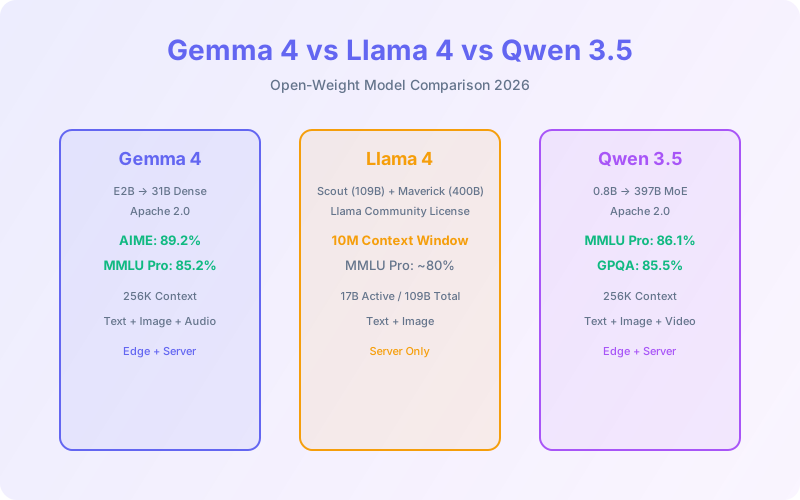
All three families shipped in early 2026 and use Mixture-of-Experts (MoE) architectures for their flagship models. But the size tiers, licensing, and deployment targets differ significantly.
| Feature | Gemma 4 | Llama 4 | Qwen 3.5 |
|---|---|---|---|
| Release Date | April 2, 2026 | April 5, 2025 | Feb 16, 2026 |
| Model Sizes | E2B, E4B, 26B MoE, 31B Dense | Scout (109B), Maverick (400B) | 0.8B–9B Small, 27B Dense, 122B, 397B MoE |
| License | Apache 2.0 | Llama 4 Community | Apache 2.0 |
| Max Context | 256K tokens | 10M tokens (Scout) | 256K tokens |
| Modalities | Text, Image, Audio (E2B/E4B) | Text, Image | Text, Image, Video |
| Architecture | Dense + MoE, Hybrid Attention | MoE only | Dense + MoE, Gated Delta Networks |
| Smallest Model | E2B (2.3B effective) | Scout (17B active / 109B total) | 0.8B |
The key structural difference: Gemma 4 covers the full spectrum from 2.3B edge models to 31B workstation models. Llama 4 starts at 109B total parameters (17B active), making it a server-only family. Qwen 3.5 has the widest range with 8 models from 0.8B to 397B, but its smallest models lack audio support.
2Licensing: Apache 2.0 vs Llama Community License
Licensing is often the deciding factor for production deployments. Here's the breakdown:
Gemma 4
Apache 2.0
- • No usage restrictions
- • Full commercial use
- • Redistribute freely
- • Modify without attribution
- • No MAU limits
Llama 4
Llama 4 Community
- • Free for most commercial use
- • 700M MAU limit
- • 'Built with Llama' required
- • Cannot use to train competing models
- • Must accept Meta's terms
Qwen 3.5
Apache 2.0
- • No usage restrictions
- • Full commercial use
- • Redistribute freely
- • Modify without attribution
- • No MAU limits
💡 Key Insight
If you're building a product that could scale past 700M MAU, or if you need to redistribute modified model weights without attribution requirements, Gemma 4 and Qwen 3.5 are the only options. Llama 4's license is generous for most startups but becomes restrictive at scale.
3Benchmark Comparison
Benchmarks don't tell the whole story, but they're the best starting point for comparing model intelligence. Here's how the flagship models stack up across reasoning, coding, math, and vision tasks.
Flagship Models (~27B–31B Class)
| Benchmark | Gemma 4 31B | Qwen 3.5 27B | Llama 4 Scout |
|---|---|---|---|
| MMLU Pro | 85.2% | 86.1% | ~80% |
| GPQA Diamond | 84.3% | 85.5% | ~74% |
| AIME 2026 | 89.2% | ~85% | N/A |
| LiveCodeBench v6 | 80.0% | 83.6% | ~68% |
| Codeforces ELO | 2150 | ~1900 | ~1400 |
| Arena AI Text | #3 (1452) | #2 (est.) | ~#10 |
Qwen 3.5 27B edges out Gemma 4 31B on MMLU Pro (86.1% vs 85.2%) and GPQA Diamond (85.5% vs 84.3%). But Gemma 4 31B dominates on math competition benchmarks (AIME 2026: 89.2%) and competitive programming (Codeforces ELO: 2150). Llama 4 Scout, despite having 109B total parameters, generally trails both on reasoning benchmarks.
MoE Efficiency Champions
The real story is parameter efficiency. Gemma 4's 26B A4B model activates only 3.8B parameters per forward pass yet ranks 6th on the Arena AI text leaderboard with a score of 1441. Qwen 3.5's flagship 397B-A17B activates 17B parameters. Llama 4 Scout activates 17B from 109B total. Per active parameter, Gemma 4's MoE model is the most efficient reasoning engine available.
💡 Benchmark Caveat
Benchmark scores don't capture real-world instruction following, tone, or creative writing quality. The Arena AI leaderboard (based on human preference votes) is the closest proxy for "how good does it feel to use." On that metric, Gemma 4 31B and Qwen 3.5 27B are neck-and-neck, both significantly ahead of Llama 4 Scout.
4Inference Speed & Memory Requirements
Benchmarks measure intelligence. Inference speed measures whether your users will actually wait for the response. This is where the three families diverge sharply.
| Model | Active Params | Total Params | Min VRAM (Q4) | ~tok/s (RTX 4090) |
|---|---|---|---|---|
| Gemma 4 31B Dense | 30.7B | 30.7B | ~20 GB | ~25 |
| Gemma 4 26B A4B | 3.8B | 25.2B | ~16 GB | ~11 |
| Qwen 3.5 27B Dense | 27B | 27B | ~17 GB | ~35 |
| Qwen 3.5 397B-A17B | 17B | 397B | Multi-GPU | ~20 |
| Llama 4 Scout | 17B | 109B | ~70 GB | ~15 |
| Llama 4 Maverick | 17B | 400B | Multi-GPU | ~10 |
Qwen 3.5 27B is the speed king at this size tier, hitting ~35 tok/s on an RTX 4090 with Q4 quantization. Gemma 4 31B Dense is competitive at ~25 tok/s. The surprise is Gemma 4's 26B MoE model — despite activating only 3.8B parameters, community benchmarks show it generating around 11 tok/s on the same hardware. The MoE routing overhead and the need to load all 25.2B parameters into VRAM explain the gap.
Llama 4 Scout requires ~70 GB VRAM even with quantization because all 109B parameters must be resident in memory. This effectively makes it a multi-GPU or cloud-only model for most developers. Maverick at 400B total is firmly in the data center tier.
⚠️ Speed vs Intelligence Trade-off
Gemma 4's 26B MoE model is slower than expected for its active parameter count, but it delivers benchmark scores that rival 30B+ dense models. If your use case is latency-sensitive (chatbots, real-time agents), consider the 31B Dense or Qwen 3.5 27B instead. If you need maximum intelligence per dollar of VRAM, the 26B MoE is hard to beat.
5Multimodal Capabilities
All three families support multimodal input, but the depth of support varies significantly.
| Capability | Gemma 4 | Llama 4 | Qwen 3.5 |
|---|---|---|---|
| Image Input | ✅ All models | ✅ All models | ✅ All models |
| Video Input | ✅ Frame extraction | ❌ | ✅ Native |
| Audio Input | ✅ E2B/E4B only | ❌ | ❌ |
| Variable Aspect Ratio | ✅ Configurable tokens | ✅ | ✅ |
| Interleaved Text+Image | ✅ | ✅ | ✅ |
| Vision Benchmark (MMMU Pro) | 76.9% (31B) | ~65% | ~72% |
Gemma 4 is the only family with native audio input support (on E2B and E4B), making it the clear choice for voice-enabled edge applications. Qwen 3.5 leads on native video understanding. Llama 4 supports only text and image input. On vision benchmarks, Gemma 4 31B leads with 76.9% on MMMU Pro.
6Context Window & Long-Document Performance
Context window size determines how much information the model can process in a single prompt. This matters for code repositories, legal documents, and RAG pipelines.
Gemma 4
256K tokens
128K on E2B/E4B. MRCR v2 128K: 66.4% (31B)
Llama 4 Scout
10M tokens
Largest context window of any open model. Quality degrades beyond ~1M in practice
Qwen 3.5
256K tokens
Consistent across all model sizes. Strong long-context retrieval
Llama 4 Scout's 10M token context window is its standout feature — no other open model comes close. However, practical testing shows quality degradation beyond ~1M tokens. For most production use cases, 256K tokens (Gemma 4 and Qwen 3.5) is more than sufficient. On the MRCR v2 128K benchmark (measuring actual retrieval accuracy at long context), Gemma 4 31B scores 66.4%, a significant improvement over Gemma 3's 13.5%.
7Edge & On-Device Deployment
Edge deployment is where the three families diverge most dramatically.
| Feature | Gemma 4 | Llama 4 | Qwen 3.5 |
|---|---|---|---|
| Sub-5B Edge Models | ✅ E2B (2.3B), E4B (4.5B) | ❌ | ✅ 0.8B, 2B, 4B |
| Audio on Edge | ✅ USM conformer | ❌ | ❌ |
| MediaPipe / LiteRT | ✅ Day-0 support | ❌ | ❌ |
| MLX (Apple Silicon) | ✅ | ✅ | ✅ |
| NVIDIA Jetson | ✅ Official support | ❌ | Community |
| Runs on Smartphone | ✅ E2B/E4B | ❌ | ✅ 0.8B/2B |
Gemma 4 is the strongest choice for edge deployment. The E2B and E4B models are purpose-built for phones and IoT devices with native audio support, MediaPipe/LiteRT integration, and official NVIDIA Jetson support. Qwen 3.5 has competitive small models (0.8B–4B) but lacks audio and Google's edge tooling. Llama 4 has no models suitable for edge deployment — even Scout requires ~70 GB VRAM.
8Agentic Workflows & Function Calling
All three families support function calling, but the implementation approaches differ.
- Gemma 4: Native function calling with 6 dedicated special tokens (
<|tool>,<|tool_call>,<|tool_result>and their closing pairs). Supports configurable thinking modes for step-by-step reasoning. Works with MCP via llama.cpp's OpenAI-compatible server. - Llama 4: Function calling via prompt engineering with JSON schema definitions. No dedicated special tokens. Works well with LangChain and similar frameworks.
- Qwen 3.5: Native tool calling with thinking/non-thinking modes. Strong structured JSON output. Excellent integration with agent frameworks.
Gemma 4's dedicated special tokens make function calling more reliable and less prone to hallucinated tool calls compared to prompt-engineering approaches. Qwen 3.5's dual thinking modes are particularly useful for complex multi-step reasoning chains. Llama 4's approach is the most framework-dependent.
9Decision Framework: Which Model to Choose
Here's a practical decision framework based on your deployment scenario:
Edge / Mobile / IoT
Pick: Gemma 4 E2B or E4B
Only option with native audio + vision on-device, MediaPipe/LiteRT support, and 128K context at sub-5B parameters.
Single-GPU Workstation
Pick: Gemma 4 31B or Qwen 3.5 27B
Both fit on a single 24GB GPU with Q4 quantization. Qwen 3.5 is faster; Gemma 4 is stronger on math/code.
Maximum Intelligence (Server)
Pick: Qwen 3.5 397B-A17B
Highest benchmark scores across the board. Requires multi-GPU but activates only 17B parameters per pass.
Ultra-Long Context (10M+)
Pick: Llama 4 Scout
10M token context window is unmatched. Best for massive document processing where context length is the bottleneck.
Unrestricted Commercial Use
Pick: Gemma 4 or Qwen 3.5
Apache 2.0 license with zero restrictions. Llama 4's 700M MAU limit and attribution requirements may not fit.
Video Understanding
Pick: Qwen 3.5
Native video input support across all model sizes. Gemma 4 handles video via frame extraction; Llama 4 doesn't support video.
Voice / Audio Applications
Pick: Gemma 4 E2B or E4B
Only open-weight models with native audio input via USM-style conformer encoder. Up to 30 seconds of audio per prompt.
❓ Frequently Asked Questions
Which open-weight model has the most permissive license in 2026?
Gemma 4 and Qwen 3.5 both use Apache 2.0, the most permissive option with no restrictions on commercial use, redistribution, or modification. Llama 4 uses a custom community license that restricts use for apps with over 700 million monthly active users.
How does Gemma 4 31B compare to Llama 4 Scout and Qwen 3.5 27B on benchmarks?
Gemma 4 31B scores 85.2% on MMLU Pro, 89.2% on AIME 2026, and 2150 Codeforces ELO. Qwen 3.5 27B scores 86.1% on MMLU Pro and 85.5% on GPQA Diamond. Llama 4 Scout generally trails on reasoning benchmarks despite having 109B total parameters.
Which model is best for on-device and edge deployment?
Gemma 4 E2B (2.3B effective) and E4B (4.5B effective) are purpose-built for edge with native audio support and 128K context. Qwen 3.5 has 0.8B–9B small models but lacks audio. Llama 4 has no models under 109B total parameters.
Which open-weight model has the fastest inference speed?
Qwen 3.5 27B leads at ~35 tok/s on an RTX 4090 with Q4 quantization. Gemma 4 31B Dense hits ~25 tok/s. Gemma 4's 26B MoE is slower at ~11 tok/s due to routing overhead.
Can I use Llama 4 commercially without restrictions?
Llama 4 is free for most commercial use but restricts applications with more than 700M MAU and requires 'Built with Llama' branding. For unrestricted use, choose Gemma 4 or Qwen 3.5 (both Apache 2.0).
📚 Sources
- Google DeepMind — Gemma 4 Announcement
- Hugging Face — Gemma 4 Blog
- Meta — Llama 4 Model Card
- Qwen Team — Qwen 3.5 Blog
- Artificial Analysis — Model Leaderboard
Content was rephrased for compliance with licensing restrictions. Benchmark data sourced from official model cards and independent leaderboards as of April 2026. Performance metrics may change with new model releases — always verify on the vendor's website.
10Why Lushbinary for Your AI Integration
Choosing the right model is step one. Deploying it reliably at scale is where most teams get stuck. At Lushbinary, we've deployed open-weight models across AWS, edge devices, and hybrid architectures for clients ranging from startups to enterprise.
- Model selection and benchmarking for your specific use case
- Production deployment on AWS (EC2, SageMaker, Inferentia2)
- Edge deployment with MediaPipe, LiteRT, and NVIDIA Jetson
- Fine-tuning pipelines with LoRA/QLoRA for domain-specific tasks
- MCP server integration for agentic workflows
- Cost optimization and auto-scaling strategies
🚀 Free Consultation
Not sure which model fits your project? We offer a free 30-minute consultation to help you evaluate Gemma 4, Llama 4, and Qwen 3.5 for your specific requirements. No commitment, just expert guidance.
Need Help Choosing the Right Open-Weight Model?
We'll benchmark Gemma 4, Llama 4, and Qwen 3.5 against your specific use case and deploy the winner to production.
Build Smarter, Launch Faster.
Book a free strategy call and explore how LushBinary can turn your vision into reality.