
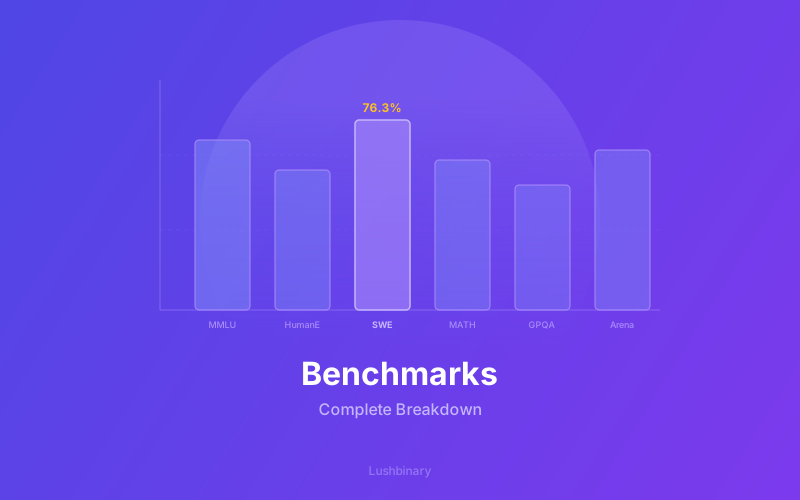
GLM-5.1 dropped with an impressive benchmark sheet — state-of-the-art on SWE-Bench Pro, leading scores on NL2Repo and CyberGym, and competitive results across reasoning and agentic tasks. But benchmarks without context are just numbers. Here's what each score actually means, how they were measured, and where GLM-5.1 genuinely excels versus where it falls short.
📋 Table of Contents
- 1.Coding Benchmarks Explained
- 2.Reasoning Benchmarks Explained
- 3.Agentic Benchmarks Explained
- 4.Evaluation Methodology & Caveats
- 5.Where GLM-5.1 Genuinely Leads
- 6.Where It Falls Short
- 7.The Long-Horizon Story
- 8.Lushbinary AI Integration
1Coding Benchmarks Explained
SWE-Bench Pro (58.4%) — State-of-the-art. This benchmark evaluates complex software engineering tasks using real GitHub issues. GLM-5.1 was evaluated with OpenHands using temperature=1, top_p=0.95, max_new_tokens=32768, and a 200K context window. The 58.4% score edges out GPT-5.4 (57.7%) and significantly leads Claude Opus 4.6 (54.2%).
NL2Repo (42.7%) — Leading score. This measures the ability to generate entire repositories from natural language descriptions. GLM-5.1 leads the next closest model (GPT-5.4 at 41.3%) and significantly outperforms Claude Opus 4.6 (33.4%). Evaluated with temperature=1.0, top_p=1.0, and 200K context with rule-based malicious command detection.
Terminal-Bench 2.0 (63.5%) — Strong but not leading. Measures real-world terminal task completion. Claude Opus 4.6 leads at 68.5%. GLM-5.1's best self-reported harness score is 66.5% using Claude Code.
CyberGym (68.7%) — Leading by a wide margin. Evaluates cybersecurity task completion across 1,507 tasks. The next closest is Claude Opus 4.6 at 66.6%. Evaluated in Claude Code 2.1.56 with a 250-minute timeout per task.
2Reasoning Benchmarks Explained
AIME 2026 (95.3%) — Competitive. Math competition problems. GPT-5.4 leads at 98.7%, Claude Opus 4.6 at 98.2%. GLM-5.1 is strong but not frontier on pure math reasoning.
GPQA-Diamond (86.2%) — Below frontier. Graduate-level science questions. Claude Opus 4.6 leads at 94.3%. This is one of GLM-5.1's weaker areas.
HLE (31.0%) — Competitive. Humanity's Last Exam, the hardest reasoning benchmark. Claude Opus 4.6 leads at 45.0%. With tools, GLM-5.1 reaches 52.3%.
3Agentic Benchmarks Explained
BrowseComp (68.0%) — Leading without context management. With context management, GLM-5.1 reaches 79.3% but Claude Opus 4.6 leads at 85.9%.
MCP-Atlas (71.8%) — Strong. Evaluates MCP tool use across 500 tasks. GPT-5.4 scores 67.2%, Claude Opus 4.6 scores 69.2%.
Vending Bench 2 ($5,634) — Strong. Measures autonomous revenue generation. GPT-5.4 leads at $6,144.
4Evaluation Methodology & Caveats
Key evaluation details to keep in mind:
- SWE-Bench Pro uses a tailored instruction prompt — results may vary with different prompting strategies
- NL2Repo includes rule-based pre-detection for malicious commands followed by model-based judgment
- HLE results marked with * are from the full set (including non-text); default is text-only subset
- KernelBench solutions are independently audited by Claude Opus 4.6 and GPT-5.4 for benchmark exploitation
- Terminal-Bench 2.0 scores are averaged over 5 runs
5Where GLM-5.1 Genuinely Leads
- ✅ SWE-Bench Pro — state-of-the-art for complex software engineering
- ✅ NL2Repo — best at generating entire repositories from descriptions
- ✅ CyberGym — strongest cybersecurity task completion
- ✅ Long-horizon optimization — sustained productivity over 600+ iterations
6Where It Falls Short
- ❌ GPQA-Diamond — 8+ points behind Claude Opus 4.6
- ❌ HLE — 14 points behind Claude Opus 4.6
- ❌ KernelBench Level 3 — 3.6× vs Claude Opus 4.6's 4.2×
- ❌ AIME 2026 — 3+ points behind GPT-5.4
7The Long-Horizon Story
The benchmarks above are single-shot evaluations. GLM-5.1's real differentiator is what happens when you give it more time. The VectorDBBench result (21.5K QPS over 600+ iterations) and the Linux desktop demo (8 hours of sustained development) show capabilities that standard benchmarks don't capture.
8Lushbinary AI Integration
Understanding benchmarks is one thing — knowing which model fits your specific workload is another. At Lushbinary, we help teams evaluate and integrate the right AI models for their engineering workflows.
🚀 Free Consultation
Not sure which AI model fits your workload? We help teams benchmark, evaluate, and integrate the right models for their engineering workflows.
❓ Frequently Asked Questions
What are GLM-5.1's best benchmark scores?
GLM-5.1 achieves state-of-the-art 58.4% on SWE-Bench Pro, 42.7% on NL2Repo, 63.5% on Terminal-Bench 2.0, 68.7% on CyberGym, 95.3% on AIME 2026, and 86.2% on GPQA-Diamond.
How were GLM-5.1 benchmarks evaluated?
Benchmarks used specific configurations: SWE-Bench Pro with OpenHands (temperature=1, top_p=0.95, 200K context), reasoning tasks with 163,840 max tokens, Terminal-Bench 2.0 with 3-hour timeout and 200K context. GPT-5.2 (medium) was used as judge for HLE.
📚 Sources
- Z.ai — GLM-5.1: Towards Long-Horizon Tasks (April 7, 2026)
- HuggingFace — GLM-5.1 Model Weights
- GitHub — GLM-5.1 Repository
Content was rephrased for compliance with licensing restrictions. Benchmark data sourced from official Zhipu AI publications as of April 8, 2026. Pricing and availability may change — always verify on the vendor's website.
Need Help Evaluating AI Models?
Lushbinary helps engineering teams benchmark, compare, and integrate frontier AI models into their workflows.
Build Smarter, Launch Faster.
Book a free strategy call and explore how LushBinary can turn your vision into reality.