
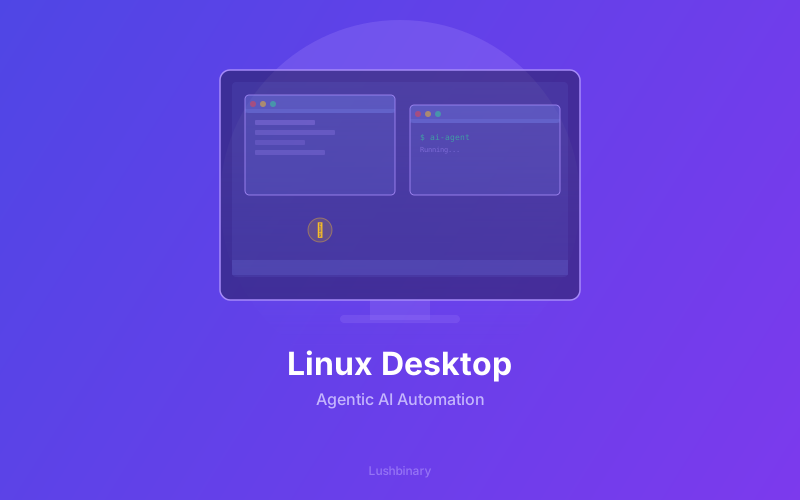
GLM-5.1 was given one prompt: build a Linux-style desktop environment as a web application. No starter code. No design mockups. No intermediate guidance. Eight hours later, it had produced a complete, visually consistent desktop environment running in the browser — with a file browser, terminal, text editor, system monitor, calculator, and games. Here's why this matters more than any benchmark score.
📋 Table of Contents
- 1.The Challenge: No Metric, No Guidance
- 2.The Self-Review Harness
- 3.Hour-by-Hour Progression
- 4.What Other Models Produce
- 5.Why Self-Evaluation Matters
- 6.The Remaining Challenges
- 7.What This Means for Developers
- 8.Lushbinary AI Development
1The Challenge: No Metric, No Guidance
The VectorDBBench and KernelBench demos have explicit numeric objectives — QPS and speedup — that the model can benchmark against. Website generation is inherently more subjective. There is no single metric to optimize; what counts as "good" depends on completeness, visual polish, and interaction quality.
This makes it the hardest of the three long-horizon demonstrations. The model must develop its own sense of what's missing and what to improve next.
2The Self-Review Harness
The setup was simple: after each round of execution, the model reviews its own output, identifies what can be improved — missing features, rough styling, broken interactions — and continues. No human feedback. No external evaluation. Just the model's own judgment of quality.
3Hour-by-Hour Progression
Early stage
Basic layout with a taskbar and simple window — similar to what a short session would produce.
Mid stage
File browser, terminal emulator, and text editor added. Window management improved with drag, resize, and minimize.
Late stage
System monitor, calculator, games integrated. Styling polished for visual consistency. Edge cases handled. Interactions smoothed.
Final result
A complete, visually consistent desktop environment running in the browser with multiple integrated applications.
4What Other Models Produce
In a single run, most models — including earlier versions of GLM — give up quickly. They produce a basic skeleton with a static taskbar and one or two placeholder windows, then declare the task complete. The model has no mechanism to step back and ask what's missing. The self-review harness changes this, but only GLM-5.1 sustains productive iteration for the full 8 hours.
5Why Self-Evaluation Matters
The Linux desktop demo reveals a capability that standard benchmarks miss: reliable self-evaluation for tasks where there is no numeric metric. The model must judge its own work, identify gaps, and prioritize improvements — the same skills that make human developers effective over long projects.
6The Remaining Challenges
Zhipu AI acknowledges significant remaining challenges:
- Escaping local optima earlier when incremental tuning stops paying off
- Maintaining coherence over execution traces spanning thousands of tool calls
- Developing reliable self-evaluation for tasks without numeric metrics
7What This Means for Developers
The Linux desktop demo suggests a near-future where AI agents can handle open-ended development tasks with minimal human guidance. Not replacing developers, but handling the iterative refinement work that consumes most development time — styling fixes, edge case handling, feature integration, and polish.
8Lushbinary AI Development
At Lushbinary, we're building the next generation of AI-assisted development workflows. If you're interested in leveraging long-horizon AI capabilities for your projects, let's talk.
🚀 Free Consultation
Interested in leveraging long-horizon AI capabilities for your development projects? We build the next generation of AI-assisted workflows.
❓ Frequently Asked Questions
Did GLM-5.1 really build a Linux desktop in 8 hours?
Yes. GLM-5.1 was given a single prompt to build a Linux-style desktop environment as a web application with no starter code, no design mockups, and no intermediate guidance. Wrapped in a self-review harness, it ran for 8 hours and produced a complete desktop with file browser, terminal, text editor, system monitor, calculator, and games.
What makes the Linux desktop demo significant?
Unlike benchmarks with numeric metrics, website generation is subjective. The demo shows GLM-5.1 can self-evaluate and improve without external feedback — identifying missing features, rough styling, and broken interactions on its own. This is the hardest form of long-horizon task execution.
📚 Sources
- Z.ai — GLM-5.1: Towards Long-Horizon Tasks (April 7, 2026)
- HuggingFace — GLM-5.1 Model Weights
- GitHub — GLM-5.1 Repository
Content was rephrased for compliance with licensing restrictions. Benchmark data sourced from official Zhipu AI publications as of April 8, 2026. Pricing and availability may change — always verify on the vendor's website.
Building with Agentic AI?
Lushbinary builds AI-assisted development workflows that leverage long-horizon capabilities for your projects.
Build Smarter, Launch Faster.
Book a free strategy call and explore how LushBinary can turn your vision into reality.