
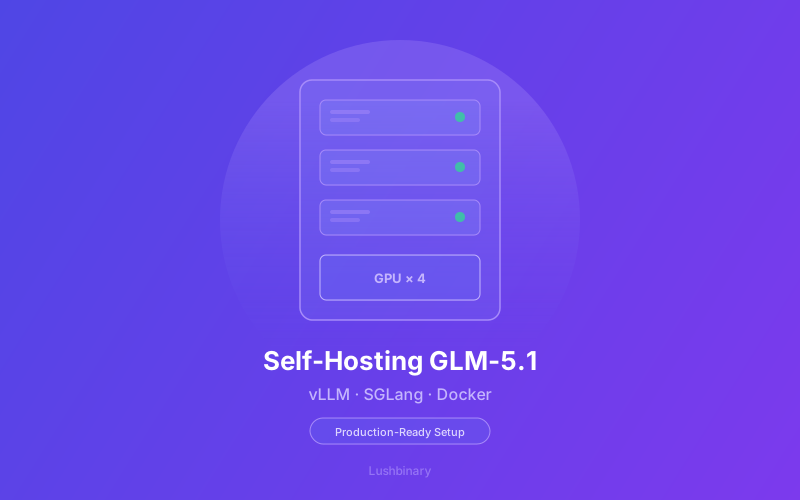
GLM-5.1 is one of the most permissively licensed frontier models available — MIT License, open weights on HuggingFace, and official support for vLLM and SGLang. This guide walks you through deploying it on your own infrastructure, from hardware requirements to production configuration.
📋 Table of Contents
- 1.Why Self-Host GLM-5.1?
- 2.Hardware Requirements
- 3.Downloading Model Weights
- 4.Deploying with vLLM
- 5.Deploying with SGLang
- 6.Production Configuration Tips
- 7.Monitoring & Scaling
- 8.Lushbinary Deployment Services
1Why Self-Host GLM-5.1?
Three reasons stand out: cost (eliminate per-token API charges for high-volume workloads), privacy (keep proprietary code and data on your infrastructure), and control (customize inference parameters, quantization, and batching for your specific use case). The MIT license means no usage restrictions or reporting requirements.
2Hardware Requirements
GLM-5.1 uses a Mixture-of-Experts (MoE) architecture inherited from GLM-5. While total parameter count is large, active parameters per inference are significantly lower. For production deployments:
| Configuration | GPUs | Use Case |
|---|---|---|
| Full precision | 8× H100 80GB | Production, max quality |
| FP8 quantized | 4× H100 80GB | Production, cost-optimized |
| INT4 quantized | 2× A100 80GB | Development, testing |
3Downloading Model Weights
Weights are available from two sources:
# From HuggingFace
huggingface-cli download zai-org/GLM-5.1 --local-dir ./glm-5.1
# From ModelScope
modelscope download --model ZhipuAI/GLM-5.1 --local_dir ./glm-5.1
4Deploying with vLLM
vLLM provides high-throughput serving with PagedAttention and continuous batching. Basic setup:
pip install vllm
python -m vllm.entrypoints.openai.api_server \
--model ./glm-5.1 \
--tensor-parallel-size 8 \
--max-model-len 200000 \
--trust-remote-code \
--port 8000
This exposes an OpenAI-compatible API at http://localhost:8000/v1, making it a drop-in replacement for any OpenAI SDK client.
5Deploying with SGLang
SGLang offers advantages for structured generation and complex prompting patterns:
pip install sglang
python -m sglang.launch_server \
--model-path ./glm-5.1 \
--tp 8 \
--port 8000
6Production Configuration Tips
- Set
temperature=1.0, top_p=0.95to match Zhipu AI's benchmark configurations - Use a 200K context window for agentic workloads requiring long-horizon execution
- Enable think mode for complex reasoning tasks
- Monitor GPU memory utilization — MoE models have spiky memory patterns during expert routing
7Monitoring & Scaling
For production deployments, monitor tokens/second throughput, time-to-first-token latency, GPU utilization per expert, and memory pressure during long context windows. Scale horizontally by running multiple vLLM/SGLang instances behind a load balancer.
8Lushbinary Deployment Services
Self-hosting frontier models requires infrastructure expertise. At Lushbinary, we handle the full deployment pipeline — from GPU provisioning and model optimization to monitoring and auto-scaling. Let us get GLM-5.1 running in your environment.
🚀 Free Consultation
Need help deploying GLM-5.1 on your own infrastructure? We offer a free 30-minute consultation to evaluate your use case and recommend the right approach.
❓ Frequently Asked Questions
Can I self-host GLM-5.1?
Yes. GLM-5.1 is released under the MIT License with weights available on HuggingFace (zai-org/GLM-5.1) and ModelScope. It supports vLLM and SGLang inference frameworks for local deployment.
What hardware do I need to run GLM-5.1 locally?
GLM-5.1 uses a Mixture-of-Experts architecture, so active parameters per inference are significantly lower than total parameters. High-end GPU clusters with multiple H100 or A100 GPUs are recommended for production workloads. Quantized versions may run on smaller setups.
Which inference framework should I use for GLM-5.1?
Both vLLM and SGLang are officially supported. vLLM is the more mature option with broader community support, while SGLang offers advantages for structured generation and complex prompting patterns. Choose based on your specific workload requirements.
📚 Sources
- Z.ai — GLM-5.1: Towards Long-Horizon Tasks (April 7, 2026)
- HuggingFace — GLM-5.1 Model Weights
- GitHub — GLM-5.1 Repository
Content was rephrased for compliance with licensing restrictions. Benchmark data sourced from official Zhipu AI publications as of April 8, 2026. Pricing and availability may change — always verify on the vendor's website.
Need Help Deploying GLM-5.1?
Let Lushbinary handle the full deployment pipeline — from GPU provisioning and model optimization to monitoring and auto-scaling.
Build Smarter, Launch Faster.
Book a free strategy call and explore how LushBinary can turn your vision into reality.