
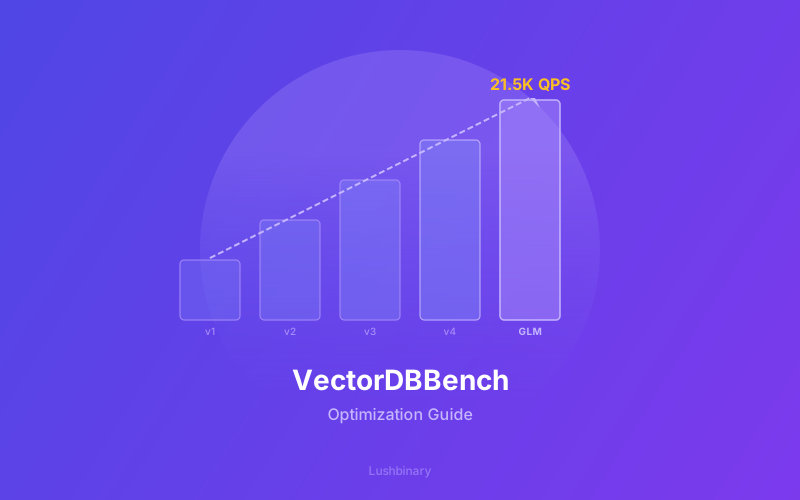
The most impressive demonstration of GLM-5.1's long-horizon capabilities came from VectorDBBench — an open-source challenge where the model built a high-performance vector database from a Rust skeleton, then optimized it over 600+ iterations to reach 21.5K QPS. That's 6× the previous best single-session result. Here's exactly how it did it.
📋 Table of Contents
- 1.The VectorDBBench Challenge
- 2.Previous Best: 3,547 QPS in 50 Turns
- 3.Extended Optimization Loop Setup
- 4.The Six Structural Transitions
- 5.Staircase Pattern Analysis
- 6.Recall Constraint Management
- 7.What This Means for AI-Driven Optimization
- 8.Lushbinary for AI-Powered Engineering
1The VectorDBBench Challenge
VectorDBBench evaluates a model's ability to build a high-performance database for approximate nearest neighbor (ANN) search. The model receives a Rust skeleton with HTTP API endpoints and empty implementation stubs, then uses tool-call-based agents to read and write files, compile, test, and profile. The final result is benchmarked on the SIFT-1M dataset, ranked by queries per second (QPS) under the constraint that Recall ≥ 95%.
2Previous Best: 3,547 QPS in 50 Turns
Under the standard 50-turn tool-call budget, the best result was 3,547 QPS achieved by Claude Opus 4.6. The natural question: is this 50-turn budget the bottleneck, or do models genuinely run out of ideas?
3Extended Optimization Loop Setup
Zhipu AI restructured the evaluation into an outer optimization loop using the Claude Code framework. In each iteration, the model can use as many tool calls as needed to edit code, compile, test, and profile, then submit a new version to be benchmarked. The model decides autonomously when to submit and what to try next.
4The Six Structural Transitions
Transition 1: IVF Cutover → 6.4K QPS
Shifted from full sequence scan to cluster-based IVF scanning with f16 vector compression, reducing per-vector bandwidth from 512B to 256B.
Transition 2: Nested Parallelism Removed → 10.4K QPS
Redesigned parallelism to per-query single-thread with outer concurrency, lowering scheduling overhead and improving cache locality.
Transition 3: Two-Stage Search → 13.4K QPS
Introduced a two-stage pipeline: u8 prescoring (coarse) followed by f16 reranking (accurate), with only a small shortlist proceeding to Phase 2.
Transition 4: Budget Trim → 15.5K QPS
Tuned candidate budgets to reduce Phase 1 output and lower Phase 2 rerank workload.
Transition 5: Two-Level Routing → 18.4K QPS
Introduced hierarchical routing with super-clusters for coarse-to-fine routing, expanding only top 33 regions.
Transition 6: u8 Routing + Early Pruning → 21.5K QPS
Quantized routing via u8 + VNNI, cluster pruning to skip low-quality clusters, eliminating unnecessary vector scoring and memory access.
5Staircase Pattern Analysis
The optimization trajectory shows a characteristic staircase pattern: periods of incremental tuning within a fixed strategy, punctuated by structural changes that shift the performance frontier. Each plateau represents the model exhausting optimizations within the current architecture before discovering a fundamentally different approach.
6Recall Constraint Management
Red crosses in the benchmark data mark iterations where Recall fell below 95%. These cluster around each major transition — the model temporarily breaks the constraint while exploring a new direction, then adjusts parameters to restore it. This shows genuine engineering judgment: willingness to temporarily violate constraints during exploration, followed by disciplined recovery.
7What This Means for AI-Driven Optimization
The VectorDBBench result demonstrates that the bottleneck for AI-driven code optimization isn't model capability in isolation — it's the ability to sustain productive iteration over long horizons. GLM-5.1's 6× improvement over single-session results suggests that many engineering optimization tasks are currently under-served by short-context interactions.
8Lushbinary for AI-Powered Engineering
At Lushbinary, we build AI-powered engineering pipelines that leverage long-horizon optimization capabilities like GLM-5.1's. Whether you need automated performance tuning, agentic code generation, or custom optimization loops, we can help.
🚀 Free Consultation
Want to build AI-powered optimization pipelines? We offer a free 30-minute consultation to evaluate your use case and recommend the right approach.
❓ Frequently Asked Questions
What is VectorDBBench and how did GLM-5.1 perform?
VectorDBBench is an open-source coding challenge that evaluates a model's ability to build a high-performance approximate nearest neighbor search database. GLM-5.1 reached 21.5K QPS over 600+ iterations with 6,000+ tool calls — roughly 6× the previous best single-session result of 3,547 QPS by Claude Opus 4.6.
How many optimization iterations did GLM-5.1 run?
GLM-5.1 ran 655 optimization iterations with over 6,000 tool calls. It went through six major structural transitions, each initiated autonomously after analyzing its own benchmark logs and identifying the current bottleneck.
📚 Sources
- Z.ai — GLM-5.1: Towards Long-Horizon Tasks (April 7, 2026)
- HuggingFace — GLM-5.1 Model Weights
- GitHub — GLM-5.1 Repository
Content was rephrased for compliance with licensing restrictions. Benchmark data sourced from official Zhipu AI publications as of April 8, 2026. Pricing and availability may change — always verify on the vendor's website.
Building AI-Powered Optimization Pipelines?
Let Lushbinary help you build long-horizon AI optimization workflows — from automated performance tuning to custom agentic pipelines.
Build Smarter, Launch Faster.
Book a free strategy call and explore how LushBinary can turn your vision into reality.