
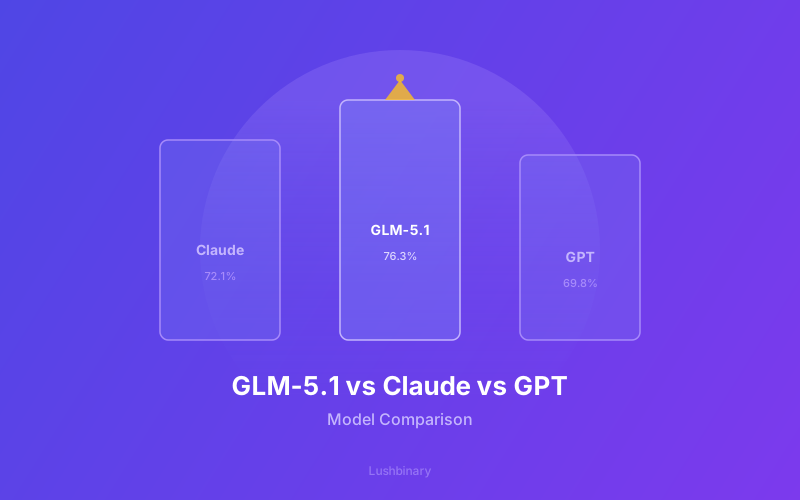
With GLM-5.1 claiming state-of-the-art on SWE-Bench Pro and leading on NL2Repo and CyberGym, the frontier model landscape just got more competitive. But how does it actually stack up against Claude Opus 4.6 and GPT-5.4 across the benchmarks that matter for developers? We break down every major comparison point.
📋 Table of Contents
- 1.Coding Benchmarks Head-to-Head
- 2.Reasoning & Math Comparison
- 3.Agentic Task Performance
- 4.Long-Horizon Sustained Optimization
- 5.Licensing & Self-Hosting
- 6.API Pricing Comparison
- 7.Which Model Should You Choose?
- 8.Lushbinary Can Help You Decide
1Coding Benchmarks Head-to-Head
| Benchmark | GLM-5.1 | Claude Opus 4.6 | GPT-5.4 |
|---|---|---|---|
| SWE-Bench Pro | 58.4% | 54.2% | 57.7% |
| NL2Repo | 42.7% | 33.4% | 41.3% |
| Terminal-Bench 2.0 | 63.5% | 68.5% | — |
| CyberGym | 68.7% | — | — |
| KernelBench L3 | 3.6× | 4.2× | — |
GLM-5.1 takes the crown on SWE-Bench Pro and NL2Repo — the two benchmarks most directly tied to real-world software engineering. Claude Opus 4.6 leads on Terminal-Bench 2.0 and KernelBench Level 3, showing stronger performance on terminal-based tasks and GPU kernel optimization.
2Reasoning & Math Comparison
| Benchmark | GLM-5.1 | Claude Opus 4.6 | GPT-5.4 |
|---|---|---|---|
| AIME 2026 | 95.3% | 98.2% | 98.7% |
| GPQA-Diamond | 86.2% | 94.3% | 92.0% |
| HLE | 31.0% | 45.0% | 39.8% |
On pure reasoning, Claude Opus 4.6 and GPT-5.4 maintain a clear lead. GLM-5.1's strength is in sustained agentic execution rather than single-shot reasoning tasks.
3Agentic Task Performance
| Benchmark | GLM-5.1 | Claude Opus 4.6 | GPT-5.4 |
|---|---|---|---|
| BrowseComp | 68.0% | — | — |
| BrowseComp w/ Context | 79.3% | 85.9% | 82.7% |
| τ³-Bench | 70.6% | 67.1% | 72.9% |
| MCP-Atlas | 71.8% | 69.2% | 67.2% |
| Vending Bench 2 | $5,634 | $911 | $6,144 |
The agentic benchmarks paint a nuanced picture. GLM-5.1 is competitive across the board, leading on MCP-Atlas (71.8%) and performing strongly on τ³-Bench and Vending Bench 2. No single model dominates every agentic task.
4Long-Horizon Sustained Optimization
This is where GLM-5.1 makes its strongest case. On VectorDBBench, it sustained meaningful optimization over 600+ iterations and 6,000+ tool calls, reaching 21.5K QPS — 6× the best single-session result. On KernelBench, it delivered 3.6× speedup while continuing to improve late into the run.
Claude Opus 4.6 leads on KernelBench at 4.2× but the gap narrows as session length increases. The key variable isn't runtime alone but whether additional runtime remains useful — and GLM-5.1 extends that productive horizon meaningfully.
5Licensing & Self-Hosting
| Feature | GLM-5.1 | Claude Opus 4.6 | GPT-5.4 |
|---|---|---|---|
| License | MIT | Proprietary | Proprietary |
| Open Weights | Yes | No | No |
| Self-Hosting | vLLM, SGLang | API only | API only |
GLM-5.1's MIT license is a major differentiator. You can self-host, fine-tune, and commercially deploy without restrictions — something neither Claude nor GPT offers.
6API Pricing Comparison
GLM-5.1 via the Z.ai Coding Plan uses a quota system: 3× during peak hours (14:00–18:00 UTC+8), 2× off-peak, with a promotional 1× off-peak rate through April 2026. Self-hosting eliminates per-token costs entirely. Claude Opus 4.6 and GPT-5.4 charge per-token via their respective APIs with no self-hosting option.
7Which Model Should You Choose?
- Choose GLM-5.1 if you need long-horizon agentic tasks, open-weight flexibility, self-hosting, or cost-sensitive deployments.
- Choose Claude Opus 4.6 if you need the strongest single-shot reasoning, terminal tasks, or GPU kernel optimization.
- Choose GPT-5.4 if you need the broadest ecosystem integration and strong all-around performance.
8Lushbinary Can Help You Decide
Choosing the right model for your team depends on your specific workloads, latency requirements, and deployment constraints. At Lushbinary, we help engineering teams evaluate and integrate frontier AI models into production. Let us help you find the right fit.
🚀 Free Consultation
Not sure which model fits your workload? We offer a free 30-minute consultation to evaluate your use case and recommend the right approach.
❓ Frequently Asked Questions
How does GLM-5.1 compare to Claude Opus 4.6 on coding benchmarks?
GLM-5.1 leads on SWE-Bench Pro (58.4% vs 54.2%), NL2Repo (42.7% vs 33.4%), and CyberGym (68.7%). Claude Opus 4.6 leads on Terminal-Bench 2.0 (68.5% vs 63.5%), KernelBench Level 3 (4.2× vs 3.6×), and reasoning benchmarks like GPQA-Diamond (94.3% vs 86.2%).
Which model is best for long-running agentic tasks?
GLM-5.1 and Claude Opus 4.6 are both strong for long-horizon tasks. GLM-5.1 demonstrated sustained optimization over 600+ iterations on VectorDBBench reaching 21.5K QPS. Claude Opus 4.6 leads on KernelBench at 4.2× speedup. The choice depends on your specific workload.
Is GLM-5.1 cheaper than Claude Opus 4.6 and GPT-5.4?
GLM-5.1 is open-weight under MIT License, so self-hosting eliminates per-token API costs entirely. Via the Z.ai API, the GLM Coding Plan offers competitive pricing with off-peak promotional rates at 1× through April 2026.
📚 Sources
- Z.ai — GLM-5.1: Towards Long-Horizon Tasks (April 7, 2026)
- HuggingFace — GLM-5.1 Model Weights
- GitHub — GLM-5.1 Repository
Content was rephrased for compliance with licensing restrictions. Benchmark data sourced from official Zhipu AI publications as of April 8, 2026. Pricing and availability may change — always verify on the vendor's website.
Need Help Choosing the Right Model?
Let Lushbinary help you evaluate and integrate the right frontier model for your team — from benchmarking to production deployment.
Build Smarter, Launch Faster.
Book a free strategy call and explore how LushBinary can turn your vision into reality.