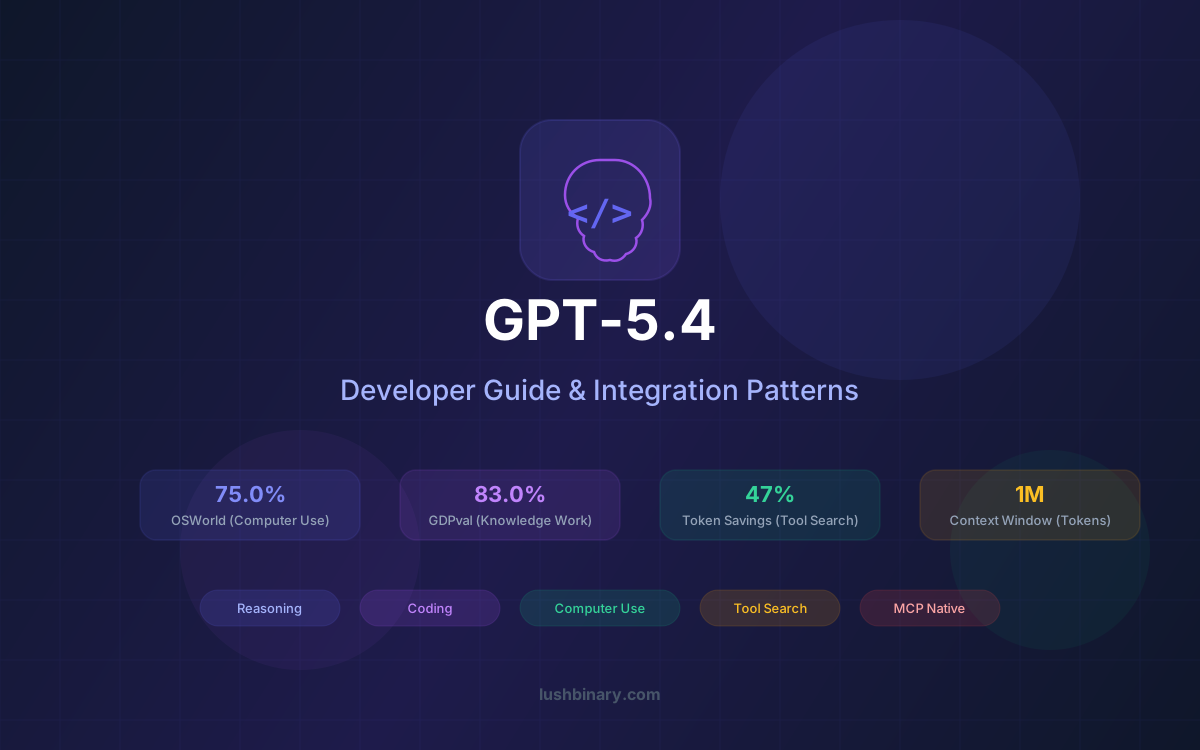
OpenAI released GPT-5.4 on March 5, 2026, and it's not just another incremental bump. This is the first model that merges the coding power of GPT-5.3-Codex, the reasoning depth of GPT-5.2, and native computer-use capabilities into a single release. It can operate your desktop better than a human (75.0% on OSWorld vs. 72.4% human baseline), handle up to 1 million tokens of context, and cut tool-heavy agent costs by 47% with a new feature called tool search.
For teams building AI-powered products, this changes the calculus. You no longer need to route between a coding model, a reasoning model, and a computer-use model. GPT-5.4 does all three. But integrating it well, managing costs, and building reliable agent workflows still takes real engineering work.
In this guide, we break down every major capability, walk through the benchmarks, cover API pricing and integration patterns, compare GPT-5.4 to Claude Opus 4.6 and Gemini 3.1 Pro, and show how LushBinary helps teams ship GPT-5.4 integrations that actually work in production.
📋 Table of Contents
- 1.What Is GPT-5.4? The Full Picture
- 2.Benchmark Breakdown: Where GPT-5.4 Actually Leads
- 3.Native Computer Use: Beyond Chatbots
- 4.Tool Search: The Biggest Cost Saver for Agents
- 5.Coding Capabilities: GPT-5.3-Codex Built In
- 6.API Pricing, Variants & Context Windows
- 7.Integration Patterns: Node.js & Python Examples
- 8.GPT-5.4 vs Claude Opus 4.6 vs Gemini 3.1 Pro
- 9.When to Use GPT-5.4 (and When Not To)
- 10.How LushBinary Integrates GPT-5.4 for Production
1What Is GPT-5.4? The Full Picture
GPT-5.4 is OpenAI's new flagship frontier model, available across ChatGPT, the API (as gpt-5.4), and Codex. It replaces GPT-5.2 Thinking in ChatGPT and unifies three previously separate model capabilities into one:
- Reasoning: Inherited from GPT-5.2, with improvements across abstract reasoning (ARC-AGI-2: 73.3%, up from 52.9%), scientific knowledge (GPQA Diamond: 92.8%), and professional knowledge work (GDPval: 83.0%)
- Coding: Incorporates GPT-5.3-Codex's industry-leading code generation, matching or exceeding it on SWE-Bench Pro (57.7% vs 56.8%)
- Computer use: First general-purpose OpenAI model with native desktop and browser automation, scoring 75.0% on OSWorld-Verified (surpassing human performance at 72.4%)
It comes in three variants:
- GPT-5.4: The standard model, available in the API as
gpt-5.4 - GPT-5.4 Thinking: The reasoning-enhanced version in ChatGPT, with a new preamble feature that outlines its approach before executing
- GPT-5.4 Pro: Maximum performance variant for complex tasks, available to Pro and Enterprise plans (
gpt-5.4-proin the API)
Key context
GPT-5.2 Thinking will remain available in ChatGPT under Legacy Models for three months, retiring on June 5, 2026. If you have production workflows on GPT-5.2, plan your migration now.
2Benchmark Breakdown: Where GPT-5.4 Actually Leads
Numbers matter more than marketing. Here's how GPT-5.4 performs across the benchmarks that matter for production AI work, based on OpenAI's official release data (March 5, 2026).
Professional Knowledge Work
| Benchmark | GPT-5.2 | GPT-5.4 | GPT-5.4 Pro |
|---|---|---|---|
| GDPval (knowledge work) | 70.9% | 83.0% | — |
| GPQA Diamond | 92.4% | 92.8% | 94.4% |
| Humanity's Last Exam | 45.5% | 52.1% | 58.7% |
| IB Modeling Tasks | 68.4% | 87.3% | — |
Abstract Reasoning & Science
| Benchmark | GPT-5.2 | GPT-5.4 | GPT-5.4 Pro |
|---|---|---|---|
| ARC-AGI-1 (Verified) | 86.2% | 93.7% | 94.5% |
| ARC-AGI-2 (Verified) | 52.9% | 73.3% | 83.3% |
| FrontierMath Tier 1-3 | 40.7% | 47.6% | 50.0% |
| FrontierMath Tier 4 | 18.8% | 27.1% | 38.0% |
| Frontier Science Research | 25.2% | 33.0% | 36.7% |
The ARC-AGI-2 jump from 52.9% to 73.3% is the standout. This is a genuine reasoning advance, not just a tool-use wrapper. FrontierMath Tier 4 (the hardest mathematical reasoning tier) nearly doubled from 18.8% to 38.0% with Pro.
GPT-5.4 is also OpenAI's most factual model: individual claims are 33% less likely to be false and full responses are 18% less likely to contain any errors compared to GPT-5.2, based on de-identified user-flagged prompts.
3Native Computer Use: Beyond Chatbots
This is the headline feature. GPT-5.4 is the first general-purpose OpenAI model that can operate computers autonomously. It works in two modes: writing Playwright code to interact with web apps, and issuing direct mouse/keyboard commands from screenshots.
| Benchmark | GPT-5.2 | GPT-5.4 | Human |
|---|---|---|---|
| OSWorld-Verified (desktop) | 47.3% | 75.0% | 72.4% |
| WebArena-Verified (browser) | 65.4% | 67.3% | — |
| Online-Mind2Web (screenshots) | — | 92.8% | — |
| MMMU-Pro (visual reasoning) | 79.5% | 81.2% | — |
The OSWorld result is remarkable: a jump from 47.3% to 75.0%, surpassing human performance. This means GPT-5.4 can navigate desktop environments, fill forms, click buttons, and complete multi-step workflows across applications more reliably than a human operator.
Image Input Improvements
GPT-5.4 introduces a new original image input detail level supporting full-fidelity perception up to 10.24M total pixels (or 6,000px max dimension). The existing high level now supports up to 2.56M total pixels (2,048px max). Early API testers report strong gains in localization, image understanding, and click accuracy.
What This Means for Developers
If you're building agents that interact with web apps, internal tools, or desktop software, GPT-5.4's computer-use capabilities are a step change. The behavior is steerable via developer messages, and you can configure custom confirmation policies for different risk tolerance levels. OpenAI also released an experimental Codex skill called "Playwright (Interactive)" that lets the model visually debug web and Electron apps while building them.
4Tool Search: The Biggest Cost Saver for Agents
If you're building agents with many tools (especially MCP servers), tool search is the feature that will save you the most money.
Previously, every tool definition was included in the prompt upfront. For systems with dozens of MCP servers, this could add tens of thousands of tokens to every request, blowing up costs and crowding the context window. Tool search changes this: GPT-5.4 receives a lightweight list of available tools and looks up full definitions on demand.
On 250 tasks from Scale's MCP Atlas benchmark with all 36 MCP servers enabled, tool search reduced total token usage by 47% while achieving the same accuracy. For enterprise deployments with large connector ecosystems, this is a massive cost reduction.
Agentic Tool Calling Improvements
| Benchmark | GPT-5.2 | GPT-5.4 |
|---|---|---|
| Toolathlon | 45.7% | 54.6% |
| MCP Atlas | 60.6% | 67.2% |
| BrowseComp | 65.8% | 82.7% |
| BrowseComp (Pro) | 77.9% | 89.3% |
The BrowseComp jump (65.8% → 82.7%) means GPT-5.4 is significantly better at persistent web research, finding hard-to-locate information across multiple search rounds. GPT-5.4 Pro sets a new state of the art at 89.3%.
5Coding Capabilities: GPT-5.3-Codex Built In
GPT-5.4 incorporates the coding strengths of GPT-5.3-Codex directly. You no longer need to choose between a reasoning model and a coding model. It matches or outperforms GPT-5.3-Codex on SWE-Bench Pro while being lower latency across reasoning effort levels.
| Benchmark | GPT-5.2 | GPT-5.3-Codex | GPT-5.4 |
|---|---|---|---|
| SWE-Bench Pro | 55.6% | 56.8% | 57.7% |
| Terminal-Bench 2.0 | 62.2% | 77.3% | 75.1% |
Note that GPT-5.3-Codex still edges out GPT-5.4 on Terminal-Bench 2.0 (77.3% vs 75.1%), which tests terminal-based coding tasks. If your workload is purely code generation in a terminal context, GPT-5.3-Codex may still be the better choice. But for everything else, GPT-5.4 gives you coding plus reasoning plus computer use in one model.
In Codex, the /fast mode delivers up to 1.5x faster token velocity with GPT-5.4. Developers can access the same speeds via the API using priority processing.
Frontend development standout
OpenAI specifically calls out GPT-5.4's improved performance on complex frontend tasks, producing more aesthetic and functional results than any previous model. The new "Playwright (Interactive)" Codex skill lets GPT-5.4 visually debug web apps while building them.
6API Pricing, Variants & Context Windows
GPT-5.4 is priced higher per token than GPT-5.2, but its improved token efficiency means the total cost for many workloads may be comparable or lower. Here's the full pricing breakdown as of March 2026 (source: OpenAI pricing page):
| Model | Input / M | Cached / M | Output / M |
|---|---|---|---|
| gpt-5.2 | $1.75 | $0.175 | $14.00 |
| gpt-5.4 | $2.50 | $0.25 | $15.00 |
| gpt-5.4-pro | $30.00 | — | $180.00 |
- Batch & Flex processing: 50% off standard rates
- Priority processing: 2x standard rates (equivalent to Codex
/fastmode) - Context beyond 272K: 2x input + 1.5x output for the full session
- Regional processing: 10% uplift for data residency endpoints
- Reasoning tokens: Count as output tokens
- 1M context: Experimental in Codex, configurable via
model_context_windowandmodel_auto_compact_token_limit
Cost tip
The per-token input price increase from $1.75 to $2.50 (43% bump) is partially offset by GPT-5.4's improved token efficiency. OpenAI states it uses significantly fewer reasoning tokens than GPT-5.2 for equivalent problems. For tool-heavy agents, the 47% token reduction from tool search can make GPT-5.4 cheaper overall. Benchmark your specific workload before assuming a cost increase.
ChatGPT Availability
- GPT-5.4 Thinking: Available now for Plus, Team, and Pro users (replaces GPT-5.2 Thinking)
- GPT-5.4 Pro: Available to Pro and Enterprise plans
- Enterprise & Edu: Enable early access via admin settings
- GPT-5.2 retirement: Available in Legacy Models until June 5, 2026
7Integration Patterns: Node.js & Python Examples
Getting started with GPT-5.4 in the API is straightforward. The model identifier is gpt-5.4 (or gpt-5.4-pro for the Pro variant). Here are practical integration patterns.
Basic Chat Completion (Node.js)
import OpenAI from "openai";

const client = new OpenAI();

const response = await client.responses.create({
  model: "gpt-5.4",
  input: [
    {
      role: "developer",
      content: "You are a helpful coding assistant.",
    },
    {
      role: "user",
      content: "Explain the difference between tool search and traditional tool calling.",
    },
  ],
});

console.log(response.output_text);
Tool Search with MCP (Node.js)
// Tool search reduces token usage by loading
// tool definitions on demand instead of upfront.
// Configure via the tools parameter with type: "mcp"

const response = await client.responses.create({
  model: "gpt-5.4",
  tools: [
    {
      type: "mcp",
      server_label: "my_mcp_server",
      server_url: "https://my-mcp-server.example.com/sse",
      require_approval: "never",
    },
  ],
  input: "Look up the latest sales data and create a summary.",
});
Computer Use (Python)
from openai import OpenAI

client = OpenAI()

response = client.responses.create(
    model="gpt-5.4",
    tools=[
        {
            "type": "computer_use_preview",
            "display_width": 1920,
            "display_height": 1080,
            "environment": "browser",
        }
    ],
    input=[
        {
            "role": "user",
            "content": "Navigate to our dashboard and export the monthly report as CSV.",
        }
    ],
    reasoning={"effort": "high"},
)

# Process computer_call items in response.output
for item in response.output:
    if item.type == "computer_call":
        print(f"Action: {item.action.type}")
        # Execute the action and send screenshot back
Reasoning Effort Control
GPT-5.4 supports configurable reasoning effort from none to xhigh. Lower effort means faster responses and fewer output tokens (reasoning tokens count as output). For latency-sensitive use cases, none or low can dramatically reduce costs.
// Adjust reasoning effort per request
const response = await client.responses.create({
  model: "gpt-5.4",
  reasoning: { effort: "low" }, // none | low | medium | high | xhigh
  input: "What is 2 + 2?",
});8GPT-5.4 vs Claude Opus 4.6 vs Gemini 3.1 Pro
The frontier model landscape in March 2026 is a genuine three-way race. Here's an honest comparison based on the latest benchmark data (sources: OpenAI, Vals.ai SWE-bench).
| Capability | GPT-5.4 | Claude Opus 4.6 | Gemini 3.1 Pro |
|---|---|---|---|
| Computer use (OSWorld) | 75.0% | — | — |
| SWE-bench Verified | 57.7% (Pro) | 79.2% (Thinking) | — |
| ARC-AGI-2 | 73.3% | — | 77.1% |
| Knowledge work (GDPval) | 83.0% | — | — |
| Context window | 1M tokens | 200K tokens | 2M tokens |
| Tool search / MCP | Native (47% savings) | MCP support | Function calling |
| API input price / M | $2.50 | $15.00 | $1.25 |
When Each Model Wins
GPT-5.4
- • Computer-use agents
- • Tool-heavy MCP workflows
- • Knowledge work & documents
- • Multi-modal desktop automation
Claude Opus 4.6
- • Complex code generation
- • Long-context coding tasks
- • Prompt injection resistance
- • Extended thinking workflows
Gemini 3.1 Pro
- • Ultra-long context (2M tokens)
- • Abstract reasoning (ARC-AGI-2)
- • Cost-sensitive workloads
- • Google Cloud integration
The smart play for most production systems is multi-model routing: use GPT-5.4 for agent workflows and computer use, Claude Opus 4.6 for deep coding tasks, and Gemini 3.1 Pro for cost-sensitive or ultra-long-context workloads. LushBinary builds exactly this kind of architecture. More on that in Section 10.
9When to Use GPT-5.4 (and When Not To)
✅ Use GPT-5.4 When
- You're building agents that need to operate web apps, desktop software, or internal tools autonomously
- Your agent ecosystem has many tools or MCP servers (tool search saves 47% on tokens)
- You need a single model for reasoning + coding + computer use instead of routing between three
- Professional knowledge work: spreadsheets, presentations, documents, data analysis
- You need the most factual model available (33% fewer false claims than GPT-5.2)
- Web research agents that need to find hard-to-locate information (BrowseComp: 82.7%)
❌ Consider Alternatives When
- Pure code generation: Claude Opus 4.6 (Thinking) leads on SWE-bench Verified at 79.2%
- Ultra-long context: Gemini 3.1 Pro offers 2M tokens vs GPT-5.4's 1M (and at lower cost)
- Cost-sensitive batch processing: Gemini 3.1 Pro at $1.25/M input is half the price of GPT-5.4
- Terminal-only coding: GPT-5.3-Codex still edges out GPT-5.4 on Terminal-Bench 2.0
- Simple chat/Q&A: GPT-5 Mini or Nano are far cheaper for straightforward tasks
Migration note
If you're currently on GPT-5.2, the migration path is straightforward: swap the model identifier from gpt-5.2 to gpt-5.4. The API interface is the same. Test your prompts, benchmark your token usage, and verify that reasoning effort settings still produce the quality you need. GPT-5.2 retires June 5, 2026.
10How LushBinary Integrates GPT-5.4 for Production
GPT-5.4 is powerful, but shipping a reliable production integration takes more than swapping a model identifier. At LushBinary, we've been building AI-powered products since the GPT-4 era, and we've learned what separates a demo from a production system.
Here's what we deliver for teams integrating GPT-5.4:
- API integration & architecture: We set up GPT-5.4 in your stack with proper error handling, retry logic, streaming, and rate limit management. Node.js, Python, or whatever your backend runs.
- Multi-model routing: We build intelligent routing layers that send requests to GPT-5.4, Claude Opus 4.6, or Gemini 3.1 Pro based on task type, cost constraints, and latency requirements. One API, multiple models, optimal results.
- Tool search & MCP configuration: We configure tool search for your MCP servers, reducing token costs by up to 47% while maintaining accuracy. We also build custom MCP servers for your internal tools.
- Computer-use agent pipelines: We build and deploy agents that use GPT-5.4's computer-use capabilities to automate workflows across web apps, internal tools, and desktop software.
- Cost optimization: We implement caching strategies, batch processing, reasoning effort tuning, and prompt optimization to keep your API bill under control. We've seen teams cut costs by 40-60% with the right configuration.
- Monitoring & observability: We set up token usage tracking, latency monitoring, error rate dashboards, and cost alerts so you always know what's happening in production.
🚀 Free consultation
Want to integrate GPT-5.4 into your product? We offer a free 30-minute consultation to assess your use case, recommend the right model mix, and outline an integration plan. Book a call →
❓ Frequently Asked Questions
What is GPT-5.4 and when was it released?
GPT-5.4 is OpenAI's frontier model released on March 5, 2026. It combines reasoning, coding (from GPT-5.3-Codex), and native computer-use capabilities into a single model with up to 1M tokens of context.
How much does GPT-5.4 API cost?
GPT-5.4 API pricing is $2.50 per million input tokens and $15.00 per million output tokens. Cached input is $0.25/M. GPT-5.4 Pro costs $30/M input and $180/M output. Batch and Flex processing are available at half the standard rate.
How does GPT-5.4 compare to Claude Opus 4.6 and Gemini 3.1 Pro?
GPT-5.4 leads on computer use (75.0% OSWorld vs human 72.4%), knowledge work (83% GDPval), and tool efficiency (47% token reduction via tool search). Claude Opus 4.6 leads on SWE-bench (79.2%) and long-context coding. Gemini 3.1 Pro offers a 2M token context window and strong ARC-AGI-2 scores (77.1%).
What is GPT-5.4 tool search and how does it reduce costs?
Tool search is a new API feature where GPT-5.4 receives a lightweight list of available tools and looks up full definitions on demand, instead of loading all tool schemas upfront. On Scale's MCP Atlas benchmark with 36 MCP servers, this reduced total token usage by 47% with no accuracy loss.
Can GPT-5.4 control a computer autonomously?
Yes. GPT-5.4 is OpenAI's first general-purpose model with native computer-use capabilities. It scores 75.0% on OSWorld-Verified (surpassing human performance at 72.4%) and 92.8% on Online-Mind2Web for browser automation via screenshots.
How can LushBinary help integrate GPT-5.4 into my product?
LushBinary builds production GPT-5.4 integrations including API setup, multi-model routing (GPT-5.4 + Claude + Gemini), tool search configuration for MCP servers, computer-use agent pipelines, cost optimization with caching and batch processing, and ongoing monitoring.
📚 Sources
- OpenAI — Introducing GPT-5.4 (March 5, 2026)
- OpenAI API Pricing (March 2026)
- Vals.ai — SWE-bench Leaderboard
- OpenAI Model Release Notes
Content was rephrased for compliance with licensing restrictions. Benchmark data sourced from official OpenAI announcements and independent benchmark leaderboards as of March 7, 2026. Pricing and benchmark scores may change — always verify on the vendor's website.
Ready to Integrate GPT-5.4 Into Your Product?
From API setup and multi-model routing to computer-use agents and cost optimization — we ship production AI integrations that work. Tell us about your project.
Build Smarter, Launch Faster.
Book a free strategy call and explore how LushBinary can turn your vision into reality.