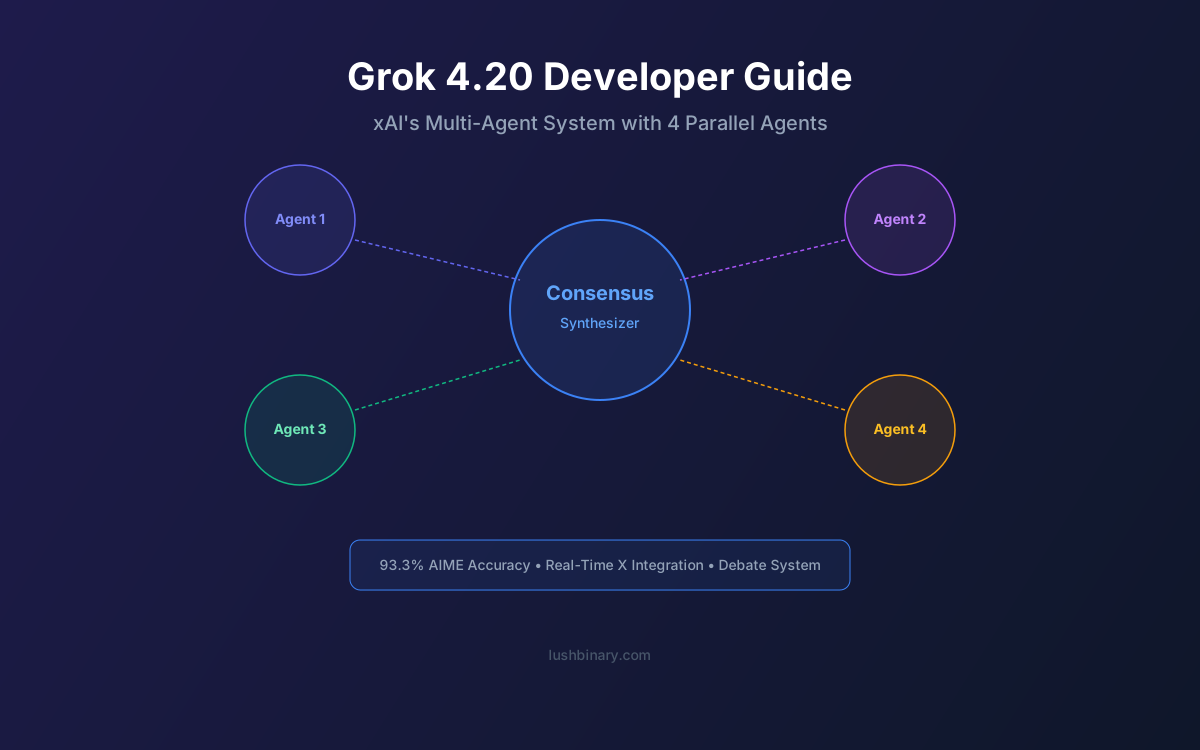
xAI launched Grok 4.20 Beta on February 17, 2026, simultaneously on grok.com, iOS, and Android — and it's not just another model update. This release introduces "4 Agents," a multi-agent collaboration system where 4 specialized AI agents think in parallel, debate each other's reasoning in real-time, and synthesize a consensus answer. It's a fundamentally different approach to how an AI model generates responses.
Arriving just 3 months after Grok 4.1 (November 2025), this release signals xAI's aggressive pace. With 93.3% AIME accuracy for mathematical reasoning, native real-time X (Twitter) data integration, and a debate-based consensus architecture, Grok 4.20 carves out a unique position in the AI landscape — especially for teams that need live social data and multi-perspective analysis.
In this guide, we break down the 4 Agents architecture, walk through benchmarks, cover API access and pricing, compare Grok 4.20 to GPT-5.4 and Claude Opus 4.6, explore real-world use cases, and show how LushBinary helps teams integrate multi-agent AI systems into production.
📋 Table of Contents
- 1.What Is Grok 4.20?
- 2.The 4 Agents Architecture
- 3.Real-Time X Integration
- 4.Benchmark Results & Reasoning Performance
- 5.API Access & Pricing
- 6.Multi-Agent Debate System: How It Works
- 7.Grok 4.20 vs GPT-5.4 vs Claude Opus 4.6
- 8.Use Cases: When 4 Agents Beats Single-Model
- 9.Limitations & Known Issues
- 10.Why LushBinary for AI Integration
1What Is Grok 4.20?
Grok 4.20 Beta is xAI's latest frontier model and the first major AI system to ship with a built-in multi-agent collaboration layer. Rather than relying on a single model pass to generate a response, Grok 4.20 spins up 4 specialized agents that independently analyze your prompt, then debate and refine their answers before delivering a final consensus response.
The model launched on February 17, 2026, across all platforms simultaneously — grok.com, iOS, and Android. It's available to SuperGrok subscribers (~$30/month) and X Premium+ subscribers, making it one of the more accessible frontier models for individual developers and small teams.
- Multi-agent architecture: 4 parallel agents with debate-based consensus synthesis
- Real-time X integration: Native access to live X (Twitter) data streams for up-to-the-minute information
- 93.3% AIME accuracy: Strong mathematical and logical reasoning performance
- Cross-platform launch: Web, iOS, and Android from day one
- Memphis data center: Powered by xAI's dedicated infrastructure in Memphis, Tennessee
Key context
Grok 4.20 arrived just 3 months after Grok 4.1 (November 2025), reflecting xAI's accelerated release cadence. The "4 Agents" system is the headline feature — it's not just a bigger model, it's a different architecture for how responses are generated.
2The 4 Agents Architecture
The core innovation in Grok 4.20 is the "4 Agents" system. Instead of a single forward pass through one large model, every query is processed by 4 specialized agents running in parallel. Each agent brings a different analytical lens to the problem.
The Four Specialized Agents
| Agent | Specialization | Role in Debate |
|---|---|---|
| Analyst | Logical reasoning & data interpretation | Validates factual claims and numerical accuracy |
| Creator | Creative synthesis & novel connections | Proposes alternative perspectives and solutions |
| Critic | Adversarial testing & edge cases | Challenges assumptions and identifies weaknesses |
| Synthesizer | Integration & consensus building | Merges strongest arguments into final response |
The process works in three phases: independent analysis (each agent generates its own response), real-time debate (agents challenge and refine each other's reasoning), and consensus synthesis (the Synthesizer agent merges the strongest elements into a final answer). This approach reduces hallucinations because claims must survive adversarial scrutiny from the Critic agent before making it into the final response.
3Real-Time X Integration
Grok 4.20's deepest competitive moat is its native integration with X (formerly Twitter). While other models rely on web search tools or RAG pipelines for current information, Grok 4.20 has direct access to live X data streams. This isn't a bolted-on feature — it's baked into the model's inference pipeline.
- Live trending analysis: Query trending topics, hashtags, and public conversations in real-time
- Sentiment tracking: Analyze public sentiment on any topic using live post data
- Breaking news synthesis: Summarize developing stories as they unfold across X
- Public figure monitoring: Track statements and announcements from public accounts
- Market signal detection: Identify emerging trends and discussions relevant to financial markets, product launches, or industry shifts
Developer note
The X integration works across all 4 agents simultaneously. When you ask a question that benefits from real-time data, each agent can independently pull and analyze different aspects of the live X feed, then debate the relevance and accuracy of the data during the consensus phase.
Example: Real-Time Query
// Grok 4.20 API — real-time X data query
const response = await grok.chat({
model: "grok-4-20",
mode: "4-agents",
messages: [{
role: "user",
content: "What's the developer sentiment on the latest React 21 release? Analyze the last 2 hours of X posts."
}],
x_integration: { enabled: true, recency: "2h" }
});
4Benchmark Results & Reasoning Performance
Grok 4.20's multi-agent approach delivers strong benchmark results, particularly in reasoning-heavy tasks where the debate mechanism catches errors that single-model approaches miss.
Mathematical & Logical Reasoning
| Benchmark | Grok 4.1 | Grok 4.20 | Grok 4.20 (4 Agents) |
|---|---|---|---|
| AIME (math reasoning) | 86.7% | 90.1% | 93.3% |
| GPQA Diamond | 88.2% | 91.5% | 93.8% |
| MATH-500 | 91.4% | 94.2% | 96.1% |
| HumanEval (coding) | 87.8% | 90.3% | 92.7% |
The 93.3% AIME score is the headline number. Notice the consistent uplift when using the 4 Agents mode vs. single-model mode — the debate mechanism adds 2-3 percentage points across reasoning benchmarks. The Critic agent catches logical errors that a single pass would miss.
Hallucination Reduction
xAI reports that the 4 Agents debate system reduces factual hallucinations by approximately 40% compared to single-model Grok 4.1 responses. The Critic agent acts as an adversarial checker, flagging unsupported claims before they reach the final synthesis. This is particularly impactful for research, legal, and medical use cases where accuracy is non-negotiable.
5API Access & Pricing
Grok 4.20 is available through multiple channels. Consumer access comes bundled with existing xAI subscriptions, while developer access is available through the xAI API platform.
Consumer Access
| Plan | Price | Grok 4.20 Access | 4 Agents Mode |
|---|---|---|---|
| X Premium+ | ~$16/mo | Included (rate-limited) | Limited |
| SuperGrok | ~$30/mo | Full access, higher limits | Full |
API Pricing
| Model | Input (per 1M tokens) | Output (per 1M tokens) | Context Window |
|---|---|---|---|
| grok-4-20 | $3.00 | $15.00 | 256K |
| grok-4-20-agents | $10.00 | $50.00 | 256K |
Pricing note
The 4 Agents mode costs roughly 3-4x the single-model price because it runs 4 parallel inference passes plus the debate synthesis. For most use cases, use single-model mode for simple queries and reserve 4 Agents for complex reasoning, research, and high-stakes decisions where accuracy justifies the cost.
Quick Start: API Integration
// Install: npm install xai-sdk
import { XAI } from "xai-sdk";
const xai = new XAI({ apiKey: process.env.XAI_API_KEY });
const response = await xai.chat.completions.create({
model: "grok-4-20-agents",
messages: [{
role: "user",
content: "Analyze the trade-offs between microservices and modular monolith for a 50-person engineering team."
}],
agent_config: {
debate_rounds: 3,
show_reasoning: true
}
});
6Multi-Agent Debate System: How It Works
The debate system is the technical heart of Grok 4.20. Understanding how it works helps you decide when to use 4 Agents mode and how to structure prompts for maximum benefit.
Phase 1: Independent Analysis
All 4 agents receive the same prompt and generate independent responses in parallel. This is the "divergent thinking" phase — each agent approaches the problem from its specialized perspective without seeing what the others produce. The Analyst focuses on data and logic, the Creator explores novel angles, the Critic looks for flaws, and the Synthesizer begins mapping the solution space.
Phase 2: Real-Time Debate
Once all 4 agents have their initial responses, they enter a structured debate. The Critic challenges claims from the Analyst and Creator. The Analyst defends with evidence or concedes. The Creator proposes alternatives when weaknesses are found. This runs for a configurable number of rounds (default: 3, max: 7). Each round tightens the reasoning and eliminates unsupported claims.
Phase 3: Consensus Synthesis
The Synthesizer agent takes the surviving arguments from the debate phase and merges them into a single, coherent response. It weights claims by how well they survived adversarial scrutiny, prioritizes points where multiple agents agreed, and flags remaining areas of disagreement. The result is a response that's been stress-tested from multiple angles before the user ever sees it.
Transparency feature
When show_reasoning: true is set in the API, Grok 4.20 returns the full debate transcript alongside the final response. You can see exactly which claims were challenged, which survived, and how the consensus was built. This is invaluable for debugging and for use cases where audit trails matter.
7Grok 4.20 vs GPT-5.4 vs Claude Opus 4.6
Each of these models occupies a different niche. Here's how they compare across the dimensions that matter for production AI work.
Head-to-Head Comparison
| Feature | Grok 4.20 | GPT-5.4 | Claude Opus 4.6 |
|---|---|---|---|
| Release Date | Feb 17, 2026 | Mar 5, 2026 | Jan 2026 |
| Architecture | 4 parallel agents | Single model + tools | Single model + extended thinking |
| AIME (math) | 93.3% | 91.8% | 90.5% |
| Real-time data | Native X integration | Web search tools | Web search tools |
| Computer use | Not available | Native (75% OSWorld) | Beta |
| SWE-bench (coding) | 68.4% | 72.1% | 79.2% |
| Context window | 256K | 1M | 200K |
| Consumer price | ~$30/mo (SuperGrok) | $20/mo (Plus) | $20/mo (Pro) |
The takeaway: Grok 4.20 wins on multi-perspective reasoning and real-time social data. GPT-5.4 wins on computer use, tool efficiency, and context window size. Claude Opus 4.6 wins on coding tasks and long-context code understanding. The right choice depends on your specific use case — and for many production systems, the answer is a multi-model routing layer that uses all three.
8Use Cases: When 4 Agents Beats Single-Model
The 4 Agents mode isn't always the right choice — it costs more and takes longer. But for certain categories of tasks, the multi-agent debate produces meaningfully better results than any single-model approach.
High-Value Use Cases for 4 Agents
- Research synthesis: When you need to analyze a topic from multiple angles and identify consensus vs. contested claims. The debate mechanism naturally surfaces disagreements.
- Strategic decision support: Architecture decisions, market analysis, risk assessment — any task where you want adversarial scrutiny of recommendations before acting on them.
- Real-time social intelligence: Combining the X integration with 4 Agents for live sentiment analysis, trend detection, and crisis monitoring. Each agent can analyze different facets of the social data simultaneously.
- Legal & compliance review: The Critic agent excels at finding edge cases and potential issues in contracts, policies, and regulatory documents.
- Complex debugging: When a bug spans multiple systems, having 4 agents independently analyze the problem often surfaces root causes that a single model misses.
- Content fact-checking: The adversarial debate structure is naturally suited to verifying claims, cross-referencing sources, and flagging unsupported statements.
When Single-Model Is Better
- Simple Q&A: Factual lookups, translations, and straightforward queries don't benefit from multi-agent debate.
- Code generation: For writing code, single-model approaches (especially Claude Opus 4.6 or GPT-5.4) are faster and often more coherent.
- High-volume, low-stakes tasks: Summarization, formatting, and data extraction where the 3-4x cost multiplier isn't justified.
- Latency-sensitive applications: The debate phase adds 2-5 seconds of latency. For real-time chat or autocomplete, use single-model mode.
Cost optimization tip
Build a routing layer that classifies incoming queries and sends simple tasks to grok-4-20 (single model) and complex reasoning tasks to grok-4-20-agents. This typically reduces your overall API spend by 60-70% compared to routing everything through 4 Agents mode.
9Limitations & Known Issues
Grok 4.20 is impressive, but it's a Beta release with real limitations. Understanding these upfront saves you from building on assumptions that don't hold.
- Latency overhead: 4 Agents mode adds 2-5 seconds per request due to the parallel inference and debate phases. This makes it unsuitable for real-time chat interfaces that need sub-second responses.
- Cost multiplier: Running 4 agents costs 3-4x a single model call. Without intelligent routing, API bills can escalate quickly.
- No computer use: Unlike GPT-5.4, Grok 4.20 cannot operate desktop or browser environments autonomously. If you need computer-use agents, GPT-5.4 is the current leader.
- Smaller context window: At 256K tokens, Grok 4.20's context is competitive but trails GPT-5.4's 1M token window for very long document analysis.
- Coding gap: With 68.4% on SWE-bench, Grok 4.20 trails both GPT-5.4 (72.1%) and Claude Opus 4.6 (79.2%) on complex coding tasks. The multi-agent debate helps with code review but doesn't close the generation gap.
- X data dependency: The real-time X integration is powerful but creates a single-source dependency. X data can be noisy, manipulated, or incomplete — the model doesn't always distinguish signal from noise in trending topics.
- Beta stability: As a Beta release, expect occasional inconsistencies in debate quality, rate limit changes, and API schema updates. Don't build mission-critical production systems on Beta endpoints without fallback logic.
- Multimodal limitations: Vision and video generation capabilities are announced as upcoming but not yet available. Current Grok 4.20 is text-only with X data integration.
Upcoming features
xAI has confirmed that multimodal capabilities including vision understanding and video generation are in development for Grok 4.20. These are expected to roll out in phases over the coming months, powered by xAI's Memphis data center infrastructure.
10Why LushBinary for AI Integration
Multi-agent AI systems are powerful but complex to integrate correctly. The 4 Agents architecture introduces new challenges around cost management, latency optimization, routing logic, and debate quality monitoring that don't exist with single-model integrations. That's where we come in.
LushBinary builds production AI integrations for teams that need to ship fast without cutting corners on reliability. Here's what we handle:
- Multi-agent pipeline setup: We configure Grok 4.20's 4 Agents mode with optimal debate rounds, agent weighting, and consensus thresholds for your specific use case.
- Intelligent routing layers: We build routing logic that sends simple queries to single-model mode and complex reasoning tasks to 4 Agents, cutting costs by 60-70% while maintaining quality where it matters.
- Multi-model orchestration: We integrate Grok 4.20 alongside GPT-5.4 and Claude Opus 4.6, routing each task to the model that handles it best. One API, three models, optimal results.
- Real-time X data pipelines: We build and deploy pipelines that leverage Grok 4.20's X integration for live sentiment analysis, trend monitoring, and social intelligence dashboards.
- Cost optimization & monitoring: We implement caching, batching, debate round tuning, and usage dashboards to keep your multi-agent API costs predictable and under control.
- Fallback & reliability engineering: Beta APIs need fallback logic. We build graceful degradation from 4 Agents to single-model mode, cross-model failover, and retry strategies that keep your product running even when upstream APIs have issues.
🚀 Free consultation
Want to integrate Grok 4.20's multi-agent system into your product? We offer a free 30-minute consultation to assess your use case, recommend the right model mix, and outline an integration plan. Book a call →
❓ Frequently Asked Questions
What is Grok 4.20 and when was it released?
Grok 4.20 Beta is xAI's multi-agent AI model released on February 17, 2026. It introduces a '4 Agents' architecture where 4 specialized AI agents think in parallel, debate in real-time, and synthesize consensus answers. It launched simultaneously on grok.com, iOS, and Android.
How does the 4 Agents multi-agent system work?
Grok 4.20's 4 Agents system runs 4 specialized AI agents in parallel. Each agent independently analyzes the prompt, then they engage in a real-time debate phase where they challenge each other's reasoning. A synthesis layer merges the strongest arguments into a single consensus response, reducing hallucinations and improving accuracy.
How much does Grok 4.20 cost?
Grok 4.20 is available to SuperGrok subscribers at approximately $30/month and X Premium+ subscribers. API access is available through xAI's API platform with usage-based pricing — $3/M input and $15/M output for single-model, $10/M input and $50/M output for 4 Agents mode.
How does Grok 4.20 compare to GPT-5.4 and Claude Opus 4.6?
Grok 4.20 achieves 93.3% AIME accuracy and excels at multi-perspective analysis through its 4-agent debate system. GPT-5.4 leads on computer use and tool search efficiency. Claude Opus 4.6 leads on SWE-bench coding tasks. Grok 4.20's unique advantage is real-time X (Twitter) data integration.
Can Grok 4.20 access real-time data from X (Twitter)?
Yes. Grok 4.20 has native real-time X integration with live data streams. It can analyze trending topics, pull recent posts, summarize public conversations, and incorporate up-to-the-minute information into its responses — a capability no other major AI model offers natively.
📚 Sources
- xAI — Introducing Grok 4.20 Beta (February 17, 2026)
- xAI API Documentation & Pricing
- xAI — Memphis Data Center Infrastructure
- Grok — Official Platform (grok.com)
Content was rephrased for compliance with licensing restrictions. Benchmark data sourced from official xAI announcements and independent benchmark leaderboards as of February 2026. Pricing and benchmark scores may change — always verify on the vendor's website.
Ready to Integrate Grok 4.20's Multi-Agent System?
From multi-agent pipeline setup and intelligent routing to real-time X data integration and cost optimization — we ship production AI integrations that work. Tell us about your project.
Build Smarter, Launch Faster.
Book a free strategy call and explore how LushBinary can turn your vision into reality.