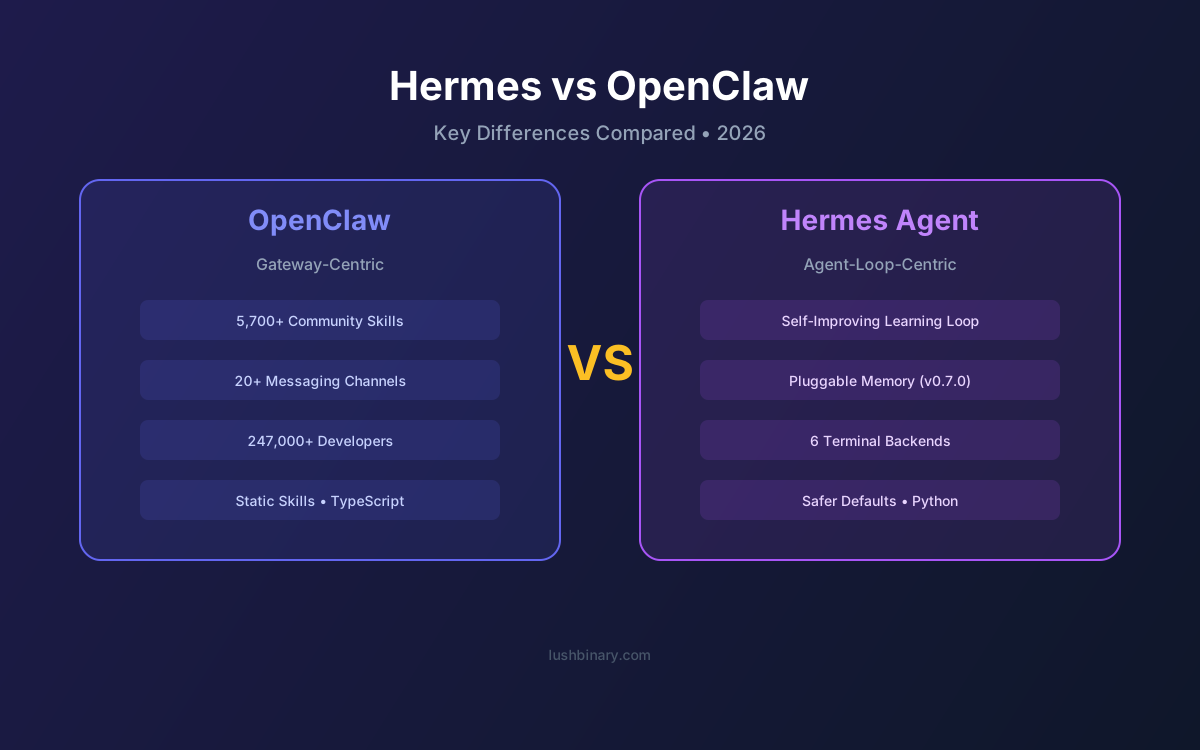
OpenClaw proved that self-hosted AI agents could manage your inbox, automate workflows, and run 24/7 across WhatsApp, Telegram, and Slack. With 247,000+ developers and 5,700+ community skills, it defined the category. Then in February 2026, Nous Research released Hermes Agent with a fundamentally different promise: an agent that doesn't just execute tasks — it learns from them.
The difference matters. OpenClaw skills are static files you write and maintain. Hermes skills are created autonomously by the agent, refined during use, and compounded across sessions. If you're choosing between the two in April 2026, this guide breaks down every architectural, security, and practical difference so you can pick the right foundation for your AI workflows.
We've deployed both platforms for clients at Lushbinary and have hands-on experience with their strengths and limitations. Here's what we've learned.
📑 What This Guide Covers
1Origins & Philosophy
OpenClaw emerged as a community-driven project in late 2025 and quickly became the first mainstream autonomous AI agent framework. Built in TypeScript/Node.js, it proved that a single agent could manage complex business workflows — content, sales, analytics, customer service — for roughly $65/day in LLM costs. Its architecture established the template: a Gateway that routes messages from chat apps into a ReAct-loop Brain, with Markdown-based memory and plug-in skills.
Hermes Agent comes from Nous Research, the lab behind the Hermes model family, Atropos RL environments, and DisTrO distributed training. Released in February 2026 under MIT license, Hermes was built with a different center of gravity: the agent's own execution loop. Where OpenClaw is organized around a central controller that coordinates everything, Hermes puts the focus on a repeatable “do, learn, improve” cycle.
💡 The Core Philosophical Difference
OpenClaw is a tool you configure. Hermes Agent is a teammate that learns. OpenClaw stays the same while you use it. Hermes gets better.
2Architecture Comparison
Both platforms share the same high-level pattern: a persistent process that connects to messaging apps, calls LLMs, executes tools, and maintains state. The differences are in where the center of gravity sits.
OpenClaw Architecture
OpenClaw's Gateway is the control plane — a single long-running Node.js process that owns sessions, routing, tool execution, and state. Everything flows through it. The Gateway routes messages from Telegram, Discord, Slack, and WhatsApp into the agent runtime, which uses a ReAct loop (reason → act → observe) to orchestrate LLM calls. Memory is stored as plain Markdown files searchable via SQLite. A Heartbeat cron job wakes the agent periodically to check for proactive tasks.
Hermes Agent Architecture
Hermes defines the AIAgent loop itself as the core orchestration engine. The gateway, cron scheduler, tooling runtime, ACP (Agent Communication Protocol) integration, SQLite-backed session persistence, and RL environments are all structured around the agent loop. This means the learning cycle — experience, extraction, skill creation, refinement, nudge — is a first-class architectural concern, not an afterthought.
Hermes also supports six terminal backends: local execution, Docker containers, SSH, Daytona, Singularity, and Modal serverless environments. OpenClaw primarily supports local and Docker execution.
3The Self-Improving Learning Loop
This is Hermes Agent's defining feature and the biggest reason developers are switching. OpenClaw's skills are static — you write a skill file, the agent uses it, and if it's wrong or incomplete, you edit it manually. Hermes takes a fundamentally different approach:
- Experience: The agent completes a complex multi-step task
- Extraction: It identifies reusable patterns from what it did
- Skill Creation: It writes a new reusable Markdown skill file
- Refinement: The skill self-improves during subsequent use
- Nudge: The agent periodically reviews and updates its knowledge
Every 15 tasks, Hermes evaluates its own performance, analyzing both successes and failures. It extracts what worked, writes it as a reusable skill, and loads it the next time a similar problem comes up. The memory architecture is cache-aware, so it doesn't keep growing your token bill as the agent learns more.
🔄 Practical Impact
An agent that handles customer enquiries in March will be measurably better at it in June because it learned from every conversation. With OpenClaw, the skill stays exactly as you wrote it unless you manually update it.
4Memory Systems
Memory is where the two platforms diverge most sharply after the learning loop.
OpenClaw Memory
OpenClaw stores memory in plain Markdown files: SOUL.md (agent persona), MEMORY.md (persistent notes), and USER.md (user profile). These are searchable via SQLite vector and keyword search. The system is simple and transparent — you can read and edit memory files directly. However, cross-session memory requires manual setup, and there's no automatic knowledge persistence.
Hermes Agent Memory
Hermes uses a layered memory stack with distinct tiers:
- Persistent notes: Agent-curated knowledge that survives across sessions
- Session history: FTS5 full-text search with LLM summarization over SQLite
- User modeling: Honcho dialectic modeling that builds a deepening understanding of who you are
- Procedural memory: Skills as reusable procedures (remembers methods, not just facts)
- Hot/cold architecture: Strict separation between prompt memory and archival storage for token efficiency
As of v0.7.0 (released April 3, 2026), Hermes memory is fully pluggable. You can swap in third-party backends like Honcho, vector stores, or custom databases via a plugin interface. Six third-party memory providers are supported out of the box.
5Skills & Ecosystem
OpenClaw has the larger ecosystem today. Its ClawHub marketplace hosts 5,700+ community skills covering everything from email management to browser automation. Skills are human-authored Markdown files loaded from workspace, personal, shared, or plugin scopes. The community is active and growing.
Hermes Agent takes a different approach. Skills follow the agentskills.io open standard rather than a proprietary format. The ecosystem is smaller (Hermes launched just two months ago), but the self-improving nature means the agent generates its own skills over time. Hermes also includes 40+ built-in tools and supports MCP (Model Context Protocol) for extensibility.
| Aspect | OpenClaw | Hermes Agent |
|---|---|---|
| Community Skills | 5,700+ on ClawHub | Growing (agentskills.io) |
| Skill Format | Custom Markdown | agentskills.io open standard |
| Skill Creation | Manual (human-authored) | Autonomous + manual |
| Skill Improvement | Manual edits only | Self-improving during use |
| Built-in Tools | Via skills/plugins | 40+ built-in |
| MCP Support | Yes | Yes (+ MCP Server Mode in v0.6.0) |
6Security & Safety
Security is where OpenClaw has faced the most criticism in 2026. Multiple critical CVEs have been disclosed:
- CVE-2026-25253 (CVSS 8.8): Token exfiltration leading to full gateway compromise via a single malicious link. Patched in v2026.1.29.
- CVE-2026-27001: Prompt injection via unsanitized workspace directory paths. Patched in v2026.2.15.
- CVE-2026-30741: Remote code execution through request-side prompt injection. Patched in later releases.
Snyk found 1,467 malicious skills in ClawHub (91% combining prompt injection with traditional malware), and over 40,000 self-hosted instances were found running with insecure default configurations. OpenClaw ships with weak default security settings but deep, privileged access to your system — a risky combination.
Hermes Agent takes a safer-by-default approach:
- Built-in prompt injection scanning
- User authorization and approval checks
- Credential filtering in context
- Context scanning for sensitive data
- Container hardening with read-only root and dropped capabilities
- Isolation via Docker, SSH, or serverless backends
⚠️ Important Caveat
Neither platform provides enterprise-grade zero-trust sandboxing. For regulated industries handling customer data, financial records, or health information, consider IronClaw or NanoClaw. See our comprehensive AI agent comparison for details.
7Deployment & Infrastructure
OpenClaw runs on Node.js and is typically deployed on a VPS, Docker container, or cloud VM. It's straightforward to set up — npx openclaw gets you running in minutes. The platform supports local and Docker terminal backends.
Hermes Agent is Python-based and supports significantly more deployment options:
Local Terminal
Direct execution on your machine
Docker
Containerized with read-only root
SSH
Remote server execution
Daytona
Cloud development environments
Singularity
HPC and research clusters
Modal
Serverless GPU compute
The serverless options (Daytona, Modal) are particularly interesting for cost optimization — you only pay when the agent is actively processing, not while it's idle. A $5/month VPS is sufficient for basic Hermes deployment.
Both platforms run on Linux, macOS, and WSL2. Hermes requires a Unix-like environment; Windows users need WSL2.
8Full Feature Comparison Table
| Feature | OpenClaw | Hermes Agent |
|---|---|---|
| License | MIT | MIT |
| Creator | Community project | Nous Research |
| Language | TypeScript / Node.js | Python |
| Latest Version | v2026.3.2 (April 2026) | v0.7.0 (April 3, 2026) |
| Learning Loop | None (static skills) | Self-improving closed loop |
| Skill Creation | Manual only | Autonomous + manual |
| User Modeling | Basic (USER.md) | Honcho dialectic modeling |
| Memory | Markdown files + SQLite | Layered: FTS5 + LLM summarization + pluggable backends |
| Terminal Backends | 2 (local, Docker) | 6 (local, Docker, SSH, Daytona, Singularity, Modal) |
| Messaging | Telegram, Discord, Slack, WhatsApp, 20+ channels | Telegram, Discord, Slack, WhatsApp, Signal, CLI |
| LLM Providers | OpenRouter, OpenAI, Anthropic, Ollama | Nous Portal, OpenRouter (200+), z.ai, Kimi, MiniMax, OpenAI, custom |
| MCP Support | Yes | Yes + MCP Server Mode |
| Subagents | Thread-bound subagent sessions | Isolated subagents with own conversations and terminals |
| Cron / Scheduling | Heartbeat cron | Full cron scheduler with fresh sessions |
| Research Tools | No | Atropos RL training, trajectory export |
| Security Default | Weak defaults, patched via updates | Safer-by-default with prompt injection scanning |
| Community Size | 247,000+ developers | Growing (launched Feb 2026) |
| Install Command | npx openclaw | pip install hermes-agent / brew |
9Cost Breakdown
Both platforms are free to self-host. Your costs come from two sources: infrastructure and LLM API usage.
| Cost Component | OpenClaw | Hermes Agent |
|---|---|---|
| Software License | Free (MIT) | Free (MIT) |
| Minimum VPS | ~$5–15/mo | ~$5/mo |
| LLM (Budget: DeepSeek V3.2) | ~$2–5/mo | ~$2–5/mo |
| LLM (Premium: Claude/GPT) | ~$30–65/mo | ~$30–65/mo |
| Local LLM (Ollama) | $0 (your hardware) | $0 (your hardware) |
| Serverless Option | Not available | Modal / Daytona (pay-per-use) |
For a deeper dive into running AI agents with open-source LLMs on a budget, see our guide on running OpenClaw with open-source LLMs for almost free.
10When to Choose Each
Choose OpenClaw If:
- You need to get started fast with minimal configuration
- Your workflows are well-defined and don't change often
- You want access to 5,700+ community skills immediately
- Your team is comfortable with TypeScript/JavaScript
- You need 20+ messaging channels (QQ, LINE, Feishu, Teams, etc.)
- Budget constraints require the fastest path to value
Choose Hermes Agent If:
- You want an agent that improves over time without manual updates
- You need serverless deployment to minimize idle costs
- You're doing research or want RL training capabilities
- You value deep user modeling and personalization
- Security-by-default matters more than ecosystem size
- You're building a long-term AI teammate, not a quick automation
11Migration Path
If you're already running OpenClaw and want to try Hermes, the migration is straightforward. Hermes includes a dedicated migration tool:
hermes claw migrateThis imports your SOUL.md persona files, MEMORY.md and USER.md entries, user-created skills, command allowlists, messaging platform configs, API keys for common services, and TTS assets. The migration is interactive with dry-run previews so you can verify everything before committing.
For a detailed walkthrough, see our complete OpenClaw to Hermes migration guide.
12How Lushbinary Can Help
At Lushbinary, we've deployed both OpenClaw and Hermes Agent for clients across industries. Whether you're building your first AI agent or migrating an existing deployment, we can help with:
- Platform selection: We'll assess your workflows and recommend the right agent framework
- Custom skill development: Purpose-built skills for your specific business processes
- AWS deployment: Production-grade infrastructure with cost optimization
- Security hardening: Proper isolation, credential management, and monitoring
- Migration support: Smooth transition from OpenClaw to Hermes (or vice versa)
- MCP integration: Connect your agent to enterprise tools and data sources
🚀 Free Consultation
Not sure which platform fits your use case? Book a free 30-minute call with our AI engineering team. We'll review your workflows and give you an honest recommendation — no sales pitch.
❓ Frequently Asked Questions
What is the main difference between Hermes Agent and OpenClaw?
The core difference is learning capability. OpenClaw uses static, human-authored skills. Hermes Agent has a self-improving learning loop that autonomously creates skills from completed tasks, refines them during use, and builds a deepening model of the user over time.
Is Hermes Agent free to use?
Yes. Hermes Agent is MIT-licensed, free to self-host. You only pay for LLM API costs ($2-65/month) and optional VPS hosting (~$5/month).
Can I migrate from OpenClaw to Hermes Agent?
Yes. Run hermes claw migrate to import your persona, memory, skills, configs, and API keys. The migration is interactive with dry-run previews.
Which has better security?
Hermes Agent has safer defaults with built-in prompt injection scanning and credential filtering. OpenClaw has faced multiple critical CVEs in 2026 but patches are available.
Which AI models do they support?
Both support 200+ models via OpenRouter. OpenClaw also supports OpenAI, Anthropic, and Ollama. Hermes adds Nous Portal, z.ai, Kimi, MiniMax, and custom endpoints.
Should I choose Hermes or OpenClaw for business automation?
OpenClaw for well-defined, short-term workflows with 5,700+ community skills. Hermes for long-term AI teammates that improve over time with serverless deployment options.
📚 Sources
- Hermes Agent Official Documentation
- Hermes Agent GitHub Repository
- OpenClaw CVE-2026-25253 Disclosure (The Hacker News)
- ClawHub Malware Analysis (Blink)
Content was rephrased for compliance with licensing restrictions. Feature comparisons sourced from official documentation and release notes as of April 2026. Features and pricing may change — always verify on the vendor's website.
Need Help Choosing or Deploying an AI Agent?
We've deployed both Hermes and OpenClaw in production. Let us help you pick the right platform and build custom skills for your business.
Build Smarter, Launch Faster.
Book a free strategy call and explore how LushBinary can turn your vision into reality.