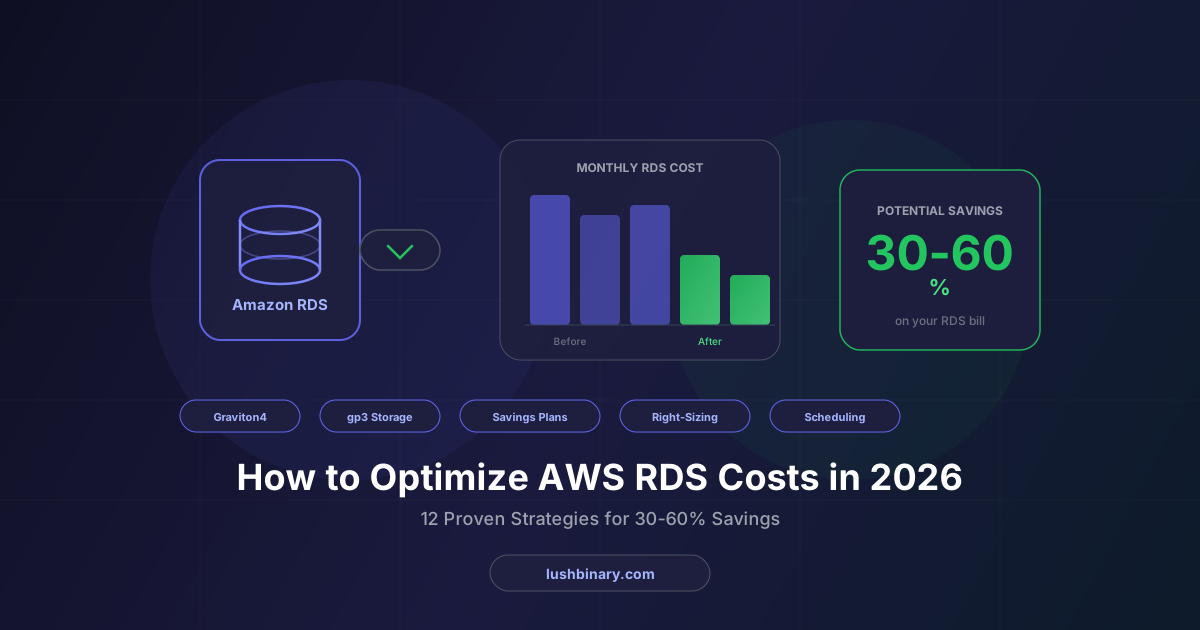
Amazon RDS is one of the top cost drivers in AWS, yet most teams treat it like a set-and-forget service. You provision an instance, pick a storage tier, and move on. Six months later, your database bill is 3x what you expected and nobody can explain why.
The problem isn't RDS itself. It's the pricing complexity: instance hours, storage type, IOPS, backup retention, data transfer, Multi-AZ replication, and snapshot costs all stack up in ways that aren't obvious until you get the bill. And with AWS rolling out Graviton4 instances, Database Savings Plans, and gp3 storage defaults in 2025-2026, the optimization landscape has shifted significantly.
This guide covers every practical strategy to cut your RDS costs in 2026 without sacrificing performance or availability. No fluff, no vendor pitches, just the tactics that actually move the needle.
📋 Table of Contents
- 1.Understanding RDS Pricing Components
- 2.Right-Sizing: Stop Paying for Idle Capacity
- 3.Graviton4 Instances: 29% Better Price-Performance
- 4.gp3 Storage: The Default You Should Already Be Using
- 5.Reserved Instances vs Database Savings Plans
- 6.Schedule Dev/Test Databases to Save 60-70%
- 7.Multi-AZ: Pay for What You Actually Need
- 8.Backup & Snapshot Cost Control
- 9.Data Transfer Costs: The Hidden Line Item
- 10.Aurora Serverless v2 for Variable Workloads
- 11.Monitoring & Automation with AWS Tools
- 12.How Lushbinary Optimizes RDS Costs for Clients
1Understanding RDS Pricing Components
Before you can optimize, you need to know where the money goes. RDS pricing has six main components, and most teams only think about the first two:
| Cost Component | What Drives It | Typical % of Bill |
|---|---|---|
| Instance hours | Instance class, engine, region | 50-70% |
| Storage | Type (gp3/io2), allocated size, IOPS | 10-25% |
| I/O operations | Read/write requests (Standard tier) | 5-15% |
| Backup storage | Retention period, snapshot frequency | 3-8% |
| Data transfer | Cross-AZ, cross-region, internet egress | 2-10% |
| Multi-AZ | Standby replica in another AZ | ~2x instance cost |
The key insight: instance hours dominate the bill. That means right-sizing and commitment discounts (Reserved Instances or Savings Plans) are your highest-leverage moves. But the smaller line items add up fast, especially data transfer and I/O on high-throughput workloads.
Pro tip: Use AWS Cost Explorer with the "Service: Amazon Relational Database Service" filter and group by "Usage Type" to see exactly which components are driving your RDS spend.
2Right-Sizing: Stop Paying for Idle Capacity
Right-sizing is the single most impactful optimization you can make. Most RDS instances are over-provisioned because teams pick an instance size during initial setup and never revisit it. The result: you're paying for 8 vCPUs when your database averages 15% CPU utilization.
How to Identify Over-Provisioned Instances
- CloudWatch CPU Utilization: If average CPU is below 40% over 14 days, you're likely over-provisioned. Look at the p99 too, not just the average.
- FreeableMemory: If you consistently have more than 50% free memory, you can drop to a smaller instance class.
- DatabaseConnections: Compare active connections to the max connections for your instance class. If you're using less than 30% of available connections, downsize.
- AWS Compute Optimizer: Provides right-sizing recommendations for RDS instances based on actual utilization patterns. Enable it if you haven't already.
Right-Sizing Playbook
1. Pull 30 days of CloudWatch metrics (CPU, Memory, Connections, IOPS)
2. Identify peak utilization windows (usually business hours)
3. Target 60-70% peak CPU utilization for production
4. Test the smaller instance in a staging environment first
5. Use Blue/Green Deployments for zero-downtime instance class changes
6. Monitor for 7 days post-change before committing
A common pattern we see: teams running db.r6g.2xlarge ($0.922/hr) when a db.r7g.xlarge ($0.518/hr) handles the workload comfortably. That's a $290/month savings per instance, and it compounds across environments.
3Graviton4 Instances: 29% Better Price-Performance
AWS Graviton4-based RDS instances (r8g, m8g families) launched in late 2025 and expanded to additional regions in January 2026. They deliver up to 40% performance improvement and up to 29% better price-performance compared to Graviton3 instances of equivalent sizes.
If you're still running x86-based instances (r6i, m6i, r5), the savings from switching to Graviton are substantial:
| Migration Path | Typical Savings |
|---|---|
| x86 (r5/r6i) → Graviton3 (r7g) | ~20% cost reduction |
| x86 (r5/r6i) → Graviton4 (r8g) | ~30-35% cost reduction |
| Graviton3 (r7g) → Graviton4 (r8g) | ~10-15% cost reduction |
The migration is straightforward for PostgreSQL and MySQL workloads. Graviton uses ARM architecture, but RDS handles the underlying compatibility. You just change the instance class and RDS does the rest via a modify operation or Blue/Green Deployment.
Heads up: Graviton4 (r8g/m8g) instances are available for Aurora PostgreSQL, Aurora MySQL, RDS for PostgreSQL, RDS for MySQL, and RDS for MariaDB. Oracle and SQL Server workloads are limited to x86 instances. Check RDS instance types for current availability in your region.
4gp3 Storage: The Default You Should Already Be Using
If your RDS instances are still on gp2 storage, you're overpaying. gp3 is cheaper, faster at baseline, and gives you independent control over IOPS and throughput.
| Feature | gp2 | gp3 |
|---|---|---|
| Price (us-east-1) | $0.115/GB-month | $0.08/GB-month |
| Baseline IOPS | 3 IOPS/GB (min 100) | 3,000 IOPS included |
| Baseline throughput | 128-250 MB/s | 125 MB/s included |
| Max IOPS | 16,000 (at 5.3TB+) | 16,000 (provisioned) |
| IOPS scaling | Tied to volume size | Independent of size |
The math is simple: gp3 is ~30% cheaper per GB and includes 3,000 baseline IOPS regardless of volume size. With gp2, you need a 1TB volume just to get 3,000 IOPS. For smaller databases, the savings are even more dramatic.
Migrating from gp2 to gp3 is a non-disruptive operation. You can modify the storage type through the RDS console or CLI, and it completes in the background with no downtime.
# Modify storage type from gp2 to gp3
aws rds modify-db-instance \
  --db-instance-identifier my-database \
  --storage-type gp3 \
  --iops 3000 \
  --storage-throughput 125 \
  --apply-immediately
5Reserved Instances vs Database Savings Plans
Commitment discounts are the biggest lever for reducing RDS instance costs. In 2026, you have two options: RDS Reserved Instances and the newer AWS Database Savings Plans (announced at re:Invent 2025).
| Feature | Reserved Instances | Database Savings Plans |
|---|---|---|
| Max discount | Up to 69% | Up to 35% |
| Commitment | Specific instance family, size, region | $/hour spend (flexible) |
| Flexibility | Locked to instance config | Applies across RDS, Aurora, DocumentDB |
| Term | 1 or 3 years | 1 or 3 years |
| Payment options | All Upfront, Partial, No Upfront | All Upfront, Partial, No Upfront |
| Size flexibility | Within same family (with normalization) | Full flexibility across families |
| Best for | Stable, predictable workloads | Mixed/changing workloads |
Which Should You Choose?
- Use Reserved Instances when you have stable production databases that won't change instance class for 1-3 years. The deeper discount (up to 69%) makes them the better deal for predictable workloads.
- Use Database Savings Plans when you have a mix of RDS, Aurora, and DocumentDB workloads, or when you expect to change instance families (e.g., migrating from x86 to Graviton). The flexibility to apply discounts across services and families is worth the smaller discount.
- Layer both: Cover your stable baseline with Reserved Instances, then use Database Savings Plans for the remaining variable usage.
Sizing tip: Use 30-90 days of Cost Explorer data to determine your baseline $/hour spend on database services. Set your Savings Plan commitment at 70-80% of that baseline to avoid overcommitting. You can always add more later.
6Schedule Dev/Test Databases to Save 60-70%
This is the easiest win most teams miss. Development and staging databases don't need to run 24/7. If your dev database only needs to be available during business hours (say, 10 hours/day, 5 days/week), you're paying for 118 hours of idle time every week.
RDS supports stopping and starting instances. A stopped instance doesn't incur compute charges (you still pay for storage and snapshots). The math:
Always-On (168 hrs/week)
db.r7g.large at $0.259/hr = $189/month
Business Hours Only (50 hrs/week)
db.r7g.large at $0.259/hr = $56/month (70% savings)
You can automate this with AWS Instance Scheduler or a simple Lambda function triggered by EventBridge rules. Tag your non-production instances with a schedule (e.g., Schedule: office-hours) and let automation handle the rest.
Caveat: RDS automatically restarts stopped instances after 7 days. Your scheduler needs to account for this by stopping them again. Also, stopped instances still incur storage and snapshot charges.
7Multi-AZ: Pay for What You Actually Need
Multi-AZ deployments roughly double your instance cost because AWS runs a synchronous standby replica in another Availability Zone. For production databases that need high availability, this is non-negotiable. But we regularly see teams running Multi-AZ on:
- Development databases
- Staging environments
- Batch processing databases that can tolerate downtime
- Read-heavy workloads where a Read Replica would be better
The decision framework is straightforward:
Use Multi-AZ When
Production workloads, SLA requirements, RPO near zero, automated failover needed
Skip Multi-AZ When
Dev/test/staging, batch jobs, workloads that tolerate minutes of downtime, cost-sensitive environments
Also consider the newer Multi-AZ DB Cluster deployment (available for MySQL and PostgreSQL). It uses three instances across three AZs with two readable standbys, giving you both HA and read scaling. The cost is higher than single Multi-AZ but lower than running separate Read Replicas alongside a Multi-AZ instance.
8Backup & Snapshot Cost Control
RDS provides free backup storage equal to your total allocated database storage. Beyond that, you pay $0.095/GB-month. The costs sneak up when you have:
- Long retention periods: The default is 7 days, but some teams set it to 35 days "just in case." Each additional day of retention increases backup storage.
- Manual snapshots: These persist until you explicitly delete them. Forgotten manual snapshots from months ago are a common cost leak.
- Cross-region snapshot copies: If you're copying snapshots to another region for DR, you pay for storage in both regions plus the data transfer.
Optimization Tactics
- Set retention to the minimum your compliance requires. For most workloads, 7-14 days is sufficient.
- Audit and delete old manual snapshots. Use the CLI:
aws rds describe-db-snapshots --snapshot-type manualto list them. - For long-term retention, export snapshots to S3 (much cheaper at $0.023/GB-month for S3 Standard) and delete the RDS snapshot.
- Use AWS Backup with lifecycle policies to automate snapshot management and transition older backups to cold storage.
# Find manual snapshots older than 90 days
aws rds describe-db-snapshots \
  --snapshot-type manual \
  --query "DBSnapshots[?SnapshotCreateTime<='$(date -v-90d +%Y-%m-%d)'].{ID:DBSnapshotIdentifier,Created:SnapshotCreateTime,Size:AllocatedStorage}" \
--output table9Data Transfer Costs: The Hidden Line Item
Data transfer is the cost component that surprises teams the most. Here's how it breaks down for RDS:
- Same AZ: Free between RDS and EC2 in the same AZ
- Cross-AZ: $0.01/GB each way. Multi-AZ replication traffic is included, but application traffic between AZs is not.
- Cross-region: $0.02/GB for Read Replica replication. Application queries across regions cost standard inter-region rates.
- Internet egress: $0.09/GB for the first 10TB/month. This hits if your application servers are outside AWS.
How to Reduce Data Transfer Costs
- Co-locate compute and database: Run your application servers in the same AZ as your primary RDS instance. Use AZ-aware routing in your load balancer.
- Use RDS Proxy: Connection pooling reduces the number of connections and can reduce cross-AZ traffic for serverless workloads (Lambda functions).
- Cache aggressively: Use ElastiCache (Redis or Memcached) or application-level caching to reduce repeated queries that generate transfer costs.
- Compress query results: If your application fetches large result sets, enable compression at the application layer.
Watch out: If you're using Multi-AZ with Read Replicas, your application might be routing reads to a replica in a different AZ than your compute. This generates cross-AZ transfer charges on every query. Use endpoint routing to prefer same-AZ replicas.
10Aurora Serverless v2 for Variable Workloads
If your workload has significant traffic variability (think: SaaS apps with business-hours peaks, event-driven spikes, or seasonal traffic), Aurora Serverless v2 can be more cost-effective than provisioned RDS instances.
Aurora Serverless v2 scales in increments of 0.5 ACU (Aurora Capacity Units), with each ACU providing roughly 2 GB of memory. You set a minimum and maximum ACU range, and Aurora scales automatically based on demand.
When Aurora Serverless v2 Saves Money
Good Fit
Variable traffic patterns, dev/test environments, new apps with unpredictable load, multi-tenant SaaS
Not a Good Fit
Steady high-throughput workloads (provisioned is cheaper), latency-sensitive apps that can't tolerate scale-up time
The pricing is $0.12/ACU-hour (us-east-1, Aurora PostgreSQL). Compare that to a provisioned db.r7g.large (2 vCPUs, 16GB) at $0.259/hr. If your average utilization is below 50%, Serverless v2 will likely be cheaper because it scales down during idle periods.
For a deeper comparison of Aurora vs standard RDS, check out our Aurora vs RDS definitive guide.
11Monitoring & Automation with AWS Tools
Cost optimization isn't a one-time project. Workloads change, new instances get spun up, and costs drift. Here are the AWS-native tools you should have running:
AWS Cost Explorer
Filter by RDS service, group by usage type. Set up monthly cost anomaly detection alerts.
AWS Compute Optimizer
Provides right-sizing recommendations for RDS instances based on CloudWatch metrics.
AWS Trusted Advisor
Flags idle RDS instances, underutilized instances, and missing Reserved Instance coverage.
Performance Insights
Free for 7-day retention. Identifies slow queries that might be driving unnecessary I/O costs.
Cost Allocation Tags
Tag every RDS instance with team, environment, and project. Essential for chargeback and accountability.
AWS Budgets
Set per-service budgets with alerts at 80% and 100% thresholds. Catches cost spikes early.
Quick-Win Automation Checklist
- Enable Storage Autoscaling on all RDS instances to avoid over-provisioning storage upfront. Set a max threshold to prevent runaway growth.
- Set up Cost Anomaly Detection in Cost Explorer for the RDS service. Get alerted when daily spend deviates from the norm.
- Create a monthly FinOps review that checks: RI utilization, idle instances, snapshot cleanup, and right-sizing recommendations.
- Use AWS Config rules to enforce tagging compliance and flag non-compliant RDS instances.
12How Lushbinary Optimizes RDS Costs for Clients
At Lushbinary, we've helped teams cut their RDS bills by 30-60% without touching application code. Our approach combines deep AWS expertise with a systematic FinOps methodology:
Full Cost Audit
We analyze your RDS spend across all accounts, identify waste, and prioritize optimizations by impact.
Right-Sizing & Migration
Graviton migration, instance right-sizing, gp3 storage conversion, and Multi-AZ rationalization.
Commitment Strategy
Optimal mix of Reserved Instances and Database Savings Plans based on your usage patterns.
Automation Setup
Instance scheduling, snapshot lifecycle management, cost alerting, and tagging enforcement.
Ongoing Monitoring
Monthly FinOps reviews, drift detection, and continuous optimization recommendations.
Architecture Advisory
When to use Aurora vs RDS, Serverless v2 evaluation, read replica strategy, and caching layer design.
Whether you're running a single production database or managing dozens of RDS instances across multiple accounts, we can design an optimization plan that delivers measurable savings within the first month.
🚀 Get a free RDS cost audit. We'll review your current setup, identify the top savings opportunities, and give you a prioritized action plan. No commitment required.
Related reading: AWS Aurora vs RDS: Cost, Performance & Architecture Guide · MCP Developer Guide 2026
Stop Overpaying for RDS
Let Lushbinary audit your RDS setup and build an optimization plan that cuts costs without compromising performance. Most clients see 30-60% savings.
Build Smarter, Launch Faster.
Book a free strategy call and explore how LushBinary can turn your vision into reality.