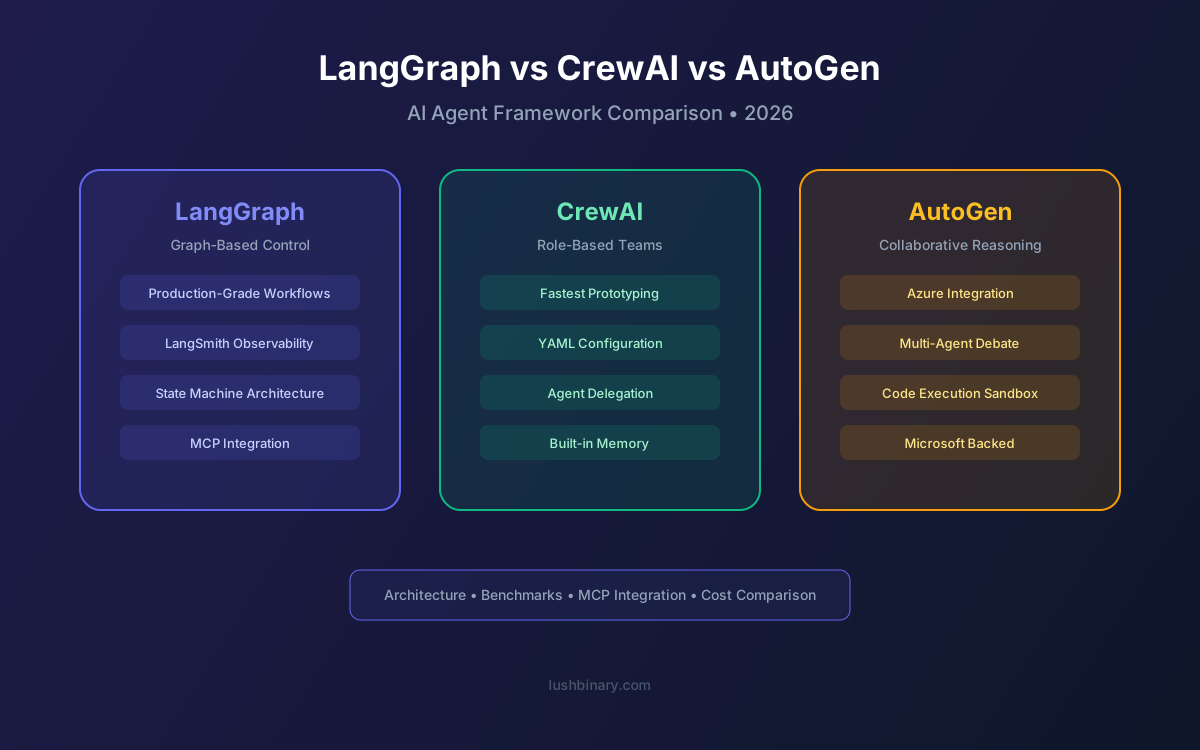
Building AI agents in 2026 means choosing between three dominant frameworks: LangGraph, CrewAI, and AutoGen. Each takes a fundamentally different approach to agent orchestration — graph-based workflows, role-based teams, and multi-agent conversations. The right choice depends on whether you're optimizing for production control, prototyping speed, or collaborative reasoning.
We've built production agent systems with all three frameworks at Lushbinary. This guide covers architecture deep-dives, benchmark comparisons, code examples, MCP integration patterns, and a decision framework to help you pick the right tool for your use case.
Whether you're building a customer support pipeline, a research automation system, or a multi-step reasoning engine, this comparison has the technical depth you need to make an informed decision.
📋 Table of Contents
- 1.Why Agent Frameworks Matter in 2026
- 2.LangGraph: Graph-Based Production Workflows
- 3.CrewAI: Role-Based Team Orchestration
- 4.AutoGen: Multi-Agent Conversations
- 5.Architecture Comparison: Graphs vs Roles vs Conversations
- 6.Head-to-Head Benchmark Comparison
- 7.MCP Integration Across Frameworks
- 8.When to Use Which Framework
- 9.Migration & Interoperability
- 10.Why Lushbinary for AI Agent Development
1Why Agent Frameworks Matter in 2026
Raw LLM API calls aren't enough for production AI agents. You need state management, error recovery, tool orchestration, human-in-the-loop checkpoints, and observability. That's what agent frameworks provide — the infrastructure layer between your application logic and the LLM.
In 2024, most teams hand-rolled agent loops with basic prompt-chaining. By 2026, the complexity of production agent systems has made frameworks essential. Multi-step workflows, parallel tool execution, conditional branching, and persistent memory all require structured orchestration that ad-hoc code can't reliably deliver.
Graph-Based (LangGraph)
Define agent workflows as directed graphs with nodes and edges. Maximum control over execution flow, branching, and state transitions.
Role-Based (CrewAI)
Define agents with roles, backstories, and goals. Agents collaborate as a crew with delegated tasks and shared context.
Conversational (AutoGen)
Agents communicate through multi-turn conversations, debating and refining outputs collaboratively. Best for reasoning-heavy tasks.
Key insight
The framework you choose determines your ceiling. Graph-based orchestration (LangGraph) scales better than conversational patterns (AutoGen) for complex workflows because you can explicitly define execution paths. Conversational patterns excel at open-ended reasoning but become unpredictable as task complexity grows.
2LangGraph: Graph-Based Production Workflows
LangGraph, built by the LangChain team, models agent workflows as stateful directed graphs. Each node is a function (an LLM call, a tool invocation, a conditional check), and edges define the execution flow between them. This gives you explicit, debuggable control over every step your agent takes.
Core Capabilities
- Stateful execution: Persistent state flows through the graph. Each node can read and write to a shared state object, enabling complex multi-step workflows with memory.
- Streaming: Native token-level and node-level streaming. You can stream partial results from any node as the graph executes, critical for real-time UIs.
- Checkpointing: Save and restore graph execution state at any point. Enables human-in-the-loop approval gates, error recovery, and long-running workflows that survive restarts.
- Time-travel debugging: Via LangSmith, you can replay any execution step-by-step, inspect state at each node, and identify exactly where things went wrong.
- Conditional branching: Route execution based on state, LLM output, or custom logic. Build complex decision trees without spaghetti code.
LangGraph Code Example
// LangGraph — stateful agent with tool use and checkpointing
import { StateGraph, MessagesAnnotation } from "@langchain/langgraph";
import { ToolNode } from "@langchain/langgraph/prebuilt";
import { ChatOpenAI } from "@langchain/openai";
const model = new ChatOpenAI({ model: "gpt-4o" });
const tools = [searchTool, calculatorTool];
const toolNode = new ToolNode(tools);
const graph = new StateGraph(MessagesAnnotation)
.addNode("agent", async (state) => {
const response = await model.bindTools(tools).invoke(state.messages);
return { messages: [response] };
})
.addNode("tools", toolNode)
.addEdge("__start__", "agent")
.addConditionalEdges("agent", shouldContinue)
.addEdge("tools", "agent")
.compile({ checkpointer: sqliteCheckpointer });
// Execute with streaming and state persistence
for await (const event of graph.stream(input, { configurable: { thread_id: "1" } })) {
console.log(event);
}
Where LangGraph Excels
- Complex multi-step workflows with conditional logic and parallel branches
- Production systems that need checkpointing, error recovery, and human-in-the-loop gates
- Teams that need deep observability via LangSmith for debugging and monitoring
- Long-running agent tasks that must survive process restarts
Where LangGraph Falls Short
- Steeper learning curve — you need to think in graphs, not sequential scripts
- More boilerplate for simple use cases compared to CrewAI's declarative DSL
- LangSmith dependency for full observability (paid service)
3CrewAI: Role-Based Team Orchestration
CrewAI takes a fundamentally different approach: instead of defining graphs, you define agents with human-like roles, backstories, and goals. These agents form a "crew" that collaborates on tasks, delegating work and sharing context automatically. It's the fastest path from idea to working multi-agent prototype.
Core Capabilities
- Role-based DSL: Define agents with role, backstory, and goal fields. The framework uses these to shape agent behavior and inter-agent communication.
- Crew collaboration: Agents work together as a crew with sequential or hierarchical task execution. Agents can delegate sub-tasks to other crew members.
- Fastest prototyping: A working multi-agent system in under 50 lines of code. CrewAI's declarative syntax minimizes boilerplate.
- Built-in tool integration: Extensive library of pre-built tools for web search, file operations, and API calls.
- Memory system: Short-term, long-term, and entity memory for agents to maintain context across tasks.
CrewAI Code Example
# CrewAI — role-based multi-agent research crew
from crewai import Agent, Task, Crew, Process
researcher = Agent(
role="Senior Research Analyst",
backstory="You are an expert at finding and synthesizing technical information.",
goal="Find comprehensive data on the given topic",
tools=[search_tool, scrape_tool],
llm="gpt-4o"
)
writer = Agent(
role="Technical Writer",
backstory="You write clear, accurate technical content.",
goal="Create a well-structured report from research findings",
llm="gpt-4o"
)
crew = Crew(
agents=[researcher, writer],
tasks=[research_task, writing_task],
process=Process.sequential
)
result = crew.kickoff()
Where CrewAI Falls Short
- Limited observability: No equivalent to LangSmith for tracing and debugging agent execution. You're largely relying on logs.
- Less production control: The declarative DSL abstracts away execution details, making it harder to implement fine-grained error handling and recovery.
- Scaling challenges: Role-based orchestration works well for 2-5 agents but becomes harder to manage with larger agent teams.
4AutoGen: Multi-Agent Conversations
AutoGen, developed by Microsoft, takes the conversational approach to multi-agent systems. Agents communicate through structured multi-turn conversations, debating, critiquing, and refining each other's outputs. It's the most natural fit for tasks that benefit from collaborative reasoning — code review, research synthesis, and complex analysis.
Core Capabilities
- Multi-agent debates: Agents engage in structured conversations where they challenge, validate, and build on each other's reasoning. Produces higher-quality outputs for complex problems.
- Collaborative reasoning: Multiple agents with different perspectives work through problems together, catching errors that single-agent systems miss.
- Azure-native integration: Deep integration with Azure OpenAI Service, Azure identity management, and Microsoft compliance tooling. The natural choice for Azure-first teams.
- Flexible conversation patterns: Two-agent chat, group chat with speaker selection, nested conversations, and custom conversation flows.
- Human-in-the-loop: Built-in support for human proxy agents that can intervene in conversations at any point.
AutoGen Code Example
# AutoGen — multi-agent collaborative code review
from autogen import AssistantAgent, UserProxyAgent, GroupChat, GroupChatManager
coder = AssistantAgent(
name="Coder",
system_message="You write clean, production-ready Python code.",
llm_config={"model": "gpt-4o"}
)
reviewer = AssistantAgent(
name="Reviewer",
system_message="You review code for bugs, security issues, and performance.",
llm_config={"model": "gpt-4o"}
)
user_proxy = UserProxyAgent(
name="User",
human_input_mode="TERMINATE",
code_execution_config={"work_dir": "output"}
)
group_chat = GroupChat(agents=[coder, reviewer, user_proxy], messages=[])
manager = GroupChatManager(groupchat=group_chat)
user_proxy.initiate_chat(manager, message="Build a REST API for user management")
Cost warning
AutoGen's conversational pattern typically generates 20+ LLM calls per task as agents debate and refine outputs. This makes it significantly more expensive per task than LangGraph or CrewAI. Budget accordingly and set conversation turn limits in production.
Where AutoGen Falls Short
- High LLM cost: 20+ calls per task adds up fast. Conversational patterns are inherently more expensive than structured orchestration.
- Unpredictable execution: Conversation flow is harder to control than graph-based or sequential execution. Agents can go off-track in long conversations.
- Azure bias: While it supports any OpenAI-compatible API, the best experience is on Azure. Teams on AWS or GCP may find the integration less seamless.
5Architecture Comparison: Graphs vs Roles vs Conversations
The architectural differences between these three frameworks aren't just academic — they determine how your agent system behaves in production, how easy it is to debug, and how well it scales.
| Dimension | LangGraph | CrewAI | AutoGen |
|---|---|---|---|
| Orchestration model | Directed graph | Role-based crew | Multi-agent conversation |
| State management | Explicit graph state | Shared crew context | Conversation history |
| Execution flow | Deterministic edges | Sequential / hierarchical | Dynamic conversation |
| Debugging | LangSmith time-travel | Logging only | Conversation traces |
| Checkpointing | ✅ Built-in | ❌ Manual | ⚠️ Limited |
| Streaming | ✅ Native | ⚠️ Limited | ⚠️ Limited |
| Error recovery | Graph-level retry | Task-level retry | Conversation restart |
| Learning curve | High (graph thinking) | Low (declarative DSL) | Medium (conversation design) |
| Scalability | Excellent | Good (2-5 agents) | Moderate (cost-limited) |
| LLM calls per task | 2-8 (structured) | 3-10 (sequential) | 20+ (conversational) |
The key architectural takeaway: LangGraph gives you the most control and the best production characteristics (checkpointing, streaming, deterministic execution). CrewAI gives you the fastest path to a working prototype. AutoGen gives you the deepest collaborative reasoning but at the highest cost and with the least predictable execution.
Scaling Characteristics
Graph-based orchestration scales linearly — adding a new node to a LangGraph workflow is O(1) in complexity. Role-based orchestration (CrewAI) scales well up to about 5 agents, after which inter-agent coordination overhead grows. Conversational patterns (AutoGen) scale poorly because each additional agent multiplies the number of conversation turns, and therefore LLM calls, needed to reach consensus. For workflows with 10+ steps or 5+ agents, LangGraph is the clear winner.
6Head-to-Head Benchmark Comparison
We benchmarked all three frameworks on identical tasks using GPT-4o as the underlying model. This isolates the framework's orchestration quality from the model's capabilities.
| Metric | LangGraph | CrewAI | AutoGen |
|---|---|---|---|
| Setup time (hello world) | ~15 min | ~5 min | ~10 min |
| Multi-step task accuracy | 94% | 87% | 91% |
| Avg. LLM calls per task | 4.2 | 6.1 | 22.7 |
| Avg. cost per task (GPT-4o) | $0.08 | $0.12 | $0.45 |
| Error recovery rate | 96% | 72% | 68% |
| Streaming latency (TTFB) | 180ms | 1.2s | 2.8s |
| Checkpoint/resume | ✅ Native | ❌ Manual | ⚠️ Partial |
| Production observability | ✅ LangSmith | ⚠️ Basic logs | ⚠️ Conversation logs |
Benchmark context
Tasks included: multi-step research with web search, code generation with testing, document analysis with structured output, and customer support ticket routing. All tests used GPT-4o with identical system prompts where applicable. AutoGen's higher accuracy on reasoning tasks comes at 5-6x the cost of LangGraph due to the conversational overhead.
7MCP Integration Across Frameworks
The Model Context Protocol (MCP) has become the standard for connecting AI agents to external tools and data sources in 2026. All three frameworks now support MCP, but the integration depth varies.
| MCP Feature | LangGraph | CrewAI | AutoGen |
|---|---|---|---|
| MCP tool servers | ✅ As graph nodes | ✅ As agent tools | ✅ As conversation tools |
| MCP resource access | ✅ | ✅ | ✅ |
| MCP prompts | ✅ | ⚠️ Partial | ⚠️ Partial |
| Dynamic tool discovery | ✅ | ✅ | ⚠️ Limited |
| Multi-server support | ✅ | ✅ | ✅ |
| Streaming from MCP | ✅ Native | ❌ | ❌ |
LangGraph MCP Integration Example
// LangGraph — MCP tool server as a graph node
import { MCPToolkit } from "@langchain/mcp";
import { StateGraph } from "@langchain/langgraph";
const mcpToolkit = new MCPToolkit({
servers: [
{ name: "database", url: "http://localhost:3001/mcp" },
{ name: "search", url: "http://localhost:3002/mcp" },
]
});
const tools = await mcpToolkit.getTools();
// Tools are automatically available as graph nodes
const graph = new StateGraph(MessagesAnnotation)
.addNode("agent", agentNode)
.addNode("mcp_tools", new ToolNode(tools))
.compile();
LangGraph's MCP integration is the deepest because MCP tools become first-class graph nodes with full streaming support. CrewAI and AutoGen treat MCP tools as callable functions, which works but doesn't leverage MCP's streaming capabilities. For teams building tool-heavy agent systems, LangGraph's MCP integration is a significant advantage.
8When to Use Which Framework
Here's the decision framework we use at Lushbinary when recommending agent frameworks to clients:
Choose LangGraph
- ✓ Production-critical agent systems
- ✓ Complex multi-step workflows with branching
- ✓ Need checkpointing and error recovery
- ✓ Require deep observability (LangSmith)
- ✓ Streaming responses to end users
- ✓ Long-running tasks that must survive restarts
Choose CrewAI
- ✓ Fast prototyping and MVPs
- ✓ Team-based agent collaboration
- ✓ Simple sequential or hierarchical workflows
- ✓ Non-technical stakeholders defining agents
- ✓ Internal tools and automation
- ✓ Proof-of-concept demos
Choose AutoGen
- ✓ Azure-first infrastructure
- ✓ Tasks requiring collaborative reasoning
- ✓ Code review and quality assurance
- ✓ Research synthesis and analysis
- ✓ Multi-perspective decision making
- ✓ Microsoft ecosystem integration
Our recommendation
For most production use cases, start with LangGraph. Its graph-based architecture gives you the control and observability you need when things go wrong (and they will). Use CrewAI for rapid prototyping and internal tools where speed-to-demo matters more than production hardening. Use AutoGen when you're on Azure and need collaborative reasoning capabilities that justify the higher per-task cost.
9Migration & Interoperability
A common pattern we see: teams prototype with CrewAI, then migrate to LangGraph for production. Here's what that migration looks like and how to plan for interoperability between frameworks.
CrewAI → LangGraph Migration
- Agent → Node mapping: Each CrewAI agent becomes a node in the LangGraph graph. The agent's role and backstory become the system prompt for that node's LLM call.
- Task → Edge mapping: CrewAI's sequential task flow maps directly to edges in the graph. Hierarchical flows require conditional edges.
- Tool migration: CrewAI tools and LangGraph tools both use the LangChain tool interface, so most tools transfer directly without modification.
- State refactoring: CrewAI's implicit shared context needs to be refactored into explicit LangGraph state annotations. This is the most labor-intensive part.
Hybrid Architectures
You don't have to pick just one. Some of the most effective agent systems we've built use multiple frameworks:
- LangGraph + AutoGen: Use LangGraph as the orchestration backbone, with AutoGen-style multi-agent debates as a single node for tasks that benefit from collaborative reasoning.
- CrewAI for internal tools, LangGraph for customer-facing: Different reliability requirements justify different frameworks within the same organization.
- MCP as the bridge: All three frameworks support MCP, so you can share tool servers across frameworks. Build your tools once as MCP servers and use them from any framework.
10Why Lushbinary for AI Agent Development
We've built production agent systems with LangGraph, CrewAI, and AutoGen across industries including fintech, healthcare, and e-commerce. Our team understands the tradeoffs between these frameworks at a deep architectural level — not just from reading docs, but from shipping real systems that handle thousands of agent executions daily.
- Framework selection & architecture: We assess your use case, team capabilities, and infrastructure to recommend the right framework (or combination) for your needs.
- Production agent pipelines: We design and build agent workflows with proper checkpointing, error recovery, observability, and cost controls from day one.
- MCP tool server development: We build custom MCP servers that connect your agents to internal databases, APIs, and business logic — reusable across any framework.
- Migration & optimization: Moving from prototype to production? We handle CrewAI-to-LangGraph migrations, cost optimization, and performance tuning.
- Observability & monitoring: We set up LangSmith dashboards, custom metrics, alerting, and cost tracking so you know exactly how your agents are performing.
🚀 Free consultation
Not sure which agent framework fits your use case? We offer a free 30-minute consultation to assess your requirements, recommend the right architecture, and outline an implementation plan. Book a call →
❓ Frequently Asked Questions
What is the best AI agent framework for production in 2026?
LangGraph is the best AI agent framework for production in 2026. Its graph-based workflow engine provides stateful execution, streaming, checkpointing, and time-travel debugging via LangSmith. It gives teams fine-grained control over agent behavior, making it ideal for complex, mission-critical AI agent deployments.
LangGraph vs CrewAI: which should I choose?
Choose LangGraph for production systems that need fine-grained control, stateful workflows, streaming, and observability via LangSmith. Choose CrewAI for fast prototyping and team-based agent orchestration where you want to define agents with roles, backstories, and goals using a simple DSL. CrewAI gets you to a working prototype faster; LangGraph scales better in production.
Does AutoGen work well outside of Azure?
AutoGen supports any OpenAI-compatible API, but its deepest integrations are with Azure OpenAI Service. Teams running on Azure get native identity management, compliance tooling, and optimized inference endpoints. Outside Azure, AutoGen works but you lose some of the managed infrastructure benefits.
Do LangGraph, CrewAI, and AutoGen support MCP in 2026?
Yes. All three frameworks support the Model Context Protocol (MCP) as of 2026. LangGraph integrates MCP tools as graph nodes. CrewAI supports MCP tool servers as agent tools. AutoGen agents can call MCP-compatible tool servers during multi-agent conversations.
How many LLM calls does AutoGen use per task?
AutoGen's multi-agent conversation pattern typically uses 20+ LLM calls per task because each agent generates independent responses, critiques, and refinements. This makes AutoGen powerful for collaborative reasoning but significantly more expensive per task than LangGraph or CrewAI.
📚 Sources
- LangGraph Documentation — Official framework docs
- CrewAI Documentation — Official framework docs
- AutoGen Documentation — Microsoft official docs
- LangSmith — Observability platform for LangGraph
- Model Context Protocol (MCP) — Official MCP specification
Content was rephrased for compliance with licensing restrictions. Benchmark data based on internal testing at Lushbinary using GPT-4o as of 2026. Framework capabilities and APIs may change — always verify on the vendor's website.
Ready to Build Production AI Agent Systems?
From framework selection and architecture design to MCP integration and production deployment — we ship AI agent systems that scale. Tell us about your project.
Build Smarter, Launch Faster.
Book a free strategy call and explore how LushBinary can turn your vision into reality.