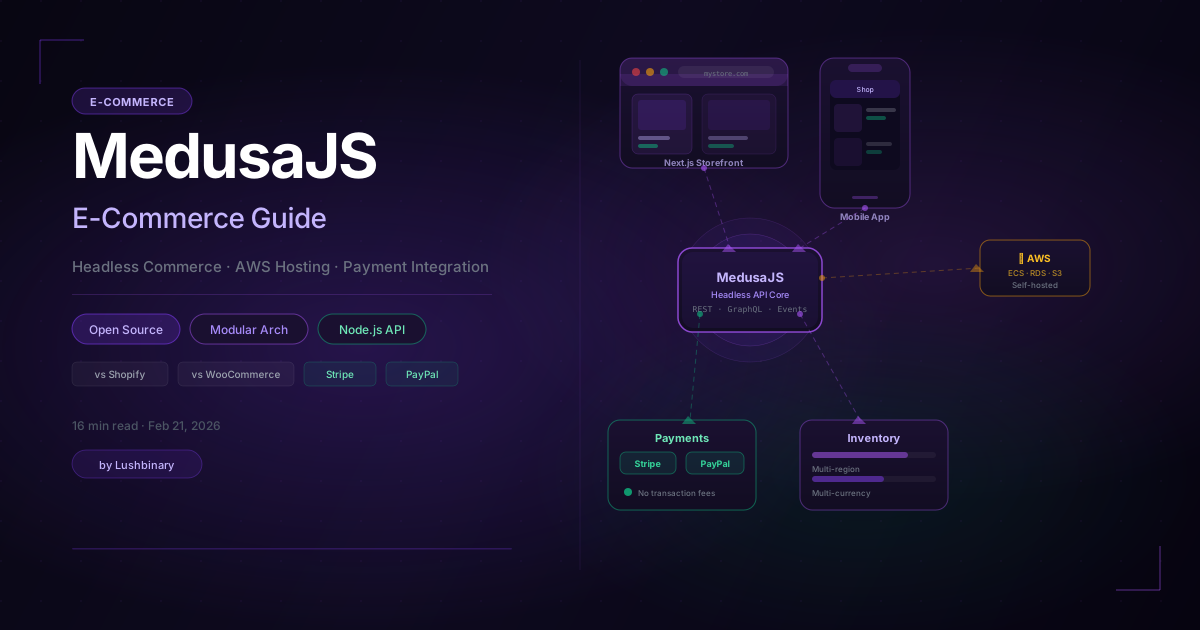
If you're a developer tired of fighting platform limitations on Shopify or wrestling with WordPress plugins on WooCommerce, MedusaJS deserves your attention. It's an open-source, headless e-commerce platform built on Node.js that gives you full control over your commerce stack without vendor lock-in, GMV fees, or transaction surcharges.
With the release of Medusa 2.0, the platform underwent a complete architectural rewrite, introducing fully isolated commerce modules, a powerful workflow engine, and a framework-agnostic approach that lets you build with React, Next.js, Remix, or any frontend you prefer. In this guide, we break down everything developers need to know: core features, payment integration, hosting costs on AWS compared to Shopify and WooCommerce, real user feedback, and an honest verdict on when MedusaJS is the right choice.
📋 Table of Contents
- 1.What Is MedusaJS & Why Developers Love It
- 2.Core Features & Modular Architecture
- 3.Payment Integration: Stripe, PayPal & Beyond
- 4.Payment Fees Compared: MedusaJS vs Shopify vs WooCommerce
- 5.AWS Hosting Cost Breakdown
- 6.Cost Comparison: MedusaJS on AWS vs Shopify vs WooCommerce
- 7.Real User Feedback & Developer Experience
- 8.The Verdict: When to Choose MedusaJS (And When Not To)
- 9.How LushBinary Can Help You Build with MedusaJS
1What Is MedusaJS & Why Developers Love It
MedusaJS is a free, open-source headless commerce engine built with Node.js and TypeScript. Unlike monolithic platforms like Shopify or WooCommerce, Medusa separates the backend commerce logic (products, orders, payments, shipping) from the frontend presentation layer. This means you can build any storefront experience you want using any framework, while Medusa handles the commerce API behind the scenes.
With over 31,000 GitHub stars and a rapidly growing community, MedusaJS has become the most popular open-source e-commerce project on GitHub. It's backed by $10M+ in venture funding and used by companies ranging from solo founders to enterprise brands.
- Fully open-source (MIT license) with no vendor lock-in
- 0% GMV fees, no transaction surcharges from the platform
- Headless & API-first, use any frontend framework
- Built on Node.js & TypeScript, familiar stack for modern developers
- Modular architecture, use only what you need, swap out what you don't
- Self-hosted or cloud, deploy anywhere or use Medusa Cloud
"Medusa struck the right balance between open source flexibility and solid opinionated architecture." - MedusaJS community
2Core Features & Modular Architecture
Medusa 2.0 was a complete rewrite that introduced fully isolated commerce modules. Every business domain (products, carts, orders, payments, inventory, pricing, promotions) is an independent module with no foreign key dependencies between them. This is a fundamental shift from how most e-commerce platforms work.
🏗️ Architecture Overview
🔑 Key Features
Native support for selling across regions with different currencies, tax rates, and shipping options
Orchestrate complex business logic across modules with built-in compensation (rollback) on failure
Full-featured React admin panel for managing products, orders, customers, and settings
Sell across web, mobile, POS, and marketplaces from a single backend
Flexible promotion engine with percentage, fixed, free shipping, and buy-X-get-Y rules
Create and manage orders manually before they're placed by customers
Track stock across multiple locations with reservation support
Pluggable tax calculation and shipping rate providers
Build your own modules with the Modules SDK for any business logic
Production-ready storefront template to get started quickly
The modular design means you can adopt Medusa incrementally. Need just the product catalog and cart? Use those modules. Want to add your own custom fulfillment logic? Build a module. This flexibility is what sets Medusa apart from monolithic platforms where you're stuck with whatever the vendor provides.
3Payment Integration: Stripe, PayPal & Beyond
MedusaJS ships with first-party support for Stripe and PayPal as payment module providers. The integration is clean and developer-friendly, configured directly in your medusa-config.ts file.
💳 Stripe Integration
Stripe is the default payment provider and comes pre-installed with new Medusa projects. It supports automatic payment methods (Apple Pay, Google Pay), manual and automatic capture, webhook handling, and refunds.
// medusa-config.ts - Stripe setup
module.exports = defineConfig({
  modules: [
    {
      resolve: "@medusajs/medusa/payment",
      options: {
        providers: [
          {
            resolve: "@medusajs/medusa/payment-stripe",
            id: "stripe",
            options: {
              apiKey: process.env.STRIPE_API_KEY,
              webhookSecret: process.env.STRIPE_WEBHOOK_SECRET,
              capture: true, // auto-capture payments
              automatic_payment_methods: true,
            },
          },
        ],
      },
    },
  ],
})
🅿️ PayPal Integration
PayPal integration follows the same module provider pattern. You can offer PayPal alongside Stripe, giving customers the choice of payment method at checkout.
🔌 Custom Payment Providers
The payment module is fully extensible. You can build custom payment providers for any gateway (Razorpay, Mollie, Adyen, Square, etc.) by implementing the payment provider interface. The community has already built providers for several popular gateways.
Key advantage: MedusaJS charges 0% platform transaction fees. You only pay the payment processor's fees (e.g., Stripe's 2.9% + $0.30). No additional surcharges from Medusa itself.
4Payment Fees Compared: MedusaJS vs Shopify vs WooCommerce
One of the biggest cost factors in e-commerce is payment processing fees. Here's how the three platforms compare when it comes to what you actually pay per transaction:
| Fee Type | MedusaJS | Shopify | WooCommerce |
|---|---|---|---|
| Platform Transaction Fee | 0% | 0% - 2%* | 0% |
| Stripe Processing | 2.9% + $0.30 | 2.9% + $0.30** | 2.9% + $0.30 |
| PayPal Processing | 2.9% + $0.30 | 2.9% + $0.30 | 2.9% + $0.30 |
| GMV Fee | 0% | 0% | 0% |
| 3rd-Party Gateway Surcharge | None | 0.5% - 2% | None |
| Monthly Platform Fee | $0 (self-hosted) | $29 - $399/mo | $0 (plugin free) |
*Shopify charges 0.5%-2% additional transaction fee when using third-party payment gateways instead of Shopify Payments. **Shopify Payments rates vary by plan: Basic 2.9%, Shopify 2.7%, Advanced 2.5%.
Let's put this in real numbers. For a store doing $50,000/month in sales using Stripe:
| Cost Item | MedusaJS | Shopify (Basic) | WooCommerce |
|---|---|---|---|
| Stripe fees (2.9% + $0.30) | $1,600 | $1,600 | $1,600 |
| Platform subscription | $0 | $39 | $0 |
| 3rd-party gateway surcharge | $0 | $0† | $0 |
| Hosting (see Section 5) | ~$50-80 | Included | ~$30-100 |
| Estimated Monthly Total | ~$1,650-1,680 | ~$1,639 | ~$1,630-1,700 |
†Assumes Shopify Payments is used (no additional surcharge). If using a third-party gateway on Shopify Basic, add 2% ($1,000/mo on $50K sales).
5AWS Hosting Cost Breakdown
Since MedusaJS is self-hosted, you need infrastructure. AWS is the most popular choice for production deployments. Here's a realistic cost breakdown for different store sizes:
🏗️ Recommended AWS Architecture
ECS Fargate or EC2 (t4g.medium)
Run the Medusa application server. Fargate for hands-off container management, or EC2 for more control. ARM-based Graviton instances offer the best price-performance.
RDS PostgreSQL (db.t4g.micro or small)
Managed PostgreSQL database. Medusa requires PostgreSQL for its data layer. Start with db.t4g.micro for small stores.
ElastiCache Redis
Required for session management, caching, and the event bus. A cache.t4g.micro instance is sufficient for most stores.
S3 for Media Storage
Product images, file uploads, and backups. Extremely cost-effective at scale.
CloudFront CDN
Serve your storefront and media assets globally with low latency. Pairs with S3 for image delivery.
Application Load Balancer
Route traffic to your Medusa instances with health checks and SSL termination.
💰 Monthly Cost Estimates by Store Size
| Resource | Small Store | Medium Store | Large Store |
|---|---|---|---|
| EC2/Fargate (app server) | ~$15 | ~$40 | ~$120 |
| RDS PostgreSQL | ~$15 | ~$30 | ~$80 |
| ElastiCache Redis | ~$12 | ~$25 | ~$50 |
| S3 + CloudFront | ~$3 | ~$10 | ~$40 |
| ALB | ~$18 | ~$22 | ~$30 |
| Data transfer | ~$2 | ~$8 | ~$30 |
| CloudWatch monitoring | Free tier | ~$5 | ~$15 |
| Total | ~$65/mo | ~$140/mo | ~$365/mo |
Small: <1,000 orders/mo, <500 products. Medium: 1,000-10,000 orders/mo, 500-5,000 products. Large: 10,000+ orders/mo, 5,000+ products.
💡 Cost optimization tip: Use Reserved Instances for EC2 and RDS to save 30-40%. Use Spot Instances for background workers. These estimates assume on-demand pricing.
6Cost Comparison: MedusaJS on AWS vs Shopify vs WooCommerce
Here's the full picture, combining platform fees, hosting, and typical plugin/app costs for a medium-sized store doing ~5,000 orders per month:
| Cost Category | MedusaJS (AWS) | Shopify | WooCommerce |
|---|---|---|---|
| Platform subscription | $0 | $79-$399/mo | $0 |
| Hosting infrastructure | $100-$180/mo | Included | $30-$150/mo |
| Payment processing (on $100K) | ~$3,200 | ~$3,000-$3,200 | ~$3,200 |
| 3rd-party gateway surcharge | $0 | $0-$1,000/mo | $0 |
| Essential plugins/apps | $0 (built-in) | $50-$300/mo | $50-$200/mo |
| SSL certificate | Free (ACM) | Included | $0-$10/mo |
| Developer maintenance | Medium | Low | Medium-High |
📊 Total Cost of Ownership (Annual Estimate, Medium Store)
MedusaJS on AWS
$2,400-$3,600/yr
Hosting + maintenance. No platform fees.
Shopify (Standard)
$3,500-$8,500/yr
Subscription + apps. Hosting included.
WooCommerce
$1,800-$4,200/yr
Hosting + plugins + maintenance.
The real cost difference shows up at scale. As your GMV grows, Shopify's percentage-based fees and app costs compound. MedusaJS's infrastructure costs scale more linearly. For stores doing $500K+/year, MedusaJS on AWS can save thousands annually compared to Shopify, especially if you're using third-party payment gateways.
☁️ Medusa Cloud Alternative
If you don't want to manage AWS infrastructure yourself, Medusa offers a managed cloud platform. The Hobby plan is free for experimentation, while the Pro plan provides production-ready infrastructure with autoscaling, automatic backups, and zero-downtime deployments. Enterprise plans include implementation support and SLA-backed uptimes. Medusa Cloud charges 0% GMV fees across all plans, which is a significant advantage over Shopify Plus.
7Real User Feedback & Developer Experience
MedusaJS has built a strong reputation in the developer community. Here's what real users are saying:
"Medusa is praised for its flexibility and open-source nature, making it a strong alternative to platforms like Shopify. Users appreciate its customization capabilities and developer-first approach."
- Product Hunt Reviews (2026)
"As the most popular open-source eCommerce project on GitHub, Medusa.js is specifically designed to address the fundamental pain points that plague traditional eCommerce platforms. Its modular architecture offers a fundamentally different approach."
- Cloudflight Engineering Blog
"Medusa.js 2.0 brings significant improvements, providing a more flexible and developer-friendly approach. Its open-source nature allows for customizations without being tied to a proprietary system."
- Developer community feedback
"The learning curve is real. If you're not comfortable with Node.js and TypeScript, expect to invest time upfront. But once you get past that, the developer experience is excellent."
- Reddit r/ecommerce community
👍 What Developers Love
- TypeScript-first: full type safety across the entire codebase
- Excellent documentation: Medusa 2.0 shipped with completely rewritten docs including learning paths
- Active community: responsive Discord community and GitHub discussions
- No vendor lock-in: you own your code, data, and infrastructure
- Extensibility: the module system makes it straightforward to add custom business logic
- Admin dashboard: the built-in admin is polished and extensible with custom widgets and routes
👎 Common Pain Points
- Learning curve: the modular architecture and workflow system take time to learn
- Smaller plugin ecosystem: compared to Shopify's 16,000+ apps or WooCommerce's 59,000+ plugins
- Requires developer resources: not a no-code solution; you need a developer to build and maintain
- Medusa 2.0 migration: the complete rewrite means 1.x projects need significant work to upgrade
- Fewer themes: limited storefront templates compared to Shopify or WooCommerce
8The Verdict: When to Choose MedusaJS (And When Not To)
After analyzing the features, costs, and developer experience, here's our honest take on when MedusaJS is the right choice and when you should look elsewhere:
✅ Choose MedusaJS When:
You need full customization
Custom checkout flows, unique business logic, multi-vendor marketplaces, or B2B workflows that Shopify can't handle without expensive workarounds
You have developer resources
Your team includes Node.js/TypeScript developers who can build and maintain the platform
You want to avoid vendor lock-in
You want to own your commerce stack and not be dependent on a single vendor's pricing decisions
You're scaling and cost-conscious
At $500K+ GMV, MedusaJS's infrastructure costs are significantly lower than Shopify Plus ($2,300+/mo)
You need multi-region commerce
Native multi-currency, multi-region, and multi-warehouse support without third-party apps
You're building a headless experience
Mobile apps, PWAs, or multi-channel storefronts where you need a pure API backend
❌ Don't Choose MedusaJS When:
You need to launch fast with no developers
Shopify gets you live in a day. MedusaJS requires development time, even with the starter storefront.
You're a small store with simple needs
If you're selling <100 products with standard checkout, Shopify Basic ($39/mo) is simpler and cheaper than managing AWS infrastructure.
You rely heavily on app ecosystem
Shopify's 16,000+ apps cover almost every use case. MedusaJS's plugin ecosystem is growing but much smaller.
You don't have technical maintenance capacity
Self-hosted means you handle updates, security patches, scaling, and monitoring. Shopify handles all of this.
You need extensive built-in marketing tools
Shopify includes email marketing, SEO tools, and social selling out of the box. MedusaJS focuses on commerce infrastructure.
🤔 MedusaJS vs WooCommerce
Both are open-source and self-hosted, but they serve different developer profiles. WooCommerce is built on PHP/WordPress and has a massive plugin ecosystem, making it great for WordPress-native teams. MedusaJS is built on Node.js/TypeScript with a modern API-first architecture, making it the better choice for JavaScript-focused teams building headless experiences. WooCommerce's monolithic architecture can become a performance bottleneck at scale, while MedusaJS's modular design scales more gracefully.
🏆 Quick Decision Matrix
9How LushBinary Can Help You Build with MedusaJS
At LushBinary, we specialize in building custom e-commerce solutions on modern, scalable infrastructure. MedusaJS is one of the platforms we work with extensively, and we've helped businesses migrate from Shopify, WooCommerce, and legacy platforms to MedusaJS-powered storefronts.
Here's what we bring to the table:
Architecture & Setup
Custom AWS architecture designed for your traffic patterns, product catalog size, and budget. We handle the full infrastructure setup.
Storefront Development
Custom Next.js storefronts built on MedusaJS with optimized performance, SEO, and conversion-focused UX.
Payment Integration
Stripe, PayPal, Razorpay, or custom gateway integration with proper webhook handling and error recovery.
Platform Migration
Migrate from Shopify, WooCommerce, or Magento to MedusaJS with data migration, URL redirects, and SEO preservation.
Custom Module Development
Build custom MedusaJS modules for your unique business logic: multi-vendor, B2B pricing, subscriptions, and more.
Scaling & Optimization
Performance tuning, autoscaling configuration, CDN setup, and ongoing cost optimization on AWS.
Whether you're a startup launching your first e-commerce store, a growing brand outgrowing Shopify's limitations, or an enterprise needing a custom multi-region commerce platform, we can design, build, and manage your MedusaJS solution end-to-end.
🚀 Get started with a free 30-minute consultation. We'll evaluate your current setup, discuss your requirements, and provide a roadmap with cost estimates for your MedusaJS migration or build. No strings attached.
Related reading: MedusaJS Full-Stack: Web, Mobile, AI Chatbots & Voice Commerce · Mixpanel Developer Guide
Ready to Build Your E-Commerce Store with MedusaJS?
Let LushBinary handle the architecture, development, and infrastructure so you can focus on growing your business. From custom storefronts to AWS deployment, we've got you covered.
Build Smarter, Launch Faster.
Book a free strategy call and explore how LushBinary can turn your vision into reality.