E-commerce in 2026 is no longer just a website with a checkout button. Customers expect seamless experiences across web, mobile, voice assistants, and even AI-powered chat. The brands winning right now are the ones that treat commerce as an API layer powering every touchpoint, not a monolithic storefront locked into one platform.
That's exactly what MedusaJS was built for. It's an open-source, headless commerce engine that gives you a powerful REST and JS SDK API layer, letting you build web storefronts, native mobile apps, AI chatbots, voice commerce, and any custom frontend you can imagine, all powered by a single backend.
In this guide, we walk through how to use MedusaJS as the backbone of a full-stack e-commerce platform. We cover the web app, React Native and Flutter mobile apps, AI-powered shopping assistants, chatbot integrations, and how the latest AI technologies (RAG, vision models, voice AI) are reshaping online retail. At the end, we show how LushBinary can build the whole thing for you.
📋 Table of Contents
- 1.Why MedusaJS for Full-Stack Commerce
- 2.Architecture: One Backend, Every Frontend
- 3.Building the Web Storefront with Next.js
- 4.Native Mobile Apps: React Native & Flutter
- 5.AI-Powered Shopping Assistants & Chatbots
- 6.Voice Commerce & Conversational AI
- 7.AI-Driven Personalization & Recommendations
- 8.Visual Search & AR Try-On with Vision Models
- 9.Automated Operations: AI for Inventory, Pricing & Support
- 10.The Full-Stack MedusaJS Tech Stack
- 11.How LushBinary Builds Your Custom E-Commerce Platform
1Why MedusaJS for Full-Stack Commerce
MedusaJS is an open-source headless commerce platform built on Node.js and TypeScript. With Medusa 2.0, the entire architecture was rewritten around fully isolated commerce modules, each handling a specific domain (products, orders, payments, inventory, promotions) with no foreign key dependencies between them.
This modular, API-first design is what makes MedusaJS ideal for full-stack commerce. Unlike Shopify or WooCommerce where the storefront is tightly coupled to the backend, MedusaJS exposes every commerce operation through clean REST APIs and a JavaScript SDK. That means any client, whether it's a Next.js web app, a React Native mobile app, or an AI chatbot, can interact with the same product catalog, cart, checkout, and order management system.
No GMV fees, no transaction surcharges. You only pay your payment processor.
Every commerce operation is an API call. Build any frontend you want.
Use only the modules you need. Build custom modules for unique business logic.
Full type safety across the entire stack. Great DX with autocomplete and type checking.
Sell globally with native support for different currencies, tax rates, and shipping.
Deploy on AWS, GCP, or use Medusa Cloud. You own your data and infrastructure.
"Medusa struck the right balance between open source flexibility and solid opinionated architecture. It's the commerce backend that gets out of your way." - MedusaJS community
2Architecture: One Backend, Every Frontend
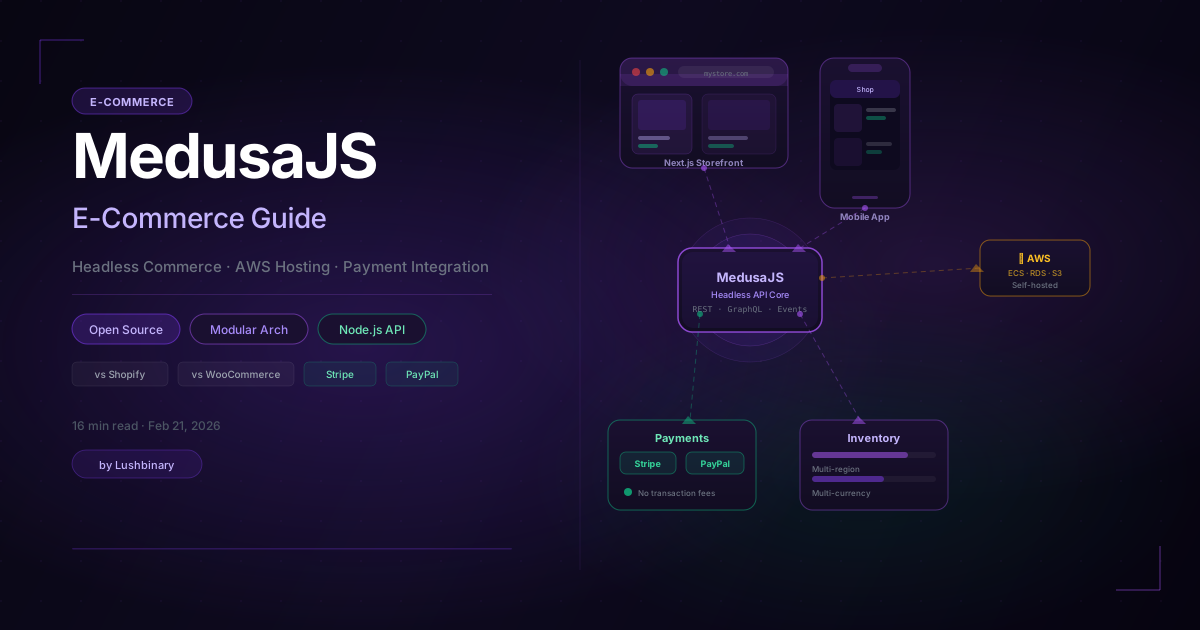
The core idea is simple: MedusaJS runs as your commerce API server, and every customer-facing experience connects to it through the same APIs. Here's what the full-stack architecture looks like:
Every frontend talks to the same MedusaJS instance. Product data, pricing, inventory, and order state are always consistent across channels. A customer can browse on the web, add items to cart on their phone, ask the AI chatbot about sizing, and complete checkout via voice, all against the same backend.
This is the real power of headless commerce. You're not rebuilding commerce logic for each channel. You're building experiences on top of a shared, reliable API layer.
3Building the Web Storefront with Next.js
MedusaJS ships with a production-ready Next.js starter storefront that demonstrates the full integration pattern. But the real value is in building a custom storefront tailored to your brand and conversion goals.
🛒 Key Integration Points
- Product Catalog: Fetch products, variants, and collections via the Store API. Use Next.js ISR (Incremental Static Regeneration) for fast page loads with fresh data.
- Cart & Checkout: Create carts, add line items, apply discounts, and initiate payment sessions, all through the JS SDK. The cart persists server-side, so it works across devices.
- Stripe & PayPal Checkout: Medusa's payment module handles the backend. You wire up Stripe Elements or PayPal buttons on the frontend and let Medusa manage capture, refunds, and webhooks.
- Customer Accounts: Registration, login, order history, saved addresses, and wishlists through the Customer API.
- SEO Optimization: Server-side rendering with Next.js gives you full control over meta tags, structured data (JSON-LD), Open Graph tags, and canonical URLs for every product and collection page.
// Fetching products with the Medusa JS SDK
import Medusa from "@medusajs/js-sdk"

const medusa = new Medusa({
  baseUrl: "http://localhost:9000",
  publishableKey: process.env.NEXT_PUBLIC_MEDUSA_KEY,
})

// Get products with pricing for a specific region
const { products } = await medusa.store.product.list({
  region_id: "reg_us",
  limit: 20,
  fields: "+variants.calculated_price",
})

// Create a cart and add items
const { cart } = await medusa.store.cart.create({
  region_id: "reg_us",
})
await medusa.store.cart.addLineItem(cart.id, {
  variant_id: "variant_abc123",
  quantity: 1,
})
The JS SDK is fully typed, so you get autocomplete and type checking across your entire storefront. Combined with Next.js App Router and Server Components, you can build a storefront that's fast, SEO-friendly, and easy to maintain.
4Native Mobile Apps: React Native & Flutter
Since MedusaJS is API-first, building native mobile apps is straightforward. You're calling the same REST endpoints your web storefront uses, just from a different client. Here's how the two most popular mobile frameworks integrate:
📱 React Native
React Native is the natural choice if your web team already works in React and TypeScript. You can use the same Medusa JS SDK directly in your React Native app, sharing types and API patterns with your web storefront.
- Use the
@medusajs/js-sdkpackage directly in React Native - Share product types, cart logic, and API utilities between web and mobile
- Integrate Stripe React Native SDK for native payment sheets (Apple Pay, Google Pay)
- Push notifications for order updates, back-in-stock alerts, and promotions
- Deep linking to product pages, collections, and checkout from emails and ads
🦋 Flutter
Flutter gives you a single codebase for iOS, Android, web, and desktop. Since MedusaJS exposes standard REST APIs, you can use Dart's http or dio packages to interact with the Medusa backend.
- Call Medusa REST APIs directly using Dart HTTP clients
- Build a typed Dart client from the Medusa OpenAPI spec for type safety
- Use Flutter's platform channels for native payment integrations
- Leverage Flutter's widget system for rich product displays, animations, and AR previews
- Single codebase deploys to iOS, Android, and web
// React Native - Adding to cart with Medusa SDK
import Medusa from "@medusajs/js-sdk"

const medusa = new Medusa({
  baseUrl: "https://api.yourstore.com",
  publishableKey: MEDUSA_PUBLISHABLE_KEY,
})

async function addToCart(cartId: string, variantId: string) {
  const { cart } = await medusa.store.cart.addLineItem(
    cartId,
    { variant_id: variantId, quantity: 1 }
  )
  return cart // same cart object as web
}
💡 Pro tip: Build a shared API layer that both your web and mobile apps consume. This keeps your commerce logic DRY and ensures consistent behavior across platforms. At LushBinary, we typically create a shared @yourstore/commerce-sdk package that wraps the Medusa SDK with your business-specific logic.
5AI-Powered Shopping Assistants & Chatbots
This is where MedusaJS's API-first design really shines. You can build AI shopping assistants that browse your catalog, answer product questions, manage carts, and even complete purchases, all through the same APIs your storefront uses.
🤖 How It Works
The pattern is straightforward: you give an LLM (GPT-5.2, Claude Opus 4.6, Gemini 3.1 Pro) access to your Medusa APIs as "tools" using function calling. The AI can then search products, check inventory, add items to cart, apply discounts, and guide customers through checkout, all in natural conversation.
Customer: "I need running shoes under $120, size 10"

AI Assistant (internally):
  1. Call medusa.store.product.list({ q: "running shoes", limit: 10 })
  2. Filter by price < $120 and size 10 availability
  3. Return formatted results with images and prices

AI Assistant: "I found 3 running shoes in your size under $120:
  1. Nike Air Zoom Pegasus 42 - $109.99
  2. Adidas Ultraboost Light - $119.99
  3. New Balance Fresh Foam X - $99.99
  Want me to add any of these to your cart?"

Customer: "Add the Nike ones"

AI Assistant (internally):
  1. Call medusa.store.cart.addLineItem(cartId, { variant_id, quantity: 1 })

AI Assistant: "Done! Nike Air Zoom Pegasus 42 (Size 10) added to your cart.
  Your total is $109.99. Ready to checkout?"
🧠 RAG for Product Knowledge
For stores with large catalogs or detailed product information, Retrieval-Augmented Generation (RAG) takes the AI assistant to the next level. Instead of relying solely on the LLM's training data, you embed your product descriptions, sizing guides, care instructions, and FAQ content into a vector database (Pinecone, Weaviate, or pgvector in PostgreSQL).
When a customer asks "What's the difference between the Pro and Standard model?" or "Will this jacket keep me warm at -20°C?", the AI retrieves the relevant product documentation and generates an accurate, context-aware answer.
Answer detailed questions about materials, sizing, compatibility, and care instructions
Compare products side-by-side based on features, price, and customer reviews
Help customers find the right product through conversational needs assessment
Check order status, initiate returns, and answer shipping questions
💬 Multi-Channel Deployment
Your AI shopping assistant isn't limited to your website. Deploy it across every channel your customers use:
6Voice Commerce & Conversational AI
Voice commerce is projected to reach $164 billion globally by 2027. With MedusaJS as your backend, you can build voice-enabled shopping experiences that work with Amazon Alexa, Google Assistant, Apple Siri Shortcuts, and custom voice interfaces.
🎙️ Voice Integration Architecture
The voice commerce flow connects speech-to-text, your AI agent, and MedusaJS APIs:
The key technologies enabling this:
- Whisper v3 / Deepgram Nova-3: Real-time speech-to-text with high accuracy across accents and languages. Deepgram Nova-3 offers the lowest latency for real-time voice agents
- ElevenLabs v3 / OpenAI TTS: ElevenLabs Eleven v3 delivers emotional, multi-speaker dialogue with inline audio tags across 70+ languages. OpenAI TTS offers a simpler, cost-effective alternative
- Function Calling: GPT-5.2 and Claude Opus 4.6 both support advanced tool use, letting the voice assistant invoke Medusa APIs as tools for truly transactional voice experiences
- Alexa Skills Kit / Google Actions: Build custom skills that connect to your Medusa backend for platform-native voice experiences. GPT-5's native audio input/output also enables building custom voice agents without separate STT/TTS pipelines
Voice commerce works especially well for repeat purchases, subscription reorders, and simple product queries. Pair it with customer account data from MedusaJS to enable personalized voice experiences like "Reorder my usual" or "What's the status of my last order?"
7AI-Driven Personalization & Recommendations
Generic product grids are leaving money on the table. AI-powered personalization can increase conversion rates by 15-30% by showing each customer the products most relevant to them. Here's how to build it with MedusaJS:
📊 Personalization Stack
Behavioral Tracking
Track product views, cart additions, purchases, and search queries. Store events in a data warehouse (BigQuery, Snowflake) or directly in PostgreSQL for smaller stores.
Embedding Models
Use OpenAI embeddings (text-embedding-3-large) or open-source models (Sentence Transformers, Cohere embed-v4) to create vector representations of products and user behavior. Store in pgvector alongside your Medusa PostgreSQL database.
Real-Time Recommendations
Query the vector database for similar products, 'customers also bought' suggestions, and personalized homepage layouts. Serve via a lightweight API that your storefront calls.
Dynamic Pricing & Promotions
Use Medusa's pricing and promotions modules with AI-driven rules. Offer personalized discounts based on customer lifetime value, cart abandonment patterns, or competitive pricing data.
// AI-powered product recommendations with pgvector
// 1. Generate embedding for the product the user is viewing
const embedding = await openai.embeddings.create({
  model: "text-embedding-3-large",
  input: product.title + " " + product.description,
})

// 2. Find similar products using pgvector
const similar = await db.query(`
  SELECT product_id, title, 1 - (embedding <=> $1) as similarity
  FROM product_embeddings
  WHERE product_id != $2
  ORDER BY embedding <=> $1
  LIMIT 6
`, [embedding.data[0].embedding, product.id])

// 3. Fetch full product data from Medusa
const recommendations = await medusa.store.product.list({
  id: similar.rows.map(r => r.product_id),
  fields: "+variants.calculated_price",
})
The beauty of this approach is that it's built on top of MedusaJS, not locked into a proprietary recommendation engine. You own the data, the models, and the logic. You can fine-tune recommendations based on your specific business needs rather than relying on a black-box SaaS tool.
8Visual Search & AR Try-On with Vision Models
Vision AI models (GPT-5.2 Vision, Gemini 3 Flash, Claude Opus 4.6's vision) have made visual search and augmented reality practical for e-commerce. Here's how to integrate them with your MedusaJS store:
📸 Visual Product Search
Let customers snap a photo of something they like and find matching products in your catalog. The flow:
- Customer uploads or takes a photo from the mobile app or web storefront
- A vision model (GPT-5.2, Gemini 3.1 Pro) analyzes the image and generates a text description: "navy blue slim-fit chinos with a tapered leg"
- The description is embedded and matched against your product embeddings in pgvector
- Matching products are returned from MedusaJS with pricing and availability
🪞 AR Try-On Experiences
For fashion, eyewear, furniture, and cosmetics, AR try-on reduces return rates by 25-40%. The integration pattern:
- Web AR: Use WebXR or libraries like model-viewer to render 3D product models in the browser. Store 3D assets in S3 alongside your Medusa product images.
- Mobile AR: ARKit (iOS) and ARCore (Android) for native AR experiences. React Native bridges like ViroReact or expo-three make this accessible.
- AI-Generated Try-On: Use diffusion models to generate realistic images of the customer wearing the product. Services like Google's Virtual Try-On API or open-source alternatives can generate these in real-time.
Visual search and AR try-on are no longer experimental. Brands using these features report 2-3x higher engagement and significantly lower return rates. MedusaJS's flexible product metadata system makes it easy to attach 3D models, AR assets, and embedding vectors to your products.
9Automated Operations: AI for Inventory, Pricing & Support
AI isn't just customer-facing. Some of the highest-ROI applications are in backend operations. MedusaJS's workflow engine and module system make it straightforward to build AI-powered automation:
Intelligent Inventory Management
Use time-series forecasting models (Prophet, NeuralProphet) to predict demand and automate reorder points. MedusaJS's inventory module tracks stock across locations, and you can build a custom workflow that triggers purchase orders when AI predicts stock will run low.
Dynamic Pricing
Adjust prices in real-time based on demand, competitor pricing, inventory levels, and customer segments. Medusa's pricing module supports price lists and rules that can be updated programmatically via the Admin API.
AI-Powered Email Marketing
Generate personalized product recommendation emails using customer purchase history and browsing data. Use LLMs to write subject lines and copy that match your brand voice. Trigger via Medusa's event system (order.placed, cart.abandoned).
Automated Customer Support
Build a support agent that can check order status, process returns, update shipping addresses, and answer product questions, all through Medusa's APIs. Escalate to human agents only when needed.
AI Content Generation
Auto-generate product descriptions, SEO meta tags, and collection copy from product attributes and images. Use vision models to analyze product photos and generate detailed, accurate descriptions.
Fraud Detection
Analyze order patterns, shipping addresses, and payment behavior to flag potentially fraudulent orders before fulfillment. Integrate with Medusa's order workflow to add an AI review step.
💡 The key advantage of building AI automation on MedusaJS vs Shopify: you have direct database access, full API control, and can run custom code without platform restrictions. No app store approval process, no API rate limits from a third party, no monthly SaaS fees for each automation.
10The Full-Stack MedusaJS Tech Stack
Here's the complete technology stack for a production-grade, AI-enhanced e-commerce platform built on MedusaJS:
| Layer | Technology | Purpose |
|---|---|---|
| Commerce Backend | MedusaJS 2.0 | Products, orders, payments, inventory, promotions |
| Web Storefront | Next.js 16 (App Router) | SSR/ISR storefront with SEO optimization |
| Mobile App | React Native / Flutter | Native iOS & Android shopping experience |
| Database | PostgreSQL + pgvector | Commerce data + vector embeddings for AI |
| Cache & Events | Redis | Session management, caching, event bus |
| AI Models | GPT-5.2 / Claude Opus 4.6 / Gemini 3.1 Pro | Chatbot, recommendations, content generation |
| Embeddings | OpenAI text-embedding-3-large | Product & user behavior vector representations |
| Voice AI | Whisper v3 + ElevenLabs v3 | Speech-to-text and text-to-speech |
| Vision AI | GPT-5.2 Vision / Gemini 3 Flash | Visual search, product analysis, AR |
| Payments | Stripe + PayPal | Payment processing with Apple Pay & Google Pay |
| Storage | AWS S3 + CloudFront | Product images, 3D assets, static files |
| Hosting | AWS ECS Fargate / EC2 | Scalable container or VM hosting |
| Monitoring | CloudWatch + Sentry | Infrastructure and application monitoring |
| CI/CD | GitHub Actions | Automated testing, building, and deployment |
💰 Estimated Monthly Infrastructure Cost
AI API costs vary significantly based on usage volume. A store with 1,000 chatbot conversations/month and basic recommendations will be on the lower end. High-volume stores with real-time personalization will be higher. All estimates assume on-demand pricing; Reserved Instances reduce costs 30-40%.
11How LushBinary Builds Your Custom E-Commerce Platform
Building a full-stack e-commerce platform with MedusaJS, mobile apps, AI chatbots, and voice commerce is a serious engineering effort. At LushBinary, this is exactly what we do. We've built custom commerce platforms for brands that outgrew Shopify, startups launching multi-channel from day one, and enterprises needing AI-powered shopping experiences.
Here's what we deliver:
MedusaJS Backend Setup
Full MedusaJS 2.0 deployment on AWS with PostgreSQL, Redis, S3, and CloudFront. Custom modules for your unique business logic.
Custom Web Storefront
Next.js storefront with SSR, ISR, SEO optimization, structured data, and conversion-focused UX. Built for speed and search rankings.
Native Mobile Apps
React Native or Flutter apps for iOS and Android. Shared commerce SDK with your web storefront. Push notifications, deep linking, and native payments.
AI Shopping Assistant
GPT-5.2 or Claude Opus 4.6-powered chatbot with RAG for product knowledge. Deployed on your website, WhatsApp, Instagram, and Telegram.
Voice Commerce Integration
Alexa Skills, Google Actions, or custom voice interfaces connected to your Medusa backend for hands-free shopping.
AI Personalization Engine
Product recommendations, dynamic pricing, and personalized email campaigns powered by embeddings and customer behavior data.
Payment & Checkout
Stripe, PayPal, Apple Pay, Google Pay, and custom gateway integration. Optimized checkout flows for maximum conversion.
Analytics & Optimization
Mixpanel, GA4, or custom analytics. A/B testing, funnel analysis, and ongoing conversion rate optimization.
We don't just build and hand off. We design the architecture, build the platform, deploy it on AWS, and provide ongoing support, optimization, and feature development. Whether you're migrating from Shopify, launching a new brand, or adding AI capabilities to an existing store, we handle the full stack.
🚀 Get started with a free 30-minute consultation. We'll review your requirements, discuss the architecture, and provide a detailed roadmap with cost estimates for your custom e-commerce platform. No strings attached.
Related reading: MedusaJS E-Commerce Guide: Features & Cost Comparison · Mixpanel Developer Guide
Ready to Build Your Full-Stack E-Commerce Platform?
Let LushBinary design and build your custom MedusaJS-powered commerce platform with web, mobile, AI chatbots, and voice commerce. From architecture to deployment, we handle everything.
Build Smarter, Launch Faster.
Book a free strategy call and explore how LushBinary can turn your vision into reality.