
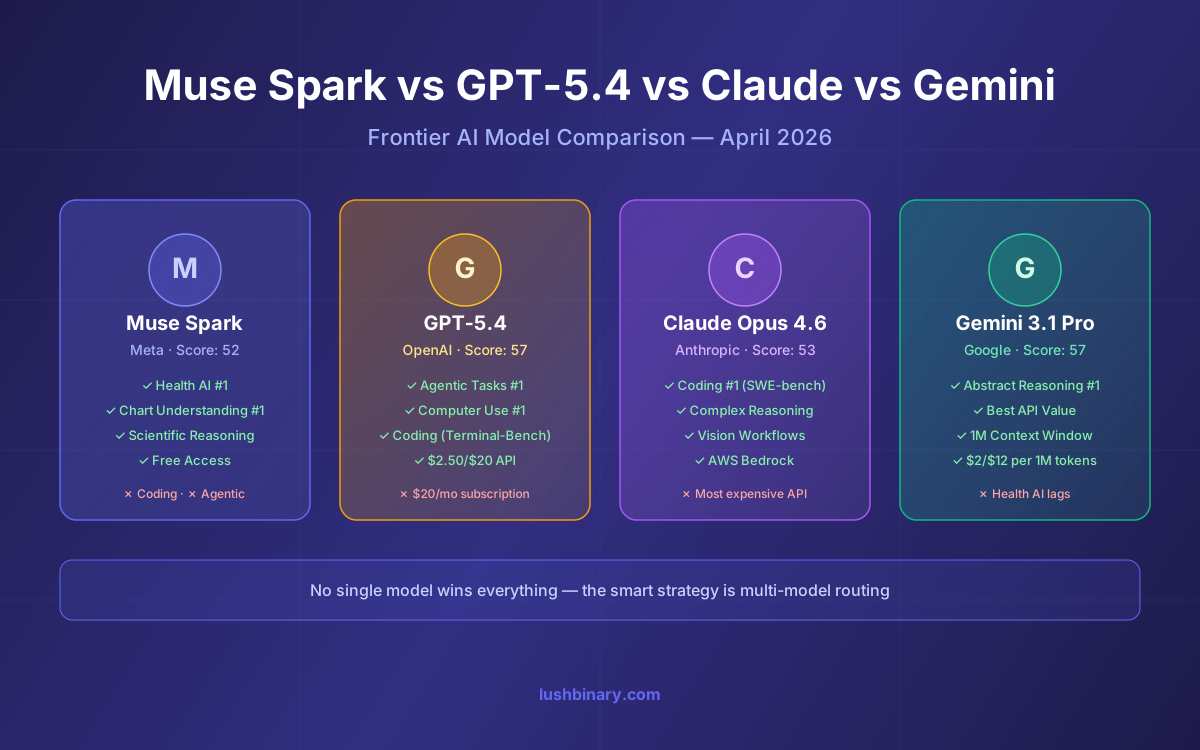
Meta just dropped Muse Spark — the first model from Meta Superintelligence Labs, the unit led by former Scale AI CEO Alexandr Wang — and it's a genuine contender. Scoring 52 on the Artificial Analysis Intelligence Index v4.0, it lands 4th overall behind Gemini 3.1 Pro (57), GPT-5.4 (57), and Claude Opus 4.6 (53). It dominates health benchmarks, introduces a novel multi-agent Contemplating mode, and it's completely free.
But the benchmarks tell a nuanced story. Muse Spark has real gaps in coding and agentic tasks where GPT-5.4 and Claude Opus 4.6 still lead by wide margins. This guide breaks down every benchmark, pricing detail, and capability so you can decide where Muse Spark fits in your AI stack — and where it doesn't.
What This Guide Covers
- What Is Muse Spark & Why It Matters
- The Four Contenders at a Glance
- Intelligence Index & Overall Ranking
- Reasoning & Scientific Benchmarks
- Multimodal Vision & Chart Understanding
- Health & Medical AI
- Coding & Software Development
- Agentic Tasks & Abstract Reasoning
- Contemplating Mode vs Deep Think vs Pro
- Pricing & Access Comparison
- Token Efficiency & Latency
- Who Should Use Which Model
- Why Lushbinary for AI Model Strategy
1What Is Muse Spark & Why It Matters
Muse Spark is the debut model from Meta Superintelligence Labs (MSL), the AI division Meta formed after its $14.3 billion investment in Scale AI brought Alexandr Wang on board. Internally codenamed "Avocado," the model was built over nine months after Meta scrapped its previous approach and rebuilt the entire AI stack from scratch — new infrastructure, architecture, and data pipelines.
Key facts about Muse Spark:
- Natively multimodal: accepts text, image, and voice inputs (text-only output for now)
- Built-in tool use: visual chain-of-thought reasoning and multi-agent orchestration
- Closed model: unlike the Llama family, Muse Spark is not open-weight (Meta says open-source weights may come later)
- Free access: available at meta.ai and the Meta AI app, rolling out to WhatsApp, Instagram, Facebook, and Messenger
- 10x compute efficiency: Meta claims Muse Spark reaches the same capability level as Llama 4 Maverick with over 10x less compute
This is a significant strategic shift for Meta. After years of championing open-source AI with Llama, Muse Spark is their first closed frontier model — a direct challenge to OpenAI, Anthropic, and Google on their own turf.
2The Four Contenders at a Glance
| Feature | Muse Spark | GPT-5.4 | Claude Opus 4.6 | Gemini 3.1 Pro |
|---|---|---|---|---|
| Developer | Meta (MSL) | OpenAI | Anthropic | Google DeepMind |
| Intelligence Index | 52 | 57 | 53 | 57 |
| Multimodal | Text, image, voice in | Text, image, audio, video | Text, image, PDF | Text, image, audio, video |
| Open Weights | No (planned) | No | No | No |
| Consumer Price | Free | $20/mo (Plus) | $20/mo (Pro) | Free tier + $20/mo |
| API Access | Private preview | $2.50/$20 per 1M tokens | $5/$25 per 1M tokens | $2/$12 per 1M tokens |
Sources: Pricing data from Artificial Analysis, OpenAI API pricing, and vendor documentation as of April 2026.
3Intelligence Index & Overall Ranking
The Artificial Analysis Intelligence Index v4.0 is one of the most comprehensive third-party model rankings available. It aggregates performance across reasoning, coding, knowledge, and multimodal tasks into a single score.
| Rank | Model | Score |
|---|---|---|
| 1 | Gemini 3.1 Pro Preview | 57 |
| 1 | GPT-5.4 | 57 |
| 3 | Claude Opus 4.6 | 53 |
| 4 | Muse Spark | 52 |
A 5-point gap from the leaders is meaningful but not insurmountable. For context, Muse Spark used just 58 million output tokens to complete the full Intelligence Index evaluation — comparable to Gemini 3.1 Pro but far less than Claude Opus 4.6 (157M) and GPT-5.4 (120M). That token efficiency translates to faster responses and lower computational costs at scale.
Key Takeaway
Muse Spark is the highest-ranked free frontier model. If you don't need the absolute best scores and want zero subscription cost, it's the strongest option available today.
4Reasoning & Scientific Benchmarks
This is where Muse Spark genuinely shines. Its Contemplating mode — which orchestrates multiple agents reasoning in parallel — gives it an edge on the hardest scientific benchmarks.
| Benchmark | Muse Spark | GPT-5.4 | Gemini 3.1 Pro |
|---|---|---|---|
| Humanity's Last Exam (no tools) | 50.2% | 43.9% (Pro) | 48.4% (Deep Think) |
| FrontierScience Research | 38.3% | 36.7% | 23.3% |
| IPhO 2025 Theory | 82.6 | 93.5 | 87.7 |
| DeepSearchQA | 74.8 | — | 69.7 |
Muse Spark's Contemplating mode scored 50.2% on Humanity's Last Exam without tools, beating both GPT-5.4 Pro (43.9%) and Gemini Deep Think (48.4%). On FrontierScience Research, it nearly doubled Gemini Deep Think's score (38.3% vs 23.3%). These are the hardest scientific reasoning benchmarks available, and Muse Spark leads on both.
However, GPT-5.4 still leads on physics-specific tasks like IPhO 2025 Theory (93.5 vs 82.6). The takeaway: Muse Spark excels at broad scientific reasoning, but GPT-5.4 has an edge on domain-specific STEM problems.
5Multimodal Vision & Chart Understanding
Muse Spark was built from the ground up as a natively multimodal model. It doesn't bolt vision on as an afterthought — visual understanding is core to its architecture.
| Benchmark | Muse Spark | GPT-5.4 | Gemini 3.1 Pro |
|---|---|---|---|
| CharXiv Reasoning | 86.4 | 82.8 | 80.2 |
| MMMU-Pro (Vision) | 80.5% | — | 82.4% |
| ZeroBench (Visual) | 33.0 | 41.0 | 29.0 |
| MedXpertQA | 78.4 | 77.1 | 81.3 |
Muse Spark leads on CharXiv Reasoning (86.4), which tests figure and chart understanding — a practical skill for anyone working with data visualizations, research papers, or business dashboards. It's the second-best multimodal model on MMMU-Pro (80.5%), just behind Gemini 3.1 Pro (82.4%).
For developers building applications that need to interpret charts, diagrams, or visual data, Muse Spark is a strong choice — especially at zero cost. Meta has highlighted use cases like interactive troubleshooting where users point a camera at a home appliance and receive annotated guidance.
6Health & Medical AI
This is Muse Spark's strongest domain. Meta collaborated with over 1,000 physicians to curate specialized training data for health-related queries, and the results are clear.
| Benchmark | Muse Spark | GPT-5.4 | Gemini 3.1 Pro | Grok 4.2 |
|---|---|---|---|---|
| HealthBench Hard | 42.8 | 40.1 | 20.6 | 20.3 |
Muse Spark scores 42.8 on HealthBench Hard, outperforming every other model tested. GPT-5.4 comes closest at 40.1, while Gemini 3.1 Pro (20.6) and Grok 4.2 (20.3) trail by more than 20 points. This benchmark tests open-ended health queries — the kind of questions real users ask about symptoms, nutrition, and wellness.
Meta has built health-specific features into Muse Spark, including interactive nutritional breakdowns, exercise biomechanics explanations, and the ability to analyze images of food or medical charts. For health-tech startups and wellness applications, this is a compelling differentiator.
⚠️ Important Disclaimer
AI models should never replace professional medical advice. While Muse Spark leads health benchmarks, all AI health responses should be treated as informational, not diagnostic. Always consult a healthcare professional for medical decisions.
7Coding & Software Development
This is where Muse Spark falls short — and Meta has openly acknowledged it. If coding is your primary use case, the other three models are significantly better.
| Benchmark | Muse Spark | GPT-5.4 | Claude Opus 4.6 | Gemini 3.1 Pro |
|---|---|---|---|---|
| Terminal-Bench 2.0 | 59.0 | 75.1 | — | 68.5 |
GPT-5.4 leads Terminal-Bench 2.0 at 75.1, followed by Gemini 3.1 Pro at 68.5. Muse Spark's 59.0 is a 16-point gap from the leader. Claude Opus 4.6 doesn't have a published Terminal-Bench score but consistently leads on SWE-bench Verified (80.8%) and is widely regarded as the strongest coding model in production.
For developers using AI coding assistants, IDE integrations, or automated code review, Muse Spark is not the right choice today. Stick with Claude Opus 4.6 or GPT-5.4 for coding workflows. Meta has stated that coding is an area of "continued investment," so future Muse models may close this gap.
Developer Tip
If you're evaluating AI coding tools, check out our AI Coding Agents Comparison for a detailed breakdown of Claude Code, Cursor, Kiro, Copilot, and more.
8Agentic Tasks & Abstract Reasoning
Agentic AI — where models autonomously complete multi-step workflows — is the next frontier. Muse Spark has notable gaps here.
| Benchmark | Muse Spark | GPT-5.4 | Claude Opus 4.6 | Gemini 3.1 Pro |
|---|---|---|---|---|
| GDPval-AA (ELO) | 1,444 | 1,674 | 1,607 | — |
| ARC-AGI-2 | 42.5 | 76.1 | — | 76.5 |
The ARC-AGI-2 gap is the most striking: Muse Spark scores 42.5 while GPT-5.4 (76.1) and Gemini 3.1 Pro (76.5) score nearly double. This benchmark tests novel pattern recognition and abstract problem-solving, requiring the model to generalize from minimal examples. Muse Spark's architecture may not handle out-of-distribution reasoning as well as knowledge-intensive tasks.
On GDPval-AA, which measures real desktop and office task performance, Muse Spark's 1,444 ELO trails GPT-5.4 (1,674) by 230 points and Claude Opus 4.6 (1,607) by 163 points. For teams building AI agents that need to autonomously navigate spreadsheets, websites, and documents, GPT-5.4 and Claude remain the safer bets.
If you're building agentic systems, our AI Agent Framework Comparison covers the best orchestration tools for multi-step workflows.
9Contemplating Mode vs Deep Think vs Pro
Every frontier model now offers an "extended reasoning" mode. Muse Spark's approach is architecturally distinct from the competition.
Muse Spark: Contemplating
Orchestrates multiple agents reasoning in parallel. Agents collaborate and synthesize findings. Achieves superior performance with comparable latency to single-agent approaches.
Gemini: Deep Think
Single model with extended chain-of-thought. Allocates more compute to a single reasoning thread. Strong on math and physics but higher latency.
GPT-5.4: Pro Mode
Extended reasoning with higher compute allocation. Requires ChatGPT Pro subscription ($200/mo). Strongest on physics-specific tasks like IPhO.
Muse Spark's multi-agent approach is the most novel. Instead of making a single model think harder, it runs multiple agents in parallel and synthesizes their outputs. Meta's RL training also includes a "thinking time penalty" that causes thought compression — the model learns to solve problems using fewer tokens, then extends its reasoning for harder problems.
Muse Spark offers three reasoning tiers:
- Instant: fast responses for casual queries (default mode)
- Thinking: deeper step-by-step analysis for complex problems
- Contemplating: multi-agent parallel reasoning for the hardest tasks (rolling out gradually)
With Contemplating mode, Muse Spark scored 58% on Humanity's Last Exam with tools and 38.3% on FrontierScience Research. The multi-agent architecture is particularly effective for problems that benefit from diverse reasoning perspectives.
10Pricing & Access Comparison
Pricing is where Muse Spark has its most disruptive advantage. It's completely free, while every competitor charges for full access.
| Model | Consumer | API (Input/Output per 1M tokens) | Platforms |
|---|---|---|---|
| Muse Spark | Free | Private preview (no public pricing) | meta.ai, Meta AI app, WhatsApp, Instagram, Facebook |
| GPT-5.4 | $20/mo (Plus) | $2.50 / $20 | ChatGPT, API, Azure |
| Claude Opus 4.6 | $20/mo (Pro) | $5 / $25 | claude.ai, API, AWS Bedrock |
| Gemini 3.1 Pro | Free tier + $20/mo | $2 / $12 | Gemini app, AI Studio, Vertex AI |
For API developers, Gemini 3.1 Pro offers the best value at $2/$12 per million tokens with a score of 57 on the Intelligence Index. Claude Opus 4.6 is the most expensive at $5/$25 but leads coding benchmarks. GPT-5.4 sits in the middle at $2.50/$20.
Muse Spark's API is in private preview with no public pricing yet. For consumer use, it's the clear winner on cost — you get a top-5 frontier model for free. The tradeoff is that you're limited to Meta's platforms with no way to integrate it into custom workflows until the API opens up.
11Token Efficiency & Latency
One of Muse Spark's underappreciated strengths is token efficiency. During the full Artificial Analysis Intelligence Index evaluation, each model consumed a different number of output tokens:
Muse Spark
58M tokens
Gemini 3.1 Pro
~60M tokens
GPT-5.4
120M tokens
Claude Opus 4.6
157M tokens
Muse Spark achieves its Intelligence Index score of 52 using less than half the tokens of Claude Opus 4.6 (53) and GPT-5.4 (57). This efficiency comes from Meta's RL training with thinking time penalties, which teaches the model to compress its reasoning.
For production applications, fewer tokens means faster responses and lower inference costs. Meta also claims Muse Spark reaches the same capability level as Llama 4 Maverick with over 10x less compute during pretraining, suggesting the underlying architecture is fundamentally more efficient.
12Who Should Use Which Model
No single model wins everything. Here's a practical decision matrix based on the benchmarks:
| Use Case | Best Model | Why |
|---|---|---|
| Health & wellness apps | Muse Spark | 42.8 HealthBench Hard, physician-curated training, free |
| Chart & data visualization analysis | Muse Spark | 86.4 CharXiv Reasoning, best chart understanding |
| Scientific research | Muse Spark | 50.2% HLE, 38.3% FrontierScience (Contemplating) |
| Coding & software development | Claude Opus 4.6 | 80.8% SWE-bench Verified, strongest coding model |
| Agentic desktop tasks | GPT-5.4 | 1,674 GDPval ELO, 75% OSWorld computer use |
| Abstract reasoning | Gemini 3.1 Pro | 76.5 ARC-AGI-2, 94.3% GPQA Diamond |
| Budget-conscious general use | Muse Spark | Free, top-5 Intelligence Index, strong multimodal |
| Best API value | Gemini 3.1 Pro | $2/$12 per 1M tokens, tied for #1 Intelligence Index |
The smart approach in 2026 is multi-model routing: use Muse Spark for health, vision, and general queries (free); Gemini 3.1 Pro for reasoning-heavy API tasks (cheapest); Claude Opus 4.6 for coding (strongest); and GPT-5.4 for agentic workflows (most autonomous).
Multi-Model Strategy
Route simple queries and health questions to Muse Spark (free), use Gemini 3.1 Pro for reasoning tasks via API ($2/$12), escalate coding tasks to Claude Opus 4.6 ($5/$25), and reserve GPT-5.4 for agentic and computer-use workflows ($2.50/$20). This approach optimizes both cost and quality.
Multi-Model Routing Architecture
13Why Lushbinary for AI Model Strategy
The frontier AI landscape is fragmenting fast. With Muse Spark joining GPT-5.4, Claude Opus 4.6, and Gemini 3.1 Pro, no single model covers every use case. The teams that win are the ones that implement smart multi-model routing — sending each task to the model that handles it best while keeping costs under control.
At Lushbinary, we help teams navigate this complexity. We've built production AI systems that route across multiple frontier models, integrated health AI features, deployed agentic workflows, and optimized inference costs for startups and enterprises alike. Whether you're evaluating Muse Spark for a health-tech product, building a multi-model coding pipeline, or designing an AI agent architecture, we can help you ship faster.
Free AI Strategy Consultation
Not sure which model fits your use case? Book a free 30-minute call with our AI team. We'll review your requirements, recommend a model routing strategy, and outline an implementation plan — no strings attached.
❓ Frequently Asked Questions
Is Meta Muse Spark better than GPT-5.4?
It depends on the task. Muse Spark leads on health (42.8 vs 40.1 HealthBench Hard), scientific reasoning (50.2% vs 43.9% HLE), and chart understanding (86.4 vs 82.8 CharXiv). GPT-5.4 leads on coding (75.1 vs 59.0), abstract reasoning (76.1 vs 42.5 ARC-AGI-2), and agentic tasks (1,674 vs 1,444 GDPval ELO).
Is Muse Spark free to use?
Yes. Muse Spark is completely free through meta.ai and the Meta AI app. GPT-5.4 and Claude Opus 4.6 require $20/month subscriptions for full access. Gemini 3.1 Pro has a generous free tier via Google AI Studio.
How does Muse Spark rank on the Artificial Analysis Intelligence Index?
Muse Spark scores 52, placing 4th behind Gemini 3.1 Pro (57), GPT-5.4 (57), and Claude Opus 4.6 (53). It is the highest-ranked free frontier model.
What is Muse Spark's Contemplating mode?
Contemplating mode orchestrates multiple AI agents reasoning in parallel. It scored 50.2% on Humanity's Last Exam (no tools) and 38.3% on FrontierScience Research, beating GPT-5.4 Pro and Gemini Deep Think on both.
Which AI model is best for coding in April 2026?
Claude Opus 4.6 leads with 80.8% SWE-bench Verified. GPT-5.4 scores 75.1 on Terminal-Bench, Gemini 3.1 Pro scores 68.5, and Muse Spark trails at 59.0. For coding, Muse Spark is not yet competitive.
Sources
- Meta AI Blog: Introducing Muse Spark
- Meta Newsroom: Muse Spark Announcement
- Artificial Analysis Intelligence Index v4.0
- OpenAI API Pricing
Content was rephrased for compliance with licensing restrictions. Benchmark data sourced from official vendor publications and third-party evaluations as of April 9, 2026. Pricing and benchmark scores may change — always verify on the vendor's website.
Need Help Choosing the Right AI Model?
Our team builds production AI systems with multi-model routing. Tell us about your project and we'll recommend the optimal model strategy.
Build Smarter, Launch Faster.
Book a free strategy call and explore how LushBinary can turn your vision into reality.