
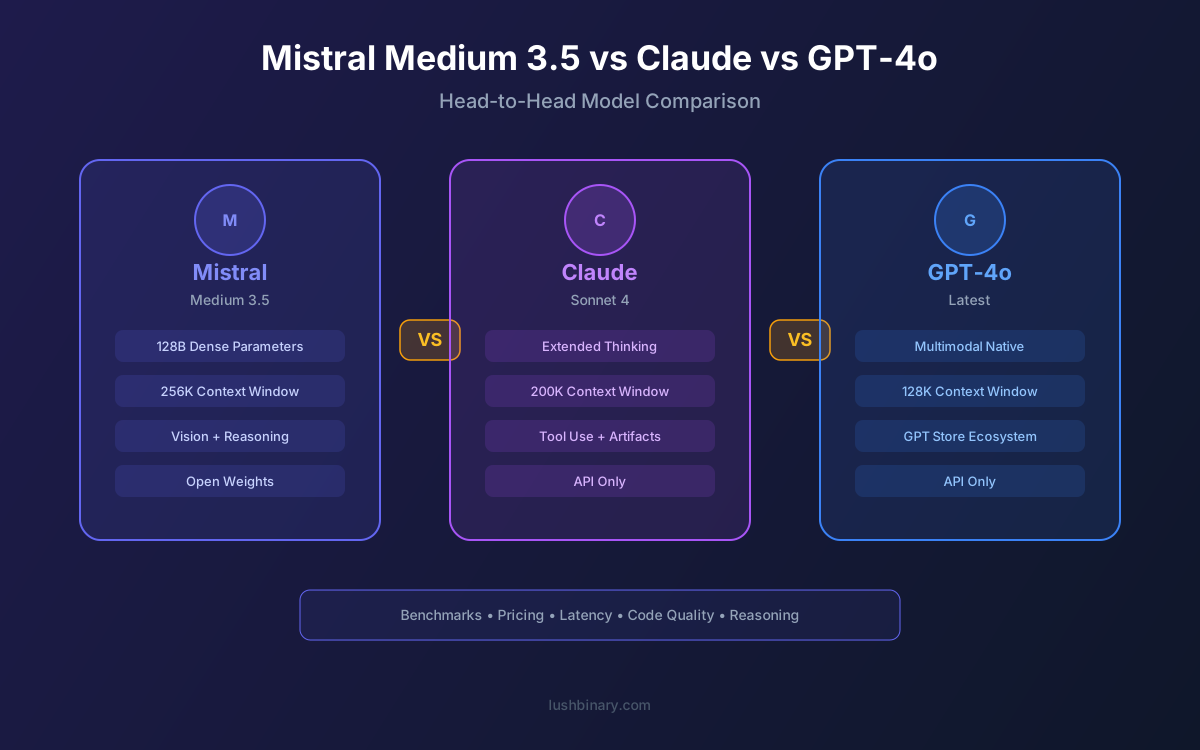
The frontier AI model landscape is more competitive than ever. Mistral AI's Medium 3.5 arrived as a 128-billion parameter dense model that challenges both OpenAI's GPT-4o and Anthropic's Claude Sonnet 4 on coding, reasoning, and agentic tasks. With Mistral AI now valued at roughly $14 billion and employing over 860 people from its Paris headquarters, the European challenger is no longer an underdog.
What makes this comparison especially interesting is the divergence in philosophy. GPT-4o and Claude Sonnet 4 are closed-source, API-only models from US-based companies. Mistral Medium 3.5 is open weights under a modified MIT license, self-hostable on just 4 GPUs, and built by an EU-based team. For developers and enterprises weighing performance against cost, flexibility, and data sovereignty, the differences matter.
This guide breaks down every major comparison point across benchmarks, pricing, context windows, coding performance, vision capabilities, licensing, and ecosystem tooling. Whether you're building agentic workflows, processing long documents, or evaluating models for production deployment, this is the comparison you need.
📋 Table of Contents
- 1.Model Overview & Specs
- 2.Benchmark Head-to-Head
- 3.Pricing Breakdown
- 4.Context Window & Long-Document Handling
- 5.Coding & Agentic Performance
- 6.Vision & Multimodal Capabilities
- 7.Open Weights & Data Sovereignty
- 8.Ecosystem & Tooling
- 9.Decision Framework
- 10.Why Lushbinary for Multi-Model AI
1Model Overview & Specs
Before diving into benchmarks, here's a high-level look at what each model brings to the table. These three represent different approaches to building frontier AI: Mistral's open-weight dense architecture, OpenAI's closed ecosystem breadth, and Anthropic's safety-focused engineering.
| Spec | Mistral Medium 3.5 | GPT-4o | Claude Sonnet 4 |
|---|---|---|---|
| Architecture | 128B dense | Undisclosed (MoE likely) | Undisclosed |
| Context Window | 256K tokens | 128K tokens | 200K tokens |
| License | Modified MIT (open weights) | Proprietary | Proprietary |
| Self-Hosting | Yes (4 GPUs) | No | No |
| Company HQ | Paris, EU | San Francisco, US | San Francisco, US |
| Vision Support | Yes (custom encoder) | Yes | Yes |
2Benchmark Head-to-Head
Benchmarks don't tell the whole story, but they provide a useful starting point. Here's how the three models compare on the evaluations that matter most for developers: SWE-Bench for real-world coding, MMLU for general knowledge, and domain-specific tests like Tau3-Telecom.
| Benchmark | Mistral Medium 3.5 | GPT-4o | Claude Sonnet 4 |
|---|---|---|---|
| SWE-Bench Verified | 77.6% | ~69% | ~72% |
| Tau3-Telecom | 91.4% | ~82% | ~85% |
| MMLU | ~87% | ~88% | ~88% |
| HumanEval | ~90% | ~91% | ~93% |
| MATH | ~82% | ~84% | ~83% |
Mistral Medium 3.5 dominates on SWE-Bench Verified (77.6%) and Tau3-Telecom (91.4%), both of which test practical, real-world coding and domain expertise. GPT-4o and Claude Sonnet 4 trade leads on general knowledge (MMLU) and math reasoning. The takeaway: Medium 3.5 is purpose-built for agentic coding workflows, while the other two maintain slight edges on broader academic benchmarks.
Note: Benchmark scores for GPT-4o and Claude Sonnet 4 on SWE-Bench Verified and Tau3-Telecom are approximate based on publicly available data. Mistral's scores are from their official release benchmarks.
3Pricing Breakdown
Cost is often the deciding factor for production deployments. Mistral Medium 3.5 offers a significant pricing advantage, and the open-weights license means self-hosting can reduce costs even further for high-volume workloads.
| Pricing (per 1M tokens) | Mistral Medium 3.5 | GPT-4o | Claude Sonnet 4 |
|---|---|---|---|
| Input | $1.50 | $2.50 | $3.00 |
| Output | $7.50 | $10.00 | $15.00 |
| Self-Host Option | Yes (open weights) | No | No |
At $1.50 per million input tokens, Mistral Medium 3.5 is 40% cheaper than GPT-4o and 50% cheaper than Claude Sonnet 4 on input. The output cost gap is even wider: $7.50 vs $10.00 vs $15.00. For teams running high-volume inference, that difference compounds quickly. And because Medium 3.5 is open weights, you can self-host on your own infrastructure and eliminate per-token costs entirely.
4Context Window & Long-Document Handling
Context window size determines how much information a model can process in a single request. This matters for tasks like analyzing large codebases, processing legal documents, or working with extensive conversation histories.
- Mistral Medium 3.5: 256K tokens - the largest of the three, enough to process roughly 500 pages of text or an entire mid-sized codebase in one pass
- Claude Sonnet 4: 200K tokens - strong for long documents, though 22% smaller than Medium 3.5
- GPT-4o: 128K tokens - adequate for most tasks but half the capacity of Medium 3.5
The 256K context window gives Mistral Medium 3.5 a practical edge for workflows that involve large inputs. If you're building RAG pipelines, processing lengthy contracts, or feeding entire repositories into a coding agent, that extra context capacity reduces the need for chunking and retrieval workarounds.
Practical tip: A 256K context window doesn't mean you should always fill it. Performance can degrade with very long contexts on any model. Use the extra capacity strategically for tasks that genuinely benefit from more context, like full-repo code analysis or multi-document synthesis.
5Coding & Agentic Performance
This is where Mistral Medium 3.5 makes its strongest case. The 77.6% score on SWE-Bench Verified places it at the top of the leaderboard for real-world software engineering tasks. SWE-Bench tests a model's ability to resolve actual GitHub issues, including understanding codebases, writing patches, and running tests.
Medium 3.5 also replaces three previous Mistral models in one: Mistral Medium 3.1, Magistral, and Devstral 2 are all consolidated into this single release. That consolidation reflects the model's versatility across coding, reasoning, and agentic workflows.
On the tooling side, Mistral has integrated Medium 3.5 with Vibe CLI for terminal-based agentic coding. This gives developers a native command-line interface for running coding agents powered by the model, similar to how Anthropic offers Claude Code.
- SWE-Bench Verified: 77.6% (Medium 3.5) vs ~72% (Claude Sonnet 4) vs ~69% (GPT-4o)
- Tau3-Telecom: 91.4% - demonstrating strong domain-specific coding ability in telecommunications
- Agentic workflows: Medium 3.5 supports function calling, tool use, and multi-step reasoning out of the box
- Vibe CLI: Mistral's terminal-based coding agent, purpose-built for agentic development workflows
Claude Sonnet 4 remains a strong coding model, particularly for tasks requiring careful reasoning and extended thinking. GPT-4o benefits from the broadest ecosystem of integrations and plugins. But for raw SWE-Bench performance and cost-effective agentic coding, Medium 3.5 currently leads.
6Vision & Multimodal Capabilities
All three models support vision and can process images alongside text. However, the approaches differ in meaningful ways.
Mistral Medium 3.5 features a vision encoder trained from scratch, specifically designed to handle variable aspect ratios. This means the model can process images at their native dimensions without forcing them into a fixed square crop, which improves accuracy on documents, charts, and screenshots that come in non-standard sizes.
- Mistral Medium 3.5: Custom vision encoder with variable aspect ratio support, trained from scratch for the model
- GPT-4o: Mature vision capabilities with strong performance on OCR, chart reading, and general image understanding
- Claude Sonnet 4: Solid vision support with particular strength in document analysis and screenshot interpretation
For most vision tasks, all three models perform well. The differentiator for Medium 3.5 is the custom encoder architecture, which may provide an edge on documents and images with unusual dimensions. If vision is a core part of your workflow, test all three on your specific image types before committing.
7Open Weights & Data Sovereignty
This is arguably the biggest differentiator in the entire comparison. Mistral Medium 3.5 is released under a modified MIT open-weights license, making it the only model of the three that you can download, inspect, self-host, and fine-tune.
Key distinction: "Open weights" means the model parameters are publicly available, but the training data and full training process are not. This is different from fully open-source, but it still enables self-hosting, fine-tuning, and commercial deployment without API dependency.
For enterprises with data sovereignty requirements, this changes the calculus entirely. Mistral AI is headquartered in Paris, subject to EU regulations, and the open-weights license means you can run the model on your own infrastructure. Your data never leaves your environment.
- Self-hosting: Medium 3.5 runs on as few as 4 GPUs using vLLM, TensorRT-LLM, or similar inference frameworks
- Fine-tuning: Open weights enable domain-specific fine-tuning for specialized use cases
- EU compliance: Mistral AI is EU-based, which simplifies GDPR and data residency compliance
- No vendor lock-in: You own the deployment, so there's no risk of API deprecation or pricing changes
Neither GPT-4o nor Claude Sonnet 4 offers anything comparable. Both are proprietary, API-only models. If data sovereignty, self-hosting, or avoiding vendor lock-in are priorities for your organization, Mistral Medium 3.5 is the clear choice.
8Ecosystem & Tooling
A model's value extends beyond raw performance. The surrounding ecosystem of tools, integrations, and developer experience can make or break adoption.
- OpenAI (GPT-4o): The broadest ecosystem by far. ChatGPT, the Assistants API, GPTs, plugins, DALL-E integration, Whisper for audio, and deep integrations with Microsoft products including Copilot. If you need the widest range of pre-built integrations, OpenAI leads.
- Anthropic (Claude Sonnet 4): Claude Code for terminal-based agentic coding, the Claude API with extended thinking support, and growing integrations with developer tools. Anthropic focuses on quality and safety over breadth.
- Mistral AI (Medium 3.5): Vibe CLI for agentic coding, Le Chat as a consumer-facing assistant (where Medium 3.5 replaces Medium 3.1, Magistral, and Devstral 2), and Work mode for enterprise productivity. The ecosystem is smaller but growing rapidly, and the open-weights model means third-party tooling can build directly on the weights.
OpenAI's ecosystem advantage is real but narrowing. Anthropic and Mistral are both investing heavily in developer tooling, and the open-source community around Mistral's models adds a layer of ecosystem that proprietary models can't match. HuggingFace hosts the weights, community-built quantizations appear within days of release, and inference frameworks like vLLM provide first-class support.
9Decision Framework
Choosing between these models depends on your specific priorities. Here's a practical framework for making the decision.
- Choose Mistral Medium 3.5 if: You need the best SWE-Bench coding performance, the largest context window (256K), the lowest API pricing, open weights for self-hosting or fine-tuning, EU-based data sovereignty, or you want to avoid vendor lock-in. It's the strongest choice for cost-sensitive production deployments and teams that value infrastructure control.
- Choose GPT-4o if: You need the broadest ecosystem of integrations, plugins, and pre-built tools. GPT-4o is the safe default for teams already invested in the OpenAI ecosystem, and it performs well across general knowledge, math, and reasoning tasks. Best for teams that prioritize ecosystem breadth over raw coding benchmarks.
- Choose Claude Sonnet 4 if: You need strong coding with extended thinking capabilities, careful and safety-conscious outputs, or you're building with Claude Code for agentic development. Sonnet 4 excels at tasks requiring nuanced reasoning and has the second-largest context window at 200K tokens.
For many teams, the answer isn't choosing just one model. A multi-model strategy lets you route different tasks to the model that handles them best: Medium 3.5 for high-volume coding tasks, Claude Sonnet 4 for complex reasoning, and GPT-4o for tasks that benefit from ecosystem integrations.
10Why Lushbinary for Multi-Model AI
The frontier model landscape moves fast. New releases, pricing changes, and benchmark improvements happen monthly. Building a production AI system that can adapt to these shifts requires more than picking a model - it requires architecture that supports model flexibility.
At Lushbinary, we help engineering teams design and build multi-model AI systems. Whether you're evaluating Mistral Medium 3.5 for self-hosted deployment, integrating Claude Sonnet 4 for agentic coding, or building a routing layer that selects the right model per task, we bring the expertise to get it done.
- Model evaluation and benchmarking for your specific use cases
- Self-hosted deployment of open-weight models like Mistral Medium 3.5
- Multi-model routing and orchestration architecture
- Production-grade AI integrations with monitoring and observability
- Cost optimization across model providers
🚀 Free Consultation
Not sure which model fits your workload? Considering self-hosting Mistral Medium 3.5 or building a multi-model pipeline? We offer a free 30-minute consultation to evaluate your use case and recommend the right approach.
❓ Frequently Asked Questions
How does Mistral Medium 3.5 compare to Claude Sonnet 4 and GPT-4o on coding benchmarks?
Mistral Medium 3.5 leads with 77.6% on SWE-Bench Verified and 91.4% on Tau3-Telecom, outperforming both Claude Sonnet 4 and GPT-4o on agentic coding tasks. Claude Sonnet 4 is strong on extended reasoning, while GPT-4o offers the broadest ecosystem integration.
Which model is cheapest per million tokens: Mistral Medium 3.5, Claude Sonnet 4, or GPT-4o?
Mistral Medium 3.5 is the most affordable at $1.50 input / $7.50 output per million tokens. GPT-4o costs $2.50 / $10.00, and Claude Sonnet 4 costs $3.00 / $15.00 per million tokens. Medium 3.5 is also open weights, so self-hosting can eliminate API costs entirely.
Can Mistral Medium 3.5 be self-hosted?
Yes. Mistral Medium 3.5 is released under a modified MIT open-weights license. It can be self-hosted on as few as 4 GPUs using frameworks like vLLM or TensorRT-LLM. Neither Claude Sonnet 4 nor GPT-4o offer self-hosting options.
Which model has the largest context window?
Mistral Medium 3.5 offers the largest context window at 256K tokens. Claude Sonnet 4 supports 200K tokens, and GPT-4o supports 128K tokens. The larger context window makes Medium 3.5 well-suited for processing long documents and large codebases.
Is Mistral Medium 3.5 good for enterprise use with data sovereignty requirements?
Mistral Medium 3.5 is an excellent choice for data sovereignty. Mistral AI is EU-based (Paris), the model uses open weights under a modified MIT license, and it can be self-hosted on your own infrastructure. This means data never leaves your environment, which is critical for regulated industries in the EU and beyond.
📚 Sources
- Mistral AI - Mistral Medium 3.5 Announcement
- HuggingFace - Mistral Medium 3.5 Model Weights
- OpenAI - GPT-4o Overview
- Anthropic - Claude Sonnet 4
Content was rephrased for compliance with licensing restrictions. Benchmark data sourced from official vendor publications. Pricing and availability may change - always verify on the vendor's website.
Need Help Choosing the Right AI Model?
Let Lushbinary help you evaluate Mistral Medium 3.5, Claude Sonnet 4, GPT-4o, or build a multi-model strategy tailored to your workload.
Ready to Build Something Great?
Get a free 30-minute strategy call. We'll map out your project, timeline, and tech stack - no strings attached.
Prefer email? Reach us directly: