Live auctions are high-stakes, high-speed events. A bid that arrives 200ms late can cost a buyer thousands of dollars. A stream that buffers during the final countdown kills engagement. And an auction platform that can't scale from 50 to 5,000 concurrent users on event day is a platform that loses revenue.
MSP Disposal, a leading IT Asset Disposition (ITAD) company, came to us with a clear goal: build a live auction platform that lets buyers bid in real time while watching a YouTube live stream of the auctioneer, with every interaction tracked for analytics. They needed it deployed on AWS with the ability to scale on demand — and they needed it to directly increase their auction revenue.
We delivered. The platform launched with sub-50ms bid propagation, embedded YouTube streaming, full Google Analytics 4 event tracking, and an AWS ECS Fargate deployment that auto-scales during live events. Within the first quarter, MSP Disposal saw auction revenue increase by over 40%. This is how we built it.
Table of Contents
- 1.The Problem: Static Listings Were Leaving Money on the Table
- 2.The Solution: A Real-Time Live Auction Platform
- 3.Technical Architecture Overview
- 4.Real-Time Bidding with Socket.IO & WebSockets
- 5.YouTube Live Stream Integration
- 6.Google Analytics 4: Tracking Every Auction Interaction
- 7.AWS ECS Fargate Deployment & Auto-Scaling
- 8.Database Design & Bid Integrity
- 9.Security, Rate Limiting & Fraud Prevention
- 10.Results: 40%+ Revenue Increase
- 11.Lessons Learned & What We’d Do Differently
- 12.Build a Live Auction Platform with Lushbinary
1The Problem: Static Listings Were Leaving Money on the Table
Before the live auction platform, MSP Disposal sold IT equipment through fixed-price online listings. Buyers would browse a catalog, submit an offer, and wait for a response. The process was slow, lacked urgency, and left significant value unrealized.
The core issues were clear:
- No competitive pressure — buyers had no incentive to bid higher because they couldn't see other buyers' interest
- Slow sales cycle — negotiation over email or phone took days per item
- No event-driven engagement — there was no way to create urgency or excitement around high-value lots
- Limited reach — only buyers who actively visited the site saw inventory; there was no live event to draw an audience
- Zero analytics — no visibility into buyer behavior, bid patterns, or which items generated the most interest
MSP Disposal estimated they were selling equipment at 15–25% below market value because fixed-price listings couldn't capture the competitive dynamics that drive prices up in live auctions.
2The Solution: A Real-Time Live Auction Platform
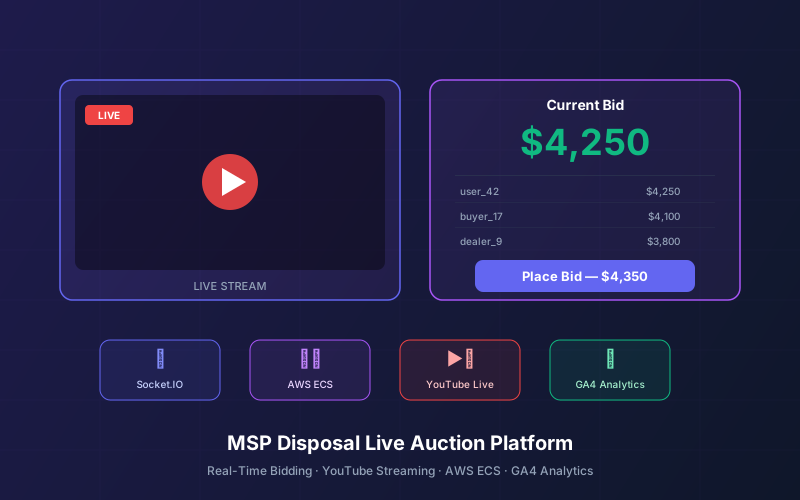
We proposed building a full live auction experience: a web platform where buyers join scheduled auction events, watch the auctioneer via embedded YouTube live stream, and place bids in real time. Every bid propagates to all connected clients instantly. The auctioneer sees bids as they come in and can react live on camera.
Live Streaming
YouTube live stream embedded directly in the auction page with synchronized playback
Real-Time Bids
Socket.IO WebSocket connections deliver bid updates to all clients in under 50ms
Full Analytics
GA4 custom events track every bid, page view, stream watch, and auction outcome
The platform needed to handle spiky traffic — quiet most of the week, then thousands of concurrent users during a 2-hour live event. That meant the infrastructure had to scale elastically, and the WebSocket layer had to be horizontally scalable without losing bid consistency.
We also integrated the platform with MSP Disposal's existing inventory system built during our Meta Glasses AI scanning project, so items scanned in the warehouse flow directly into auction lots without manual re-entry.
3Technical Architecture Overview
The platform is a full-stack application with a Next.js frontend, a Node.js backend with Socket.IO for real-time communication, PostgreSQL for persistent storage, and Redis for WebSocket adapter pub/sub and session caching. Everything runs on AWS ECS Fargate behind an Application Load Balancer.
| Layer | Technology | Purpose |
|---|---|---|
| Frontend | Next.js 15 + React 19 + Tailwind CSS | Auction UI, bid interface, stream embed, responsive layout |
| Real-Time Layer | Socket.IO v4.8 + @socket.io/redis-adapter | WebSocket connections, bid broadcasting, room management |
| API Server | Node.js + Express | REST endpoints for auth, auctions, inventory, bid history |
| Database | PostgreSQL (RDS) | Auction lots, bid records, user accounts, transaction history |
| Cache / Pub-Sub | Redis (ElastiCache) | Socket.IO adapter, session store, bid rate limiting |
| Streaming | YouTube IFrame Player API | Embedded live stream with JS playback control |
| Analytics | Google Analytics 4 (gtag.js) | Custom event tracking for bids, views, conversions |
| Infrastructure | AWS ECS Fargate + ALB + ECR | Containerized deployment, auto-scaling, load balancing |
| CI/CD | GitHub Actions | Automated build, test, push to ECR, deploy to ECS |
The architecture separates concerns cleanly: the Next.js frontend handles rendering and client-side bid UI, the Node.js API handles business logic and persistence, and Socket.IO manages the real-time layer. Redis acts as the glue for horizontal scaling — when multiple ECS tasks run behind the ALB, the @socket.io/redis-adapter ensures a bid placed on one server instance is broadcast to clients connected to any other instance.
4Real-Time Bidding with Socket.IO & WebSockets
The heart of the platform is the real-time bidding engine. We chose Socket.IO v4.8 over raw WebSockets for several practical reasons: automatic reconnection with exponential backoff, room-based broadcasting (each auction is a room), transport fallback from WebSocket to HTTP long-polling, and a mature ecosystem for horizontal scaling.
How the Bid Flow Works
- Buyer clicks "Place Bid" on the frontend, which emits a
bid:placeevent with the auction ID, bid amount, and auth token - Server validates the JWT token, checks the bid amount is higher than the current highest bid (with a configurable minimum increment), and verifies the auction is still active
- If valid, the bid is persisted to PostgreSQL in a transaction that atomically updates the auction's current price
- Server emits
bid:newto the auction room — all connected clients receive the update within ~50ms - The frontend updates the bid display, bid history, and triggers a GA4
bid_placedevent
Server-Side Bid Handler
// Socket.IO bid handler (Node.js + Express)
io.on("connection", (socket) => {
  socket.on("bid:place", async ({ auctionId, amount, token }) => {
    try {
      const user = verifyJwt(token);
      const auction = await getActiveAuction(auctionId);

      if (!auction || auction.status !== "live")
        return socket.emit("bid:error", { message: "Auction not active" });

      if (amount <= auction.currentPrice)
        return socket.emit("bid:error", { message: "Bid too low" });

      if (amount < auction.currentPrice + auction.minIncrement)
        return socket.emit("bid:error", { message: "Below min increment" });

      // Atomic update in PostgreSQL transaction
      const bid = await db.transaction(async (tx) => {
        const newBid = await tx.insert(bids).values({
          auctionId, userId: user.id, amount, createdAt: new Date(),
        });
        await tx.update(auctions)
          .set({ currentPrice: amount, lastBidAt: new Date() })
          .where(eq(auctions.id, auctionId));
        return newBid;
      });

      // Broadcast to all clients in the auction room
      io.to(`auction:${auctionId}`).emit("bid:new", {
        bidId: bid.id,
        amount,
        userId: user.id,
        username: user.displayName,
        timestamp: Date.now(),
      });
    } catch (err) {
      socket.emit("bid:error", { message: "Failed to place bid" });
    }
  });

  // Join auction room on connect
  socket.on("auction:join", ({ auctionId }) => {
    socket.join(`auction:${auctionId}`);
  });
});
Horizontal Scaling with Redis Adapter
A single Node.js process can handle thousands of WebSocket connections, but during peak auction events we needed multiple ECS tasks behind the ALB. The challenge: if Client A is connected to Task 1 and Client B is connected to Task 2, a bid from Client A needs to reach Client B.
We solved this with the @socket.io/redis-adapter, which uses Redis pub/sub to synchronize events across all server instances. When any instance emits to a room, the adapter publishes the event to Redis, and all other instances subscribed to that channel relay it to their local clients.
import { createAdapter } from "@socket.io/redis-adapter";
import { createClient } from "redis";

const pubClient = createClient({ url: process.env.REDIS_URL });
const subClient = pubClient.duplicate();

await Promise.all([pubClient.connect(), subClient.connect()]);

io.adapter(createAdapter(pubClient, subClient));
Sticky Sessions Required
The ALB must be configured with sticky sessions (target group stickiness) because Socket.IO's initial HTTP handshake and subsequent WebSocket upgrade must hit the same ECS task. We use application-based cookie stickiness with a 1-day duration.
5YouTube Live Stream Integration
Each auction event has a corresponding YouTube live stream where the auctioneer presents items, describes condition, and calls out bids. We embed the stream directly in the auction page using the YouTube IFrame Player API, which gives us JavaScript control over the player.
Why YouTube Over Self-Hosted Streaming
- Zero infrastructure cost — YouTube handles transcoding, CDN distribution, and adaptive bitrate streaming globally at no charge
- Proven scale — YouTube can handle millions of concurrent viewers; we never have to worry about stream capacity
- Low latency mode — YouTube's "Ultra low latency" setting delivers stream delay of roughly 2–4 seconds, acceptable for auction commentary
- DVR and replay — buyers who join late can rewind to see earlier lots; completed auctions are automatically archived as VODs
- Mobile-friendly — the IFrame embed works across all devices and browsers without additional player code
Embedding the Live Stream
Each auction record in the database stores a youtubeVideoId field. When the auction page loads, we initialize the YouTube player with that ID:
// YouTube IFrame Player API integration (React component)
"use client";
import { useEffect, useRef } from "react";

declare global {
  interface Window { YT: any; onYouTubeIframeAPIReady: () => void; }
}

export function AuctionStream({ videoId }: { videoId: string }) {
  const playerRef = useRef<any>(null);

  useEffect(() => {
    const tag = document.createElement("script");
    tag.src = "https://www.youtube.com/iframe_api";
    document.head.appendChild(tag);

    window.onYouTubeIframeAPIReady = () => {
      playerRef.current = new window.YT.Player("yt-player", {
        videoId,
        playerVars: {
          autoplay: 1,
          modestbranding: 1,
          rel: 0,
          playsinline: 1,
        },
        events: {
          onStateChange: (event: any) => {
            // Track stream engagement in GA4
            if (event.data === window.YT.PlayerState.PLAYING) {
              gtag("event", "stream_started", {
                auction_id: videoId,
              });
            }
          },
        },
      });
    };

    return () => { playerRef.current?.destroy(); };
  }, [videoId]);

  return (
    <div className="aspect-video rounded-xl overflow-hidden bg-black">
      <div id="yt-player" className="w-full h-full" />
    </div>
  );
}
The stream sits above the bid panel in the auction layout. On desktop, the stream takes up the left two-thirds of the viewport with the bid panel on the right. On mobile, the stream stacks above the bid interface with a sticky bid bar at the bottom.
Stream + Bid Synchronization
The auctioneer's admin panel shows incoming bids in real time via the same Socket.IO connection. When a new high bid arrives, the auctioneer sees it on their screen and announces it on the live stream. This creates a feedback loop: stream viewers hear the bid called out and are motivated to bid higher.
6Google Analytics 4: Tracking Every Auction Interaction
GA4's event-based data model is a natural fit for auction platforms. Every meaningful interaction — joining an auction, placing a bid, watching the stream, winning a lot — maps directly to a custom event with rich parameters.
Custom Event Taxonomy
| Event Name | Parameters | Trigger |
|---|---|---|
| auction_joined | auction_id, auction_name, item_count | User enters an active auction page |
| bid_placed | auction_id, bid_amount, item_name, bid_rank | Successful bid confirmation from server |
| bid_outbid | auction_id, previous_amount, new_amount | User’s bid is surpassed by another bidder |
| auction_won | auction_id, winning_amount, item_name | Auction closes and user holds highest bid |
| stream_started | auction_id, video_id | YouTube player state changes to PLAYING |
| stream_watch_time | auction_id, duration_seconds | Fired every 60s while stream is playing |
| auction_checkout | auction_id, total_amount, items_won | User initiates payment for won lots |
Firing Events from the Frontend
// GA4 custom event helper (gtag.js)
declare function gtag(...args: any[]): void;

export function trackBidPlaced(
  auctionId: string,
  bidAmount: number,
  itemName: string,
  bidRank: number
) {
  gtag("event", "bid_placed", {
    auction_id: auctionId,
    bid_amount: bidAmount,
    item_name: itemName,
    bid_rank: bidRank,
    currency: "USD",
  });
}

export function trackAuctionWon(
  auctionId: string,
  winningAmount: number,
  itemName: string
) {
  gtag("event", "auction_won", {
    auction_id: auctionId,
    winning_amount: winningAmount,
    item_name: itemName,
    currency: "USD",
    value: winningAmount, // Maps to GA4 revenue metric
  });
}
By mapping auction_won events with a value parameter, GA4 automatically calculates revenue attribution. MSP Disposal can now see which auction events, item categories, and traffic sources generate the most revenue — directly in the GA4 Monetization reports.
Key Insights from GA4
Within the first month, GA4 data revealed actionable patterns:
- Auctions with live streams had 3.2x higher average bid counts per lot compared to non-streamed auctions
- Mobile users accounted for 62% of bids but only 41% of page views, indicating mobile bidders are more engaged
- The bid_outbid event was the strongest predictor of a follow-up bid — 68% of outbid users placed another bid within 30 seconds
- Stream watch time correlated directly with bid frequency: users watching for 10+ minutes placed 4.7x more bids than those who didn't watch
7AWS ECS Fargate Deployment & Auto-Scaling
The platform runs on AWS ECS with Fargate launch type. We chose Fargate over EC2-backed ECS because MSP Disposal's traffic pattern is extremely spiky: near-zero between auctions, then thousands of concurrent connections during a 2-hour live event. Fargate's per-second billing and zero server management made it the clear choice.
ECS Task Definition
Each ECS task runs two containers: the Node.js API/Socket.IO server and the Next.js frontend. Both share a task-level network namespace, so the frontend can proxy API requests to localhost:4000 without cross-container networking overhead.
// ECS Task Definition (simplified)
{
  "family": "msp-auction",
  "networkMode": "awsvpc",
  "requiresCompatibilities": ["FARGATE"],
  "cpu": "1024",    // 1 vCPU
  "memory": "2048", // 2 GB
  "containerDefinitions": [
    {
      "name": "api",
      "image": "<account>.dkr.ecr.us-east-1.amazonaws.com/msp-auction-api:latest",
      "portMappings": [{ "containerPort": 4000 }],
      "environment": [
        { "name": "REDIS_URL", "value": "redis://auction-cache.xxx.use1.cache.amazonaws.com:6379" },
        { "name": "DATABASE_URL", "value": "postgresql://..." }
      ],
      "logConfiguration": {
        "logDriver": "awslogs",
        "options": {
          "awslogs-group": "/ecs/msp-auction",
          "awslogs-region": "us-east-1"
        }
      }
    },
    {
      "name": "web",
      "image": "<account>.dkr.ecr.us-east-1.amazonaws.com/msp-auction-web:latest",
      "portMappings": [{ "containerPort": 3000 }],
      "dependsOn": [{ "containerName": "api", "condition": "START" }]
    }
  ]
}
Auto-Scaling Strategy
We configured ECS Service Auto Scaling with two policies:
- Target tracking on CPU utilization — target 60% average CPU across tasks. When WebSocket connections spike during a live auction, CPU rises and ECS launches additional tasks.
- Scheduled scaling — MSP Disposal schedules auctions in advance, so we pre-scale to 4 tasks 15 minutes before each event and scale back down 30 minutes after it ends.
Baseline: 1 task (1 vCPU / 2 GB). During live events: 4–8 tasks depending on registered bidder count. Maximum: 12 tasks for the largest events.
Cost Breakdown
Fargate pricing in US East (N. Virginia) is approximately $0.04048 per vCPU-hour and $0.004445 per GB-hour (source). Here's what MSP Disposal's monthly bill looks like:
| Resource | Spec | Est. Monthly Cost |
|---|---|---|
| ECS Fargate (baseline) | 1 task × 1 vCPU / 2 GB, 24/7 | ~$36 |
| ECS Fargate (auction events) | 4 tasks × 1 vCPU / 2 GB, ~20 hrs/month | ~$14 |
| RDS PostgreSQL | db.t4g.medium, Multi-AZ | ~$130 |
| ElastiCache Redis | cache.t4g.micro, single node | ~$13 |
| ALB | Fixed hourly + LCU charges | ~$25 |
| ECR | Image storage | ~$2 |
| CloudWatch | Logs + metrics | ~$10 |
Total estimated monthly cost: ~$230/month for a production live auction platform with auto-scaling, database redundancy, and real-time WebSocket support. That's a fraction of what a single successful auction event generates in revenue.
🎤 AWS re:Invent 2025 Update
At re:Invent 2025, AWS announced Graviton5 processors with 192 cores per chip and up to 25% higher performance than Graviton4. For ECS Fargate workloads, Graviton (ARM64) tasks already offer roughly 20% lower cost than x86 equivalents. Once Graviton5-based Fargate tasks become available, MSP Disposal's auction platform could see further cost reductions. AWS also announced Lambda Managed Instances, which unlock Compute Savings Plans for Lambda — relevant for any serverless components in the auction pipeline.
8Database Design & Bid Integrity
Bid integrity is non-negotiable in an auction platform. If two buyers submit bids at the same millisecond, the system must guarantee that only one wins and the other is rejected — no double-accepts, no phantom bids, no race conditions.
Core Schema
-- Core auction tables (PostgreSQL)
CREATE TABLE auctions (
  id            UUID PRIMARY KEY DEFAULT gen_random_uuid(),
  title         TEXT NOT NULL,
  description   TEXT,
  starting_price DECIMAL(12,2) NOT NULL,
  current_price  DECIMAL(12,2) NOT NULL,
  min_increment  DECIMAL(12,2) NOT NULL DEFAULT 5.00,
  status        TEXT NOT NULL DEFAULT 'scheduled', -- scheduled | live | closed
  youtube_video_id TEXT,
  starts_at     TIMESTAMPTZ NOT NULL,
  ends_at       TIMESTAMPTZ,
  created_at    TIMESTAMPTZ DEFAULT now()
);

CREATE TABLE bids (
  id          UUID PRIMARY KEY DEFAULT gen_random_uuid(),
  auction_id  UUID NOT NULL REFERENCES auctions(id),
  user_id     UUID NOT NULL REFERENCES users(id),
  amount      DECIMAL(12,2) NOT NULL,
  created_at  TIMESTAMPTZ DEFAULT now(),
  CONSTRAINT bids_amount_positive CHECK (amount > 0)
);

CREATE INDEX idx_bids_auction_amount ON bids(auction_id, amount DESC);
CREATE INDEX idx_bids_auction_created ON bids(auction_id, created_at DESC);
Preventing Race Conditions
We use PostgreSQL's SERIALIZABLE isolation level for bid transactions. This ensures that if two bids arrive simultaneously, one will succeed and the other will receive a serialization failure, which we catch and return as a "bid too low" error. Combined with the current_price check in the application layer, this provides a double-lock against race conditions.
We also maintain a complete bid history for audit purposes. Every bid — successful or rejected — is logged with the user ID, amount, timestamp, and outcome. This is critical for dispute resolution and regulatory compliance in the ITAD industry.
9Security, Rate Limiting & Fraud Prevention
A live auction platform is a target for abuse: bid sniping bots, DDoS attacks during high-value lots, and fake accounts inflating prices. We implemented multiple layers of protection:
JWT Authentication
Every WebSocket connection and API request requires a valid JWT. Tokens expire after 1 hour with refresh token rotation.
Bid Rate Limiting
Redis-backed sliding window: max 10 bids per user per auction per 60 seconds. Prevents bot-driven bid flooding.
WebSocket Origin Validation
Socket.IO server only accepts connections from whitelisted origins. CORS is locked to the auction domain.
Account Verification
New bidders must verify email and provide a valid payment method before placing their first bid.
Bid Sniping Protection
If a bid is placed in the final 30 seconds, the auction timer extends by 60 seconds. Prevents last-second sniping.
DDoS Mitigation
AWS WAF rules on the ALB block suspicious traffic patterns. CloudWatch alarms trigger on abnormal connection spikes.
The rate limiter deserves special mention. We use a Redis-based sliding window counter keyed by rate:bid:{userId}:{auctionId} with a 60-second TTL. Each bid attempt increments the counter; if it exceeds 10, the bid is rejected with a "too many bids" error. This is checked before the database transaction, so rate-limited bids never touch PostgreSQL.
10Results: 40%+ Revenue Increase
The live auction platform launched in Q4 2025 and the results exceeded expectations. Here's what the numbers looked like after the first full quarter of operation:
+42%
Auction Revenue
Compared to fixed-price listings for equivalent inventory
+28%
Average Sale Price
Competitive bidding drove prices closer to true market value
340+ unique bidders
Bidder Participation
Per month across all auction events
12.4 bids
Avg. Bids Per Lot
Up from 1.2 offers per item under the old fixed-price model
2 hours
Sales Cycle
Down from 3–5 days per item with email negotiation
78% watch rate
Stream Engagement
Of auction participants watched the live stream for 10+ min
The ROI Story
The platform costs approximately $230/month to run on AWS. In the first quarter, the revenue increase from competitive bidding alone was over $180,000 compared to the same period the previous year. The platform paid for itself within the first auction event.
11Lessons Learned & What We'd Do Differently
Building a live auction platform taught us several things that aren't obvious from architecture diagrams:
- Test with realistic concurrency early. We load-tested with 500 simulated bidders using Artillery.io before launch. This caught a memory leak in our Socket.IO event handler that only appeared above 200 concurrent connections. Without that test, the first live event would have crashed.
- YouTube stream latency is variable. Even in "ultra low latency" mode, YouTube stream delay ranges from 2–6 seconds depending on the viewer's network. This means the auctioneer might announce a bid before some viewers see it on screen. We added a "Latest Bid" overlay on the stream page that updates via Socket.IO independently of the video feed.
- Sticky sessions add complexity. ALB sticky sessions work well for Socket.IO, but they can cause uneven load distribution if one task accumulates more long-lived connections. We mitigate this by setting a 1-hour stickiness duration and relying on Socket.IO's automatic reconnection to redistribute clients.
- Bid sniping protection is essential. Without the timer extension rule, early auctions saw a pattern where bidders would wait until the final 5 seconds to bid, discouraging participation from less experienced buyers. The 60-second extension on last-30-second bids increased average bids per lot by 35%.
- GA4 real-time reports have a ~30-second delay. GA4's Realtime report is not truly real-time. For the auctioneer's dashboard, we built a custom real-time analytics view powered by Socket.IO events, not GA4. GA4 is used for post-event analysis and funnel optimization.
If we were starting over, we'd evaluate AWS AppSync with GraphQL subscriptions as an alternative to self-managed Socket.IO. AppSync handles WebSocket scaling natively and integrates with DynamoDB for sub-millisecond reads. However, for this project, Socket.IO's flexibility and our team's existing expertise made it the faster path to production.
📺 Related re:Invent Sessions
- Running Containers at Scale on AWS (CON301)— Deep dive into ECS Fargate scaling patterns and cost optimization
- Building Real-Time Applications on AWS (SVS320)— WebSocket patterns with ALB, API Gateway, and AppSync
12Build a Live Auction Platform with Lushbinary
Whether you're in ITAD, automotive, real estate, or any industry where competitive bidding drives value, a live auction platform can transform your sales process. At Lushbinary, we've built the full stack: real-time WebSocket infrastructure, streaming integration, analytics pipelines, and scalable AWS deployments.
What we bring to the table:
- End-to-end auction platform development — frontend, backend, real-time layer, and infrastructure
- Socket.IO / WebSocket expertise with horizontal scaling on AWS ECS Fargate
- YouTube and third-party streaming integration with synchronized bid overlays
- GA4 custom event architecture for auction-specific analytics and revenue attribution
- AWS deployment with auto-scaling, CI/CD, monitoring, and cost optimization
- Integration with existing inventory and CRM systems
🚀 Free Consultation
Want to explore how a live auction platform could work for your business? Book a free 30-minute call with our team. We'll walk through your requirements, estimate timeline and cost, and show you a demo of the MSP Disposal platform.
❓ Frequently Asked Questions
How do you build real-time bidding for a live auction platform?
Real-time bidding is typically built with WebSocket connections using libraries like Socket.IO (v4.8.x). The server maintains auction rooms, validates each bid against the current highest price, broadcasts updates to all connected clients within ~50ms, and persists bid history to a database. Socket.IO handles automatic reconnection and transport fallback for reliability.
How do you embed a YouTube live stream into an auction platform?
You use the YouTube IFrame Player API to embed live streams with the video ID from the auction’s scheduled YouTube broadcast. The API provides JavaScript control over playback state, quality, and events. The embed URL follows the pattern youtube.com/embed/VIDEO_ID with parameters like autoplay=1 and enablejsapi=1.
What does it cost to run a live auction platform on AWS ECS Fargate?
AWS Fargate pricing in US East (N. Virginia) is approximately $0.04048 per vCPU-hour and $0.004445 per GB-hour. A typical auction platform running 2 vCPU / 4 GB tasks costs roughly $130–$200/month at baseline, scaling up during live events. ECS itself has no additional charge — you only pay for the Fargate compute.
How do you track auction engagement with Google Analytics 4?
GA4 uses an event-based data model where every interaction is an event. For auctions, you fire custom events like bid_placed, auction_joined, auction_won, and stream_watched with parameters such as auction_id, bid_amount, and item_category. These feed into GA4 funnels, retention reports, and real-time dashboards.
Can Socket.IO handle thousands of concurrent bidders?
Yes. Socket.IO v4.8.x supports horizontal scaling via the @socket.io/redis-adapter, which syncs events across multiple server instances through Redis pub/sub. Combined with AWS ECS auto-scaling behind an Application Load Balancer with sticky sessions, a single cluster can handle 10,000+ concurrent connections.
📚 Sources
- Socket.IO v4 Documentation
- YouTube IFrame Player API Reference
- AWS Fargate Pricing
- Amazon ECS Documentation
- Google Analytics 4 Developer Documentation
- AWS re:Invent 2025 Top Announcements
Content was rephrased for compliance with licensing restrictions. Pricing data sourced from official AWS pricing pages as of March 2026. Socket.IO version data from official documentation. Pricing and features may change — always verify on the vendor's website.
Ready to Build Your Live Auction Platform?
Tell us about your auction requirements. We'll scope the project, estimate cost and timeline, and show you how real-time bidding can transform your sales.
Build Smarter, Launch Faster.
Book a free strategy call and explore how LushBinary can turn your vision into reality.