
Healthcare apps are under more pressure than ever. Patients expect instant answers, providers need tools that reduce admin overhead, and regulators are tightening the rules around AI in clinical settings. Into this landscape drops Meta Muse Spark, a multimodal reasoning model that leads every frontier AI on health benchmarks — and it's free.
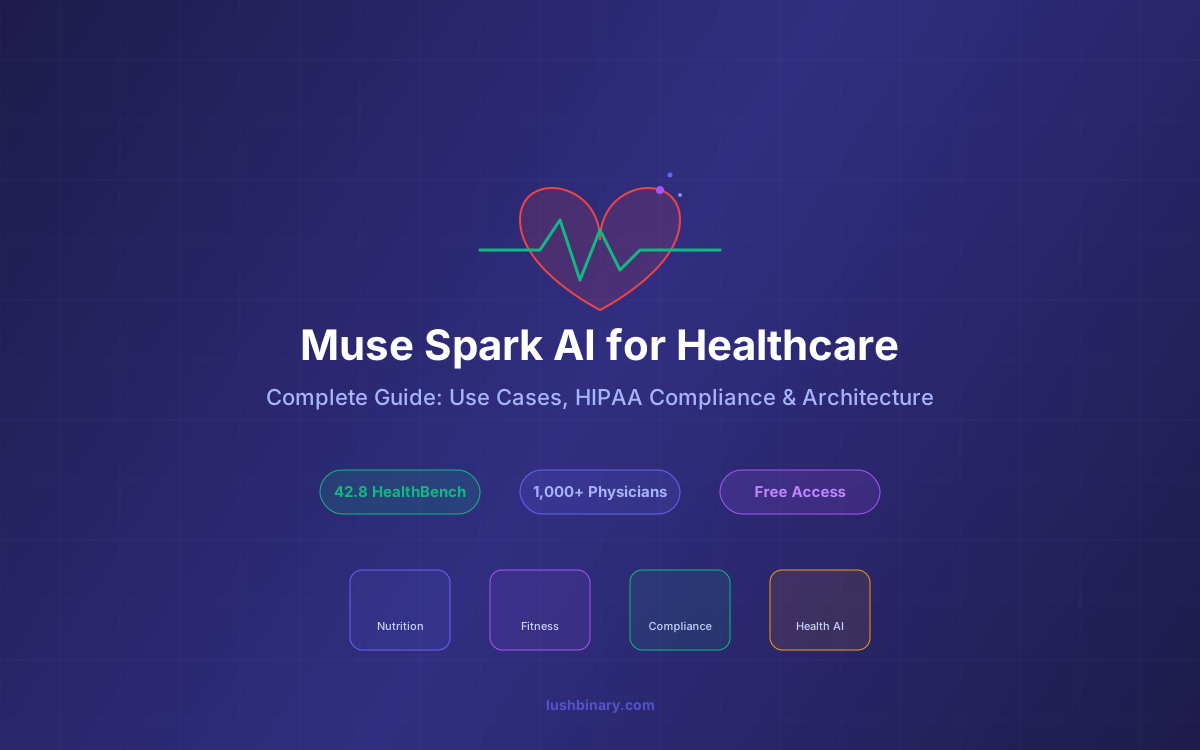
Muse Spark scores 42.8 on HealthBench Hard, beating GPT-5.4 (40.1), Gemini 3.1 Pro (20.6), and Grok 4.2 (20.3). Its health reasoning layer was built with input from over 1,000 physicians, and it can analyze images, voice, and text in a single conversation. For healthcare developers, that's a compelling combination — but there are serious compliance and architectural questions to answer before you ship it.
This guide covers everything: what Muse Spark can actually do for healthcare, where it falls short, how to architect a HIPAA-aware integration, practical use cases with code patterns, and the compliance guardrails you need to get right before going to production.
📋 Table of Contents
- 1.Why Muse Spark Matters for Healthcare
- 2.HealthBench Scores: What the Numbers Mean
- 3.Muse Spark's Health Reasoning Layer
- 4.Healthcare Use Cases That Work Today
- 5.HIPAA, BAAs & Compliance Reality Check
- 6.Architecture Patterns for Healthcare Apps
- 7.Multimodal Health Features: Images, Voice & Text
- 8.Muse Spark vs Other AI Models for Healthcare
- 9.Limitations & What Not to Build
- 10.Production Checklist for Healthcare Deployments
- 11.Why Lushbinary for Healthcare AI Integration
1Why Muse Spark Matters for Healthcare
Meta launched Muse Spark on April 8, 2026 as the first model from Meta Superintelligence Labs (MSL), led by Alexandr Wang. Unlike Meta's previous open-weight Llama models, Muse Spark is proprietary — a closed-source system designed to power the Meta AI assistant across WhatsApp, Instagram, Facebook, Messenger, and Meta's AI glasses.
What makes it relevant for healthcare is a deliberate design choice: Meta made health reasoning a first-class capability. The model was trained on physician-curated data, optimized for medical question answering, and benchmarked specifically against health evaluation suites. This isn't a general-purpose model that happens to answer health questions — it was built with healthcare as a priority use case.
For developers building patient-facing apps, telehealth platforms, wellness tools, or clinical support systems, Muse Spark offers three things that matter:
- Best-in-class health reasoning — 42.8 on HealthBench Hard, the highest score of any frontier model
- Multimodal input — accepts text, images, and voice in a single conversation, enabling features like food photo analysis and lab report interpretation
- Free access — available at no cost through meta.ai and the Meta AI app, with a private API preview for select partners
The catch? It's new, it's closed-source, and Meta hasn't announced HIPAA compliance or BAA availability yet. This guide helps you navigate what you can build today and what needs to wait.
2HealthBench Scores: What the Numbers Mean
HealthBench is an evaluation benchmark developed by OpenAI that measures AI models' ability to handle realistic health conversations. It uses rubric-based scoring across 5,000 multi-turn conversations between a model and either an individual user or a healthcare professional. The "Hard" subset contains 1,000 particularly challenging examples.
Here's how the frontier models stack up on HealthBench Hard as of April 2026:
| Model | HealthBench Hard | Intelligence Index | Price |
|---|---|---|---|
| Muse Spark | 42.8 | 52 | Free |
| GPT-5.4 | 40.1 | 57 | $200/mo Pro |
| Gemini 3.1 Pro | 20.6 | 57 | AI Premium sub |
| Grok 4.2 | 20.3 | — | X Premium+ |
| Claude Opus 4.6 | — | 53 | $20/mo Pro |
The 42.8 score is significant. HealthBench Hard evaluates accuracy, completeness, instruction following, and harm avoidance across complex medical scenarios. Muse Spark's lead over GPT-5.4 (40.1) is modest but consistent — and its lead over Gemini and Grok is substantial.
⚠️ Important Caveat
Benchmark scores measure model capability in controlled evaluations, not clinical readiness. A high HealthBench score does not mean the model is safe for unsupervised clinical use. Always pair AI health features with physician oversight and appropriate disclaimers.
3Muse Spark's Health Reasoning Layer
The core differentiator is what Meta calls the health reasoning layer — a specialized component built on physician-curated training data. According to Meta's announcement, the company collaborated with over 1,000 physicians to curate training data that enables more factual and comprehensive health responses.
This isn't just fine-tuning on medical textbooks. The physician collaboration shaped the training data to produce responses that are:
- Factually grounded — trained to cite medical consensus rather than speculate
- Contextually aware — understands when a question requires a "see your doctor" response vs. general education
- Multimodally integrated — can analyze food images for nutritional content, interpret exercise form, and explain muscle activation patterns
Meta specifically highlights two health capabilities in their launch announcement:
🍎 Nutritional Analysis
Point a camera at food and get interactive displays showing estimated calorie counts, macronutrient breakdowns, and nutritional information for each item.
💪 Exercise Analysis
Analyze exercise movements and generate interactive displays showing which muscles are activated, proper form guidance, and workout optimization suggestions.
4Healthcare Use Cases That Work Today
Given Muse Spark's current capabilities and access model (free via meta.ai, private API preview for partners), here are the healthcare use cases that are practical right now — and the ones that need to wait.
✅ Ready Now (Non-PHI Use Cases)
Health Education Chatbots
General wellness Q&A, nutrition guidance, exercise recommendations, and health literacy tools that don't process patient-specific data.
Nutritional Analysis from Food Photos
Users photograph meals and get calorie estimates, macro breakdowns, and dietary suggestions. No PHI involved since it's analyzing food, not patient records.
Symptom Information (Not Diagnosis)
Educational symptom explainers that help users understand conditions and when to seek care. Must include clear disclaimers that this is not medical advice.
Fitness & Wellness Coaching
Exercise form analysis, workout planning, muscle activation explanations, and recovery guidance using Muse Spark's multimodal capabilities.
Medical Literature Summarization
Summarize published research papers, clinical guidelines, and health news for patient-facing content or provider education tools.
Medication Information Lookup
General drug information, interaction warnings, and side effect explanations from publicly available data. Not a replacement for pharmacist consultation.
⏳ Needs BAA / Compliance Infrastructure
Patient Intake Automation
Collecting symptoms, medical history, and insurance information requires PHI handling and a BAA with the AI provider.
Lab Report Interpretation
Analyzing patient-specific lab results (blood panels, imaging reports) involves PHI. Requires de-identification or BAA coverage.
Clinical Decision Support
Assisting providers with differential diagnosis or treatment recommendations may trigger FDA SaMD classification and requires rigorous validation.
EHR-Integrated Chatbots
Any chatbot that reads from or writes to electronic health records processes PHI and needs full HIPAA compliance infrastructure.
5HIPAA, BAAs & Compliance Reality Check
This is the section that matters most. If you're building a healthcare app that touches patient data, compliance isn't optional — a HIPAA violation can cost up to $1.5 million per year per violation category. The proposed HIPAA Security Rule update, expected for finalization in May 2026, eliminates the "addressable" safeguard distinction and mandates annual risk assessments that explicitly include AI systems.
Here's the compliance landscape for Muse Spark as of April 2026:
| Requirement | Muse Spark Status |
|---|---|
| Business Associate Agreement (BAA) | ❌ Not available |
| HIPAA-compliant API | ❌ Not announced |
| SOC 2 Type II | ❌ Not published |
| Data residency controls | ❌ Unknown |
| Audit logging | ❌ Not available via API |
| PHI de-identification support | ❌ No built-in tooling |
| FDA SaMD clearance | ❌ Not applicable (Meta hasn't filed) |
🚨 Critical Rule
Do not send Protected Health Information (PHI) to Muse Spark. As of April 2026, Meta does not offer a BAA for Muse Spark. Any AI vendor that processes PHI is legally a "business associate" under HIPAA and must sign a BAA. Without one, you are in violation.
Three Compliant Approaches
1. Non-PHI Only
Use Muse Spark exclusively for general health education, wellness content, and features that never touch patient-specific data. This is the safest path and requires no BAA.
2. De-Identification Layer
Strip all 18 HIPAA identifiers before sending data to Muse Spark. Process the response, then re-associate with patient context on your HIPAA-compliant backend. This adds latency and complexity but enables richer use cases.
3. Wait for BAA-Covered API
Meta has announced a private API preview for select partners. If healthcare compliance is on their roadmap, a BAA-covered tier may follow. In the meantime, use a BAA-covered model (like OpenAI's Healthcare tier) for PHI-dependent features and Muse Spark for non-PHI features.
6Architecture Patterns for Healthcare Apps
The right architecture depends on whether your app handles PHI. Here are two patterns — one for non-PHI wellness apps and one for PHI-adjacent apps that use a de-identification layer.
Pattern A: Non-PHI Wellness App
For apps that provide general health education, nutrition tracking, or fitness coaching without processing patient records:
Pattern B: PHI-Adjacent with De-Identification
For apps that need to reference patient context (like lab values or symptoms) but can strip identifiers before sending to Muse Spark:
Code Pattern: Proxied Health Query
Here's a simplified Next.js API route pattern for proxying health queries through your backend with rate limiting and disclaimers:
// app/api/health-query/route.ts
import { NextRequest, NextResponse } from "next/server";
import { rateLimit } from "@/lib/rate-limit";

const DISCLAIMER =
  "This is general health information only. " +
  "It is not medical advice and should not replace " +
  "consultation with a qualified healthcare provider.";

export async function POST(req: NextRequest) {
  // Rate limit: 10 requests per minute per user
  const limiter = await rateLimit(req, { max: 10, window: 60 });
  if (!limiter.success) {
    return NextResponse.json(
      { error: "Rate limit exceeded" },
      { status: 429 }
    );
  }

  const { query, imageBase64 } = await req.json();

  // Validate: no PHI patterns (SSN, MRN, DOB, etc.)
  if (containsPHIPatterns(query)) {
    return NextResponse.json(
      { error: "Please do not include personal health identifiers." },
      { status: 400 }
    );
  }

  // Call Muse Spark API (private preview)
  const response = await fetch("https://api.meta.ai/v1/chat", {
    method: "POST",
    headers: {
      Authorization: `Bearer ${process.env.MUSE_SPARK_API_KEY}`,
      "Content-Type": "application/json",
    },
    body: JSON.stringify({
      model: "muse-spark",
      messages: [
        {
          role: "system",
          content:
            "You are a health education assistant. " +
            "Provide general wellness information. " +
            "Always recommend consulting a healthcare " +
            "provider for personal medical decisions.",
        },
        {
          role: "user",
          content: query,
          ...(imageBase64 && { image: imageBase64 }),
        },
      ],
    }),
  });

  const data = await response.json();

  return NextResponse.json({
    answer: data.choices[0].message.content,
    disclaimer: DISCLAIMER,
    model: "muse-spark",
    timestamp: new Date().toISOString(),
  });
}
💡 API Note
The Muse Spark API is currently in private preview for select partners. The endpoint and request format shown above are illustrative — actual API documentation will be available when Meta opens general access. For now, you can prototype using the Meta AI web interface and plan your architecture around the expected API shape.
7Multimodal Health Features: Images, Voice & Text
Muse Spark is natively multimodal — it accepts text, images, and voice inputs and processes them together. For healthcare apps, this opens up interaction patterns that text-only models can't match.
Image-Based Health Features
- Food photography → nutritional breakdown: Users snap a photo of their plate and get estimated calories, protein, carbs, fat, and micronutrient information per item
- Medication identification: Photograph a pill and get general information about the medication (not a substitute for pharmacist verification)
- Skin condition education: Upload a photo and get general information about common skin conditions (with strong disclaimers to see a dermatologist)
- Exercise form analysis: Record a movement and get feedback on form, muscle engagement, and injury prevention tips
Voice-Based Health Features
- Hands-free wellness coaching: Voice-guided workout instructions, meditation guidance, and breathing exercises
- Accessibility: Voice input makes health information accessible to users with visual impairments or limited mobility
- Elderly-friendly interfaces: Voice-first health Q&A for users who find typing difficult
Contemplating Mode for Complex Health Questions
Muse Spark's Contemplating mode orchestrates multiple AI agents reasoning in parallel. For healthcare, this is useful for complex questions that benefit from multiple perspectives — like evaluating the pros and cons of different treatment approaches or synthesizing information from multiple medical domains.
Contemplating mode scored 50.2% on Humanity's Last Exam and 38.3% on FrontierScience Research, suggesting strong capability for complex scientific reasoning. For a healthcare app, you might use standard mode for quick Q&A and Contemplating mode for in-depth health research queries.
8Muse Spark vs Other AI Models for Healthcare
Muse Spark isn't the only option for healthcare AI. Here's how it compares to the alternatives that healthcare developers are actually evaluating:
| Model | Health Score | BAA Available | Best For |
|---|---|---|---|
| Muse Spark | 42.8 | No | Non-PHI wellness, nutrition, fitness |
| GPT-5.4 | 40.1 | Yes (Healthcare tier) | PHI-dependent apps, clinical support |
| MedGemma | — | Self-hosted | On-premise, full data control |
| Gemini 3.1 Pro | 20.6 | Via Vertex AI | Google Cloud healthcare stack |
| Claude Opus 4.6 | — | Yes | Complex reasoning, coding, analysis |
The practical recommendation for most healthcare developers in April 2026:
Use a multi-model approach. Route non-PHI health education and wellness features through Muse Spark (free, best health reasoning). Route PHI-dependent features through a BAA-covered model like OpenAI's Healthcare tier or a self-hosted model like MedGemma. This gives you the best health reasoning where compliance allows and full HIPAA coverage where it doesn't.
9Limitations & What Not to Build
Muse Spark has real limitations that healthcare developers need to understand before committing to it:
Technical Limitations
- Text-only output — Muse Spark accepts multimodal input (text, images, voice) but currently produces text-only output. It cannot generate medical images, charts, or visual reports.
- Closed source — No open weights, no fine-tuning access, no community forks. You cannot customize the model for your specific medical domain.
- Coding gaps — Muse Spark scores 59.0 on Terminal-Bench vs GPT-5.4's 75.1. If your healthcare app needs AI-generated code (e.g., for data pipelines or integrations), use a different model.
- Agentic task weakness — Muse Spark scores 1,444 ELO on GDPval-AA vs GPT-5.4's 1,672. Complex multi-step healthcare workflows (like automated prior authorization) are better handled by other models.
- No API SLA — The private API preview has no published uptime guarantees, rate limits, or latency commitments. Not suitable for mission-critical healthcare systems.
What Not to Build with Muse Spark
❌ Autonomous Diagnostic Tools
Do not build tools that diagnose conditions without physician oversight. This may trigger FDA SaMD classification and Muse Spark is not validated for clinical diagnosis.
❌ Prescription or Dosage Recommenders
Never use any AI model to recommend specific medications or dosages. This is a clinical decision that requires a licensed provider.
❌ Mental Health Crisis Intervention
AI models are not appropriate for suicide prevention or acute mental health crisis response. Always route to human crisis counselors and hotlines.
❌ PHI-Processing Systems (Without BAA)
Until Meta offers a BAA, do not send patient records, lab results with identifiers, or any PHI to Muse Spark.
10Production Checklist for Healthcare Deployments
Before shipping any healthcare feature powered by Muse Spark, work through this checklist:
Pre-Launch Checklist
- ☐Confirmed no PHI is sent to Muse Spark (or de-identification layer is validated)
- ☐Medical disclaimer displayed on every AI-generated health response
- ☐Rate limiting implemented to prevent abuse
- ☐Input validation rejects PHI patterns (SSN, MRN, DOB formats)
- ☐System prompt instructs model to recommend professional consultation
- ☐Logging captures all queries and responses for audit (stored HIPAA-compliantly if applicable)
- ☐Fallback behavior defined for API outages or rate limit hits
- ☐User consent collected for AI-powered health features
- ☐Legal review completed for health-related content liability
- ☐FDA SaMD classification assessed (if features could be interpreted as diagnostic)
- ☐Accessibility tested: voice input works, screen readers supported, color contrast meets WCAG guidelines
- ☐Error handling prevents raw API errors from reaching users
- ☐Content moderation layer filters inappropriate or harmful health advice
- ☐Terms of service updated to reflect AI-powered health features
11Why Lushbinary for Healthcare AI Integration
Building healthcare apps with AI isn't just a technical challenge — it's a compliance, architecture, and user experience challenge rolled into one. At Lushbinary, we've built AI integrations across healthcare, wellness, and enterprise platforms, and we understand the unique constraints of shipping AI features in regulated industries.
We can help you with:
- Multi-model architecture design — routing health queries to the right model based on PHI sensitivity, cost, and capability requirements
- HIPAA-compliant infrastructure — encrypted backends, audit logging, de-identification layers, and BAA management on AWS
- Muse Spark integration — API integration, multimodal feature development, and Contemplating mode orchestration for complex health queries
- Healthcare app development — patient-facing mobile apps, telehealth platforms, wellness tools, and clinical support systems built with Next.js, React Native, and AWS
- Compliance guidance — navigating HIPAA, FDA SaMD classification, and state-level health data regulations
🩺 Free Healthcare AI Consultation
Planning a healthcare app with Muse Spark or another AI model? We'll review your architecture, compliance requirements, and model selection strategy — no charge. Book a 30-minute call →
❓ Frequently Asked Questions
Can Muse Spark be used in healthcare apps?
Yes, for non-PHI use cases like health education, nutrition analysis, and fitness coaching. It leads all frontier models on HealthBench Hard (42.8) and was trained with input from 1,000+ physicians. However, it lacks HIPAA compliance infrastructure (no BAA, no SOC 2), so it cannot process patient-specific health data in production.
Is Muse Spark HIPAA compliant for healthcare use?
No. As of April 2026, Meta has not announced BAA availability or HIPAA compliance for Muse Spark. Healthcare developers must either use it for non-PHI features only, implement a de-identification layer, or wait for Meta to offer a compliant API tier.
What healthcare use cases does Muse Spark support?
Nutritional analysis from food photos, exercise form analysis, general health education Q&A, medical literature summarization, medication information lookup, and wellness coaching. It should not be used for clinical diagnosis, prescription recommendations, or any feature that processes PHI.
How does Muse Spark compare to other AI models for healthcare?
Muse Spark has the highest HealthBench Hard score (42.8) of any frontier model, beating GPT-5.4 (40.1) by 6.7%. However, OpenAI offers a Healthcare tier with BAA support, and Google provides MedGemma for self-hosted deployments. The best approach is multi-model: Muse Spark for non-PHI health reasoning, a BAA-covered model for PHI-dependent features.
Is Muse Spark free for healthcare developers?
Yes, Muse Spark is free through meta.ai and the Meta AI app. A private API preview is available to select partners with no public pricing announced. For programmatic healthcare app integration, developers need API access — apply for the private preview or wait for general availability.
📚 Sources
- Meta AI — Introducing Muse Spark: Scaling Towards Personal Superintelligence
- Meta Newsroom — Muse Spark: Meta's Most Powerful Model Yet
- SiliconANGLE — Meta debuts Muse Spark multimodal reasoning model
- Artificial Analysis — Muse Spark: Everything You Need to Know
- OpenAI — Introducing OpenAI for Healthcare
Content was rephrased for compliance with licensing restrictions. Benchmark data sourced from official Meta announcements and Artificial Analysis as of April 2026. HealthBench scores sourced from published model evaluations. HIPAA compliance information reflects the regulatory landscape as of April 2026 — always verify current requirements with a qualified healthcare compliance attorney.
Build Your Healthcare App with AI That Actually Understands Health
From HIPAA-compliant architecture to Muse Spark integration, we help healthcare teams ship AI features that are safe, compliant, and genuinely useful for patients.
Build Smarter, Launch Faster.
Book a free strategy call and explore how LushBinary can turn your vision into reality.