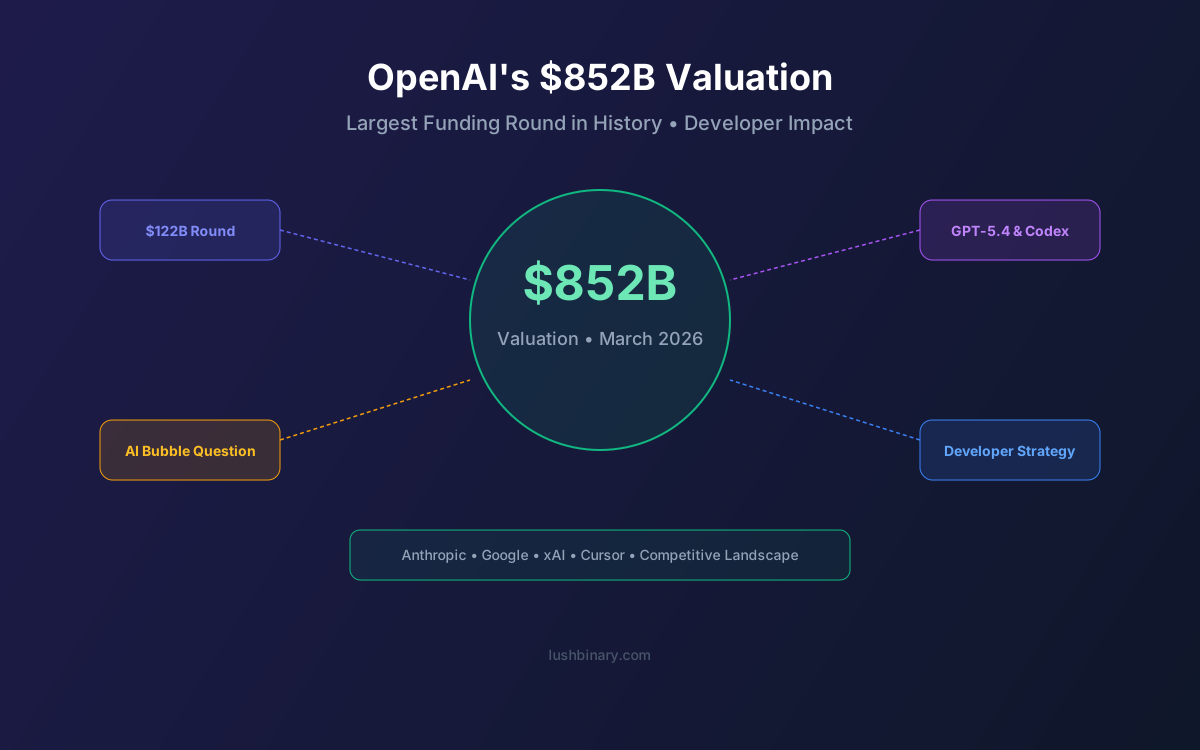
On March 31, 2026, OpenAI closed a $122 billion funding round at an $852 billion post-money valuation. It's the largest private financing in human commercial history. Backed by Amazon, NVIDIA, SoftBank, and Microsoft, the round cements OpenAI as the most valuable private company ever — worth more than most public tech giants.
For developers, this isn't just a headline about venture capital. It's a signal about where the industry is going, what infrastructure will be available, how API pricing will evolve, and which bets are worth making. When a single company raises more than the GDP of most countries in a single round, the ripple effects touch every team building on AI.
This analysis breaks down what happened, why it matters, and what developers and startups should do about it. We cover the funding mechanics, the product moat that justified the valuation, the competitive landscape, the bubble question, and practical steps for teams navigating this new reality.
📋 Table of Contents
- 1.The $122B Round: What Happened
- 2.Why $852B? Revenue, Products & Market Position
- 3.GPT-5.4 & Codex: The Product Moat
- 4.The AI Infrastructure Arms Race
- 5.Impact on Developer Tools & Pricing
- 6.Anthropic, Google & the Competition
- 7.What This Means for Startups Building on AI
- 8.The AI Bubble Question
- 9.What Developers Should Do Now
- 10.Why Lushbinary for AI Strategy
1The $122B Round: What Happened
OpenAI's $122 billion raise closed on March 31, 2026. The round was led by SoftBank with significant participation from Amazon, NVIDIA, and Microsoft — OpenAI's longest-standing backer. At $852 billion post-money, OpenAI is now valued higher than Meta was at its 2021 peak and roughly on par with the current market cap of companies like Berkshire Hathaway.
To put the scale in perspective: the previous record for a private funding round was OpenAI's own $40 billion raise in late 2025. This round tripled that. The $122 billion figure exceeds the entire annual GDP of over 130 countries.
| Detail | Value |
|---|---|
| Round size | $122 billion |
| Post-money valuation | $852 billion |
| Close date | March 31, 2026 |
| Lead investor | SoftBank |
| Key backers | Amazon, NVIDIA, SoftBank, Microsoft |
| Previous round | $40B (late 2025) |
| Monthly revenue at close | $2B+ |
| Structure | Equity (post-conversion to for-profit) |
The investor lineup is telling. Amazon's participation signals that even companies with their own foundation models (Amazon backs Anthropic heavily) see value in hedging with OpenAI. NVIDIA's involvement ties the compute supply chain directly to the model builder. SoftBank, which has been aggressively building AI infrastructure through its Stargate joint venture with OpenAI, is doubling down on the thesis that OpenAI will be the platform layer for the AI era.
Microsoft, which has invested over $13 billion in OpenAI since 2019, continues to deepen the relationship despite building its own competing models. The strategic logic: OpenAI's models power Azure AI services, and Azure is Microsoft's fastest-growing revenue line.
2Why $852B? Revenue, Products & Market Position
An $852 billion valuation for a private company sounds absurd until you look at the numbers. OpenAI crossed $2 billion in monthly revenue heading into the round — that's a $24 billion annualized run rate. At roughly 35x forward revenue, the multiple is high but not unprecedented for a company growing at OpenAI's pace in a market this large.
The revenue comes from multiple streams that are all growing:
- ChatGPT subscriptions: Consumer ($20/mo Plus, $200/mo Pro) and business plans driving recurring revenue at massive scale. ChatGPT has over 400 million weekly active users.
- API revenue: Developers and enterprises paying for GPT-5.4, GPT-5 Mini, DALL-E, Whisper, and other model APIs. This is the fastest-growing segment.
- Enterprise contracts: Large organizations paying for ChatGPT Enterprise, custom model fine-tuning, and dedicated capacity.
- Codex & developer tools: The Codex platform, including subagents shipped March 14, 2026, is becoming a significant revenue driver as developers adopt AI-native workflows.
But the valuation isn't just about current revenue. Investors are pricing in OpenAI's trajectory toward becoming what Sam Altman has called an "AI superapp" — a single platform that handles search, coding, image generation, voice, video, and autonomous agent workflows. The vision is to be the operating system layer for AI, not just a model provider.
Key context
OpenAI's COO and AGI CEO both stepped aside in the weeks leading up to the IPO preparations. Leadership transitions at this scale typically signal a shift from research-first to commercialization-first priorities — exactly what public market investors want to see.
3GPT-5.4 & Codex: The Product Moat
The timing of the funding round wasn't accidental. OpenAI shipped two major products in the weeks before closing: GPT-5.4 on March 5, 2026, and Codex subagents on March 14, 2026. Both dramatically strengthened the case for the valuation.
GPT-5.4: The Unified Frontier Model
GPT-5.4 merged three previously separate capabilities into a single model: the reasoning depth of GPT-5.2, the coding power of GPT-5.3-Codex, and native computer-use capabilities. The key specs:
- 1 million token context window: Enough to hold entire codebases, long documents, or complex multi-turn agent conversations in a single session.
- Native computer use: GPT-5.4 can operate desktops and browsers autonomously, scoring 75.0% on OSWorld-Verified — surpassing human performance at 72.4%.
- Tool search: A new API feature that reduces token usage by 47% when working with multiple MCP servers, by loading tool definitions on demand instead of upfront.
- 33% fewer hallucinations: Individual claims are 33% less likely to be false compared to GPT-5.2, based on de-identified user-flagged prompts.
Codex Subagents: Autonomous Coding at Scale
Codex subagents, shipped March 14, 2026, allow developers to spin up multiple autonomous coding agents that work in parallel. Each subagent operates in its own sandboxed environment, can read and write files, run tests, and iterate on code independently. This transforms Codex from a single-task tool into a multi-agent coding platform.
For investors, the product story is clear: OpenAI isn't just selling API tokens. It's building an integrated platform where models, tools, and agent infrastructure work together. That's a much more defensible business than a model-only play.
| Product | Ship Date | Key Capability |
|---|---|---|
| GPT-5.4 | March 5, 2026 | Unified reasoning + coding + computer use, 1M context |
| Codex Subagents | March 14, 2026 | Parallel autonomous coding agents in sandboxed environments |
| Tool Search API | March 5, 2026 | 47% token reduction for multi-tool agent workflows |
| Computer Use | March 5, 2026 | 75.0% OSWorld (superhuman desktop automation) |
4The AI Infrastructure Arms Race
OpenAI's $122 billion raise is part of a broader infrastructure arms race that's reshaping the tech industry. The money isn't sitting in bank accounts — it's being converted into GPU clusters, data centers, and compute capacity at an unprecedented rate.
The Stargate project — a joint venture between OpenAI and SoftBank — represents a $100 billion commitment to build AI data center infrastructure across the United States. NVIDIA is supplying the chips. Microsoft is providing cloud infrastructure. The scale is staggering: these facilities will house hundreds of thousands of GPUs dedicated to training and serving OpenAI's next-generation models.
But OpenAI isn't alone. The infrastructure buildout is happening across the industry:
- Google is investing heavily in its own TPU infrastructure and Gemini model training, with Gemini 3.1 Pro offering a 2M token context window.
- Amazon is backing both Anthropic (with billions in investment) and OpenAI simultaneously, hedging across the model layer while building Bedrock as the enterprise AI platform.
- Meta continues to invest in open-source models (Llama series) and custom silicon, betting that open models will capture the long tail of AI adoption.
- Microsoft is building its own Phi and MAI models while maintaining the OpenAI partnership, ensuring it has options regardless of how the model landscape evolves.
For developers, this arms race is mostly good news. More compute means faster models, lower latency, and eventually lower prices. Competition between infrastructure providers means better developer experience and more options. The risk is concentration: if a small number of companies control the compute layer, they control the economics of everything built on top.
5Impact on Developer Tools & Pricing
The $852 billion valuation has direct implications for every developer building on AI. Here's what changes:
API Pricing Trajectory
With $2 billion in monthly revenue and $122 billion in fresh capital, OpenAI has the runway to be aggressive on pricing. GPT-5.4 API pricing is already competitive at $2.50 per million input tokens and $15.00 per million output tokens. Cached input drops to $0.25/M. Batch and Flex processing are available at half the standard rate.
The trend is clear: model costs are falling while capabilities are rising. GPT-5 Mini and Nano offer even cheaper options for tasks that don't need frontier-level reasoning. For developers, this means the cost of building AI-powered features is dropping every quarter.
Developer Tools Ecosystem
The funding round also signals continued investment in developer tools. OpenAI's Codex platform, the API, and integrations with IDEs like Cursor and Windsurf are all part of the strategy to make OpenAI the default platform for AI-assisted development.
The developer tools market itself is seeing massive valuations:
| Company | Valuation / Deal | Context |
|---|---|---|
| Cursor | $29.3B | AI-native IDE with the largest developer community |
| Windsurf | ~$3B (split deal) | Acquired/split between Google and Cognition in a dramatic deal |
| OpenAI (Codex) | Part of $852B | Codex subagents and autonomous coding platform |
| GitHub Copilot | Part of Microsoft | Integrated into the world's largest developer platform |
The Windsurf situation deserves special attention. What started as a promising independent AI IDE ended in a $3 billion drama where the company was effectively split between Google (which absorbed the IDE technology) and Cognition (which acquired the AI agent capabilities). It's a cautionary tale about the consolidation pressure in AI developer tools — and a reminder that independent tools can be acquired or absorbed by platform players at any time.
Developer takeaway
Cursor's $29.3 billion valuation proves that developer tools built on top of foundation models can capture enormous value. But the Windsurf split shows the risk: platform companies (Google, Microsoft, OpenAI) can acquire or replicate your tool at any time. Build on the platform, but don't depend on a single provider.
6Anthropic, Google & the Competition
OpenAI's $852 billion valuation doesn't exist in a vacuum. The competitive landscape is intense, and the other major players are moving fast.
Anthropic: Racing to IPO
Anthropic is also in a hurry to go public. The company has raised billions from Amazon and Google, and its Claude model family (currently led by Claude Opus 4.6) competes directly with GPT-5.4 on coding and reasoning benchmarks. Claude Opus 4.6 leads on SWE-bench (79.2% vs GPT-5.4's 57.7%) and has a loyal developer following, particularly among teams that value safety-first AI development.
Anthropic's challenge: it doesn't have OpenAI's consumer brand (ChatGPT) or the breadth of products (image generation, voice, video). Its strength is in the API and developer tools market, where Claude Code has become the terminal-native coding tool of choice for many senior engineers.
Google: The Infrastructure Advantage
Google has something no other AI company has: end-to-end control of the stack. It designs its own chips (TPUs), runs its own cloud (Google Cloud), builds its own models (Gemini), and distributes through its own products (Search, Android, Chrome). Gemini 3.1 Pro offers a 2M token context window — double GPT-5.4's 1M — at lower per-token costs.
Google's acquisition of Windsurf's IDE technology signals its intent to compete directly in the developer tools space. Combined with the Antigravity IDE (the first agent-first IDE with multi-agent orchestration and a built-in browser), Google is building a comprehensive developer platform that could rival OpenAI's Codex.
The Competitive Landscape at a Glance
| Company | Strength | Weakness |
|---|---|---|
| OpenAI | Consumer brand, product breadth, $852B war chest | Burn rate, leadership transitions, concentration risk |
| Anthropic | Best coding model (SWE-bench), safety reputation, developer loyalty | No consumer product, narrower product surface |
| Full-stack control (chips to cloud), 2M context, distribution | Slower to ship, enterprise sales execution | |
| Meta | Open-source models (Llama), massive distribution | No API business, limited enterprise AI revenue |
| Microsoft | Azure distribution, GitHub/Copilot, enterprise relationships | Dependent on OpenAI for frontier models |
7What This Means for Startups Building on AI
If you're a startup building on top of OpenAI's APIs (or any foundation model), the $852 billion valuation carries both opportunity and risk.
The Opportunity
- Cheaper, better models: OpenAI's scale means continued price drops and capability improvements. What costs $100 in API calls today will cost $30 in a year.
- Platform effects: As OpenAI builds toward the "AI superapp," there will be integration points and marketplace opportunities for third-party developers — similar to how the App Store created a massive ecosystem.
- Legitimacy: The $852B valuation validates the entire AI market. Enterprise buyers who were hesitant about AI adoption now see it as inevitable. That makes selling AI-powered products easier.
- Talent availability: The AI hiring frenzy means more engineers are learning AI skills, expanding the talent pool for startups that need AI expertise.
The Risk
- Platform risk: OpenAI can build any feature you offer. If your product is a thin wrapper around GPT, you're one product update away from irrelevance. The Windsurf acquisition is a real-world example.
- Pricing dependency: Your unit economics depend on OpenAI's API pricing. If they raise prices (unlikely but possible), your margins evaporate.
- Model lock-in: Building exclusively on one provider's models creates dependency. If OpenAI has an outage, changes its terms, or deprecates a model, you're exposed.
- Valuation compression: With $45 billion invested in generative AI in 2026 alone, there's a lot of competition. Many AI startups will fail or be acquired at unfavorable terms.
Startup survival rule
The startups that survive the AI platform shift will be the ones that own proprietary data, domain expertise, or distribution — not the ones that own a clever prompt. Build your moat in the application layer, not the model layer.
8The AI Bubble Question
With $45 billion invested in generative AI in 2026 alone, the bubble question is unavoidable. Is $852 billion for a private company rational? Is the broader AI market overheated?
The honest answer: it depends on which layer of the stack you're looking at.
Where the Bubble Risk Is Low
- Infrastructure layer: Companies like NVIDIA, TSMC, and cloud providers are selling real products to real customers. GPU demand exceeds supply. Data center construction is backed by long-term contracts. This isn't speculative.
- Foundation model companies with revenue: OpenAI at $2B+/month, Anthropic with growing enterprise contracts, and Google with Gemini integrated into its existing products — these companies have real revenue and real customers. The valuations are high, but they're not based on hope alone.
- Enterprise AI adoption: Companies are deploying AI in production for customer service, code generation, document processing, and data analysis. The ROI is measurable and the adoption curve is still early.
Where the Bubble Risk Is High
- Thin wrapper startups: Companies that are essentially a UI on top of GPT with no proprietary data, no domain expertise, and no distribution moat. Many of these will fail as OpenAI and others expand their product surface.
- AI-for-everything startups: Companies applying AI to problems where traditional software works fine. Not every product needs a language model.
- Overvalued developer tools: Cursor at $29.3B is impressive, but the developer tools market has historically been smaller than consumer or enterprise markets. The Windsurf $3B split shows how quickly valuations can compress.
Not a Bubble
- • GPU/infrastructure demand
- • Foundation model revenue ($2B+/mo)
- • Enterprise AI deployment
- • Developer tool adoption
Bubble Risk
- • Thin wrapper startups
- • AI applied to wrong problems
- • Overvalued niche tools
- • $45B/year investment pace
The parallel to the dot-com era is instructive. In 2000, the infrastructure companies (Cisco, telecom providers) were overvalued but the underlying technology was real. The internet did change everything — just not as fast as the market priced in. AI is likely following a similar pattern: the technology is transformative, but some of the current valuations are pricing in outcomes that are 5-10 years away.
9What Developers Should Do Now
Regardless of whether the AI market is in a bubble, the technology is real and the opportunity is now. Here's what we recommend for developers and engineering teams:
Build multi-model architectures
Don't lock yourself into a single provider. Use OpenAI for reasoning-heavy tasks, Anthropic for coding, and Google for long-context work. Build an abstraction layer that lets you swap models without rewriting your application.
Invest in prompt engineering and evaluation
As models get cheaper, the differentiator shifts from 'can you afford the API' to 'can you use it effectively.' Build evaluation pipelines that measure model output quality for your specific use cases.
Learn agent architectures
Codex subagents, Claude Code, and Google Antigravity all point toward a future where AI agents do real work autonomously. Understanding agent patterns — tool use, planning, error recovery, human-in-the-loop — is the most valuable skill you can develop right now.
Optimize costs aggressively
Use GPT-5.4's tool search to cut token costs by 47%. Implement caching. Use batch processing for non-real-time tasks. Route simple queries to cheaper models (GPT-5 Mini, Gemini Flash). Every dollar saved on API costs is a dollar of margin.
Own your data and domain expertise
The moat for AI-powered products isn't the model — it's the data you train on, the domain knowledge you encode, and the distribution you build. Invest in proprietary datasets, fine-tuning, and customer relationships.
Watch the IPO timeline
OpenAI's IPO will be a defining moment for the AI industry. It will set public market expectations for AI company valuations and potentially trigger a wave of AI IPOs (Anthropic is also preparing). The pricing and terms will signal how the market values AI companies going forward.
🚀 Free AI strategy consultation
Not sure how to position your product in the post-$852B AI landscape? We offer a free 30-minute consultation to assess your AI strategy, recommend the right model mix, and identify opportunities. Get in touch →
10Why Lushbinary for AI Strategy
At Lushbinary, we've been building AI-powered products since the GPT-4 era. We've shipped production integrations with OpenAI, Anthropic, and Google models across industries — from developer tools to enterprise automation to consumer applications.
In a market where $45 billion is being invested in generative AI annually, having a technical partner who understands both the technology and the business landscape is critical. Here's what we bring:
- Multi-model architecture: We build systems that route between GPT-5.4, Claude Opus 4.6, Gemini 3.1 Pro, and open-source models based on task type, cost, and latency requirements. No single-provider lock-in.
- Cost optimization: We implement caching, batch processing, tool search configuration, and prompt optimization to reduce API costs by 40-60%. At scale, this saves tens of thousands per month.
- Agent development: We build production agent systems using Codex subagents, Claude Code, and custom MCP servers. From autonomous coding pipelines to customer service agents to data processing workflows.
- AI strategy consulting: We help teams evaluate which AI capabilities to build vs. buy, how to position products in the evolving landscape, and how to build defensible moats in the application layer.
- Production reliability: We set up monitoring, observability, fallback routing, and error handling so your AI features work reliably at scale. No demo-quality code.
The AI industry is moving faster than any technology shift in history. OpenAI's $852 billion valuation is just the latest proof point. Whether you're building on AI, competing with AI companies, or trying to understand what this all means for your business — we can help you navigate it.
Need Help Navigating the AI Landscape?
We help teams build AI-powered products, optimize model costs, and develop strategies for the post-$852B AI era. Whether you're integrating GPT-5.4, building multi-model architectures, or figuring out your AI roadmap — we'll help you ship faster and smarter.
Build Smarter, Launch Faster.
Book a free strategy call and explore how LushBinary can turn your vision into reality.
Contact Us
❓ Frequently Asked Questions
How much is OpenAI worth after the 2026 funding round?
OpenAI closed a $122 billion funding round on March 31, 2026, valuing the company at $852 billion post-money. This is the largest private financing round in commercial history, backed by Amazon, NVIDIA, SoftBank, and Microsoft.
What does OpenAI's $852B valuation mean for developers?
For developers, it signals continued investment in AI infrastructure, competitive API pricing, and more product surface area. OpenAI's $2B+/month revenue means the platform is sustainable, and the push toward an 'AI superapp' creates integration opportunities for third-party developers.
Is the AI industry in a bubble in 2026?
The infrastructure layer (GPUs, data centers) and revenue-generating model companies (OpenAI, Anthropic) are on solid ground. The bubble risk is concentrated in thin-wrapper startups and companies applying AI to problems where traditional software works fine. $45 billion invested in generative AI in 2026 is a lot, but the underlying technology is real.
How does OpenAI's valuation compare to competitors?
OpenAI at $852B dwarfs competitors. Anthropic is racing toward an IPO at a significantly lower valuation. In developer tools, Cursor reached $29.3B and Windsurf was split between Google and Cognition in a ~$3B deal. The gap between OpenAI and the rest is widening.
What products did OpenAI ship before the $852B round?
GPT-5.4 shipped March 5, 2026 with 1M context, native computer use (75% OSWorld, superhuman), and tool search (47% token reduction). Codex subagents launched March 14, 2026 for parallel autonomous coding. These products, plus $2B+/month revenue, justified the record valuation.
📚 Sources & Further Reading
- OpenAI — Introducing GPT-5.4 (March 5, 2026)
- OpenAI — $122B Funding Round Announcement (March 31, 2026)
- OpenAI API Pricing (March 2026)
- Reuters — AI Industry Coverage
- The Information — OpenAI Funding Round Analysis
- Bloomberg — OpenAI Valuation Coverage
Content was rephrased for compliance with licensing restrictions. Financial data sourced from official announcements and reporting as of April 2026. Valuations and pricing may change — always verify with primary sources.
Ready to Build Your AI Strategy?
From multi-model architectures and cost optimization to agent development and AI roadmapping — we ship production AI integrations that work. Tell us about your project.
Build Smarter, Launch Faster.
Book a free strategy call and explore how LushBinary can turn your vision into reality.