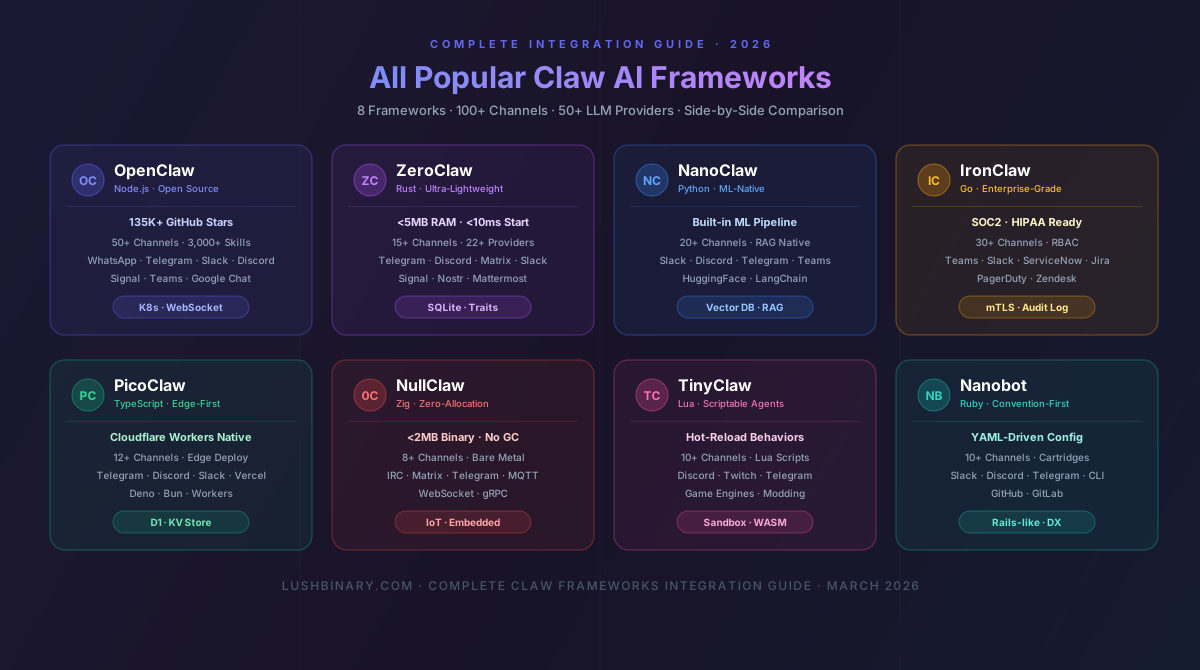
The "claw" ecosystem has become one of the most active corners of open-source AI in 2026. What started as a single viral project called Clawdbot has spawned a family of autonomous AI agent frameworks — each making different bets about what matters most. OpenClaw prioritizes ecosystem breadth. ZeroClaw prioritizes efficiency. NanoClaw prioritizes security. IronClaw prioritizes cryptographic trust. NullClaw prioritizes extreme minimalism. TinyClaw prioritizes multi-agent collaboration.
If you're trying to figure out which framework connects to the tools your team already uses — or which one fits your hardware, security posture, and deployment model — this is the definitive guide. We've mapped every major integration across all popular claw frameworks: messaging channels, LLM providers, developer tools, memory systems, and security architectures.
All data verified as of March 2026 from official documentation, GitHub repositories, and community sources.
📋 Table of Contents
- 1.The Claw Family Tree: 8 Frameworks Compared
- 2.OpenClaw: The Feature-Complete Original (160K+ Stars)
- 3.ZeroClaw: Rust-Native, Trait-Driven, Ultra-Efficient
- 4.NanoClaw: Container-Isolated, Security-First
- 5.IronClaw: WASM Sandbox & Encrypted Credential Vault
- 6.PicoClaw: Go Binary for $10 Edge Hardware
- 7.NullClaw: 678KB Zig Binary, ~1MB RAM
- 8.TinyClaw: Multi-Agent Team Orchestration
- 9.Nanobot: Python, MCP-First, Research-Ready
- 10.Integration Matrix: Channels, Providers & Tools Side-by-Side
- 11.Security Comparison: CVEs, Sandboxing & Safe Practices
- 12.Choosing the Right Claw for Your Use Case
- 13.Why Lushbinary for Claw Framework Deployments
1The Claw Family Tree: 8 Frameworks Compared
Every claw framework traces back to November 2025, when Peter Steinberger built Clawdbot as a personal AI assistant. After viral growth and two renames (Moltbot → OpenClaw), the project inspired a wave of reimplementations — each optimizing for a different constraint.
| Framework | Lang | RAM | Stars | Focus |
|---|---|---|---|---|
| OpenClaw | TypeScript | 1GB+ | 160K+ | Full personal assistant, max ecosystem |
| ZeroClaw | Rust | <5MB | 16K+ | Efficiency, swappable traits, security |
| NanoClaw | TypeScript | ~200MB | 10K+ | Container isolation, minimal codebase |
| IronClaw | Rust | ~500MB | 2.7K+ | WASM sandbox, encrypted vault, NEAR AI |
| PicoClaw | Go | <10MB | 17K+ | Edge hardware, $10 boards, AI-written core |
| NullClaw | Zig | ~1MB | 1.4K+ | Extreme minimalism, 678KB binary |
| TinyClaw | TS/Shell | Minimal | 2.3K+ | Multi-agent teams, chain/fan-out |
| Nanobot | Python | ~100MB | 22K+ | MCP-first, research-ready, China platforms |
Note: All frameworks are free and open-source. OpenClaw is MIT-licensed. ZeroClaw and IronClaw use Apache-2.0 / MIT dual license. NullClaw uses MIT. You bring your own LLM API keys — none of these charge for the runtime itself.
2OpenClaw: The Feature-Complete Original (160K+ Stars)
OpenClaw is the dominant open-source AI agent framework — 160,000+ GitHub stars, 300,000+ users, and a ClawHub marketplace with 3,000+ community skills. It's the most feature-complete option but also the heaviest, requiring 1GB+ RAM and a Node.js runtime.
Messaging Channels (50+)
LLM Providers
OpenClaw supports multiple providers with automatic failover chains and OAuth-based subscriptions (Claude Pro/Max, ChatGPT Plus) in addition to API keys. The recommended model is Claude Opus 4.6 for long-context strength and prompt injection resistance.
ClawHub Skills Ecosystem (3,000+)
ClawHub is OpenClaw's skill marketplace. Skills follow the AgentSkills standard format — an open standard developed by Anthropic — meaning skills can theoretically run on other compatible platforms. Top categories:
- Developer tools: GitHub, GitLab, Jira, Linear, Sentry, Datadog, PagerDuty, Kubernetes
- Productivity: Notion, Google Calendar/Drive/Gmail, Todoist, Airtable, LinkedIn, YouTube
- Marketing: Google Ads, Meta Ads, LinkedIn Ads, TikTok Ads (103 tools via Adspirer MCP)
- Browser automation: Actionbook (deterministic web interaction), Auto-Booker Pro
- Privacy/compliance: Modeio PII anonymization (HIPAA, GDPR)
Latest Releases
v2026.3.1 (Mar 2)
OpenAI WebSocket streaming, Claude 4.6 Adaptive Thinking, native K8s support
v2026.3.2 (Mar 3)
Native PDF tool, Telegram live streaming, ACP subagents on by default, 150+ fixes
⚠️ Security: CVE-2026-25253 (CVSS 8.8)
RCE via token exfiltration in OpenClaw Gateway. Fixed in v2026.1.29. Also: ClawHavoc supply chain attack (341 malicious skills, 9,000+ compromised installs). Only install skills from Verified ClawHub authors. Run openclaw doctor to audit your config.
3ZeroClaw: Rust-Native, Trait-Driven, Ultra-Efficient
ZeroClaw is a Rust-native AI agent runtime that uses under 5MB RAM and starts in under 10ms. Every core subsystem implements a Rust trait, making every component swappable without touching agent logic. It ships as a single 8.8MB binary and runs on hardware as small as a $10 board.
Provider trait
22+ providers: OpenAI, Anthropic, OpenRouter, Groq, Gemini, Ollama, any OpenAI-compatible endpoint
Channel trait
15+ channels: Telegram, Discord, Slack, Mattermost, Matrix, Signal, iMessage, WhatsApp, Lark, DingTalk, Nostr, Email, IRC, Webhook, QQ, Linq
Memory trait
SQLite hybrid search (vector cosine + FTS5 BM25), PostgreSQL, Markdown files, or none
Tool trait
Shell, file ops, git, browser, HTTP, screenshots, hardware access
Tunnel trait
Cloudflare, Tailscale, ngrok, or custom implementations
Runtime trait
Native binary or Docker container — same agent code, different execution environment
Security Architecture
- Gateway pairing with device codes (deny-by-default)
- Filesystem sandboxing with workspace scoping
- Encrypted secrets at rest
- Rate limiting built-in
- 1,017 tests — most thoroughly tested in the claw family
- No community skill marketplace = no ClawHavoc-style attack surface
4NanoClaw: Container-Isolated, Security-First
NanoClaw is the radical answer to OpenClaw's security problems. Built by the qwibitai team, it delivers the same core functionality in ~500 lines of TypeScript across 15 source files — a codebase you can read and understand in 8 minutes vs. 1-2 weeks for OpenClaw's 430,000+ lines.
The key innovation is OS-level container isolation per group. Each WhatsApp or Telegram group gets its own isolated Linux container — not an application-level permission check, but a real OS boundary. On macOS, it uses Apple Container (lightweight VMs in macOS Tahoe). On Linux, it uses Docker. Container A literally cannot access files in Container B, regardless of prompt injection bugs.
Integrations
Messaging
WhatsApp (Baileys), Telegram, and more via skills
LLM
Claude via Agent SDK (primary); Claude Code guides setup
Memory
Per-group CLAUDE.md + SQLite (isolated per container)
Skills
Gmail, Telegram, GitHub, web access, custom via /add-* commands
Scheduled Tasks
Cron, interval, and one-shot tasks (morning briefings, weekly reviews)
Agent Swarms
NEW: Teams of specialized agents collaborating on complex tasks
NanoClaw is intentionally opinionated: one LLM (Claude), one primary platform (WhatsApp/Telegram), one database (SQLite). The philosophy is that with new models arriving every 3-6 months, code doesn't need to stand the test of time — better agents will simply rewrite it.
5IronClaw: WASM Sandbox & Encrypted Credential Vault
IronClaw is a security-focused Rust reimplementation by NEAR AI, announced at NEARCON 2026. It was built to solve the fundamental trust problem in always-on AI agents: how do you give an agent your API keys and filesystem access without it ever being able to leak them?
The answer: credentials live in an encrypted vault inside a TEE (Trusted Execution Environment) — injected at the network boundary only for approved endpoints. The AI model never sees the raw values. Every tool runs in a WebAssembly sandbox with capability-based permissions, no filesystem access, strict resource limits, and constrained outbound networking.
Integrations & Channels
Input Channels
REPL, HTTP webhooks, WASM-compiled channels (Telegram, Slack), browser-based web gateway with SSE/WebSocket streaming
LLM Providers
OpenAI, Anthropic, OpenRouter, and any OpenAI-compatible endpoint
Tool Execution
Every tool runs in isolated WASM container with capability-based permissions
Credential Storage
Encrypted vault in TEE — model never sees raw API keys or secrets
Routines Engine
Background tasks on cron schedules, event triggers, or webhook handlers
Deployment
NEAR AI Cloud (confidential GPU), self-hosted, Docker
IronClaw also features self-expanding tool capabilities — the agent can write new tools for itself, but those tools execute in the WASM sandbox, not on the host. Outbound traffic is scanned for credential leaks before leaving the runtime.
6PicoClaw: Go Binary for $10 Edge Hardware
PicoClaw comes from a hardware company and was built specifically to run on their $10 boards. Written in Go, it uses under 10MB RAM and boots in under a second. Notably, 95% of its core code was written by an AI agent itself during a self-bootstrapping process — making it one of the first AI-native codebases in the ecosystem.
PicoClaw is an ultra-lightweight personal AI assistant that connects to the messaging platforms you already use and includes a built-in exec tool that lets the agent write and run scripts autonomously. It targets RISC-V boards, Raspberry Pi, and any resource-constrained environment.
Integrations
Messaging
Telegram, Discord, and other channels via gateway mode
LLM Providers
OpenAI-compatible endpoints, Ollama (local), cloud APIs
Core Capabilities
Interactive chat, long-term memory, skill system, local code execution, data analysis
Hardware
$10 boards, RISC-V, Raspberry Pi, any ARM/x86 device
Deployment
Single Go binary, sub-second startup, no runtime dependencies
Built-in Tool
exec tool for autonomous script writing and execution
7NullClaw: 678KB Zig Binary, ~1MB RAM
NullClaw takes performance to the extreme. Written in Zig, it compiles to a 678KB static binary with no allocator overhead, no garbage-collection pauses, and no runtime dependencies. It uses ~1MB RAM and starts in under 2ms — running on $5 hardware including STM32/Nucleo boards and Raspberry Pi GPIOs.
Despite being the smallest, NullClaw is the most thoroughly tested in the claw family with ~2,000 tests. It supports 22+ LLM providers, 17 chat channels, hardware peripheral support (Arduino, Raspberry Pi GPIOs, STM32/Nucleo), and a hybrid SQLite memory engine.
Integrations
| Category | Details |
|---|---|
| LLM Providers | 22+: OpenRouter, Anthropic, OpenAI, Ollama, Gemini, Mistral, Venice, Groq, xAI, DeepSeek + 12 more |
| Messaging Channels | 17 channels: broad coverage including Asian platforms |
| Memory | SQLite hybrid: vector cosine similarity + FTS5 BM25 keyword search |
| Hardware | Arduino, Raspberry Pi GPIOs, STM32/Nucleo, $5 edge devices |
| Deployment | Native binary, Docker, WASM module — all from the same 678KB binary |
| Observability | Built-in telemetry, health registry, trace compression, cost auditing |
NullClaw's interface abstraction model means every subsystem — provider, channel, memory, tool, tunnel, observability — is a pluggable component. The architecture enforces deterministic behavior and explicit control at every layer, making it suitable for production IoT deployments and high-throughput API services alike.
8TinyClaw: Multi-Agent Team Orchestration
TinyClaw is the odd one out in the claw family. Every other framework is a single personal assistant — TinyClaw is about running multiple agents as a team. A coder, a writer, and a reviewer hand work off to each other in chains or fan-out patterns, with a live terminal dashboard to watch them collaborate in real time.
Built with Bash + TypeScript (~20K LOC), TinyClaw delegates all tool execution to Claude/Codex CLI. It uses a file-based message queue for inter-agent communication and gives each agent an isolated workspace with its own conversation history.
Integrations & Capabilities
Messaging
Telegram, Discord, WhatsApp
LLM
Claude (via Claude CLI), OpenAI Codex CLI
Orchestration
Chain execution (sequential handoff), fan-out (parallel agents), live terminal dashboard
Agent Roles
Coder, writer, reviewer, researcher — any specialized role you define
Memory
Per-agent isolated workspace with own conversation history
Best For
Complex tasks requiring multiple specialized perspectives, code review pipelines, content production workflows
9Nanobot: Python, MCP-First, Research-Ready
Nanobot comes from the Data Intelligence Lab at the University of Hong Kong. It was designed to answer: what is the absolute minimum code needed to build a fully functional multi-platform AI agent? The answer: ~4,000 lines of Python — 99% smaller than OpenClaw's 430,000+ lines.
Nanobot's key design decision is MCP-first architecture. It acts as a thin orchestrator — the interesting capabilities live in MCP tool servers you plug in at startup. Adding a new capability means plugging in a new MCP server, not modifying the core codebase.
Integrations
| Category | Details |
|---|---|
| Messaging Channels | Telegram, Discord, WhatsApp, Slack + 5 more including DingTalk, QQ, Feishu (China platforms OpenClaw doesn't cover) |
| LLM Providers | Claude, GPT, DeepSeek, Gemini + 8 more providers (12+ total) |
| MCP Tools | Web search, file operations, image generation, code execution — any MCP server plugs in at startup |
| Memory | ContextBuilder assembles from SOUL.md, USER.md, memory, and skills; MemoryStore converts conversations to searchable facts |
| Architecture | AgentLoop (20-iteration cap), ContextBuilder, MessageBus (asyncio pub-sub), SkillsLoader, MemoryStore |
| Performance | ~100MB RAM, 0.8s startup, pip install — easiest setup in the family |
Nanobot is the best choice for developers who want to understand agent architecture by reading the code, researchers building on top of an agent loop, or teams that need China-specific messaging platforms (DingTalk, QQ, Feishu) that OpenClaw doesn't support natively.
10Integration Matrix: Channels, Providers & Tools Side-by-Side
Here's the full side-by-side comparison of what each framework supports across the three most important integration dimensions:
Messaging Channel Coverage
| Channel | OpenClaw | ZeroClaw | NanoClaw | IronClaw | NullClaw | Nanobot |
|---|---|---|---|---|---|---|
| ✅ | ✅ | ✅ | — | ✅ | ✅ | |
| Telegram | ✅ | ✅ | ✅ | ✅ | ✅ | ✅ |
| Slack | ✅ | ✅ | — | ✅ | ✅ | ✅ |
| Discord | ✅ | ✅ | — | ✅ | ✅ | ✅ |
| Signal | ✅ | ✅ | — | — | ✅ | — |
| iMessage | ✅ | ✅ | — | — | — | — |
| Microsoft Teams | ✅ | — | — | — | — | — |
| Google Chat | ✅ | — | — | — | — | — |
| Matrix | ✅ | ✅ | — | — | ✅ | — |
| DingTalk / QQ / Feishu | ⚠️ | ✅ | — | — | ✅ | ✅ |
| ⚠️ | ✅ | — | — | ✅ | — | |
| Webhook | ⚠️ | ✅ | — | ✅ | ✅ | — |
| CLI / REPL | ✅ | ✅ | — | ✅ | ✅ | ✅ |
✅ Native support · ⚠️ Community plugin · — Not available
LLM Provider Coverage
| Framework | Provider Count | Notable Providers |
|---|---|---|
| OpenClaw | 8+ | Claude, GPT, Gemini, DeepSeek, Kimi-K2.5, Grok, MiniMax, Ollama |
| ZeroClaw | 22+ | All above + OpenRouter, Groq, Fireworks, Together, Perplexity, any OpenAI-compatible |
| NanoClaw | 1 (primary) | Claude via Agent SDK (recommended); others via skills |
| IronClaw | 4+ | OpenAI, Anthropic, OpenRouter, any OpenAI-compatible |
| PicoClaw | Any OpenAI-compatible | Ollama, cloud APIs, any OpenAI-compatible endpoint |
| NullClaw | 22+ | OpenRouter, Anthropic, OpenAI, Ollama, Gemini, Mistral, Venice, Groq, xAI, DeepSeek + 12 more |
| TinyClaw | 2 | Claude (via Claude CLI), OpenAI Codex CLI |
| Nanobot | 12+ | Claude, GPT, DeepSeek, Gemini + 8 more |
11Security Comparison: CVEs, Sandboxing & Safe Practices
Security posture varies dramatically across the claw family. Here's the honest breakdown:
| Framework | Isolation Model | Known Issues |
|---|---|---|
| OpenClaw | Application-level checks + optional Docker sandbox | CVE-2026-25253 (CVSS 8.8, fixed v2026.1.29), ClawHavoc (341 malicious skills) |
| ZeroClaw | WASM sandbox, encrypted secrets, deny-by-default allowlists | None documented |
| NanoClaw | OS-level container per group (Docker / Apple Container) | None documented |
| IronClaw | WASM per tool, encrypted vault in TEE, outbound traffic scanning | None documented |
| PicoClaw | Application-level | Not published |
| NullClaw | Interface abstraction, ~2,000 tests | None documented |
| TinyClaw | Per-agent isolated workspace | Not published |
| Nanobot | Application-level, 20-iteration loop cap | None documented |
OpenClaw Security Hardening Checklist
- Update to v2026.3.2+ immediately (patches CVE-2026-25253)
- Run
openclaw doctorto audit DM policies and risky configurations - Enable DM Pairing — unknown senders get a pairing code before messages are processed
- Run agents in Docker with
--network nonewhen web access is not needed - Only install skills from Verified ClawHub authors
- Rotate credentials if you used Moltbook (1.5M tokens exposed in Moltbook-Leak)
- Enable Sandbox Mode (v2.3+) for group/channel sessions
12Choosing the Right Claw for Your Use Case
Here's the decision framework we use at Lushbinary when evaluating which claw framework to deploy for a client:
| Your Situation | Best Choice | Why |
|---|---|---|
| Max ecosystem, 50+ channels, 3K+ skills | OpenClaw | Largest community, most integrations, browser/voice/canvas |
| Security-critical production deploy | IronClaw or NanoClaw | WASM sandbox + TEE (IronClaw) or OS container isolation (NanoClaw) |
| Edge hardware, Raspberry Pi, $10 boards | NullClaw or PicoClaw | 678KB / <10MB binary, <1-5MB RAM |
| Rust team, swappable architecture | ZeroClaw | Trait-driven, 22+ providers, 1,017 tests |
| China platforms (DingTalk, QQ, Feishu) | Nanobot | Only framework with native China platform support |
| Multi-agent team workflows | TinyClaw | Only framework built for agent-to-agent collaboration |
| Understand agent architecture / research | Nanobot | 4,000 lines of clean Python, MCP-first, readable |
| Minimal codebase you can audit in 8 min | NanoClaw | ~500 lines TypeScript, 15 source files |
| Extreme minimalism, IoT, $5 hardware | NullClaw | 678KB Zig binary, ~1MB RAM, Arduino/STM32 support |
13Why Lushbinary for Claw Framework Deployments
Deploying any claw framework in production is more than running a Docker container. You need to think about security hardening, model routing strategy, skill vetting, cloud cost optimization, and integration with your existing toolchain. That's where Lushbinary comes in.
We've deployed OpenClaw, ZeroClaw, NanoClaw, and IronClaw for clients across industries — from e-commerce teams automating customer support to dev shops using agents for automated error triage. Our services include:
- Production-grade deployment on AWS (EC2, ECS Fargate, K8s) for any claw framework
- Custom skill development for ClawHub or ZeroClaw/NullClaw trait implementations
- Security audits: CVE patching, DM policy review, Docker/WASM sandboxing setup
- Multi-agent architecture design (TinyClaw-style team workflows)
- Integration with your existing stack: GitHub, Slack, Sentry, Datadog, Notion
- Framework selection consulting — we help you pick the right claw for your constraints
- Ongoing monitoring, cost optimization, and model routing strategy
❓ Frequently Asked Questions
What are all the popular claw AI agent frameworks in 2026?
The major claw frameworks are: OpenClaw (Node.js, 160K+ stars, 50+ channels), ZeroClaw (Rust, <5MB RAM, 15+ channels), NanoClaw (TypeScript, container-isolated), IronClaw (Rust, WASM sandbox, NEAR AI), PicoClaw (Go, <10MB RAM, edge hardware), NullClaw (Zig, 678KB binary, ~1MB RAM), TinyClaw (multi-agent teams), and Nanobot (Python, MCP-first, 8+ channels including China platforms).
Which claw framework has the most integrations?
OpenClaw has the most integrations with 50+ messaging channels and 3,000+ ClawHub skills. NullClaw and ZeroClaw both support 22+ LLM providers. Nanobot uniquely supports China-specific platforms like DingTalk, QQ, and Feishu.
Which claw framework is most secure?
IronClaw (WASM sandbox, encrypted credential vault in TEE), NanoClaw (OS-level container isolation per group), and ZeroClaw (WASM sandbox, 1,017 tests, encrypted secrets) are the most security-focused. OpenClaw has had CVE-2026-25253 and the ClawHavoc supply chain attack.
Which claw framework runs on the least hardware?
NullClaw is the smallest at 678KB binary and ~1MB RAM, running on $5 hardware. PicoClaw (Go, <10MB RAM) targets $10 boards. ZeroClaw uses <5MB RAM. OpenClaw requires 1GB+ RAM.
What is TinyClaw and how does it differ from other claw frameworks?
TinyClaw is the only claw framework focused on multi-agent team orchestration. It lets you run specialized agents (coder, writer, reviewer) that hand off work in chains or fan-out patterns, with a live terminal dashboard. It supports Telegram, Discord, and WhatsApp.
What is Nanobot and how does it compare to OpenClaw?
Nanobot is a Python-based, MCP-first AI agent from the University of Hong Kong. At ~4,000 lines (99% smaller than OpenClaw), it supports 8+ messaging channels including China platforms (DingTalk, QQ, Feishu), 12+ LLM providers, and uses ~100MB RAM with a 0.8s startup.
📚 Sources
- OpenClaw Official Site
- ZeroClaw Official Site
- NanoClaw Official Site
- NullClaw Official Site
- IronClaw — NEAR AI Blog
- PicoClaw Official Site
- Personal AI Agents 2026: Complete Landscape (Ry Walker)
- The Six Claws: A Field Guide (ibl.ai)
- OpenClaw vs PicoClaw vs NullClaw vs ZeroClaw vs NanoBot vs TinyClaw
- OpenClaw 2026.3.2 Release Notes
Content was rephrased for compliance with licensing restrictions. Integration data sourced from official documentation, GitHub repositories, and community resources as of March 2026. Feature availability may change — always verify on the vendor's website.
🚀 Free Consultation
Not sure which claw framework fits your stack? Book a free 30-minute consultation with the Lushbinary team. We'll map your use case to the right framework, integration set, and deployment architecture — at no cost.
Deploy Your AI Agent the Right Way
From OpenClaw skill development to ZeroClaw, NanoClaw, and IronClaw production deployments on AWS — Lushbinary handles the full stack so you can focus on what your agent does, not how it runs.
Build Smarter, Launch Faster.
Book a free strategy call and explore how LushBinary can turn your vision into reality.