In early 2025, Andrej Karpathy posted a casual observation that would define how software gets built: "fully give in to the vibes, embrace exponentials, forget that the code even exists." He called it vibe coding. By the end of that year, Collins English Dictionary named it their Word of the Year. By 2026, it became the dominant way developers ship software.
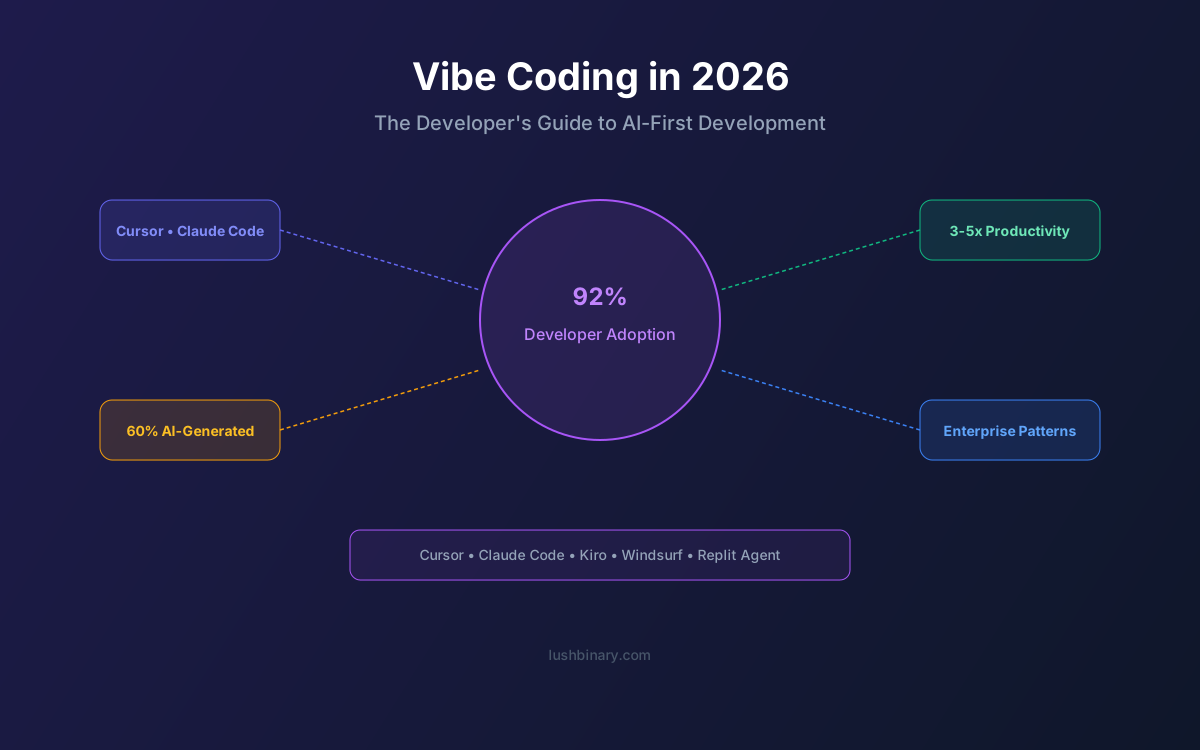
The numbers tell the story: 92% of US developers have adopted vibe coding practices, the global AI coding market hit $8.5 billion, and 60% of all new code written in 2026 is AI-generated. MIT named AI-assisted coding a breakthrough technology of the year. This isn't a trend — it's a fundamental shift in how software gets made.
This guide covers everything: what vibe coding actually is, the tools that power it, when it works (and when it doesn't), security considerations, enterprise adoption patterns, and where it's all heading. Whether you're a senior engineer evaluating AI tools, a startup founder looking to ship faster, or a CTO building an AI-first development culture — this is the comprehensive reference you need.
📋 Table of Contents
- 1.What Is Vibe Coding?
- 2.The Numbers: Adoption, Market Size & Productivity
- 3.Best Vibe Coding Tools in 2026
- 4.How Vibe Coding Actually Works
- 5.Vibe Coding vs Traditional Development
- 6.When Vibe Coding Works (And When It Doesn't)
- 7.Security & Quality Considerations
- 8.Enterprise Adoption Patterns
- 9.The Future: Where Vibe Coding Is Heading
- 10.Why Lushbinary for AI-First Development
1What Is Vibe Coding?
Vibe coding is an AI-first approach to software development where you describe what you want in natural language and let AI write the code. The term was coined by Andrej Karpathy — former Tesla AI director and OpenAI co-founder — in February 2025. His original description: "fully give in to the vibes, embrace exponentials, forget that the code even exists."
The concept resonated so deeply that Collins English Dictionary named "vibe coding" their Word of the Year 2025, defining it as "a style of computer programming in which a person describes the problem to be solved in natural language to an AI tool which then generates the code."
At its core, vibe coding shifts the developer's role from writing syntax to directing intent. Instead of typing for (let i = 0; i < arr.length; i++), you say "filter this array to only include active users and sort by last login date." The AI handles the implementation. You review, iterate, and guide.
Key distinction: Vibe coding isn't "no-code." Developers still need to understand architecture, review generated code, and make design decisions. The difference is that the mechanical act of writing code is delegated to AI, freeing developers to focus on higher-level problem solving.
The Three Levels of Vibe Coding
Assisted
AI suggests completions and answers questions. You write most code. Think GitHub Copilot autocomplete. This is where most developers started.
Collaborative
AI writes entire functions and files from descriptions. You review, edit, and iterate. Cursor Composer and Claude Code operate here. This is the current mainstream.
Autonomous
AI plans, implements, tests, and deploys features end-to-end. You provide high-level direction. Replit Agent and background agents are pushing toward this frontier.
2The Numbers: Adoption, Market Size & Productivity
The adoption curve for vibe coding has been steeper than almost any technology shift in software development history. Here's the data that matters:
| Metric | Value | Source |
|---|---|---|
| US developer adoption | 92% | Industry surveys, 2026 |
| Global AI coding market | $8.5B | Market analysis, 2026 |
| Developers using/planning AI tools | 82% | GitHub Developer Survey, March 2026 |
| New code that is AI-generated | 60% | Industry estimates, 2026 |
| Enterprise adoption growth (YoY) | 340% | Enterprise reports, 2025-2026 |
| Non-technical user adoption growth | 520% | Platform analytics, 2025-2026 |
| Productivity gains reported | 3-5x | Developer surveys, 2026 |
| Idea-to-prototype timeline | Weeks → Hours | Case studies, 2026 |
| Cursor ARR | $500M in under 3 years | Company reports, 2026 |
| MIT breakthrough technology | AI-assisted coding, 2026 | MIT Technology Review |
The 520% surge in non-technical user adoption is particularly significant. Vibe coding has opened software creation to product managers, designers, and entrepreneurs who previously needed to hire developers for every prototype. Tools like Replit Agent and Cursor have made it possible for someone with zero coding experience to build functional web applications.
Cursor's trajectory tells the commercial story: hitting $500M ARR in under 3 years with a $29.3 billion valuation. For context, Slack took 5 years to reach similar revenue. The demand for AI-first development tools is real, growing, and reshaping the entire developer tooling market.
3Best Vibe Coding Tools in 2026
The vibe coding tool landscape has matured rapidly. Here are the five tools that define the space, each with a different philosophy and sweet spot:
| Tool | Type | Best For | Pricing | Key Differentiator |
|---|---|---|---|---|
| Cursor | Agentic IDE | Power users, large codebases | From $20/mo | $29.3B valuation, largest community, multi-model support, Background Agents |
| Claude Code | Terminal Agent | Complex reasoning, big refactors | From $20/mo | 1M token context window, deepest reasoning with Opus models |
| Kiro | Spec-Driven IDE | Teams, production quality | From $20/mo | Spec-driven development, hooks, steering files — structured AI coding from AWS |
| Windsurf | Agentic IDE | Value-conscious developers | From $15/mo | Best price-to-feature ratio, Cascade agent, Memories feature |
| Replit Agent | Cloud IDE + Agent | Non-technical users, prototyping | From $0 (free tier) | Zero-setup, deploy instantly, natural language to full app |
Cursor: The Market Leader
Cursor has become the default vibe coding IDE for professional developers. With a $29.3 billion valuation and $500M ARR achieved in under 3 years, it's the fastest-growing developer tool in history. Its Composer feature lets you describe multi-file changes in natural language, and Background Agents can work on tasks autonomously while you focus on other things. The multi-model support (Claude, GPT, Gemini) means you're never locked into one AI provider.
Claude Code: The Reasoning Powerhouse
Claude Code takes a different approach — it's a terminal-native agent with a 1 million token context window. That means it can hold your entire codebase in memory and reason about complex architectural decisions that stump other tools. It's the go-to choice for large-scale refactors, complex debugging, and projects where deep understanding of the codebase matters more than speed.
Kiro: Structured AI Development
Kiro, from AWS, introduces spec-driven development — structured documents that formalize requirements, design, and tasks before the AI writes a single line of code. This produces more maintainable, production-ready output compared to freeform vibe coding. Hooks (event-driven automation) and steering files (team coding standards) make it particularly strong for teams that need consistency and quality at scale.
Windsurf & Replit Agent
Windsurf offers the best value in the agentic IDE category at $15/mo, with its Cascade agent and unique Memories feature that learns your codebase over time. Replit Agent is the gateway for non-technical users — describe an app in plain English and it builds, deploys, and hosts it for you. The 520% surge in non-technical adoption is largely driven by tools like Replit.
4How Vibe Coding Actually Works
Vibe coding isn't magic — it's a workflow. Understanding the mechanics helps you get dramatically better results. Here's the typical flow:
Describe Intent
You write a natural language prompt describing what you want. The more specific and contextual, the better the output. 'Build a user authentication system with JWT tokens, refresh token rotation, and rate limiting' beats 'make a login page.'
AI Generates Code
The AI model analyzes your prompt, your existing codebase (via context window or indexing), and generates code across one or more files. Modern tools like Cursor and Claude Code can create entire features spanning dozens of files.
Review & Iterate
You review the generated code, accept what works, and provide feedback on what doesn't. This is the critical step — vibe coding without review is how bugs ship. Good developers iterate 2-3 times per feature.
Test & Validate
Run the generated code, check for edge cases, and verify it integrates correctly with your existing system. Many AI tools can now run tests autonomously and fix failures.
Refine & Ship
Polish the output, ensure it meets your team's coding standards, and deploy. Spec-driven tools like Kiro handle much of this refinement automatically through structured requirements.
Prompt Engineering for Vibe Coding
The quality of your output is directly proportional to the quality of your prompts. Here are patterns that consistently produce better results:
- Be specific about constraints: "Use TypeScript strict mode, no any types, handle all error cases" produces cleaner code than "write it in TypeScript."
- Provide architectural context: "This is a Next.js 15 app using server components, Drizzle ORM, and PostgreSQL" helps the AI match your stack.
- Reference existing patterns: "Follow the same pattern as the UserService class" leverages codebase context for consistency.
- Break complex tasks into steps: Instead of "build the entire checkout flow," start with "create the cart data model" then iterate.
- Specify what you don't want: "Don't use any external libraries for this — use native fetch and built-in crypto" prevents dependency bloat.
5Vibe Coding vs Traditional Development
Vibe coding doesn't replace traditional development — it augments it. Understanding where each approach excels helps you use the right tool for the right job:
| Dimension | Traditional Development | Vibe Coding |
|---|---|---|
| Speed to prototype | Days to weeks | Hours to days (3-5x faster) |
| Code understanding | Deep — you wrote every line | Variable — depends on review discipline |
| Boilerplate handling | Manual, repetitive | Instant — AI excels at patterns |
| Complex algorithms | Full control, optimized | Good first draft, needs expert review |
| Team consistency | Style guides, PR reviews | AI follows patterns + tools like Kiro enforce specs |
| Learning curve | Years of language mastery | Prompt engineering + domain knowledge |
| Debugging | Manual, systematic | AI-assisted, but can introduce new bugs |
| Cost per feature | Developer hours × rate | Subscription + reduced developer hours |
The most effective teams in 2026 use a hybrid approach: vibe coding for rapid prototyping, boilerplate, and well-understood patterns; traditional development for performance-critical code, security implementations, and novel algorithms. The 3-5x productivity gains come from knowing when to use which approach.
6When Vibe Coding Works (And When It Doesn't)
Vibe coding isn't universally better. It has clear strengths and equally clear limitations. Knowing the difference saves you time and prevents costly mistakes.
✅ Where Vibe Coding Excels
- CRUD applications and APIs: Standard REST/GraphQL endpoints, database models, and admin panels. AI has seen millions of these patterns and generates them reliably.
- UI components and layouts: React components, Tailwind styling, responsive layouts. AI is remarkably good at translating design descriptions into working UI.
- Boilerplate and scaffolding: Project setup, configuration files, CI/CD pipelines, Docker configs. The tedious stuff that AI handles in seconds.
- Prototyping and MVPs: Going from idea to working demo in hours instead of weeks. This is where the 3-5x productivity gain is most dramatic.
- Test generation: Unit tests, integration tests, and test data. AI can generate comprehensive test suites from existing code faster than any human.
- Documentation and comments: API docs, README files, inline comments. AI excels at explaining code it can read.
⚠️ Where Vibe Coding Struggles
- Novel algorithms: If the problem hasn't been solved before in training data, AI will hallucinate plausible but incorrect solutions. Custom ML pipelines, novel data structures, and unique optimization problems need human expertise.
- Security-critical code: Authentication flows, encryption implementations, and access control logic require expert review. AI can introduce subtle vulnerabilities that pass casual inspection.
- Performance-critical systems: Real-time systems, high-frequency trading, game engines. AI-generated code is functional but rarely optimized for extreme performance.
- Complex state management: Distributed systems with intricate state machines, consensus protocols, and eventual consistency patterns. AI struggles with the nuance.
- Legacy system integration: Connecting to undocumented APIs, proprietary protocols, and systems with decades of accumulated quirks. Context that isn't in training data.
Rule of thumb: If you can clearly describe the desired behavior in 2-3 sentences and the pattern exists in common codebases, vibe coding will save you significant time. If the problem requires deep domain expertise or novel solutions, use AI as a starting point but expect to rewrite substantially.
7Security & Quality Considerations
The biggest risk with vibe coding isn't that AI writes bad code — it's that AI writes code that looks correct but contains subtle issues. Here are the real concerns and how to mitigate them:
Common Security Risks
- Dependency injection: AI may suggest packages with known vulnerabilities or unmaintained dependencies. Always audit
package.jsonadditions. - Hardcoded secrets: AI sometimes generates example code with placeholder API keys or credentials that developers forget to replace before committing.
- SQL injection and XSS: AI-generated database queries and HTML rendering may not always use parameterized queries or proper sanitization.
- Overly permissive access: AI tends to generate code that works first and restricts access second. IAM policies, CORS configs, and file permissions need manual review.
- License compliance: AI may reproduce patterns from copyleft-licensed code without attribution, creating legal risk.
Quality Assurance Framework
Teams shipping production code with vibe coding should implement these guardrails:
Mandatory Code Review
Every AI-generated change gets human review. No exceptions for 'simple' changes — AI bugs hide in simple code.
Automated Testing
Run AI-generated tests AND write your own. AI tests often test the happy path and miss edge cases.
Security Scanning
Integrate SAST/DAST tools (Snyk, SonarQube) into CI/CD. Catch vulnerabilities before they reach production.
Spec-Driven Development
Use tools like Kiro that formalize requirements before code generation. Structured specs produce more predictable, reviewable output.
8Enterprise Adoption Patterns
Enterprise adoption of vibe coding grew 340% year-over-year, but the way enterprises adopt it looks very different from individual developers. Here are the patterns we're seeing:
The Three-Phase Enterprise Rollout
Phase 1: Pilot (1-2 months)
5-10 developers on a single team use AI coding tools on non-critical projects. Measure productivity gains, code quality metrics, and developer satisfaction. Most enterprises start with GitHub Copilot or Cursor due to familiarity.
Phase 2: Expansion (3-6 months)
Expand to 3-5 teams. Establish coding standards for AI-generated code, integrate security scanning, and create prompt libraries for common patterns. Teams using Kiro's spec-driven approach report smoother expansion due to built-in structure.
Phase 3: Standardization (6-12 months)
Organization-wide rollout with governance policies, approved tool lists, training programs, and metrics dashboards. Enterprise plans from Cursor ($40/user/mo), Kiro, or GitHub Copilot Enterprise ($39/user/mo) provide admin controls and audit logs.
Enterprise Tool Selection Matrix
| Requirement | Cursor | Claude Code | Kiro | Copilot | Windsurf |
|---|---|---|---|---|---|
| SSO/SAML | ✅ | ✅ | ✅ | ✅ | ✅ |
| Audit logs | ✅ | ✅ | ✅ | ✅ | ✅ |
| Data residency | ❌ | ❌ | ✅ (AWS) | ❌ | ❌ |
| Self-hosted option | ❌ | ❌ | ❌ | ✅ (GHES) | ❌ |
| Admin controls | ✅ | ✅ | ✅ | ✅ | ✅ |
| Spec-driven workflow | ❌ | ❌ | ✅ | ❌ | ❌ |
| Cost per seat (team) | $40/mo | $150/mo | $20-40/mo | $19-39/mo | $30/mo |
The key enterprise insight: Kiro's spec-driven approach is uniquely suited for enterprises because it creates an auditable trail from requirements to implementation. When compliance teams ask "why was this code written this way," the spec document provides the answer. Combined with AWS data residency options, it's becoming the enterprise favorite for regulated industries.
9The Future: Where Vibe Coding Is Heading
MIT named AI-assisted coding a breakthrough technology of 2026, and the trajectory suggests we're still in the early innings. Here's where the industry is heading:
Near-Term (2026-2027)
- Multi-agent orchestration: Multiple AI agents working in parallel on different parts of a project. One agent handles frontend, another handles backend, a third writes tests — all coordinated by a planning agent. Google Antigravity and OpenAI Codex are already shipping early versions.
- Autonomous deployment pipelines: AI agents that don't just write code but deploy it, monitor production, and fix issues automatically. The gap between "code written" and "code in production" is shrinking rapidly.
- Context windows beyond 1M tokens: As context windows grow, AI will be able to reason about entire organizations' codebases simultaneously, enabling cross-project refactoring and architectural decisions.
Medium-Term (2027-2028)
- AI-native programming languages: Languages designed from the ground up for AI generation and verification, with built-in formal verification and type systems that AI can reason about more effectively.
- Continuous AI code review: AI that monitors your codebase 24/7, proactively identifying bugs, security vulnerabilities, and performance issues before they reach production.
- Democratized software creation: The 520% non-technical adoption growth accelerates. Product managers, designers, and domain experts build production applications directly, with AI handling all technical implementation.
What This Means for Developers
The developer role is evolving, not disappearing. The most valuable skills in 2026 and beyond are system design, AI orchestration, security expertise, and domain knowledge. Developers who can effectively direct AI agents, review generated code critically, and architect systems that leverage AI capabilities will be in higher demand than ever. The mechanical skill of typing code is being commoditized; the intellectual skill of designing systems is becoming more valuable.
10Why Lushbinary for AI-First Development
At Lushbinary, we've been building with AI-first development practices since the early days of vibe coding. We use Cursor, Claude Code, and Kiro daily on production projects — not as experiments, but as core parts of our development workflow.
What we bring to the table:
- AI tool expertise: We've evaluated and used every major vibe coding tool on real projects. We know which tool fits which use case and how to get the most out of each one.
- Production-grade AI workflows: We don't just prototype with AI — we ship production applications built with AI-assisted development, complete with security reviews, testing, and monitoring.
- 3-5x delivery speed: Our AI-first workflow compresses timelines dramatically. Features that traditionally take weeks ship in days. MVPs that take months ship in weeks.
- Enterprise AI adoption consulting: We help teams evaluate, integrate, and optimize AI coding tools for their specific workflows and compliance requirements.
🚀 Free AI Development Consultation
Not sure how to integrate vibe coding into your workflow? Book a free 30-minute call with our team. We'll review your current development process, recommend the right AI tools, and show you how to achieve 3-5x productivity gains without sacrificing code quality.
❓ Frequently Asked Questions
What is vibe coding?
Vibe coding is an AI-first development approach coined by Andrej Karpathy where developers describe what they want in natural language and let AI generate the code. Collins English Dictionary named it Word of the Year 2025.
What are the best vibe coding tools in 2026?
The top tools are Cursor ($29.3B valuation, largest community), Claude Code (1M token context, deepest reasoning), Kiro (spec-driven development from AWS), Windsurf (best value at $15/mo), and Replit Agent (best for non-technical users).
How much faster is vibe coding?
Developers report 3-5x productivity gains. Idea-to-prototype timelines compress from weeks to hours. 60% of all new code in 2026 is AI-generated.
Is vibe coding safe for production?
With proper guardrails — mandatory code review, automated testing, security scanning, and spec-driven tools like Kiro — vibe coding can produce production-quality code. Without review, it introduces security and quality risks.
Will vibe coding replace developers?
No. The developer role is evolving, not disappearing. System design, AI orchestration, security expertise, and domain knowledge are becoming more valuable. The mechanical skill of typing code is being commoditized; the intellectual skill of designing systems is not.
📚 Sources
- Andrej Karpathy — Original "vibe coding" post
- Collins English Dictionary — Word of the Year 2025
- GitHub Developer Survey, March 2026 — 82% AI tool adoption data
- MIT Technology Review — Breakthrough Technologies 2026
- Cursor — $29.3B valuation, $500M ARR
- Kiro — Spec-driven AI development from AWS
- Claude Code Documentation — 1M token context window
Content was rephrased for compliance with licensing restrictions. Market data, adoption statistics, and pricing sourced from official vendor pages, industry surveys, and public reports as of 2026. Statistics and pricing may change — always verify with primary sources.
Ready to Build with AI-First Development?
Our team ships production software with vibe coding tools daily. Let us help you adopt AI-first development, pick the right tools, and achieve 3-5x productivity gains.
Build Smarter, Launch Faster.
Book a free strategy call and explore how LushBinary can turn your vision into reality.