
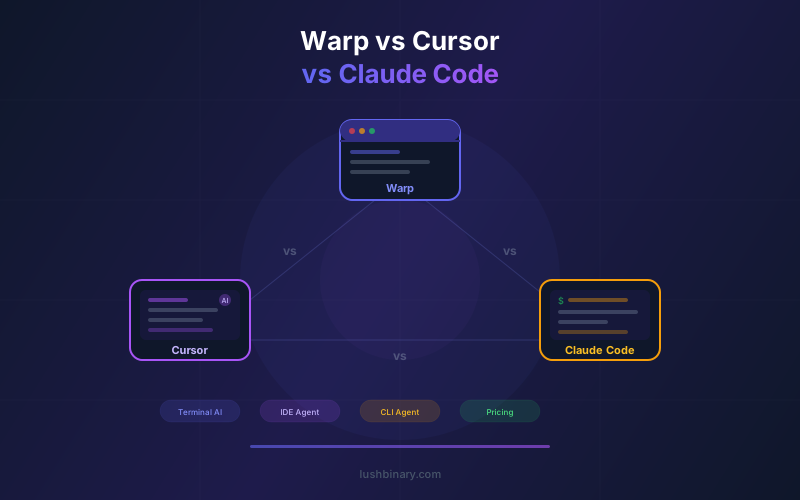
The agentic development environment (ADE) market has fractured into three distinct approaches. Warp reimagines the terminal as an AI-native workspace. Cursor transforms the IDE into an agent-powered editor. Claude Code strips everything down to a CLI agent that works in any terminal. Each tool reflects a fundamentally different bet on how developers will work with AI in 2026 and beyond.
This is not a surface-level feature list. We have used all three tools on production codebases, tracked real costs, and tested them against the same refactoring and feature-building tasks. If you are evaluating these tools for yourself or your team, this comparison covers the architecture, features, pricing, model support, and practical decision framework you need.
For broader context on the full AI coding tool landscape including GitHub Copilot, Windsurf, Kiro, and Google Antigravity, see our complete AI coding agents comparison for 2026. This guide focuses specifically on the Warp vs Cursor vs Claude Code triangle.
📋 Table of Contents
- 01The Three Approaches to Agentic Development
- 02Warp: Terminal-First Agentic Development
- 03Cursor: IDE-First with Composer and Background Agents
- 04Claude Code: CLI-Native Coding Agent
- 05Head-to-Head Feature Comparison
- 06AI Model Support & Flexibility
- 07Pricing Comparison
- 08When to Use Which Tool
- 09Using Multiple Tools Together
- 10Why Lushbinary for Agentic Development
1The Three Approaches to Agentic Development
Before diving into individual tools, it helps to understand the three philosophies driving agentic development in 2026. Each approach makes a different assumption about where AI belongs in your workflow.
Terminal-First (Warp)
The terminal becomes the primary development surface. AI agents operate alongside your shell, reading command output, proposing commands, and orchestrating cloud-based agents. Best for DevOps, infrastructure, and CLI-heavy workflows.
IDE-First (Cursor)
The code editor is the center of gravity. AI agents understand your project structure, edit across files, and run in the background. Best for application development, refactoring, and teams that live in their editor.
CLI Agent (Claude Code)
A standalone agent that runs in any terminal. No custom UI, no IDE lock-in. It reads your codebase, makes changes, runs tests, and iterates autonomously. Best for deep reasoning tasks and developers who want tool-agnostic AI.
These categories are not mutually exclusive. Many developers use two or even all three tools together. But understanding the core philosophy helps you evaluate which tool deserves the most investment in your workflow.
The terminal-first approach (Warp) bets that the command line is where real work happens, especially for infrastructure, deployment, and system administration. The IDE-first approach (Cursor) bets that code editing is the bottleneck and that AI should be deeply embedded in the editor experience. The CLI agent approach (Claude Code) bets that AI should be a portable tool that works anywhere, without requiring you to switch editors or terminals.
Key Insight
The "best" tool depends entirely on your workflow. A backend engineer managing Kubernetes clusters has different needs than a frontend developer building React components. This guide helps you match the right tool to the right use case.
2Warp: Terminal-First Agentic Development
Warp is a Rust-based terminal with over 700,000 active developers that reimagines the command line as an agentic development environment. In April 2026, Warp open-sourced its terminal client under the AGPL-3.0 license, with the Oz cloud agent orchestration platform released under MIT. The company has raised $73M in total funding and was adding $1M in ARR every 10 days before the open-source announcement.
Block-Based Output
Warp's defining feature is its block model. Every command and its output are grouped into a discrete block that you can select, copy, share, or feed as context to the AI agent. This is fundamentally different from the continuous scrollback buffer in traditional terminals. Blocks make it easy to reference specific command results, share debugging context with teammates via Warp Drive, and give the AI agent precise context about what happened.
Agent Mode
Agent Mode lets you describe tasks in natural language. The agent proposes executable commands, chains multi-step workflows, reads command output, and self-corrects when something fails. It operates directly in your shell with full access to your toolchain context. Unlike chat-based AI assistants, Agent Mode executes real commands in your environment, making it practical for deployment scripts, debugging sessions, and infrastructure management.
Oz Cloud Agents
Oz is Warp's cloud agent orchestration platform. It lets you spin up parallel agents on remote infrastructure with configurable compute (2-8 vCPU, 4-16 GiB RAM). Oz handles multi-model routing, environment management with Docker images, and integrations with Slack, Linear, webhooks, and cron schedules. The Oz CLI lets you trigger cloud agents from any terminal, script, or CI/CD pipeline.
MCP Support and Extensibility
Warp supports the Model Context Protocol (MCP) for extending agent capabilities. MCP servers act as plugins that expose external tools and data sources to Warp's agents. The Warp Bridge VS Code extension also connects external AI coding agents (Claude Code, Codex, Gemini CLI) to Warp via MCP, letting those agents run commands and spawn other agents inside Warp.
Open Source (AGPL-3.0)
The terminal client is open source under AGPL-3.0, meaning you can audit the Rust codebase, contribute features, and build custom integrations. The AGPL-3.0 license requires that modifications distributed as a service must also be open-sourced. Oz uses the more permissive MIT license, so you can embed it in proprietary toolchains without licensing friction.
3Cursor: IDE-First with Composer and Background Agents
Cursor is a VS Code fork that has become the most popular AI-enhanced IDE. It takes the familiar VS Code experience and layers on deep AI capabilities including Composer 2 for multi-file editing, Background Agents for autonomous coding, and Tab completion that predicts your next edit. Cursor has attracted significant attention in the developer community, with SpaceX acquisition rumors adding to its profile in early 2026.
Composer 2
Composer is Cursor's agentic editing interface. You describe what you want in natural language, and Composer plans and executes changes across multiple files. Composer 2 introduced significant improvements in planning accuracy, diff generation, and the ability to run terminal commands as part of its workflow. It can create new files, modify existing ones, run tests, and iterate based on results.
Background Agents
Background Agents run autonomously in cloud sandboxes, working on tasks while you continue coding. You can assign a GitHub issue or describe a feature, and the agent will create a branch, implement the changes, run tests, and open a pull request. This is Cursor's answer to the "fire and forget" workflow that developers want for routine tasks like bug fixes, test writing, and documentation updates.
Tab Completion
Cursor's Tab completion goes beyond simple autocomplete. It predicts your next edit based on the context of what you are doing, not just the current line. If you are refactoring a function, Tab will suggest the same refactoring pattern in similar functions throughout the file. This predictive editing is one of Cursor's most-loved features for day-to-day coding speed.
@cursor/sdk and Extensibility
The @cursor/sdk allows developers to build custom tools and integrations that plug into Cursor's agent system. Combined with MCP support, this makes Cursor extensible for team-specific workflows. Cursor also supports .cursorrules files for project-level AI configuration, letting teams define coding standards, preferred patterns, and context that the AI should always consider.
Credit-Based Pricing Model
In June 2025, Cursor switched from unlimited requests to a credit-based pricing model. This was controversial in the community, as heavy users saw their effective costs increase. The Pro plan at $20/month includes a set number of credits, with additional credits available for purchase. Business plans at $40/month include more credits and admin controls.
4Claude Code: CLI-Native Coding Agent
Claude Code is Anthropic's terminal-based coding agent. Unlike Warp and Cursor, Claude Code has no custom GUI, no proprietary terminal, and no IDE. It runs in any terminal (iTerm, Warp, the default macOS Terminal, Windows Terminal, or any Linux terminal emulator) and operates as a pure CLI tool that reads your codebase, makes changes, runs tests, and iterates autonomously.
Autonomous Multi-File Editing
Claude Code's core strength is deep, autonomous coding. You describe a task, and the agent reads relevant files, plans changes across multiple files, implements them, runs your test suite, and fixes issues it finds. With a context window that can handle large codebases, Claude Code excels at complex refactoring, feature implementation, and bug fixing that spans many files.
Deep Reasoning with Opus Models
Claude Code leverages Anthropic's most capable models, including Claude Opus for complex reasoning tasks. The combination of large context windows and strong reasoning makes Claude Code particularly effective for tasks that require understanding architectural patterns, tracing data flow across modules, and making coordinated changes that maintain consistency.
No GUI, No Lock-In
Claude Code's lack of a custom UI is both its limitation and its strength. You do not get block-based output like Warp or visual diffs like Cursor. But you also do not need to switch terminals or editors. Claude Code works wherever you already work. This makes it the most portable of the three tools and the easiest to integrate into existing workflows.
Anthropic-Only Models
The biggest limitation of Claude Code is model lock-in. It only works with Anthropic's Claude models. You cannot use GPT-4o, Gemini, or open-source models. If Anthropic's models underperform on a specific task type, you have no fallback within the tool. This contrasts sharply with Warp's multi-model routing and Cursor's model flexibility.
MCP and IDE Integration
Claude Code supports MCP for connecting to external tools and data sources. It also integrates with VS Code and JetBrains IDEs as an embedded terminal agent, giving you IDE-level context while keeping the CLI-first workflow. The Warp Bridge extension lets Claude Code run inside Warp with full block-based output support.
5Head-to-Head Feature Comparison
Here is a detailed feature comparison across all three tools. This table covers the capabilities that matter most for daily development work.
| Feature | Warp | Cursor | Claude Code |
|---|---|---|---|
| Primary Interface | Terminal (Rust-native) | IDE (VS Code fork) | CLI (any terminal) |
| Agentic Mode | Agent Mode + Oz cloud agents | Composer 2 + Background Agents | Autonomous CLI agent |
| Multi-File Editing | Via agent commands | Native (Composer diffs) | Native (autonomous) |
| Background/Cloud Agents | Oz (2-8 vCPU, 4-16 GiB) | Background Agents (cloud sandbox) | No (runs locally) |
| Block-Based Output | Yes (core feature) | No | No |
| Tab Completion | CLI autocompletion (400+ tools) | Predictive edit completion | No |
| MCP Support | Yes (Streamable HTTPS, SSE) | Yes | Yes |
| Team Collaboration | Warp Drive (shared workflows) | .cursorrules, shared config | CLAUDE.md project files |
| Open Source | AGPL-3.0 (client), MIT (Oz) | No (proprietary) | No (proprietary) |
| Cross-Platform | macOS, Linux, Windows | macOS, Linux, Windows | Any OS with a terminal |
| GPU Acceleration | Yes (Metal, Vulkan, DirectX) | Electron-based rendering | N/A (text-only CLI) |
| BYOK (Bring Your Own Key) | Yes | Yes | API key required |
Important Note
Features and capabilities change rapidly in this space. This comparison reflects the state of each tool as of mid-2026. Always check the official documentation for the latest capabilities.
6AI Model Support & Flexibility
Model flexibility is one of the biggest differentiators between these three tools. The ability to switch models based on task complexity, cost, and performance matters more as AI models specialize.
Warp: Multi-Model with BYOK
Warp offers the broadest model support of the three. It includes Claude (Sonnet and Opus), GPT-4o, Gemini, Kimi, MiniMax, and Qwen out of the box. The "auto" mode automatically selects the best model for each task based on complexity and context. BYOK (Bring Your Own Key) lets you use your own API keys for any supported provider, which is valuable for teams with negotiated enterprise rates. Warp's multi-model routing through Oz means cloud agents can use different models for different steps in a workflow.
Cursor: Multi-Model with Custom Options
Cursor supports Claude, GPT-4o, Gemini, and allows custom model configurations. You can switch models per conversation or set a default for different task types. Cursor also supports BYOK, letting you bring your own API keys. The model selection is slightly narrower than Warp's (no Kimi, MiniMax, or Qwen), but covers the major providers that most developers need.
Claude Code: Anthropic Only
Claude Code is locked to Anthropic's model family. You get Claude Sonnet for fast tasks and Claude Opus for complex reasoning, but there is no option to use GPT-4o, Gemini, or any other provider. This is a deliberate design choice by Anthropic to optimize the agent experience for their models, but it means you cannot comparison-shop or fall back to a different model when Claude underperforms on a specific task type.
| Model / Provider | Warp | Cursor | Claude Code |
|---|---|---|---|
| Claude Sonnet | ✅ | ✅ | ✅ |
| Claude Opus | ✅ | ✅ | ✅ |
| GPT-4o | ✅ | ✅ | ❌ |
| Gemini | ✅ | ✅ | ❌ |
| Kimi | ✅ | ❌ | ❌ |
| MiniMax | ✅ | ❌ | ❌ |
| Qwen | ✅ | ❌ | ❌ |
| BYOK Support | ✅ | ✅ | API key |
| Auto Model Selection | ✅ | Manual | ❌ |
7Pricing Comparison
Pricing models differ significantly across the three tools. Warp uses credit-based tiers, Cursor uses credit-based subscriptions, and Claude Code ties into Anthropic's API and subscription pricing. Here is the full breakdown.
Warp Pricing
| Plan | Price | AI Credits | Cloud Agents |
|---|---|---|---|
| Free | $0 | 75/month | 4 concurrent (2 vCPU) |
| Build | $18/month | 1,500/month | 20 concurrent (4 vCPU) |
| Max | $180/month | 18,000/month | 40 concurrent (8 vCPU) |
| Business | $45/user/month | Custom | Custom (up to 50 seats) |
Cursor Pricing
| Plan | Price | Key Features |
|---|---|---|
| Free | $0 | Limited completions and chat |
| Pro | $20/month | Credit-based usage, Composer, multi-model |
| Business | $40/month | More credits, admin controls, Background Agents |
Claude Code Pricing
| Plan | Price | Key Features |
|---|---|---|
| API Usage | Pay per token | Direct API access, usage-based billing |
| Pro | $20/month | 5x free tier usage, Sonnet access |
| Max 5x | $100/month | Opus access, higher limits, priority |
| Max 20x | $200/month | Highest limits, Opus priority, extended context |
| Teams | $150/user/month | Admin controls, usage management, SSO |
Cost Reality Check
For a team of 10 developers, annual costs look roughly like this: Warp Build at $2,160/year, Cursor Pro at $2,400/year, and Claude Code Max 5x at $12,000/year. Warp offers the best value for terminal-heavy teams. Cursor is the sweet spot for IDE-centric teams. Claude Code is the most expensive but provides the deepest autonomous coding capabilities. Many teams use a tiered approach, giving power users Claude Code Max while the rest use Warp or Cursor.
8When to Use Which Tool
Choosing between Warp, Cursor, and Claude Code comes down to your primary workflow, team size, and what kind of tasks you spend the most time on. Here is a practical decision framework.
Choose Warp If...
- You spend most of your day in the terminal (DevOps, SRE, infrastructure, backend)
- You need cloud agents for parallel task execution and CI/CD automation
- Model flexibility matters - you want to use Claude, GPT-4o, Gemini, and open-source models interchangeably
- Open source is a requirement for your organization's security or compliance policies
- You want team collaboration features like shared workflows, notebooks, and prompts via Warp Drive
- You value a fast, GPU-accelerated terminal experience with block-based output
Choose Cursor If...
- You live in your code editor and want AI deeply integrated into the editing experience
- Multi-file refactoring and feature implementation are your primary use cases
- You want Background Agents that can work on tasks autonomously while you focus on other work
- Tab completion and predictive editing would significantly speed up your daily coding
- You are already a VS Code user and want a familiar environment with AI superpowers
- Your team needs project-level AI configuration via .cursorrules files
Choose Claude Code If...
- You need the deepest autonomous coding capabilities for complex, multi-file tasks
- You want a tool-agnostic agent that works in any terminal and any editor
- Reasoning quality matters more than model variety - you trust Anthropic's models for your use cases
- You work on large codebases that benefit from extended context windows
- You prefer a minimal, CLI-first workflow without extra UI layers
- You are already invested in the Anthropic ecosystem (Claude Pro or Max subscription)
Best for DevOps/Infra
Warp
Terminal-native agent mode, cloud agents, MCP integrations for AWS/GCP/Azure
Best for App Development
Cursor
IDE-integrated editing, Composer 2 for multi-file changes, Background Agents
Best for Complex Refactoring
Claude Code
Deep reasoning, large context window, autonomous multi-file editing
9Using Multiple Tools Together
The most productive developers in 2026 are not picking one tool. They are combining them. Each tool excels in a different part of the development workflow, and using them together creates a more complete agentic development setup than any single tool provides.
Warp + Cursor
This is the most natural pairing. Use Cursor as your primary code editor with Composer 2 for multi-file editing and refactoring. Use Warp as your terminal for running commands, debugging, deployment, and infrastructure tasks. Warp's block-based output makes it easy to copy command results and feed them into Cursor's chat for context. Warp's Agent Mode handles terminal-specific tasks (Docker, kubectl, git operations) while Cursor handles code-level changes.
Warp + Claude Code
Run Claude Code inside Warp's terminal to get the best of both worlds. Claude Code's autonomous coding runs within Warp's block-based environment, so every command Claude Code executes is captured in a discrete block you can review, share, or reference. The Warp Bridge extension enables deeper integration, letting Claude Code access Warp's MCP servers and agent context. Use Warp's Agent Mode for quick terminal tasks and Claude Code for deep, multi-file coding sessions.
All Three Together
The full stack approach: Cursor for IDE-level editing and Background Agents, Warp for terminal workflows and cloud agent orchestration, and Claude Code for complex autonomous coding tasks. This setup maximizes coverage but requires managing three subscriptions. It makes the most sense for senior engineers and tech leads who work across the full stack and need different tools for different contexts.
Practical Tip
Start with one tool and add others as you hit limitations. Most developers find that Warp + Cursor covers 90% of their needs. Add Claude Code when you encounter tasks that require deeper autonomous reasoning than Cursor's Composer can handle, like large-scale refactoring across dozens of files or complex architectural changes.
10Why Lushbinary for Agentic Development
🚀 Build with the Right Tools
At Lushbinary, we build production systems using Warp, Cursor, Claude Code, and the full spectrum of agentic development tools. Our team works with these tools daily to deliver faster, more reliable software for our clients.
Choosing the right agentic development setup is not just about picking a tool. It is about designing a workflow that matches your team's skills, your codebase's complexity, and your deployment pipeline. We help engineering teams evaluate, adopt, and optimize their AI-powered development workflows.
Whether you need help setting up Warp with custom MCP servers, configuring Cursor's Background Agents for your CI/CD pipeline, integrating Claude Code into your development process, or architecting a multi-tool workflow from scratch, Lushbinary has the hands-on experience to get it done right.
We also build custom software products that leverage agentic development internally. From SaaS platforms to mobile apps to infrastructure automation, our team uses these tools to ship faster without sacrificing code quality. If you are building a product and want a development partner that operates at the cutting edge of AI-assisted development, let's talk.
For a deeper look at how Warp fits into the open-source ecosystem, check out our Warp open-source developer guide.
❓ Frequently Asked Questions
What is the difference between Warp, Cursor, and Claude Code?
Warp is a terminal-first agentic development environment built in Rust with block-based output, Agent Mode, and Oz cloud agents. Cursor is an IDE-first tool (VS Code fork) with Composer 2 for multi-file editing and Background Agents. Claude Code is a CLI-native coding agent from Anthropic that runs in any terminal and performs autonomous multi-file editing.
Which AI coding tool supports the most AI models?
Warp supports the widest range including Claude, GPT-4o, Gemini, Kimi, MiniMax, Qwen, and open-source models via BYOK. Cursor supports Claude, GPT-4o, Gemini, and custom models. Claude Code is limited to Anthropic models only.
How much do Warp, Cursor, and Claude Code cost in 2026?
Warp offers Free ($0), Build ($18/month), and Max ($180/month) plans. Cursor offers Pro ($20/month) and Business ($40/month). Claude Code uses API-based pricing, with Pro at $20/month, Max 5x at $100/month, and Max 20x at $200/month via Claude subscriptions.
Can I use Warp, Cursor, and Claude Code together?
Yes. Many developers combine tools for different parts of their workflow. Warp plus Cursor gives you a powerful terminal alongside an AI-enhanced IDE. Warp plus Claude Code lets you run Claude Code inside Warp's block-based terminal. All three together provide maximum coverage across terminal, IDE, and autonomous coding workflows.
Which tool is best for autonomous multi-file coding?
Claude Code excels at autonomous multi-file coding with deep reasoning and large context windows. Cursor's Composer 2 and Background Agents handle multi-file editing well within the IDE. Warp's Agent Mode and Oz cloud agents are strongest for terminal-based workflows and CI/CD automation.
📚 Sources
- Warp GitHub Repository (AGPL-3.0)
- Warp Pricing Page
- Oz Platform Documentation
- Cursor Pricing Page
- Claude Code Documentation
- Anthropic Pricing Page
Content was rephrased for compliance with licensing restrictions. Pricing and feature data sourced from official documentation and pricing pages as of mid-2026. Pricing and features may change - always verify on the vendor's website.
Ready to Build with Agentic Development Tools?
Lushbinary helps engineering teams adopt Warp, Cursor, Claude Code, and other AI-powered development tools. We'll design the right workflow for your team and codebase.
Ready to Build Something Great?
Get a free 30-minute strategy call. We'll map out your project, timeline, and tech stack - no strings attached.
Prefer email? Reach us directly: