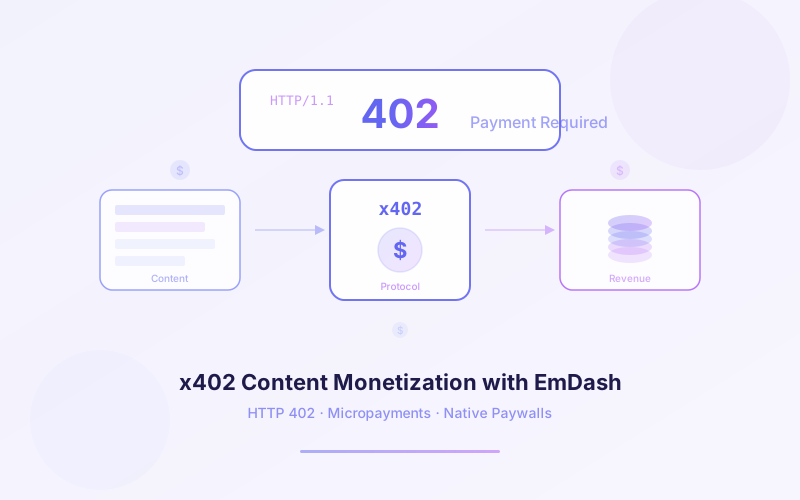
The web's content monetization model is broken. Advertising revenue is declining, AI agents don't see banner ads, and subscription fatigue has pushed users to their limit. Meanwhile, AI crawlers are consuming content at unprecedented scale without paying creators a cent. In September 2025, Coinbase and Cloudflare launched x402, an open payment protocol that finally gives HTTP its missing payment layer.
x402 uses the HTTP 402 "Payment Required" status code — a response code that has existed since HTTP/1.1 was defined in 1997 but was reserved "for future use" for nearly three decades. Combined with EmDash, Cloudflare's open-source CMS with native x402 support, content creators now have a turnkey solution for monetizing content in the AI agent era.
This guide covers everything you need to understand about x402: how the protocol works, why it matters for content creators, how EmDash makes it trivially easy to implement, and what the shift from ad-based to micropayment-based monetization means for the future of the web.
📋 Table of Contents
- 1.The Content Monetization Crisis in the AI Era
- 2.What Is x402: The HTTP 402 Payment Required Protocol
- 3.How x402 Works: Request/Response Flow
- 4.The x402 Foundation: Coinbase, Cloudflare & the Universal Standard
- 5.EmDash’s Built-in x402 Support
- 6.Use Cases: From Premium Content to AI Agent Data Feeds
- 7.x402 vs Traditional Monetization Models
- 8.Technical Implementation: HTTP Flow & Payment Verification
- 9.The Business Model Shift: From Ads to Micropayments
- 10.How Lushbinary Implements x402 Monetization
1The Content Monetization Crisis in the AI Era
The economics of content creation have been deteriorating for years, but the rise of AI agents has accelerated the collapse. Here's the core problem: the web's dominant monetization model — advertising — depends on human eyeballs. AI agents don't have eyeballs.
When an AI agent crawls your site to answer a user's question, it strips out your ads, ignores your newsletter popups, and extracts the content it needs. The user gets their answer without ever visiting your site. Your content generated value, but you captured none of it.
The numbers tell the story:
- AI-driven traffic now accounts for a growing share of web requests, with many publishers reporting 20-40% of their traffic coming from automated agents
- Ad revenue per pageview has declined steadily as ad blockers reach over 40% adoption and AI summaries reduce click-through rates
- Subscription fatigue is real — the average consumer already pays for 4-6 digital subscriptions and resists adding more
- Paywall friction kills conversion — traditional paywalls require account creation, credit card entry, and ongoing commitment for what might be a single article
The fundamental mismatch: content is consumed per-request, but monetized per-subscription. x402 aligns the payment model with the consumption model — pay for what you use, at the moment you use it.
2What Is x402: The HTTP 402 Payment Required Protocol
HTTP status code 402 has been part of the HTTP specification since 1997. The original RFC defined it as "reserved for future use" — the authors of HTTP knew the web would eventually need a native payment layer, but the technology wasn't ready. Nearly three decades later, stablecoins and blockchain settlement have made it possible.
x402 is the protocol that finally activates HTTP 402. Created by Coinbase and Cloudflare in September 2025, it defines a standard way for servers to request payment and for clients to submit payment — all within the HTTP request/response cycle. No redirects to payment processors. No OAuth flows. No account creation. Just HTTP.
The key design principles of x402:
- Protocol-level payments: Payment is part of HTTP itself, not an application-layer bolt-on
- Stablecoin settlement: Payments use USDC on Base (Coinbase's L2 network), settling in seconds with minimal fees
- Machine-readable: AI agents can parse 402 responses, calculate costs, and submit payments programmatically without human intervention
- Open standard: The protocol is open-source and governed by the x402 Foundation, not controlled by any single company
- Facilitator model: Payment verification is handled by trusted facilitators (like Cloudflare) that validate transactions before granting access
Think of x402 as "Stripe for HTTP" — except there's no Stripe account, no API keys, no webhook configuration, and no monthly fees. The payment infrastructure is built into the protocol itself.
3How x402 Works: Request/Response Flow
The x402 protocol operates entirely within standard HTTP request/response cycles. Here's the complete flow when a client (human browser or AI agent) requests paid content:
┌─────────┐         ┌─────────────┐         ┌─────────────┐
│  Client │         │   Server    │         │ Facilitator │
│(Agent/  │         │ (EmDash/    │         │ (Cloudflare)│
│ Browser)│         │  Cloudflare)│         │             │
└────┬────┘         └──────┬──────┘         └──────┬──────┘
     │                     │                       │
     │  1. GET /article    │                       │
     │────────────────────>│                       │
     │                     │                       │
     │  2. HTTP 402        │                       │
     │  Payment Required   │                       │
     │  {                  │                       │
     │    price: "$0.01",  │                       │
     │    network: "base", │                       │
     │    token: "USDC",   │                       │
     │    address: "0x..." │                       │
     │    facilitator: ... │                       │
     │  }                  │                       │
     │<────────────────────│                       │
     │                     │                       │
     │  3. Client signs    │                       │
     │     stablecoin tx   │                       │
     │     ───────────     │                       │
     │                     │                       │
     │  4. GET /article    │                       │
     │  X-PAYMENT: {signed │                       │
     │    tx payload}      │                       │
     │────────────────────>│                       │
     │                     │                       │
     │                     │  5. Verify payment    │
     │                     │────────────────────── >│
     │                     │                       │
     │                     │  6. Payment valid ✓   │
     │                     │<──────────────────────│
     │                     │                       │
     │  7. HTTP 200 OK     │                       │
     │  + article content  │                       │
     │<────────────────────│                       │
     │                     │                       │
Breaking down each step:
- Step 1: The client makes a standard GET request to the content URL
- Step 2: The server responds with HTTP 402 and a JSON body containing the price, accepted token (USDC), blockchain network (Base), recipient wallet address, and facilitator endpoint
- Step 3: The client constructs and signs a stablecoin transaction for the specified amount
- Step 4: The client retries the original request with an
X-PAYMENTheader containing the signed transaction payload - Step 5-6: The server forwards the payment to the facilitator (Cloudflare) for verification. The facilitator confirms the transaction is valid and the funds are settled
- Step 7: The server returns the content with a standard HTTP 200 response
The entire flow completes in seconds. For AI agents, this is fully automated — the agent parses the 402 response, evaluates whether the price is within its budget, signs the transaction, and retries. No human intervention required.
4The x402 Foundation: Coinbase, Cloudflare & the Universal Standard
The x402 Foundation was established by Coinbase and Cloudflare to govern the protocol specification and drive adoption across the web. The foundation's mission is to create a universal standard for machine-to-machine payments — a protocol as ubiquitous as HTTPS itself.
The scale is already significant. Cloudflare, which proxies approximately 20% of all web traffic, sends over 1 billion HTTP 402 responses daily. This means x402 isn't a theoretical protocol — it's already operating at internet scale.
Key milestones in the x402 timeline:
- September 2025: Coinbase and Cloudflare launch x402 and establish the x402 Foundation
- Late 2025: Cloudflare integrates x402 into its edge network, enabling any site behind Cloudflare to accept payments with a configuration toggle
- Early 2026: EmDash launches with native x402 support, making content monetization a first-class CMS feature
- 2026: The x402 Foundation publishes the open specification, inviting other CDNs, hosting providers, and payment networks to implement the standard
The x402 Foundation operates similarly to the Let's Encrypt model: a non-profit that provides critical web infrastructure as a public good. Just as Let's Encrypt made HTTPS free and universal, the x402 Foundation aims to make web payments free and universal at the protocol level.
5EmDash's Built-in x402 Support
EmDash, Cloudflare's open-source CMS, ships with x402 support out of the box. Unlike WordPress where you'd need to install a payment plugin, configure a Stripe account, and build custom paywall logic, EmDash treats content monetization as a core CMS feature.
Setting up x402 payments in EmDash requires three configuration values:
// emdash.config.ts
import { defineConfig } from "emdash";

export default defineConfig({
  payments: {
    // 1. Your wallet address for receiving payments
    walletAddress: "0xYourWalletAddress",

    // 2. Default price per request (in USDC)
    defaultPrice: "0.01",

    // 3. Which content requires payment
    rules: [
      {
        // All posts in the "premium" collection
        collection: "premium",
        price: "0.05",
      },
      {
        // Specific content by slug pattern
        pattern: "/api/data/*",
        price: "0.02",
      },
      {
        // Free content (no payment required)
        collection: "blog",
        price: "0",
      },
    ],
  },
});
That's it. Once configured, EmDash automatically returns HTTP 402 responses for protected content, handles payment verification through Cloudflare's facilitator, and serves content once payment is confirmed.
The admin interface also provides a visual dashboard for managing payment rules:
- Per-collection pricing: Set different prices for different content types (blog posts, research papers, API data)
- Per-post overrides: Override the collection price for individual high-value pieces of content
- Free tier rules: Allow a certain number of free requests per IP or agent before requiring payment
- Revenue analytics: Track payments, popular content, and revenue trends in real time
- Wallet management: Connect your wallet and monitor incoming USDC payments
EmDash's x402 integration works on both Cloudflare Workers and Node.js deployments. On Cloudflare, payment verification happens at the edge with near-zero latency. On Node.js, EmDash calls the facilitator API directly.
6Use Cases: From Premium Content to AI Agent Data Feeds
x402 unlocks monetization models that were previously impractical because the transaction costs of traditional payment systems made micropayments uneconomical. Here are the most compelling use cases:
📰 Premium Content & Journalism
Instead of forcing readers to subscribe for $10/month to read one article, charge $0.05 per article. Readers pay only for what they consume. Publishers earn from every piece of content, not just from the fraction of visitors who convert to subscribers.
🔌 API Access & Developer Tools
Charge per API call without requiring API keys, rate limit tiers, or billing dashboards. A developer's agent can discover your API, pay per request, and integrate your data — all without signing up for an account.
🤖 AI Agent Data Feeds
This is the killer use case. AI agents need real-time, high-quality data to generate accurate responses. With x402, agents can pay for access to proprietary datasets, research databases, and curated content feeds. The agent's budget determines how much data it can access, creating a natural market for information quality.
📄 Research Papers & Academic Content
Academic publishers can charge per-paper instead of requiring institutional subscriptions. A researcher (or their AI assistant) pays $0.50 for a single paper instead of $30 for a journal subscription they'll use once.
🎨 Digital Media & Creative Assets
Stock photos, music samples, design templates — any digital asset can be monetized per-download without marketplace intermediaries taking 30-50% cuts. The creator sets the price, receives payment directly to their wallet, and the buyer gets instant access.
7x402 vs Traditional Monetization Models
To understand why x402 matters, compare it against the monetization models that dominate the web today:
| Factor | Ads | Subscriptions | Paywalls | x402 |
|---|---|---|---|---|
| Works with AI agents | No | No | No | Yes |
| Per-content pricing | No | No | Partial | Yes |
| Account required | No | Yes | Yes | No |
| Settlement speed | 30-90 days | Instant | Instant | Seconds |
| Transaction fees | 30-50% rev share | 2-3% | 2-3% | < 1% |
| Micropayments viable | N/A | No | No | Yes |
| Machine-readable | No | No | No | Yes |
| Privacy preserving | No | No | No | Yes |
| Setup complexity | Medium | High | High | Low |
The most critical difference is AI agent compatibility. Subscriptions and paywalls require human interaction — creating accounts, entering credit cards, solving CAPTCHAs. AI agents can't do any of that. x402 is the only model where an agent can autonomously discover, evaluate, pay for, and consume content.
Privacy is another major advantage. With x402, there's no user account, no email address, no browsing history tracked. The payment itself is the authentication. You pay, you get access. The server doesn't need to know who you are.
8Technical Implementation: HTTP Flow & Payment Verification
Under the hood, x402 extends HTTP with a small set of well-defined headers and response formats. Here's what the actual HTTP exchange looks like:
The 402 Response
HTTP/1.1 402 Payment Required
Content-Type: application/json
X-PAYMENT-REQUIRED: true

{
  "x402Version": 1,
  "scheme": "exact",
  "network": "base",
  "token": "USDC",
  "amount": "10000",
  "recipient": "0xContentCreatorWallet",
  "facilitator": {
    "url": "https://x402.org/facilitator",
    "network": "base",
    "authority": "0xCloudflareVerifier"
  },
  "payload": {
    "description": "Access to premium article",
    "mimeType": "text/html",
    "maxTimeoutSeconds": 300
  }
}
Key fields in the 402 response:
- amount: Price in the token's smallest unit (10000 = $0.01 USDC, since USDC has 6 decimal places)
- network: The blockchain network for payment (Base, Coinbase's L2, is the default)
- facilitator: The trusted third party that verifies payment before the server releases content
- payload: Metadata about what the client will receive after payment
The Payment Request
GET /article/premium-content HTTP/1.1
Host: example.com
X-PAYMENT: {
  "x402Version": 1,
  "scheme": "exact",
  "network": "base",
  "payload": {
    "signature": "0xSignedTransactionPayload...",
    "authorization": {
      "from": "0xPayerWallet",
      "to": "0xContentCreatorWallet",
      "value": "10000",
      "validAfter": 1695000000,
      "validBefore": 1695000300
    }
  }
}
The Facilitator Role
The facilitator is the critical trust layer in x402. When the server receives a payment header, it doesn't verify the blockchain transaction itself — that would be slow and require running a node. Instead, it forwards the payment to the facilitator, which:
- Validates the cryptographic signature on the transaction
- Confirms the payer has sufficient USDC balance
- Settles the transaction on the Base network
- Returns a verification receipt to the server
Cloudflare operates the primary facilitator, processing payments at the edge alongside its existing CDN infrastructure. This means payment verification adds minimal latency — typically under 100ms — because it happens at the same edge node that's already serving the content.
The facilitator model is designed to be decentralized. While Cloudflare is the first facilitator, the x402 Foundation specification allows any entity to operate a facilitator. This prevents vendor lock-in and ensures the protocol remains open.
9The Business Model Shift: From Ads to Micropayments
The advertising model worked when humans were the primary consumers of web content. But the economics are shifting. As AI agents become a larger share of web traffic, the value of an ad impression approaches zero for non-human visitors.
x402 enables a fundamentally different business model: micropayments. Instead of monetizing attention (ads) or commitment (subscriptions), you monetize access. Every piece of content has a price, and every consumer — human or machine — pays that price.
Consider the math for a content publisher:
Traditional Ad Model:
  100,000 pageviews/month
  × $5 CPM (cost per 1,000 impressions)
  = $500/month revenue
  - 40% lost to ad blockers
  = $300/month actual revenue

x402 Micropayment Model:
  100,000 requests/month (humans + AI agents)
  × $0.01 per request
  = $1,000/month revenue
  - < 1% transaction fees
  = $990/month actual revenue

  Even at $0.005 per request:
  = $500/month with near-zero fees
  + AI agent traffic adds incremental revenue
    (agents that previously paid nothing)
The micropayment model has several structural advantages:
- No ad blocker vulnerability: Payments happen at the HTTP level, not in the browser DOM
- AI agent monetization: Every agent request generates revenue, turning previously zero-value traffic into a revenue stream
- Content quality incentive: When users pay per article, creators are incentivized to produce fewer, higher-quality pieces rather than churning out clickbait for ad impressions
- Direct creator compensation: Payments go directly to the creator's wallet with no intermediary taking a 30-50% cut
- Global accessibility: Anyone with a stablecoin wallet can pay, regardless of country, banking status, or credit history
The shift from ads to micropayments doesn't have to be all-or-nothing. Many publishers will adopt a hybrid model: free content supported by ads for casual human visitors, with x402 payments for AI agents and premium content. EmDash supports both models simultaneously.
10How Lushbinary Implements x402 Monetization
At Lushbinary, we're building x402 monetization into our content platforms and helping clients adopt the protocol. Our approach combines deep experience with EmDash and Cloudflare infrastructure with practical monetization strategy.
What we deliver for x402 implementations:
- Content audit & pricing strategy: We analyze your content library to determine which pieces should be free (for SEO and discovery), which should be gated with x402, and what price points maximize revenue without killing traffic
- EmDash deployment with x402: Full CMS setup on Cloudflare Workers with x402 payment rules configured, wallet integration, and revenue dashboards
- AI agent optimization: We configure your MCP server and x402 endpoints so AI agents can discover, evaluate, and pay for your content programmatically
- Hybrid monetization: We build systems that serve ad-supported content to casual browsers while requiring x402 payments from AI agents and power users accessing premium content
- Custom facilitator integration: For enterprise clients who need custom payment verification logic or want to operate their own facilitator node
- Analytics & reporting: Custom dashboards tracking x402 revenue, agent traffic patterns, content performance, and payment conversion rates
🚀 Ready to Monetize Your Content with x402?
Whether you're a publisher looking to monetize AI agent traffic, a SaaS company wanting to charge per-API-call, or a content creator exploring micropayments — we'll help you design and implement an x402 strategy that works. Book a free 30-minute consultation with our team.
❓ Frequently Asked Questions
What is the x402 payment protocol?
x402 is an open payment protocol created by Coinbase and Cloudflare in September 2025. It uses the HTTP 402 Payment Required status code to enable pay-per-request content access using stablecoin payments that settle in seconds, without requiring subscriptions or user accounts.
How does x402 work with AI agents?
When an AI agent requests content from an x402-enabled server, it receives an HTTP 402 response containing pricing details and a payment address. The agent submits a stablecoin payment, includes the transaction proof in a follow-up request, and the server verifies the payment through a facilitator before granting access.
What is the x402 Foundation?
The x402 Foundation was established by Coinbase and Cloudflare to create a universal standard for machine-to-machine payments on the web. It governs the x402 protocol specification and promotes adoption across platforms, with Cloudflare sending over 1 billion HTTP 402 responses daily.
Does EmDash support x402 payments natively?
Yes. Every EmDash site has built-in x402 support. Configuration requires just three things: which content should require payment, how much to charge per request, and a wallet address to receive payments. No plugins or third-party integrations are needed.
How is x402 different from traditional paywalls?
Unlike traditional paywalls that require user accounts, subscriptions, and credit card forms, x402 enables frictionless pay-per-request access at the HTTP protocol level. Payments happen in stablecoins and settle in seconds, making it ideal for both human users and AI agents that need programmatic content access.
📚 Sources
- Cloudflare Blog: x402 Foundation Launch
- Cloudflare Blog: Introducing EmDash
- x402 Foundation: Protocol Specification
- Coinbase Blog: x402 Protocol Announcement
Content was rephrased for compliance with licensing restrictions. Technical details sourced from official Cloudflare, Coinbase, and x402 Foundation documentation as of 2026. Protocol specifications and availability may change — always verify on the official x402 documentation.
Monetize Your Content with x402
From strategy to deployment, our team builds x402-powered content platforms that turn every request into revenue.
Build Smarter, Launch Faster.
Book a free strategy call and explore how LushBinary can turn your vision into reality.