
Warp has redefined what a terminal can be. With 700,000+ users, $73M in venture funding, and a reported $1M in new ARR added every 10 days, Warp proved that developers will pay for a modern terminal experience. In April 2026, Warp took the bold step of open-sourcing its entire terminal client under the AGPL-3.0 license, giving the community full visibility into the Rust-based, GPU-accelerated architecture that powers it.
But Warp isn't without friction. Users have pushed back on mandatory account requirements, credit-based AI pricing, and resource consumption that dwarfs minimalist alternatives like Alacritty and Ghostty. These gaps represent real opportunities for a competitor that keeps what makes Warp great while addressing what it gets wrong.
This guide breaks down exactly how to build a terminal application that competes with Warp: the business model, the technical architecture, the AI features that differentiate, and the development cost to get there. Whether you want to fork Warp's open-source code or build from scratch, this is your roadmap.
📋 Table of Contents
- 1. What Makes Warp a $73M Terminal Business
- 2. Warp Revenue Model & Pricing Analysis
- 3. User Complaints & Market Gaps
- 4. Core Features for an MVP
- 5. System Architecture & Tech Stack
- 6. AI-Powered Features That Differentiate
- 7. Development Cost & Timeline
- 8. Open-Source Advantage: Learning from Warp's Code
- 9. Why Lushbinary for Your Terminal MVP
- 10. FAQ, Sources & Next Steps
1What Makes Warp a $73M Terminal Business
Before building a competitor, you need to understand why Warp attracted $73M in venture capital and grew to 700,000+ users. Warp isn't just another terminal emulator - it's a developer productivity platform that happens to run in a terminal window.
The Numbers
- 700,000+ users across macOS and Linux, with a growing enterprise customer base
- $73M total funding from investors including Dylan Field (Figma), Jeff Weiner (LinkedIn), and Elad Gil
- $1M ARR added every 10 days - one of the fastest-growing developer tools in 2026
- Open-sourced April 2026 under AGPL-3.0, with the Oz orchestration platform under MIT
- Built in Rust with GPU-accelerated rendering via wgpu for sub-millisecond frame times
What Warp Got Right
Warp's core insight was that the terminal hadn't meaningfully evolved since the 1980s. While IDEs got autocomplete, collaboration, and AI, the terminal stayed frozen in time. Warp brought modern IDE concepts to the command line:
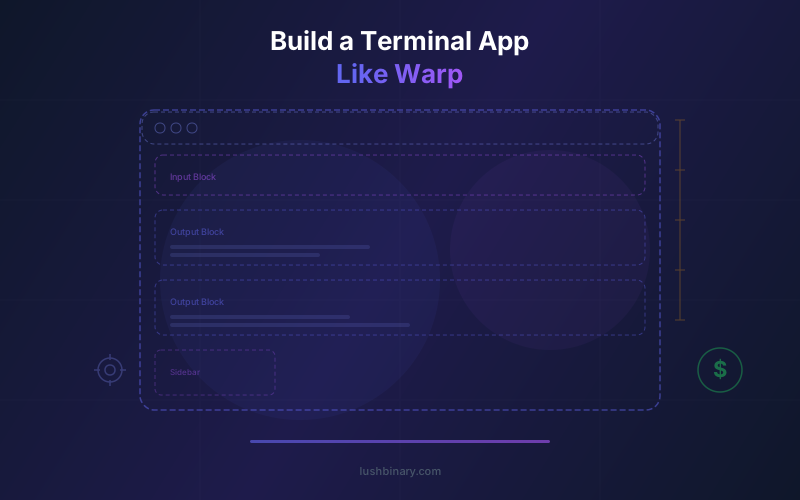
- Block-based output - each command and its output is a discrete, selectable, copyable block instead of an endless scroll of text
- IDE-style input editor - multi-line editing, syntax highlighting, cursor positioning, and selections that work like a real text editor
- AI command generation - describe what you want in natural language and Warp generates the command, explains errors, and suggests fixes
- Warp Drive - shared workflows, commands, and notebooks that teams can collaborate on in real time
- Agent Mode - autonomous AI that can execute multi-step terminal workflows, read files, and iterate on errors
💡 Key Insight
Warp's $73M valuation isn't about building a better terminal emulator. It's about owning the developer workflow layer. The terminal is the entry point, but the real product is AI-powered developer productivity. Your competitor should think the same way.
2Warp Revenue Model & Pricing Analysis
Warp uses a freemium model with credit-based AI pricing. Understanding the tiers helps you identify where users feel friction and where a competitor can undercut:
| Plan | Price | AI Credits | Key Features |
|---|---|---|---|
| Free | $0 | 75/month | 4 cloud agents, 3 indexed codebases, basic AI features |
| Build | $18/mo | 1,500/month | 10 cloud agents, 10 indexed codebases, priority support |
| Max | $180/mo | 18,000/month | Unlimited cloud agents, unlimited codebases, advanced models |
| Business | $45/user/mo | Custom | Team management, SSO, audit logs, centralized billing |
| Enterprise | Custom | Custom | Dedicated support, SLAs, custom integrations, on-prem options |
Pricing Gaps You Can Exploit
- 75 free credits is very limiting - power users burn through this in a single session. A more generous free tier (200-500 credits) would attract users who feel nickel-and-dimed
- The jump from $18 to $180 is steep - there's no mid-tier option for developers who need more than 1,500 credits but don't need 18,000. A $50-60/month tier with 5,000 credits fills this gap
- $45/user/month for teams is expensive - for a 10-person team, that's $5,400/year just for terminal access. A flat team rate or lower per-seat pricing would be compelling
- No bring-your-own-key option - many developers already pay for OpenAI or Anthropic API access. Letting them use their own keys eliminates the credit system entirely
💡 Competitive Strategy
Consider a hybrid model: free core terminal with optional AI subscription, plus a bring-your-own-API-key option for power users. This removes the biggest friction point (mandatory account + credits) while still generating revenue from users who want a managed AI experience.
3User Complaints & Market Gaps
Warp's growth is impressive, but its user base is vocal about friction points. These complaints are sourced from Reddit, Hacker News, GitHub issues, and developer forums. Each one represents a differentiation opportunity:
Mandatory Account Requirement
Warp requires creating an account and signing in just to use the terminal. For many developers, this is a dealbreaker. A terminal is a local tool - requiring authentication to run commands on your own machine feels invasive. Competitors like Alacritty, Ghostty, and iTerm2 work immediately with zero setup. Your terminal should work offline by default, with accounts only required for cloud features like sync and collaboration.
Telemetry and Data Collection Concerns
Before open-sourcing, Warp faced persistent criticism about what data it collected. Developers working with sensitive codebases, production credentials, and proprietary systems were uncomfortable with a closed-source terminal that phoned home. The April 2026 open-source release under AGPL-3.0 addressed much of this by making the code auditable. However, the cloud AI features still route through Warp's servers. A competitor can differentiate by offering fully local AI inference as an option, using models like Ollama or llama.cpp for on-device processing.
Resource Usage vs. Minimalist Terminals
Warp's GPU-accelerated rendering and rich UI come at a cost. Users report significantly higher memory and CPU usage compared to Alacritty, Ghostty, or kitty. For developers running multiple terminal sessions alongside resource-hungry IDEs, Docker containers, and local dev servers, every megabyte matters. A competitive terminal should offer a "lite mode" that strips the UI back to essentials while keeping the AI features accessible via keyboard shortcuts.
Credit-Based AI Pricing
The credit system creates anxiety. Developers don't want to think about whether asking the AI to explain an error will cost them 1 credit or 5. The 75 free credits run out quickly, and the jump to $18/month feels steep for what is essentially autocomplete and error explanation. A flat-rate AI subscription or BYOK (bring your own key) model removes this friction entirely.
Platform Support Timeline
Warp launched macOS-first and took years to ship Linux support. Windows support arrived even later. For teams with mixed-OS environments, this fragmented rollout was a blocker. Building cross-platform from day one using Rust + wgpu (which abstracts over Metal, Vulkan, and DX12) eliminates this problem.
| Complaint | Your Opportunity |
|---|---|
| Mandatory sign-in | Works offline by default, account only for cloud features |
| Telemetry concerns | Open source from day one, local AI inference option |
| High resource usage | Lite mode with configurable UI complexity |
| Credit-based AI pricing | Flat-rate subscription + BYOK option |
| Slow cross-platform rollout | macOS, Linux, and Windows from v1.0 |
4Core Features for an MVP
Building a terminal like Warp requires a phased approach. You can't ship everything at once, but you need enough in the MVP to demonstrate the vision. Here's the feature breakdown by phase:
Phase 1: MVP (3-4 Months)
The MVP must prove that a modern, AI-enhanced terminal is viable. Focus on the core experience that makes users switch from their current terminal:
- GPU-accelerated rendering - Rust + wgpu for smooth, 120fps terminal rendering. This is non-negotiable for a premium feel. Text rendering must be crisp with proper font shaping (harfbuzz) and ligature support
- Block-based output - each command and its output is a discrete block that can be selected, copied, shared, or collapsed. This is Warp's signature UX innovation and the feature users cite most often
- IDE-style input editor - multi-line editing with syntax highlighting, cursor movement, selections, and undo/redo. The input area should feel like VS Code, not a 1980s TTY
- Basic AI integration - natural language to command translation, error explanation, and command suggestions. Start with OpenAI or Anthropic APIs, add local model support later
- Cross-platform from day one - macOS, Linux, and Windows using wgpu's abstraction over Metal, Vulkan, and DX12
- Themes and customization - import existing terminal themes (iTerm2, Alacritty YAML), custom fonts, and configurable keybindings
- Split panes and tabs - essential terminal multiplexing without needing tmux or screen
Phase 2: Differentiation (Months 5-7)
- Team collaboration - shared command libraries, workflow templates, and real-time terminal sharing (like Warp Drive)
- Workflows and automation - save multi-step command sequences as reusable workflows with parameterized inputs
- MCP (Model Context Protocol) support - connect AI to external tools, databases, and APIs through the standardized MCP protocol. See our Warp MCP integration guide for implementation details
- BYOK (Bring Your Own Key) - let users connect their own OpenAI, Anthropic, or local model endpoints
- Plugin/extension system - allow third-party developers to extend the terminal with custom commands, UI panels, and integrations
Phase 3: Platform (Months 8-12)
- Cloud agents - autonomous AI agents that run in the cloud, execute multi-step tasks, and report back results (similar to Warp's agent mode powered by Oz)
- Multi-model routing - automatically route AI requests to the best model based on task type. Use fast models for autocomplete, powerful models for complex debugging, and local models for sensitive operations
- Enterprise features - SSO, audit logs, role-based access control, compliance reporting, and on-premise deployment options
- Marketplace - a marketplace for community-built plugins, themes, workflows, and AI prompts
5System Architecture & Tech Stack
A terminal like Warp requires a carefully layered architecture. The rendering engine must be blazing fast, the AI layer must be responsive, and the collaboration features need real-time sync. Here's the recommended stack:
Recommended Tech Stack
| Layer | Technology | Why |
|---|---|---|
| Core Engine | Rust | Memory safety, zero-cost abstractions, same language Warp uses |
| GPU Rendering | wgpu | Cross-platform GPU abstraction over Metal, Vulkan, DX12 |
| UI Layer | TypeScript + React | Rich UI components, settings panels, collaboration views |
| Terminal Emulation | Custom VTE in Rust | Full xterm-256color compatibility with block-based extensions |
| Font Rendering | harfbuzz + freetype | Proper text shaping, ligatures, and emoji support |
| Database | PostgreSQL | User data, team workspaces, shared workflows, analytics |
| Caching | Redis | Session state, AI response caching, real-time pub/sub |
| AI Backend | Rust + Python | API gateway in Rust, model orchestration in Python |
| Local AI | Ollama / llama.cpp | On-device inference for privacy-sensitive environments |
Architecture Diagram
The following diagram shows the high-level architecture of a Warp-like terminal, from the GPU rendering layer through the AI backend:
Why Rust for the Core
Rust is the clear choice for a terminal engine. Warp, Alacritty, and the Zed editor all use Rust for the same reasons: memory safety without garbage collection pauses, zero-cost abstractions for performance-critical rendering loops, and excellent cross-platform support. The Rust ecosystem also has mature crates for terminal emulation (vte, alacritty_terminal), GPU rendering (wgpu), and async I/O (tokio).
For the UI layer, TypeScript with React provides the fastest path to rich settings panels, collaboration views, and marketplace interfaces. The terminal rendering itself stays in Rust/wgpu for performance, while the "chrome" around it uses web technologies for rapid iteration. This is the same hybrid approach Warp uses, and it's proven at scale.
6AI-Powered Features That Differentiate
AI is what separates a modern terminal from a traditional one. Warp pioneered AI in the terminal, but there's room to go further. Here are the AI features that will define the next generation of terminal applications:
Natural Language Commands
Users type what they want in plain English, and the AI generates the correct command. This goes beyond Warp's current implementation by supporting context-aware generation. The AI should know your current directory, recent commands, running processes, and project type (Node.js, Python, Rust) to generate more accurate commands. For example, typing "find all TypeScript files with unused imports" in a Node.js project should generate the correct eslint command with the right config flags.
Error Explanation and Auto-Fix
When a command fails, the AI should automatically detect the error, explain what went wrong in plain language, and suggest a fix. For common errors (permission denied, port already in use, missing dependency), the fix should be a one-click action. The AI should also learn from your error patterns - if you frequently forget to activate a virtual environment before running pip, it should proactively remind you.
Multi-Step Workflows
Complex tasks like "set up a new Next.js project with TypeScript, Tailwind, and deploy to Vercel" require multiple commands executed in sequence. The AI agent should break this into steps, execute each one, handle errors, and adapt the plan based on results. This is similar to Warp's Agent Mode but with better transparency - users should see the full plan before execution and be able to modify individual steps.
MCP Integration
The Model Context Protocol (MCP) is becoming the standard for connecting AI to external tools. Your terminal should support MCP servers out of the box, allowing the AI to query databases, read documentation, interact with APIs, and manage cloud infrastructure directly from the terminal. This transforms the terminal from a command executor into a full developer workstation. For a deep dive into MCP implementation, see our Warp MCP integration guide.
Codebase-Aware Context
Warp's indexed codebase feature lets the AI understand your project structure. Take this further by integrating with LSP (Language Server Protocol) for real-time code intelligence. The AI should know your function signatures, dependencies, test coverage, and deployment configuration. When you ask "run the tests for the auth module," it should know exactly which test file to run and with which framework.
💡 Differentiation Tip
The biggest AI differentiation opportunity is local inference. Many enterprise developers can't send code to cloud APIs due to compliance requirements. Offering on-device AI via Ollama or llama.cpp with models like CodeLlama or DeepSeek Coder means your terminal works in air-gapped environments where Warp's cloud-dependent AI cannot.
7Development Cost & Timeline
Building a terminal like Warp is a significant engineering investment. Here's a realistic breakdown of costs and timelines based on current market rates for senior Rust and systems engineers:
| Category | MVP | Full-Featured |
|---|---|---|
| Total Cost | $150,000 - $250,000 | $500,000 - $800,000 |
| Timeline | 3-4 months | 8-12 months |
| Team Size | 3-4 engineers | 6-8 engineers |
| Core Engine (Rust) | $60K - $100K | $150K - $250K |
| GPU Rendering | $30K - $50K | $80K - $120K |
| AI Integration | $25K - $40K | $100K - $180K |
| UI / UX | $20K - $35K | $60K - $100K |
| Backend / Cloud | $15K - $25K | $80K - $130K |
| Key Features | GPU rendering, blocks, IDE editor, basic AI | + Collaboration, cloud agents, MCP, multi-model, marketplace |
Cost Reduction Strategies
- Fork Warp's open-source code - the AGPL-3.0 codebase gives you a massive head start on the rendering engine, terminal emulation, and block parsing. This can cut 40-60% off the core engine cost if your licensing model is compatible
- Use AI-assisted development - tools like Claude Code, Cursor, and GitHub Copilot can accelerate Rust development by 30-40%, especially for boilerplate, tests, and documentation
- Start with cloud AI only - defer local inference to Phase 2. OpenAI and Anthropic APIs are faster to integrate than setting up on-device model serving
- Leverage existing crates - the Rust ecosystem has production-ready crates for terminal emulation (vte), GPU rendering (wgpu), font shaping (harfbuzz), and async networking (tokio)
💡 Budget Tip
The biggest cost variable is the GPU rendering engine. If you build from scratch, expect 2-3 months of a senior Rust engineer's time just on text rendering, font shaping, and scroll performance. Forking Warp's renderer or using Alacritty's rendering code (also Rust + wgpu) can save $50K-$80K.
8Open-Source Advantage: Learning from Warp's Code
Warp's decision to open-source under AGPL-3.0 in April 2026 changed the competitive landscape. For the first time, developers can study exactly how a $73M terminal is built. Here's how to leverage this:
What You Can Learn from the Codebase
- GPU text rendering pipeline - how Warp achieves sub-millisecond frame times with wgpu, including glyph caching, atlas management, and batched draw calls
- Block-based terminal emulation - the custom VTE parser that segments command output into discrete blocks while maintaining full xterm compatibility
- IDE-style editor integration - how the input editor handles multi-line editing, syntax highlighting, and cursor management within a terminal context
- AI prompt engineering - the system prompts, context injection, and structured output parsing that power Warp's AI features
- Cross-platform abstractions - how Warp handles platform-specific differences in PTY management, clipboard access, and window management across macOS and Linux
The Oz Orchestration Platform
Warp also open-sourced Oz, their cloud agent orchestration platform, under the more permissive MIT license. Oz handles multi-step AI workflows, tool execution, error recovery, and agent state management. Since it's MIT-licensed, you can use it directly in commercial products without the AGPL's copyleft requirements. For a complete walkthrough of the open-source codebase, see our Warp open-source developer guide.
AGPL-3.0 Licensing Considerations
The AGPL-3.0 license on Warp's terminal client has important implications if you plan to fork it:
- Network copyleft - if you modify Warp's code and offer it as a service (SaaS), you must release your modifications under AGPL-3.0
- Distribution requirement - any distributed binary built from modified Warp code must include source code access
- Study and learn freely - you can study the architecture, patterns, and algorithms without any licensing obligation. Only copying or modifying the actual code triggers AGPL requirements
- Clean-room alternative - if AGPL is too restrictive for your business model, study the architecture and re-implement from scratch. This is legal and common in the industry
💡 Strategic Advice
The smartest approach is to study Warp's architecture deeply, then build your own implementation. Use Oz (MIT) directly for agent orchestration, but write your own terminal engine and renderer. This gives you the architectural knowledge without AGPL constraints on your core product.
9Why Lushbinary for Your Terminal MVP
Building a terminal like Warp requires deep expertise in systems programming, GPU rendering, AI integration, and developer tooling. Lushbinary has the team and experience to take your terminal from concept to shipped product:
- Rust and systems programming expertise - our engineers have shipped production Rust applications including GPU-accelerated renderers, real-time systems, and high-performance backends
- AI integration at scale - we've built AI-powered features using OpenAI, Anthropic, and open-source models across dozens of products, including multi-model routing and MCP integrations
- Developer tool experience - we understand the developer audience. We've built CLI tools, IDE extensions, and developer platforms that prioritize performance and developer experience
- Full-stack delivery - from the Rust core engine to the TypeScript UI layer to the cloud backend, we handle the entire stack so you don't need to coordinate multiple vendors
- AI-accelerated development - we use AI coding tools internally to ship MVPs 30-40% faster without sacrificing code quality or test coverage
🚀 Free Consultation
Want to build a terminal that competes with Warp? Lushbinary specializes in high-performance developer tools with AI integration. We'll scope your project, recommend the right architecture (fork vs. clean-room), and give you a realistic timeline and budget - no obligation. Book a free 30-minute strategy call.
10Frequently Asked Questions
How much does it cost to build a terminal app like Warp?
An MVP terminal with GPU-accelerated rendering, block-based output, and basic AI integration costs $150,000-$250,000 over 3-4 months with a team of 3-4 engineers. A full-featured terminal with team collaboration, cloud agents, multi-model AI routing, and MCP support ranges from $500,000-$800,000 over 8-12 months with 6-8 engineers.
What tech stack does Warp use and what should I use to build a similar terminal?
Warp is built in Rust with wgpu for GPU-accelerated rendering. For a similar terminal, use Rust for the core engine, wgpu or Metal/Vulkan for rendering, TypeScript for the UI layer, PostgreSQL for persistent data, and Redis for caching. Warp open-sourced its codebase under AGPL-3.0 in April 2026, so you can study the architecture directly.
Is Warp open source and can I fork it?
Yes. Warp open-sourced its terminal client under the AGPL-3.0 license in April 2026. The Oz cloud agent orchestration platform was released under the MIT license. You can fork, study, and contribute to the codebase on GitHub. The AGPL-3.0 license requires that modified versions distributed as a service must also be open-sourced.
What are the main complaints about Warp terminal from users?
Common complaints include the mandatory account requirement for a local terminal app, telemetry and data collection concerns (now partially addressed by open-sourcing), higher resource usage compared to minimalist terminals like Alacritty or Ghostty, credit-based AI pricing that can feel limiting, and macOS-first development with Linux support arriving later.
How does Warp make money and what is its revenue model?
Warp uses a freemium model with credit-based AI pricing. The free tier includes 75 AI credits per month. Paid plans include Build ($18/month, 1,500 credits), Max ($180/month, 18,000 credits), Business ($45/user/month), and custom Enterprise pricing. Warp has raised $73M in funding and reportedly adds $1M in ARR every 10 days.
📚 Sources
- Warp GitHub Repository - Open-source terminal client (AGPL-3.0) and Oz orchestration platform (MIT)
- Warp Pricing Page - Current pricing tiers and AI credit allocations
- Oz Documentation - Cloud agent orchestration platform documentation
- Warp Open-Source Developer Guide - Our comprehensive guide to the Warp open-source codebase
- Warp MCP Integration Guide - Implementing Model Context Protocol with Warp
Content was rephrased for compliance with licensing restrictions. Pricing data sourced from official Warp pricing page and GitHub repository as of April 2026. Funding and ARR figures from public reporting and investor announcements. All figures may change - always verify on the vendor's website.
Build a Terminal That Competes with Warp
GPU-accelerated rendering, AI-powered workflows, and cross-platform support from day one. Let Lushbinary build your Warp alternative with the architecture and features developers actually want.
Ready to Build Something Great?
Get a free 30-minute strategy call. We'll map out your project, timeline, and tech stack - no strings attached.
Prefer email? Reach us directly: