
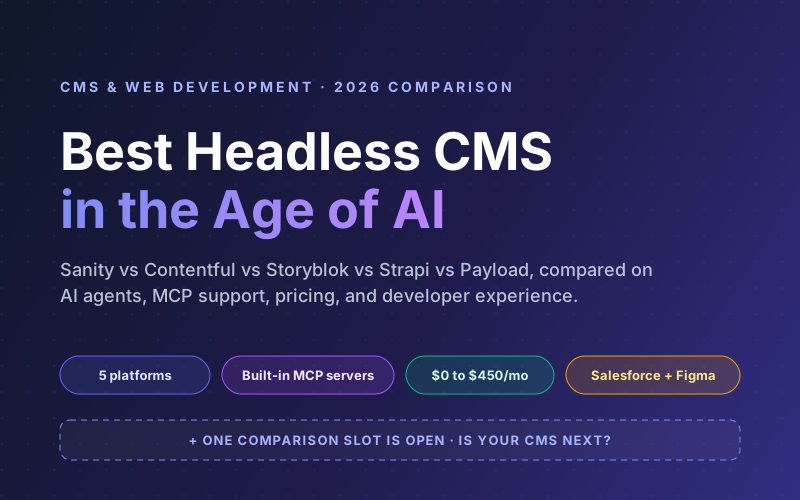
The headless CMS market stopped being about content modeling and APIs sometime in the last year. In 2026 the real question every team asks is simpler and sharper: can my CMS be driven by an AI agent? Can a model read my schema, draft an article, translate it, and publish it without a human clicking through five screens? The platforms that answered yes are pulling ahead fast.
The signals are everywhere. Sanity rebranded itself as a "Content Operating System for the AI era." Strapi and Payload shipped official MCP servers so coding agents can manage content directly. And in early June 2026, Salesforce signed a definitive agreement to acquire Contentful and wire it into Agentforce. Content infrastructure is now AI infrastructure.
This guide compares the five headless CMS platforms that matter most right now: Sanity, Contentful, Storyblok, Strapi, and Payload. We rank them on AI and agent support, MCP readiness, pricing, and developer experience, with real numbers verified against each vendor's pricing page in June 2026. And we left one slot in the comparison deliberately open. More on that at the end.
📣 Breaking: Salesforce is acquiring Contentful
In early June 2026, Salesforce signed a definitive agreement to acquire Contentful, positioning it as the content layer for Agentforce and Data 360. If you are evaluating Contentful today, read section 4 before you commit. Ownership changes can reshape pricing and roadmap.
📋 Table of Contents
- 1.The 2026 Headless CMS Landscape
- 2.How We Compared Them
- 3.Sanity: The Content Operating System
- 4.Contentful: Enterprise Content, Now Salesforce-Bound
- 5.Storyblok: Visual Editing Meets AI
- 6.Strapi: Open Source With a Built-In MCP Server
- 7.Payload: The Next.js-Native Backend
- 8.Feature & AI Capability Matrix
- 9.Pricing Compared: Real Numbers
- 10.Positioning Map: Which One Fits You
- 11.The Open Slot: Sponsor This Comparison
- 12.How Lushbinary Helps You Choose
1The 2026 Headless CMS Landscape
Headless CMS platforms separate content from presentation. You model content once, store it in a hosted or self-hosted backend, and deliver it over an API to any frontend: a Next.js site, a mobile app, a digital sign, or, increasingly, an AI agent. That decoupling is the whole point, and it is exactly what makes these platforms a natural fit for the agent era.
Three shifts define the 2026 market. First, AI moved from a bolt-on plugin to a native layer. Content drafting, translation, SEO optimization, and semantic search now ship inside the editor. Second, the Model Context Protocol (MCP) became the connective tissue between CMS backends and coding agents, so a model in your IDE can create and publish content with full schema awareness. Third, consolidation arrived: Figma acquired Payload in 2025, and Salesforce is acquiring Contentful in 2026.
The result is a market split along two axes that we will map at the end: managed versus self-hosted, and developer-first versus marketer-first. Every platform here makes a different bet.
2How We Compared Them
We evaluated each platform on five criteria that actually move the needle in 2026:
- AI and agent features: native content generation, translation, semantic search, and agentic actions.
- MCP readiness: whether agents can manage content through a Model Context Protocol server.
- Pricing transparency: published prices verified against the vendor's own pricing page in June 2026.
- Developer experience: schema definition, type safety, API ergonomics, and framework fit.
- Hosting model: managed SaaS versus self-hosted, and the cost and control trade-offs that follow.
All pricing in this article was checked against each vendor's official pricing page in June 2026. CMS pricing changes often, especially for AI usage and seats, so always confirm current numbers before you commit.
3Sanity: The Content Operating System
Sanity has leaned harder into the AI era than any other player. It now describes itself as a "Content Operating System for the AI era," and the product backs up the slogan. The platform ships a Content Agent, Agent Actions, Agent Context, and an MCP server that lets agents run GROQ queries, manage releases, and patch documents with full schema awareness.
For developers, Sanity's big differentiator is schema-as-code in TypeScript and the GROQ query language, plus a customizable React Studio. Content lives in a hosted, real-time Content Lake, which makes collaboration and live previews feel instant.
- AI and agents: Content Agent, Agent Actions, AI Assist, semantic search, and an official MCP server. AI credits cost $0.05 each, with 1,000 included per month on Free and Growth.
- Pricing: Free plan with up to 20 seats; Growth at $15 per seat per month with up to 50 seats; Enterprise is custom.
- Best for: developer-led teams that want the deepest structured-content tooling and agentic content operations.
- Watch out for: usage-based pricing (API CDN requests, bandwidth, AI credits) can climb as you scale, so model your usage before committing.
Sanity's free tier is unusually generous for teams: 20 seats, 1M API CDN requests per month, and Content Agent access included. For a developer-heavy startup, that often covers a real production launch.
4Contentful: Enterprise Content, Now Salesforce-Bound
Contentful is the enterprise standard-bearer of the headless world, and the news that defines it in 2026 is the definitive agreement for Salesforce to acquire it. Salesforce wants Contentful as the content layer for Agentforce and Data 360, so agents can assemble and deliver personalized digital experiences across channels.
On the product side, Contentful's AI story centers on AI Actions: editor-triggered operations that rewrite, translate, summarize, and optimize content for SEO using your content plus external context. It also has Contentful Studio for visual building and Personalization as add-ons on Premium.
- AI and agents: AI Actions (rewrite, translate, SEO, summarize), Studio, Personalization. Content Management API enables agent-driven workflows.
- Pricing: Free at $0 (10 users, 100K API calls/mo); Lite at $300 per month; Premium is custom and enterprise-priced.
- Best for: large organizations with complex governance, multi-brand content, and existing Salesforce investments.
- Watch out for: the jump from Free to Lite is steep at $300 per month, and the Salesforce acquisition introduces roadmap and pricing uncertainty.
⚠️ Acquisition watch
Acquisitions reshape products. If you adopt Contentful now, expect tighter Salesforce integration over time and budget for the possibility that pricing and packaging shift as it folds into the Customer 360 stack.
5Storyblok: Visual Editing Meets AI
Storyblok is the platform marketers actually enjoy using. Its signature feature is a real visual editor with a live preview panel where editors click directly on a page section and edit in context. Under the hood it is fully API-first and component-based, delivering content over REST and GraphQL.
On AI, Storyblok bundles AI credits into every plan and offers AI SEO on its enterprise tiers, alongside an automation product called FlowMotion for content workflows. The visual-first approach makes it a strong fit for teams where non-technical editors own day-to-day publishing.
- AI and agents: AI credits on every plan (25k on Starter up to 200k on Growth Plus), AI SEO on enterprise, and FlowMotion workflow automation.
- Pricing: Starter is free (1 seat); Growth is 99 euros per month (5 seats); Growth Plus is 349 euros per month (15 seats); Premium and Elite are custom.
- Best for: marketing teams that need visual, in-context editing without filing a ticket for every change.
- Watch out for: seats are capped per tier (max 2 on Starter, 10 on Growth), so growing teams move up plans quickly.
6Strapi: Open Source With a Built-In MCP Server
Strapi is the most popular open-source headless CMS, and Strapi 5 made it genuinely agent-ready. It includes a built-in MCP server that lets AI clients create, read, update, delete, publish, and unpublish content through the Content Manager, with every operation gated by admin token permissions. That permission model is exactly what production teams want before they hand an agent write access.
Strapi is MIT-licensed and free to self-host with no feature gating. Strapi Cloud is the managed option, and Strapi AI adds content assistance with a monthly credit allowance on the Growth tier.
- AI and agents: built-in MCP server with permission-scoped tokens, Strapi AI content features, and a Docs MCP server for IDE code suggestions.
- Pricing: self-hosted is free (MIT). Strapi Cloud runs Free, Essential at $18, Pro at $90, and Scale at $450 per project per month.
- Best for: developer teams that want open source, full control, and an MCP server out of the box.
- Watch out for: major version migrations have been painful historically (v4 to v5), so plan upgrades carefully.
7Payload: The Next.js-Native Backend
Payload is the headless CMS that installs directly into your Next.js app. Since Payload 3.0, it runs inside the App Router rather than as a separate service, giving you a full TypeScript backend, admin panel, authentication, and access control in one codebase. Figma acquired Payload in June 2025 and kept the MIT license intact, so it is completely free for projects of any size.
For AI, Payload offers an official open-source MCP plugin plus community AI plugins for content generation. Because it is just code in your Next.js project, wiring up custom AI workflows is straightforward for any TypeScript developer.
- AI and agents: official open-source MCP plugin, community AI content plugins, and full programmatic control via local APIs.
- Pricing: free and open source (MIT). You pay only for infrastructure; an enterprise tier adds SSO, audit logs, and workflows on request.
- Best for: Next.js teams that want their CMS and app in one TypeScript codebase with zero per-seat fees.
- Watch out for: self-hosting is the primary path, so you own infrastructure, scaling, and security from day one.
8Feature & AI Capability Matrix
Here is how the five platforms stack up on the criteria that matter most in the agent era.
| Capability | Sanity | Contentful | Storyblok | Strapi | Payload |
|---|---|---|---|---|---|
| Official MCP server | Yes | Via CMA | Via API | Yes | Yes (plugin) |
| Native AI authoring | Content Agent | AI Actions | AI credits | Strapi AI | Plugins |
| Agentic actions | Yes | Yes | FlowMotion | Partial | Custom |
| Visual editing | Yes | Studio | Best in class | Partial | Live preview |
| Hosting model | Managed | Managed | Managed | Self or Cloud | Self-hosted |
| License | Proprietary | Proprietary | Proprietary | MIT | MIT |
| Best frontend fit | Any (Next) | Any | Any | Any | Next.js |
9Pricing Compared: Real Numbers
Prices below were verified against each vendor's official pricing page in June 2026. Storyblok prices are listed in euros as published. Strapi Cloud is priced per project; Sanity is priced per seat.
| Platform | Free tier | Entry paid | Scale / mid | Enterprise |
|---|---|---|---|---|
| Sanity | Free (20 seats) | $15/seat/mo (Growth) | Pay-as-you-go usage | Custom |
| Contentful | Free (10 users) | $300/mo (Lite) | Premium (custom) | Custom |
| Storyblok | Free (1 seat) | 99 euros/mo (Growth) | 349 euros/mo (Growth Plus) | Custom |
| Strapi | Free self-host (MIT) | $18/mo (Cloud Essential) | $90-$450/mo (Cloud) | Custom |
| Payload | Free (MIT) | Infra cost only | Infra cost only | Custom (on request) |
The headline takeaway: open-source Payload and self-hosted Strapi have the flattest cost curve because you only pay for infrastructure. Sanity's per-seat model is predictable for small teams but adds usage-based charges at scale. Storyblok scales by seat tier, and Contentful has the steepest entry step at $300 per month for Lite.
10Positioning Map: Which One Fits You
The cleanest way to choose is to place each platform on two axes: managed versus self-hosted, and developer-first versus marketer-first.
Use the map as a starting point, not a verdict. Sanity and Strapi sit on the developer side; Storyblok and Contentful lean toward marketers. Payload anchors the self-hosted developer corner, while Contentful and Storyblok own the managed marketer space. Your team's skills and your hosting philosophy should drive the final call.
11The Open Slot: Sponsor This Comparison
We deliberately compared five platforms and left a sixth seat open. The headless CMS space is moving fast, and there are excellent platforms we did not cover in depth here: Hygraph, Prismic, Directus, Cosmic, Builder.io, Agility CMS, and emerging serverless options like Cloudflare's EmDash, among others.
If you build or represent a headless CMS and want it evaluated in this comparison, that slot is open. We will assess it on the same five criteria, with the same honesty, and add it to the matrix, pricing table, and positioning map. Sponsored placements are clearly labeled, and our evaluation stays independent: we will note the weaknesses as plainly as the strengths.
🪧 Want your CMS in the comparison?
Reach out through the form below. Tell us about your platform, its AI and MCP capabilities, and your pricing. If it is a fit for our readers, we will add it to this living comparison and keep it updated as the market shifts.
12How Lushbinary Helps You Choose
We have built production sites and content platforms on managed and self-hosted CMS stacks, and we wire AI agents into content workflows for clients every week. We do not push one platform. We help you pick the right tool for your team, budget, and roadmap, then build the integration, schema, and agent automation around it.
Whether you want a Next.js-native Payload backend, an agentic Sanity setup with MCP-driven publishing, or a Strapi instance your editors can run themselves, we can scope it, build it, and hand it over clean.
🚀 Free CMS Consultation
Not sure which headless CMS fits your project and AI ambitions? We'll review your requirements, recommend the right platform and architecture, and give you a realistic timeline with no obligation.
❓ Frequently Asked Questions
What is the best headless CMS for AI in 2026?
There is no single winner. Sanity leads on agentic content operations with its Content Agent, Agent Actions, and MCP server. Strapi and Payload are the strongest open-source picks with built-in MCP support. Storyblok wins for marketing teams that need visual editing plus AI credits, and Contentful is the enterprise standard now being acquired by Salesforce. The right choice depends on your team, budget, and hosting model.
Which headless CMS has a built-in MCP server?
Sanity and Strapi both ship official MCP servers that let AI agents query, create, update, and publish content directly. Payload offers an official open-source MCP plugin. Contentful exposes AI Actions and a Content Management API that agents can drive, and Storyblok provides AI credits and management APIs. MCP support is now a core buying criterion, not a nice-to-have.
How much does a headless CMS cost in 2026?
Costs range widely. Payload and self-hosted Strapi are free and open source (MIT), so you only pay for infrastructure. Sanity Growth is $15 per seat per month. Storyblok Growth is 99 euros per month and Growth Plus is 349 euros per month. Strapi Cloud runs from $18 to $450 per project per month. Contentful jumps from a free tier to $300 per month for Lite, then custom Premium pricing.
Is Contentful being acquired by Salesforce?
Yes. In early June 2026, Salesforce signed a definitive agreement to acquire Contentful. Salesforce plans to use Contentful as the content layer for its Agentforce and Data 360 platforms to assemble AI-driven digital experiences. The deal signals how central content infrastructure has become to enterprise AI strategy.
Should I choose an open-source or managed headless CMS?
Open-source options like Strapi and Payload give you full control, no per-seat fees, and no vendor lock-in, but you own the infrastructure and security. Managed platforms like Sanity, Storyblok, and Contentful handle hosting, scaling, and uptime for you, but pricing scales with seats, API calls, and AI usage. Pick open source for control and cost ceilings, managed for speed and lower operational burden.
📚 Sources
- Sanity Pricing and Sanity MCP Server docs
- Contentful Pricing and Salesforce acquisition announcement
- Storyblok Pricing
- Strapi Cloud Pricing and Strapi MCP Server docs
- Payload open-source announcement and Payload MCP plugin docs
Content was rephrased for compliance with licensing restrictions. Pricing and feature data sourced from official vendor pricing pages and announcements as of June 2026. Pricing and features may change - always verify on the vendor's website.
Pick the Right Headless CMS, Then Make It AI-Native
Tell us about your project. We'll recommend the right platform and build the agent and MCP integrations to match. CMS vendors: ask about the open comparison slot here too.
Ready to Build Something Great?
Get a free 30-minute strategy call. We'll map out your project, timeline, and tech stack - no strings attached.
Prefer email? Reach us directly: