
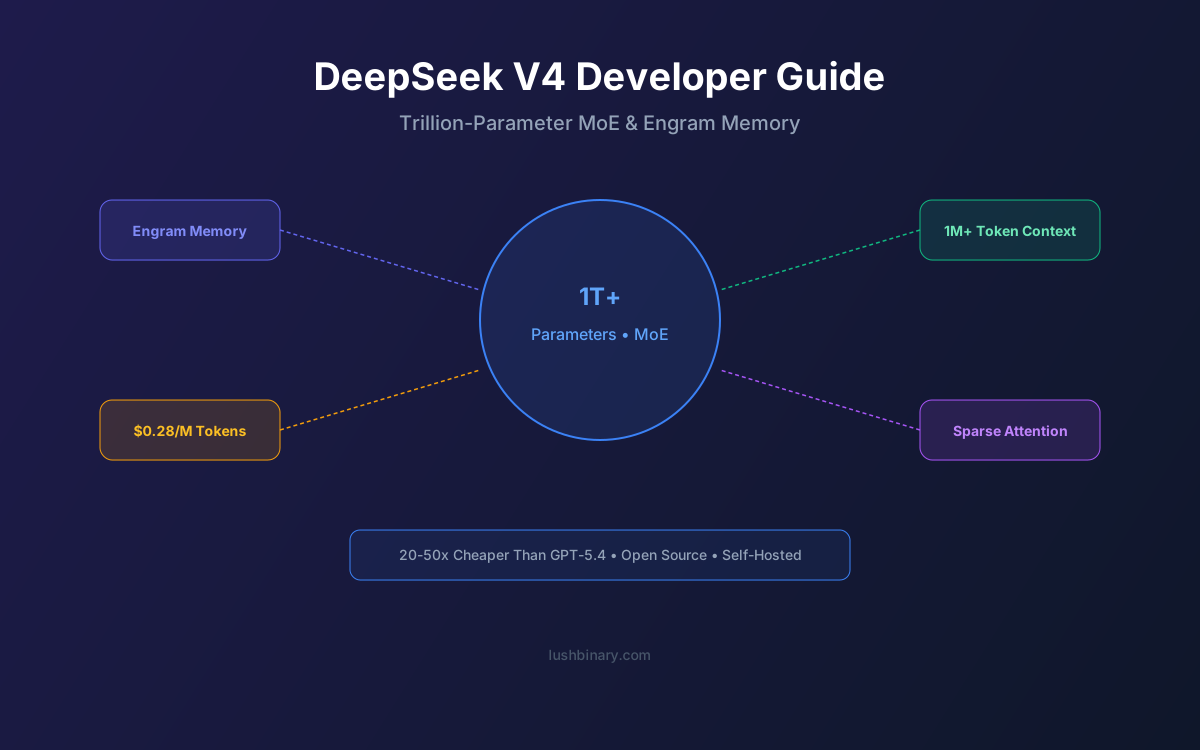
DeepSeek shipped the V4 preview series on April 23-24, 2026, with open weights under MIT license. V4-Pro is a 1.6 trillion parameter Mixture-of-Experts model with 49B active per token. V4-Flash is a leaner 284B total with 13B active. Both share a native 1M-token context window and pricing that undercuts Claude Opus 4.7 and GPT-5.5 by roughly 7-100x depending on the variant.
V4-Flash lists at $0.14/M input and $0.28/M output. V4-Pro at $1.74/M input and $3.48/M output. Both models also apply 50% off during Beijing off-peak hours and charge 10% of the cache-miss rate on cache hits.
This guide breaks down V4's architecture, benchmark results, API integration, pricing math, and how it stacks up against the other April 2026 frontier releases. If you're evaluating V4 for production, this is the reference.
What This Guide Covers
- Architecture: V4-Pro and V4-Flash MoE Design
- Hybrid CSA+HCA Attention & mHC
- Benchmark Results
- API Pricing & Cache Economics
- 1M Context Window & Off-Peak Discount
- Code Examples: Getting Started with the API
- V4-Pro vs GPT-5.5 vs Claude Opus 4.7
- Use Cases & Production Patterns
- Limitations & What to Watch
- Why Lushbinary for AI Integration
1Architecture: V4-Pro and V4-Flash MoE Design
DeepSeek V4 ships in two variants, both using a sparse Mixture-of-Experts (MoE) design:
- V4-Pro: 1.6 trillion total parameters with 49B activated per token.
- V4-Flash: 284 billion total parameters with 13B activated per token.
Both models were pre-trained on more than 32 trillion tokens and share the same architectural innovations. DeepSeek's technical report highlights three upgrades versus V3.2: hybrid CSA+HCA attention, Manifold-Constrained Hyper-Connections (mHC), and the Muon optimizer for training stability.
Key Architecture Stats
- V4-Pro: 1.6T total, 49B active. V4-Flash: 284B total, 13B active.
- 1M-token context window on both variants.
- V4-Pro at 1M context: 27% of V3.2's inference FLOPs, 10% of V3.2's KV cache.
- V4-Flash at 1M context: 10% of FLOPs, 7% of KV cache.
- MIT licensed weights on Hugging Face and ModelScope.
2Hybrid CSA+HCA Attention & mHC
Three architectural innovations distinguish V4 from prior DeepSeek models:
Hybrid CSA + HCA Attention
V4 combines Compressed Sparse Attention (CSA) and Heavily Compressed Attention (HCA). The hybrid design cuts both single-token FLOPs and KV cache dramatically at long context, which is what makes 1M-token inference viable at current API prices.
Manifold-Constrained Hyper-Connections (mHC)
mHC strengthens conventional residual connections by constraining signal propagation to a manifold. DeepSeek reports this improves stability across layers without sacrificing model expressivity.
Muon Optimizer
DeepSeek used the Muon optimizer for V4 training, replacing the AdamW-family optimizers used in prior generations. Faster convergence and better training stability are the reported benefits.
3Benchmark Results
DeepSeek published benchmark results for V4-Pro-Max and V4-Flash-Max (the maximum reasoning effort configuration) on the official model card. Here are the headline numbers against GPT-5.4 xHigh and Claude Opus 4.6 Max, the reported peers in the DeepSeek comparison table:
| Benchmark | V4-Pro Max | Opus 4.6 Max | GPT-5.4 xHigh |
|---|---|---|---|
| MMLU-Pro (EM) | 87.5 | 89.1 | 87.5 |
| LiveCodeBench (Pass@1) | 93.5 | 88.8 | - |
| Codeforces Rating | 3206 | - | 3168 |
| SWE-Verified | 80.6% | 80.8% | - |
| SWE-Pro | 55.4% | 57.3% | 57.7% |
| Terminal-Bench 2.0 | 67.9% | 65.4% | 75.1% |
| GPQA Diamond (Pass@1) | 90.1 | 91.3 | 93.0 |
| HLE (Pass@1) | 37.7 | 40.0 | 39.8 |
| MCPAtlas Public | 73.6 | 73.8 | 67.2 |
| MRCR 1M (MMR) | 83.5 | 92.9 | - |
Numbers sourced from the official DeepSeek V4-Pro model card on Hugging Face (April 2026). The released V4 comparison table uses Claude Opus 4.6 Max and GPT-5.4 xHigh as the reported peers. Opus 4.7 (April 16, 2026) and GPT-5.5 (April 23, 2026) shifted some of these comparisons; see our V4 vs Opus vs GPT guide for the head-to-head against the newer flagships.
4API Pricing & Cache Economics
DeepSeek's pricing is the disruptive feature. Standard rates (peak hours, per 1M tokens):
| Tier | V4-Flash | V4-Pro |
|---|---|---|
| Input (cache miss) | $0.14 | $1.74 |
| Input (cache hit) | $0.028 | $0.145 |
| Output | $0.28 | $3.48 |
| Off-peak discount | 50% | 50% |
Cost Comparison
Processing 1 billion output tokens per month: V4-Flash costs $280, V4-Pro costs $3,480. The same workload on Claude Opus 4.7 ($25/M output) costs $25,000. On GPT-5.5 ($30/M output) it costs $30,000. That puts V4-Flash roughly 90-107x cheaper than Opus 4.7 or GPT-5.5 on output, and V4-Pro roughly 7-9x cheaper.
51M Context Window & Off-Peak Discount
V4 defaults to a 1M-token context window on both variants with no surcharge. The hybrid CSA+HCA attention and lower KV cache footprint are what make this economically viable; previous generations would have required 10x the memory at 1M context.
Context caching is automatic: shared prompt prefixes (system instructions, tool definitions, document context) are cached at 10% of the cache-miss rate. If you send the same 100K-token system prompt on every request, you effectively pay for it once.
A 50% off-peak discount applies during Beijing nighttime (roughly 11pm-7am Beijing time). Batch-able workloads like overnight report generation or nightly analysis can halve their token bill by scheduling around this window.
6Code Examples: Getting Started with the API
DeepSeek exposes an OpenAI-compatible API, so the standard OpenAI SDKs work with just a base URL change:
import OpenAI from "openai";

const client = new OpenAI({
  baseURL: "https://api.deepseek.com",
  apiKey: process.env.DEEPSEEK_API_KEY,
});

// V4-Flash for high-volume, cost-sensitive workloads
const response = await client.chat.completions.create({
  model: "deepseek-v4-flash",
  messages: [
    { role: "system", content: "You are a senior engineer." },
    { role: "user", content: "Review this PR diff..." },
  ],
  max_tokens: 4096,
  temperature: 0.3,
});

// V4-Pro for complex reasoning, agentic coding, long-horizon tasks
const proResponse = await client.chat.completions.create({
  model: "deepseek-v4-pro",
  reasoning_effort: "high", // or "max" for deepest chain-of-thought
  messages: [
    { role: "user", content: "Refactor this codebase..." },
  ],
});

console.log(response.choices[0].message.content);7V4-Pro vs GPT-5.5 vs Claude Opus 4.7
The April 2026 frontier landscape: Claude Opus 4.7 shipped April 16, DeepSeek V4 on April 23-24, GPT-5.5 on April 23. Each model leads on a different axis.
| Factor | V4-Pro | Opus 4.7 | GPT-5.5 |
|---|---|---|---|
| Input $/M | $1.74 | $5.00 | $5.00 |
| Output $/M | $3.48 | $25.00 | $30.00 |
| Context | 1M | 1M | 1M |
| SWE-Pro | 55.4% | 64.3% | 58.6% |
| Open Weights | Yes (MIT) | No | No |
| Best For | Cost, competitive programming, self-hosting | Real-world software engineering | Agentic CLI & desktop automation |
8Use Cases & Production Patterns
V4 is the right choice when cost efficiency or long context is the primary driver:
- High-volume chat and summarization: V4-Flash at $0.28/M output makes conversational AI viable at scale.
- Batch code review: Process hundreds of PRs per day. Cache the system prompt once, pay 10% of input on subsequent requests.
- Long-document analysis: 1M context is the default. Ingest legal contracts, research bundles, or whole technical specs in one shot.
- RAG generation: Use V4-Flash as the generation model in RAG pipelines. At these prices, you can over-retrieve without blowing the budget.
- Competitive programming and algorithmic work: V4-Pro-Max leads LiveCodeBench (93.5) and Codeforces (3206).
- Self-hosted inference: MIT license plus open weights means you can deploy on your own infrastructure for data sovereignty and compliance.
- Codebase Q&A: Load a full repository into context for intelligent code search, refactoring suggestions, and explanations.
9Limitations & What to Watch
V4 is strong but has trade-offs worth noting:
- No native computer use: GPT-5.5 and Claude have computer use / desktop automation APIs. V4 does not.
- Real-world software engineering gap: On SWE-bench Pro, V4-Pro scores 55.4% vs Opus 4.7 at 64.3%. For multi-file production code changes, Opus still leads.
- Factual recall: V4-Pro scores 57.9 on SimpleQA-Verified vs Gemini 3.1 Pro at 75.6. Not the model to pick when precise factual knowledge is the main axis.
- Data routing: DeepSeek's hosted API is China-based. Regulated industries should self-host the open weights on their own cloud instead.
- Preview status: V4 shipped as a preview release. Expect behavior tweaks and potential model-id updates over the next few months.
10Why Lushbinary for AI Integration
Lushbinary designs, integrates, and deploys AI models into production systems. For DeepSeek V4 specifically, we build cost-optimized RAG pipelines, self-hosted vLLM deployments on AWS, and multi-model routing layers that send each request to the right model (V4-Flash, V4-Pro, Opus 4.7, or GPT-5.5) based on task complexity.
Teams typically see 40-60% cost reduction when they move from a single-model architecture to well-tuned multi-model routing without a measurable quality drop.
Free AI Architecture Consultation
Book a free call with our AI team. We'll review your workload, estimate costs across providers, and recommend the optimal architecture.
❓ Frequently Asked Questions
What is DeepSeek V4 and how big is it?
V4 is a preview MoE model family released April 23-24, 2026 under MIT license. V4-Pro has 1.6T total parameters and 49B active per token. V4-Flash has 284B total and 13B active. Both support 1M-token context.
How much does DeepSeek V4 API cost?
V4-Flash: $0.14/M input, $0.028/M input on cache hit, $0.28/M output. V4-Pro: $1.74/M input, $0.145/M input on cache hit, $3.48/M output. Both get 50% off during Beijing off-peak hours.
What attention architecture does V4 use?
Hybrid CSA+HCA (Compressed Sparse Attention plus Heavily Compressed Attention) with Manifold-Constrained Hyper-Connections. V4-Flash at 1M context uses only 7% of V3.2's KV cache.
How does V4 compare to Opus 4.7 and GPT-5.5?
V4-Pro leads competitive programming (LiveCodeBench 93.5, Codeforces 3206). Opus 4.7 leads real-world SWE-bench Pro (64.3% vs V4's 55.4%). GPT-5.5 leads Terminal-Bench 2.0. No single model dominates.
Can I self-host DeepSeek V4?
Yes. Both variants ship with open weights under MIT on Hugging Face. V4-Flash (158GB) fits on 2x H200 or 4x A100 80GB. V4-Pro (862GB) needs 8x H200 141GB (1,128GB) or two p5.48xlarge nodes.
📚 Sources
- DeepSeek V4-Pro Model Card on Hugging Face
- DeepSeek V4-Flash Model Card on Hugging Face
- DeepSeek API Pricing
Content was rephrased for compliance with licensing restrictions. Benchmark data sourced from the official DeepSeek V4 model cards on Hugging Face as of April 24, 2026. API pricing may change, always verify on the vendor's website.
Need Help Integrating DeepSeek V4?
Our team builds production AI pipelines with DeepSeek V4, Claude Opus 4.7, and GPT-5.5. Let us help you cut costs and ship faster.
Ready to Build Something Great?
Get a free 30-minute strategy call. We'll map out your project, timeline, and tech stack - no strings attached.
Prefer email? Reach us directly: