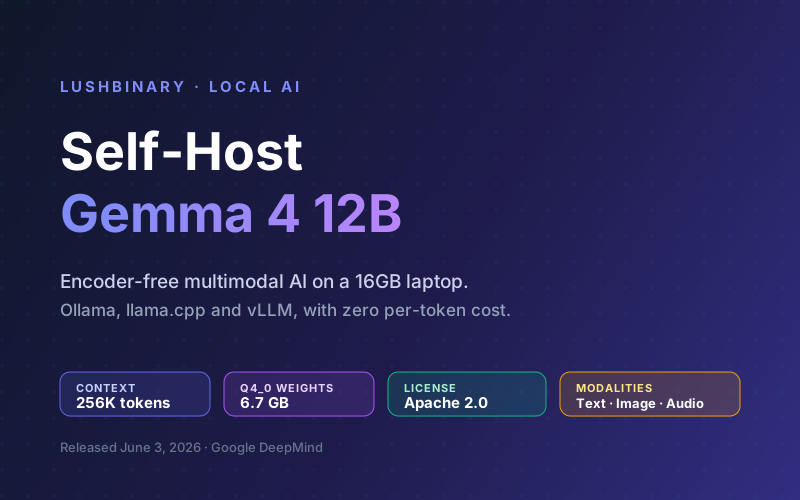

On June 3, 2026, Google DeepMind released Gemma 4 12B, the medium-sized member of the Gemma 4 family and arguably its most practically useful. It is a 12-billion-parameter multimodal model that takes text, images, and audio as input, runs on a laptop with 16 GB of memory, and ships under the Apache 2.0 license.
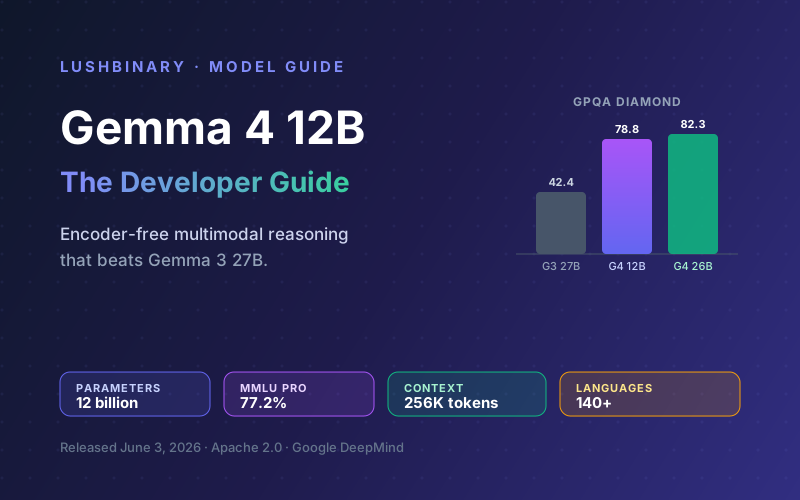
The headline number undersells the engineering. Gemma 4 12B is the first mid-sized Gemma to ditch separate multimodal encoders entirely and the first medium model in the family to natively ingest audio. The result is a small model that punches well above its weight: Google says it beats the older Gemma 3 27B across tests like GPQA Diamond, MMLU Pro, and DocVQA while nearly matching the twice-as-large 26B.
This guide breaks down the architecture, the benchmarks, the multimodal capabilities, and where Gemma 4 12B fits in a real stack, with every figure checked against Google's model card and release materials as of June 2026.
📑 What This Guide Covers
1What Gemma 4 12B Is
Gemma 4 is Google DeepMind's open-weight model family. The 12B is the mid-sized entry, slotting between the small edge variants (E2B, E4B) and the larger workstation models (26B A4B Mixture-of-Experts and 31B Dense). At a glance:
| Parameters | 12 billion |
| Inputs | Text, image, audio (output is text) |
| Context window | Up to 256K tokens |
| Languages | 140+ |
| License | Apache 2.0 |
| Released | June 3, 2026 |
| Local footprint | 26.7 GB BF16 / 13.4 GB SFP8 / 6.7 GB Q4_0 (weights) |
The pitch is simple: flagship-style multimodal reasoning that you can actually run on hardware you own, under a license that lets you ship it commercially.
2The Encoder-Free Architecture
The most important change in the 12B is architectural. Previous multimodal models, including earlier Gemma generations, attached a separate vision tower (a SigLIP-style encoder of roughly 550M parameters) and an audio encoder onto the language model. Those encoders had to finish processing an image or audio clip before the language model could begin.
Gemma 4 12B is the first unified Gemma: there is no separate vision or audio encoder. A small (~35M) embedder replaces the 550M vision encoder, and image patches and audio frames are projected directly into the language model, where the shared decoder processes everything together.
Why it matters in practice:
- Lower memory. Dropping the heavy encoders is part of how a 12B multimodal model fits a 16 GB machine.
- Lower latency. The decoder can start working on inputs earlier instead of blocking on a separate encoder pass.
- Simpler deployment. Fewer components to load and keep in sync, which is exactly what you want when self-hosting.
Google also released a dedicated multi-token prediction (MTP) model for Gemma 4 to enable speculative decoding, a technique that speeds up inference by predicting several tokens at once and verifying them, which helps local generation speed.
3Benchmarks: It Beats Gemma 3 27B
The story Google tells is that the 12B nearly matches the twice-as-large 26B A4B and clearly beats the previous-generation Gemma 3 27B on reasoning, science, and document tasks. Reported figures put Gemma 4 12B around 77.2% on MMLU Pro and 78.8% on GPQA Diamond, with DocVQA close to the 26B.
For context, here is the broader Gemma 4 family on the benchmarks Google publishes (the 31B is the family flagship; Gemma 3 27B is the previous generation):
| Benchmark | Gemma 4 31B | Gemma 3 27B |
|---|---|---|
| GPQA Diamond (science) | 84.3% | 42.4% |
| AIME 2026 (math, no tools) | 89.2% | 20.8% |
| LiveCodeBench v6 (coding) | 80.0% | 29.1% |
| τ2-bench (agentic tool use, Retail) | 86.4% | 6.6% |
⚠️ Read benchmarks carefully
The 31B and 26B figures above are the family's top scores, not the 12B's. The 12B lands below the 26B on coding-heavy tests like LiveCodeBench while staying close on reasoning and document tasks. The takeaway holds either way: the 12B is far stronger than Gemma 3 27B at a fraction of the size. Always validate on your own workload rather than trusting a single headline number.
The most striking jump across the family is agentic tool use. Gemma 3 27B scored just 6.6% on τ2-bench Retail; Gemma 4 31B scores 86.4%. That is the kind of step change that turns a model from "chat toy" into something you can build agents on, and it is why a local Gemma 4 model is now a credible agent backend. See our companion guide on running Hermes Agent with Gemma 4 12B.
4Multimodal: Text, Image & Audio
Gemma 4 12B accepts text, images, and audio, and is the first medium-sized model in the family capable of natively ingesting audio. That opens up local, private multimodal workflows that previously needed a hosted API:
- Document intelligence. Strong DocVQA performance makes it well suited to reading invoices, forms, and scanned documents.
- Image understanding. Describe, classify, and answer questions about images, including screenshots fed into an agent.
- Audio understanding. Process spoken input directly, useful for transcription-adjacent tasks, voice notes, and audio Q&A without a separate speech model.
- Long-context work. The 256K window handles large documents and multi-file context in one pass.
💡 Multimodal needs the projector
When self-hosting, image and audio input require the multimodal projector (the mmproj file) in addition to the language weights. Some early text-only builds shipped without it. Our self-hosting guide covers exactly how to wire it up.
5Where the 12B Sits in the Gemma 4 Family
Gemma 4 spans from phone-sized to workstation-class. The 12B is the "runs on my laptop and is genuinely capable" option:
| Variant | Best for | Rough memory |
|---|---|---|
| E2B / E4B | Phones, Raspberry Pi, small PCs | ~2-5 GB at 4-bit |
| 12B | Laptops and single consumer GPUs; native audio | 6.7 GB at Q4_0 (weights) |
| 26B A4B (MoE) | One consumer GPU; higher benchmarks | ~18 GB at 4-bit |
| 31B Dense | Workstation; family-best scores | ~24 GB+ at 4-bit |
Pick the 12B when you want one model that runs on a 16 GB laptop, does multimodal work including audio, and is strong enough for assistants, document tasks, and agents. Step up to the 26B or 31B when you have a bigger GPU and need the extra coding or reasoning headroom.
6Practical Use Cases
Private document processing
Extract and answer questions over invoices, contracts, and forms on-device, no documents sent to a third party.
Local coding assistant
Wire it into an IDE or terminal agent for code help that runs offline with no per-token cost.
On-device agents
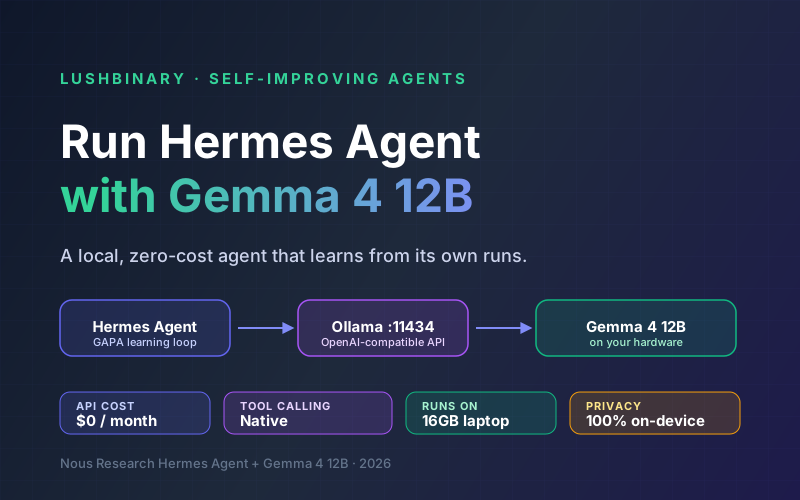
The agentic tool-use gains make it a credible backend for self-hosted agents like Hermes Agent.
Multimodal apps
Build features that read images and audio, from screenshot triage to voice-note summaries, all locally.
7Getting Started
Gemma 4 12B is available on Hugging Face, Kaggle, and Ollama under Apache 2.0. The quickest local start is Ollama:
# Pull and chat
ollama run gemma4:12b
For full deployment details, hardware sizing, quantization tradeoffs, llama.cpp and vLLM walkthroughs, and how to expose an OpenAI-compatible server, read our self-hosting Gemma 4 12B guide. To put it to work as an agent, see running Hermes Agent with Gemma 4 12B.
8Why Lushbinary
Choosing the right model is the easy part. Designing the system around it, the serving stack, multimodal pipelines, security, and a fallback plan, is where projects succeed or stall. Lushbinary builds AI products and infrastructure on open-weight models like Gemma 4, balancing cost, privacy, and performance for your use case.
- Model selection and benchmarking against your actual workload, not a leaderboard
- Self-hosted and hybrid deployments on AWS or on-prem with autoscaling and monitoring
- Multimodal document, image, and audio pipelines built on Gemma 4 and peers
- Agentic systems with tool calling, memory, and guardrails
🚀 Free Consultation
Evaluating Gemma 4 12B for your product? Lushbinary will benchmark it against your workload, recommend the right deployment, and design the architecture around it, with no obligation.
9Frequently Asked Questions
What is Gemma 4 12B?
A 12-billion-parameter open multimodal model from Google DeepMind, released June 3, 2026 under Apache 2.0. It takes text, image, and audio input, generates text, supports up to a 256K context and 140+ languages, and is built to run on a 16 GB laptop. It is the first medium-sized Gemma to natively ingest audio.
Is Gemma 4 12B better than Gemma 3 27B?
On Google's reported benchmarks, yes. Despite being less than half the size, it clearly beats Gemma 3 27B on GPQA Diamond, MMLU Pro, and DocVQA, and nearly matches the twice-as-large Gemma 4 26B A4B.
What does encoder-free mean?
It replaces the ~550M vision encoder with a ~35M embedder and removes the audio encoder, projecting image patches and audio frames directly into the shared decoder. That lowers memory, simplifies deployment, and lets the model start generating without waiting on encoders.
What are its benchmark scores?
Reported figures put the 12B around 77.2% on MMLU Pro and ~78.8% on GPQA Diamond, with DocVQA close to the 26B. The family flagship 31B reaches 89.2% AIME 2026, 80.0% LiveCodeBench v6, and 84.3% GPQA Diamond.
How do I run Gemma 4 12B?
It is on Hugging Face, Kaggle, and Ollama under Apache 2.0. Run it with Ollama ('ollama run gemma4:12b'), llama.cpp with a GGUF quant, or vLLM for serving. A 4-bit quant is 6.7 GB of weights and fits a 16 GB laptop or GPU with a working context.
Sources
- Introducing Gemma 4 12B (Google blog)
- Gemma 4 12B model card (Hugging Face)
- Gemma 4 family benchmarks (Google DeepMind)
- Gemma 4 model card (Google AI for Developers)
Content was rephrased for compliance with licensing restrictions. Benchmark figures, architecture details, and specifications sourced from official Google model cards and release posts as of June 5, 2026. The 12B-specific MMLU Pro and GPQA Diamond figures are from reported coverage of the launch; family benchmark numbers are from Google's published table. Numbers may change, always verify on the official model card.
Build on Gemma 4 With Lushbinary
From model selection to a production multimodal stack, we design and deploy AI products on open-weight models so you keep control of cost, privacy, and performance.
Ready to Build Something Great?
Get a free 30-minute strategy call. We'll map out your project, timeline, and tech stack - no strings attached.
Prefer email? Reach us directly: