
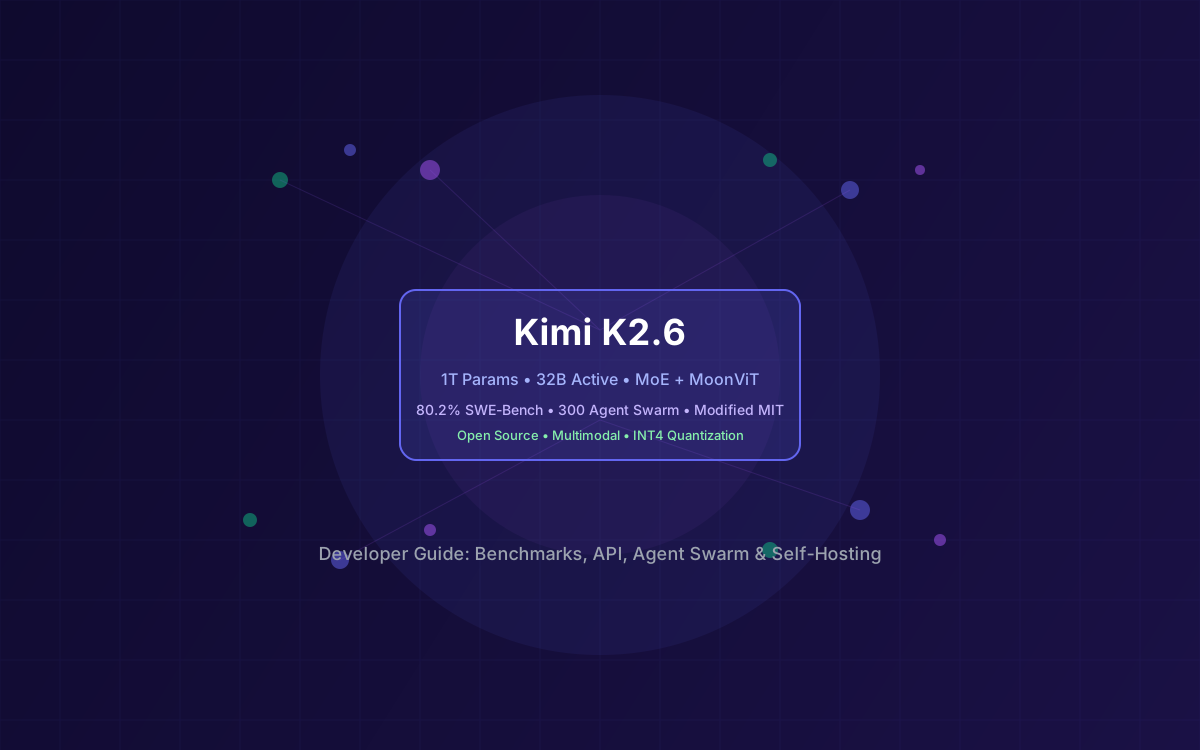
Moonshot AI has been on an aggressive release cadence since the original Kimi K2 landed in July 2025. K2 Thinking followed in November with 200-300 sequential tool calls. K2.5 added native vision in January 2026. Now, Kimi K2.6 arrives as the most capable open-source agentic model available — a native multimodal system that scales to 300 sub-agents, generates production-ready interfaces from prompts, and matches GPT-5.4 and Claude Opus 4.6 on the benchmarks that matter most for real-world coding.
The numbers speak for themselves: 80.2% on SWE-Bench Verified, 54.0% on Humanity's Last Exam with tools, 83.2% on BrowseComp, and an agent swarm that coordinates 4,000 steps across 300 parallel sub-agents. All of this under a Modified MIT License, deployable on your own infrastructure with native INT4 quantization.
This guide covers K2.6's architecture, benchmark results, API integration, self-hosting options, and practical patterns for building with it.
What This Guide Covers
- Architecture & Model Summary
- Key Features: What's New in K2.6
- Benchmark Results vs Frontier Models
- API Integration & Pricing
- Multimodal Capabilities: Vision & Video
- Thinking & Instant Modes
- Agent Swarm: 300 Sub-Agents at Scale
- Self-Hosting with vLLM, SGLang & KTransformers
- Kimi Code CLI: The Recommended Agent Framework
- Why Lushbinary for Your AI Integration
1Architecture & Model Summary
K2.6 inherits the Mixture-of-Experts (MoE) architecture from the K2 family. The core design activates only 32 billion of its 1 trillion total parameters per token, keeping inference costs manageable while maintaining frontier-level quality.
| Spec | Value |
|---|---|
| Architecture | Mixture-of-Experts (MoE) |
| Total Parameters | 1 Trillion |
| Activated Parameters | 32 Billion |
| Layers (incl. Dense) | 61 |
| Attention Heads | 64 |
| Experts / Selected per Token | 384 / 8 + 1 shared |
| Context Length | 256K tokens |
| Vocabulary Size | 160K |
| Attention Mechanism | Multi-head Latent Attention (MLA) |
| Activation Function | SwiGLU |
| Vision Encoder | MoonViT (400M params) |
| Quantization | Native INT4 (QAT) |
| License | Modified MIT |
The MLA attention mechanism reduces KV cache memory by compressing key-value pairs into a lower-dimensional latent space. Combined with SwiGLU activation and 384 routed experts (8 active + 1 shared per token), K2.6 achieves a strong balance between quality and throughput. The 400M-parameter MoonViT vision encoder, introduced in K2.5, enables native image and video understanding without external preprocessing.
2Key Features: What's New in K2.6
K2.6 introduces four major capability upgrades over K2.5:
🔧 Long-Horizon Coding
Significant improvements on complex, end-to-end coding tasks across Rust, Go, and Python. Generalizes robustly across front-end, DevOps, and performance optimization domains.
🎨 Coding-Driven Design
Transforms simple prompts and visual inputs into production-ready interfaces. Generates structured layouts, interactive elements, and rich animations with deliberate aesthetic precision.
🐝 Elevated Agent Swarm
Scales to 300 sub-agents executing 4,000 coordinated steps. Dynamically decomposes tasks into parallel, domain-specialized subtasks for end-to-end autonomous output.
🤖 Proactive Orchestration
Powers persistent, 24/7 background agents that proactively manage schedules, execute code, and orchestrate cross-platform operations without human oversight.
3Benchmark Results vs Frontier Models
K2.6 was evaluated with thinking mode enabled, temperature 1.0, top-p 1.0, and 262,144 token context. Here's how it stacks up against GPT-5.4 (xhigh), Claude Opus 4.6 (max effort), and Gemini 3.1 Pro (thinking high):
Agentic Benchmarks
| Benchmark | K2.6 | GPT-5.4 | Opus 4.6 | Gemini 3.1 |
|---|---|---|---|---|
| HLE-Full (w/ tools) | 54.0 | 52.1 | 53.0 | 51.4 |
| BrowseComp | 83.2 | 82.7 | 83.7 | 85.9 |
| BrowseComp (Swarm) | 86.3 | 78.4 | — | — |
| DeepSearchQA (f1) | 92.5 | 78.6 | 91.3 | 81.9 |
| OSWorld-Verified | 73.1 | 75.0 | 72.7 | — |
Coding Benchmarks
| Benchmark | K2.6 | GPT-5.4 | Opus 4.6 | Gemini 3.1 |
|---|---|---|---|---|
| SWE-Bench Verified | 80.2 | — | 80.8 | 80.6 |
| SWE-Bench Pro | 58.6 | 57.7 | 53.4 | 54.2 |
| Terminal-Bench 2.0 | 66.7 | 65.4 | 65.4 | 68.5 |
| LiveCodeBench (v6) | 89.6 | — | 88.8 | 91.7 |
| SWE-Bench Multilingual | 76.7 | — | 77.8 | 76.9 |
Reasoning & Vision
| Benchmark | K2.6 | GPT-5.4 | Opus 4.6 | Gemini 3.1 |
|---|---|---|---|---|
| AIME 2026 | 96.4 | 99.2 | 96.7 | 98.3 |
| GPQA-Diamond | 90.5 | 92.8 | 91.3 | 94.3 |
| MMMU-Pro | 79.4 | 81.2 | 73.9 | 83.0 |
| MathVision (w/ python) | 93.2 | 96.1 | 84.6 | 95.7 |
Key Takeaway
K2.6 leads on agentic benchmarks (HLE-Full, DeepSearchQA, BrowseComp Swarm) and SWE-Bench Pro, while trading blows with Claude Opus 4.6 on SWE-Bench Verified and trailing GPT-5.4 on pure math reasoning. For coding agent workloads, K2.6 is the strongest open-source option available.
4API Integration & Pricing
K2.6's API is available at platform.moonshot.ai with OpenAI and Anthropic-compatible endpoints. Here's a basic chat completion:
import openai

client = openai.OpenAI(
    api_key="YOUR_API_KEY",
    base_url="https://api.moonshot.ai/v1"
)

# Thinking mode (default)
response = client.chat.completions.create(
    model="kimi-k2.6",
    messages=[
        {"role": "system", "content": "You are Kimi, an AI assistant."},
        {"role": "user", "content": "Refactor this function for performance."}
    ],
    max_tokens=4096,
    temperature=1.0,
    top_p=0.95
)

# Access reasoning content
print(response.choices[0].message.reasoning)
print(response.choices[0].message.content)

# Instant mode (disable thinking)
response = client.chat.completions.create(
    model="kimi-k2.6",
    messages=[...],
    extra_body={"thinking": {"type": "disabled"}}
)
Pricing
| Model | Input (per M tokens) | Output (per M tokens) |
|---|---|---|
| Kimi K2.6 | ~$0.60 | ~$3.00 |
| Kimi K2.6 (cached) | ~$0.10-$0.15 | ~$3.00 |
| GPT-5.4 (comparison) | $2.50 | $15.00 |
| Claude Opus 4.6 (comparison) | $15.00 | $75.00 |
Automatic caching provides 75-83% savings on repeated prompts, making K2.6 exceptionally cost-effective for agentic workflows where system prompts and tool definitions are reused across many calls.
5Multimodal Capabilities: Vision & Video
K2.6 natively processes images and video through MoonViT, the 400M-parameter vision encoder introduced in K2.5. This enables agentic tasks that require visual understanding — replicating website journeys from screenshots, analyzing UI mockups, or processing video demonstrations.
import base64, requests

# Image input
image_b64 = base64.b64encode(
    requests.get("https://example.com/screenshot.png").content
).decode()

response = client.chat.completions.create(
    model="kimi-k2.6",
    messages=[{
        "role": "user",
        "content": [
            {"type": "text", "text": "Describe this UI and suggest improvements."},
            {"type": "image_url", "image_url": {
                "url": f"data:image/png;base64,{image_b64}"
            }}
        ]
    }],
    max_tokens=8192
)

# Video input (official API only)
video_b64 = base64.b64encode(
    requests.get("https://example.com/demo.mp4").content
).decode()

response = client.chat.completions.create(
    model="kimi-k2.6",
    messages=[{
        "role": "user",
        "content": [
            {"type": "text", "text": "Describe the user journey in this video."},
            {"type": "video_url", "video_url": {
                "url": f"data:video/mp4;base64,{video_b64}"
            }}
        ]
    }]
)
⚠️ Note
Video input is currently an experimental feature and is only supported through the official Moonshot API. Third-party deployments via vLLM or SGLang support image input but not video at this time.
6Thinking & Instant Modes
K2.6 supports two inference modes. Thinking mode (default) exposes the model's reasoning chain via a reasoning field, ideal for complex coding and multi-step tasks. Instant mode disables reasoning for faster, cheaper responses on straightforward queries.
K2.6 also supports preserve_thinking mode, which retains full reasoning content across multi-turn interactions. This is particularly valuable for coding agent scenarios where the model needs to reference its prior reasoning:
# Enable preserve_thinking for multi-turn agent loops
response = client.chat.completions.create(
    model="kimi-k2.6",
    messages=[
        {"role": "user", "content": "List three approaches to fix this bug."},
        {
            "role": "assistant",
            "reasoning_content": "I see five possible approaches...",
            "content": "Here are three approaches: ..."
        },
        {"role": "user", "content": "What were the other two?"}
    ],
    extra_body={"thinking": {"type": "enabled", "keep": "all"}}
)7Agent Swarm: 300 Sub-Agents at Scale
The headline feature of K2.6 is its elevated agent swarm capability. Where K2.5 supported up to 100 parallel sub-agents, K2.6 scales to 300 sub-agents executing 4,000 coordinated steps in a single autonomous run.
The swarm dynamically decomposes complex tasks into parallel, domain-specialized subtasks. A single prompt can produce end-to-end outputs spanning documents, websites, spreadsheets, and code repositories. The BrowseComp (Agent Swarm) benchmark demonstrates this: K2.6 scores 86.3% vs GPT-5.4's 78.4%, a 7.9-point lead that reflects the model's ability to coordinate many agents effectively.
Practical use cases include: batch refactoring across a large codebase, generating a complete marketing site from a brief, producing multi-format documentation (PDF, HTML, slides) from a single source, and running parallel research tasks that synthesize into a unified report.
8Self-Hosting with vLLM, SGLang & KTransformers
K2.6 shares the same architecture as K2.5, so existing deployment configurations can be reused directly. The model requires transformers >=4.57.1, <5.0.0 and supports three inference engines:
- vLLM — Production-grade serving with tensor parallelism, continuous batching, and PagedAttention. Best for high-throughput API deployments.
- SGLang — Optimized for structured generation and multi-turn conversations. Strong choice for agent frameworks that need constrained output.
- KTransformers — Moonshot's own inference engine, optimized specifically for the K2 architecture. Supports native INT4 quantization out of the box.
Native INT4 quantization via Quantization-Aware Training (QAT) delivers 2x faster inference with 50% reduced GPU memory compared to FP16. The INT4 model is available as a ~594GB download on Hugging Face at moonshotai/Kimi-K2.6.
# Recommended temperatures
# Thinking mode: temperature=1.0, top_p=0.95
# Instant mode: temperature=0.6, top_p=0.95

# For vLLM/SGLang, use chat_template_kwargs for mode switching:
# Instant mode:
extra_body={"chat_template_kwargs": {"thinking": False}}

# Preserve thinking mode:
extra_body={"chat_template_kwargs": {
    "thinking": True, "preserve_thinking": True
}}9Kimi Code CLI: The Recommended Agent Framework
Moonshot AI recommends Kimi Code CLI as the primary agent framework for K2.6. It's an open-source terminal-based coding agent that competes directly with Claude Code and Aider, with native support for K2.6's thinking modes, tool calling, and multi-step workflows.
K2.6 also supports interleaved thinking and multi-step tool calls, following the same design as K2 Thinking. This means the model can reason, call a tool, reason about the result, call another tool, and continue this loop autonomously — critical for complex coding tasks that require iterative debugging and testing.
For verification, Moonshot provides the Kimi Vendor Verifier to confirm that third-party deployments are producing correct outputs.
10Why Lushbinary for Your AI Integration
Integrating a model like K2.6 into production requires more than API calls. You need model routing strategies (K2.6 for complex agentic tasks, lighter models for simple queries), cost optimization with caching, proper error handling for 300-agent swarm workflows, and infrastructure that scales. Lushbinary specializes in exactly this kind of AI engineering.
We've built AI-powered products ranging from real-time auction platforms to self-improving AI agent deployments. Whether you need K2.6 integrated into an existing product, a custom agent swarm architecture, or a full AI-powered MVP, we can scope it, build it, and ship it.
🚀 Free Consultation
Want to integrate Kimi K2.6 into your product or build an agent swarm? Lushbinary specializes in AI-powered applications with frontier models. We'll scope your project, recommend the right architecture, and give you a realistic timeline — no obligation.
❓ Frequently Asked Questions
What is Kimi K2.6 and when was it released?
Kimi K2.6 is Moonshot AI's latest open-source multimodal agentic model, released in April 2026. It builds on the K2 family with 1 trillion total parameters (32B active) and adds native multimodal capabilities, 300-agent swarm orchestration, and coding-driven design features.
How does Kimi K2.6 compare to GPT-5.4 and Claude Opus 4.6?
K2.6 scores 80.2% on SWE-Bench Verified (vs 80.8% Claude Opus 4.6), 54.0% on HLE-Full with tools (vs 52.1% GPT-5.4), and 83.2% on BrowseComp (vs 82.7% GPT-5.4). It matches or exceeds frontier proprietary models on most agentic benchmarks while being fully open-source.
What is Kimi K2.6's Agent Swarm capability?
K2.6 can scale horizontally to 300 sub-agents executing 4,000 coordinated steps. It dynamically decomposes tasks into parallel, domain-specialized subtasks, delivering end-to-end outputs in a single autonomous run.
How much does Kimi K2.6 API access cost?
API pricing starts at approximately $0.60 per million input tokens and $2.50-$3.00 per million output tokens, with automatic caching providing 75-83% savings. This is 4-17x cheaper than GPT-5.4.
Can I self-host Kimi K2.6?
Yes. K2.6 is released under the Modified MIT License and supports deployment via vLLM, SGLang, and KTransformers with native INT4 quantization for 2x faster inference.
Sources
Content was rephrased for compliance with licensing restrictions. Benchmark data sourced from official Moonshot AI model card as of April 2026. Pricing may change — always verify on the vendor's website.
Build With Kimi K2.6
From agent swarm architectures to production API integrations, Lushbinary helps you ship AI-powered products with frontier open-source models.
Ready to Build Something Great?
Get a free 30-minute strategy call. We'll map out your project, timeline, and tech stack - no strings attached.
Prefer email? Reach us directly: