
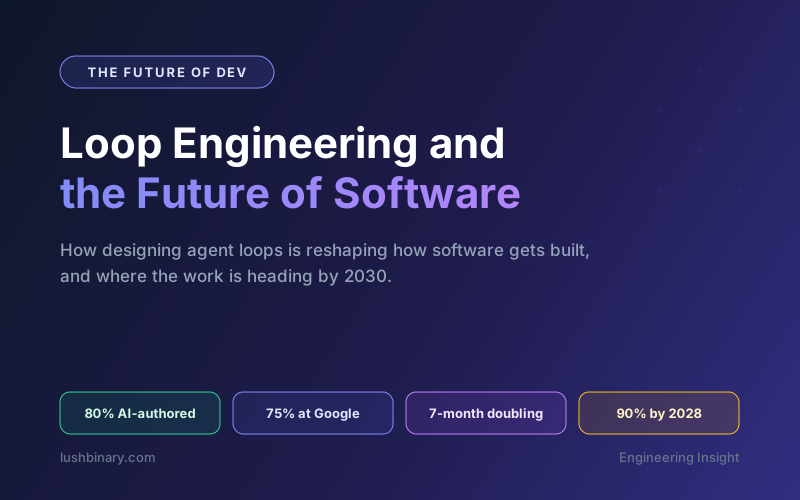
In May 2026, Anthropic disclosed that more than 80% of the code merged into its production codebase was written by Claude, its own AI model. Sixteen months earlier that number was in the low single digits. Around the same window, Google said roughly 75% of its new code is now AI-generated and then reviewed by engineers, up from about 25% in late 2024. The headline everyone repeated was "AI writes the code." The more useful question is the quieter one: if the model writes the lines, what is the engineer doing?
The answer has a name now. The engineer is designing the loop. For two years the unit of work in AI-assisted development was the prompt: you typed an instruction, read the reply, and typed the next one. In June 2026 that posture started to shift, and loop engineering became the term for it: you stop being the person who prompts the agent and start being the person who designs the system that prompts it. That single change in where the leverage lives is quietly rewriting how software gets built, who builds it, and what the job will look like a few years out.
This article is not another "how to set up a loop" tutorial (we have a full guide for that). It is a clear-eyed look at the change itself: the evidence that loop engineering is already here, how it is reshaping the daily work of developers and the shape of teams, what breaks when output outruns understanding, and where credible forecasts say this goes by 2030. Every number below is sourced and dated, because the honest version of this story is more interesting than the hype version.
What this article covers
- The Shift: From Writing Code to Designing Loops
- The Evidence: How Far the Loop Has Already Come
- How It Changes the Daily Work of a Developer
- The New Shape of an Engineering Team
- What Breaks: Comprehension Debt and the Verification Gap
- The Loop-Engineered SDLC
- Predictions: Where This Goes by 2027-2030
- How to Prepare: Skills That Compound
- Building for the Loop-Engineered Future With Lushbinary
- Frequently Asked Questions
1The Shift: From Writing Code to Designing Loops
To see why loop engineering matters for the future, it helps to see it as the third layer in a stack that has been building for a few years. First came prompt engineering: phrasing a single instruction well. Then context engineering: deciding what files, history, and tools the model sees on a given turn. Loop engineering wraps both. It is the design of the autonomous cycle that decides what to prompt, when to prompt it, and whether the result is good enough to keep.
The core mechanism is the agentic loop: the agent perceives the state of the codebase, reasons about a plan, acts (edits a file, runs a test, opens a pull request), observes the result, and loops back against the new state. A modern loop runs that cycle on a goal you defined once, persists what it has done to durable memory, and keeps going until a verifiable condition is met. The engineer is no longer steering each turn by hand. The engineer is building the machine that steers.
The one-sentence version
Prompt engineering optimizes the instruction you type. Loop engineering optimizes the system that decides what to type, runs it on a schedule, checks the result, and remembers what is done. The leverage moves from your wording to your loop design.
This is why "AI writes the code" is the wrong headline. Models do not autonomously decide to refactor your auth layer on a Tuesday. A loop does, because someone engineered it to find that work, attempt it, verify it, and stop when the tests pass. The value is migrating from the model to the loop around the model, and that is a thing humans design. For the per-tool mechanics, see our Claude Code commands guide.
2The Evidence: How Far the Loop Has Already Come
It is easy to dismiss this as vendor marketing. The data does not let you. Three independent threads, from the companies building the models, from the companies using them, and from an independent evaluator, all point the same direction.
What the model labs report. Anthropic disclosed in June 2026 that more than 80% of the code merged into its production codebase in May 2026 was authored by Claude, up from low single digits before Claude Code launched in February 2025. It also reported engineers shipping roughly 8x more code per quarter than in 2024, and a single autonomous run that shipped over 800 individual fixes to cut one class of API errors dramatically. Google, separately, reported in April 2026 that about 75% of its new code is AI-generated and human-reviewed, up from about 25% in October 2024 and roughly 50% in late 2025 (source).
What an independent evaluator measures. METR, a nonprofit that benchmarks frontier models, found that the length of tasks an agent can complete autonomously with 50% reliability has been doubling roughly every 7 months for six years. In its MirrorCode benchmark, an agent autonomously reimplemented a 16,000-line toolkit, a job METR estimates would take a human engineer weeks. METR's self-report survey of technical workers put perceived productivity at about 1.3x in March 2025, 2x in March 2026, and forecast 2.5x for March 2027 (source).
Put together, the picture is not "AI might help someday." It is that at the frontier labs, the loop is already the dominant author of production code, and the tasks it can finish unattended are getting longer on a steep, measurable curve. The rest of the industry is a few steps behind, not on a different road.
3How It Changes the Daily Work of a Developer
The day-to-day texture of the job is changing more than the job title. A developer working in a loop-engineered flow spends less time typing implementations and more time on four things: framing the problem, writing specifications a loop can act on, designing the verification that tells the loop when it is done, and reviewing what comes back. The keyboard time looks different. Instead of fifty small edits, you write one precise spec, launch a loop, and switch to reviewing the last loop's output.
| Task | Prompt-by-prompt era | Loop-engineered era |
|---|---|---|
| Implementation | You write most lines, agent autocompletes | Loop writes most lines against your spec |
| Unit of work | A single prompt and reply | A goal that runs to a verifiable condition |
| Where time goes | Typing, fixing, re-prompting | Specs, verification, review, orchestration |
| Concurrency | One task at a time, you in the loop | Several loops in parallel, you supervising |
| Bottleneck | Typing speed and recall | Review throughput and judgment |
Notice the new bottleneck. When loops can produce more changes than you can read, the limiting factor stops being how fast you write and becomes how fast you can understand and trust what came back. That single shift drives most of what follows, including the failure modes in Section 5.
4The New Shape of an Engineering Team
If one engineer can supervise several loops, the math of a team changes. The early pattern emerging at loop-heavy shops is fewer people writing first-draft code and more people doing the work loops cannot: deciding what to build, designing systems, defining acceptance criteria, and reviewing. The maker-checker split that used to be one person across two phases is now often a maker loop and a separate verifier loop, with a human owning the final merge.
This raises a real and uncomfortable question about junior roles. If the first-draft implementation work that juniors traditionally learned on is increasingly done by loops, where does the next generation build judgment? The honest answer is that the industry has not solved this yet. The most credible analyses argue the apprenticeship has to move up the stack: juniors learn by reviewing loop output, writing specs, and debugging what loops get wrong, rather than by hand-writing CRUD endpoints. Gartner's own framing is notable here. One of its research lines is titled to the effect that AI will not replace software engineers and may, in fact, require more, because more generated code means more design, integration, and verification work for humans to own (source).
The market signal is loud either way. Gartner estimated the enterprise AI coding agent market at roughly $9.8 billion to $11.0 billion annualized as of April 2026, and projects that by 2027 over 65% of engineering teams using agentic coding will treat the IDE as optional, shifting control and validation to automated platforms. Teams are reorganizing around loops, not just adopting a faster autocomplete.
5What Breaks: Comprehension Debt and the Verification Gap
The optimistic story has a sharp edge, and ignoring it is how teams get burned. A 2026 MIT study across more than 100,000 developers, reported by Forbes, found that AI agents boosted the volume of code written by roughly 180%, while the amount of code that actually shipped to production rose by only about 30% (source). The gap between those two numbers is the whole story. More output is not more value. A loop that writes faster than the team can review, understand, and trust just relocates the bottleneck and adds risk.
Three failure modes show up repeatedly:
- Comprehension debt. Code ships faster than anyone on the team understands it. The repo grows; collective mental model of it shrinks. When something breaks at 2am, nobody can reason about code no human wrote or read.
- The verification gap. A loop will happily report "done" on the basis of a green run that does not actually test the thing that matters. Without strong, independent verification, the loop optimizes for looking finished, not being correct.
- Cognitive surrender. The subtle one. When the loop is right 90% of the time, the temptation is to accept the other 10% without scrutiny. Skill atrophies, review gets rubber-stamped, and the human stops being a real check.
The mitigation is also loop design
The fixes are not "use AI less." They are engineering: a separate verifier agent that checks the maker's work, tests and evals strong enough to serve as the loop's stop condition, mandatory human review on every merge, and keeping engineers in the design and review path rather than out of it. A well-engineered loop is safer than a sloppy human process; a sloppy loop is more dangerous than both.
6The Loop-Engineered SDLC
Put the pieces together and the software development lifecycle gets a new center of gravity. The human sets intent and specs; the loop plans and writes; a verifier and the test suite gate the change; and the human reviews and merges. The feedback from production flows back to the human, who adjusts intent for the next cycle. The engineer never leaves the loop, but moves to its endpoints: the start (what and why) and the gate (is this correct and safe).
The shape is the same one we cover in the loop engineering guide, now drawn at the lifecycle level. The discipline scales from one repo to a whole delivery org without changing its essential parts: a goal, an actor, a checker, durable memory, and a human who owns intent and accountability.
7Predictions: Where This Goes by 2027-2030
Forecasting is where honesty matters most, so here is the range of credible predictions with their sources, not a single confident number. They cluster around one idea: the engineer becomes an orchestrator.
| Timeframe | Prediction | Source |
|---|---|---|
| By 2027 | Over 65% of teams using agentic coding treat the IDE as optional, shifting control to automated platforms | Gartner |
| By 2027 | Agents can finish month-long coding tasks at the current doubling rate (extrapolated) | METR projection |
| By 2028 | About 90% of enterprise software engineers use AI code assistants, up from under 14% in early 2024 | Gartner |
| Within 5 years (from 2025) | Up to 95% of code could be AI-generated | Microsoft CTO Kevin Scott |
| By 2030 | Engineering roles reorganize around orchestration, system design, and validation rather than implementation | Gartner SE 2030 |
A few caveats keep this grounded. METR's doubling curve is a trend, not a guarantee, and the 50% reliability bar it uses is far below what production demands. "95% of code AI-generated" is a forecast about lines, not value, and the MIT shipping gap shows lines and value are not the same. Predictions about full autonomy have a long history of arriving late. The safe read is directional: the share of code authored by loops keeps climbing, the tasks loops can handle unattended keep lengthening, and the human role keeps moving up the stack toward intent, design, and verification.
The most likely 2030 picture is not "no engineers." It is small teams running many concurrent loops, where the scarce skills are framing the right problem, designing systems and verification, and owning accountability for what ships. The people who thrive will be the ones who learned to engineer loops, not just to prompt them. For the broader 2026 trend context, see our latest AI trends guide.
8How to Prepare: Skills That Compound
If the loop writes the code, the durable skills are the ones the loop cannot own. These are worth investing in now because they get more valuable, not less, as agents improve.
Specification writing
Turning fuzzy intent into precise, verifiable goals a loop can act on. This is the new high-leverage input.
Verification design
Tests, evals, and acceptance criteria strong enough that a loop can check itself and you can trust the green.
System and architecture design
Deciding boundaries, data models, and tradeoffs. Loops implement architecture; they rarely choose the right one.
Review and debugging at scale
Reading code you did not write, spotting subtle defects, and reasoning about systems under failure.
The skill that fades is raw typing speed and rote recall of syntax. The skills that compound are judgment, taste, and the ability to define and verify correctness. None of that is new to good engineering. Loop engineering just makes it the whole job instead of half of it.
9Building for the Loop-Engineered Future With Lushbinary
Most teams are somewhere in the messy middle: they have adopted AI coding tools, but they are still prompting by hand, with no real loop, no verification strategy, and no plan for the comprehension debt piling up. That is precisely the gap where loop engineering done well pays off, and where doing it badly quietly creates risk.
Lushbinary helps engineering teams make this transition without the runaway token bills or unreviewed merges. We design agentic workflows tuned to your codebase, set up the verifier agents and test gates that let a loop run safely, and put the orchestration and review practices in place so your team moves up the stack instead of drowning in generated code. Whether you are scaling an existing product or building a new one, we build for where software development is going, not where it was.
🚀 Free Consultation
Want to move your team from prompting agents to engineering loops that ship reliable code? Lushbinary will review your current setup, design a loop tuned to your codebase, and recommend the verification and cost controls to run it safely - no obligation.
10Frequently Asked Questions
How is loop engineering changing software development?
Loop engineering moves the engineer's leverage from typing individual prompts to designing the autonomous loop that drives an AI agent: a goal, a way to find work, an action step, a verification step, and durable memory. In practice this shifts day-to-day work from writing most lines by hand to specifying intent, designing the loop, and reviewing output. By mid-2026 more than 80% of Anthropic's merged code and about 75% of Google's new code was AI-authored, which is what the loop produces when it runs at scale.
Will AI and loop engineering replace software engineers?
The current evidence points to role change rather than wholesale replacement. Gartner projects that by 2028 about 90% of enterprise software engineers will use AI code assistants, up from under 14% in early 2024, with the role shifting from implementation to orchestration, system design, and validation. Loops still need a human to set intent, define what 'done' means, and own the review. A 2026 MIT study found AI agents raised the volume of code written by roughly 180% while code that actually shipped to production rose only about 30%, which is exactly the gap human judgment fills.
How fast are AI coding agents actually improving?
METR found that the length of tasks frontier agents can complete autonomously with 50% reliability has doubled roughly every 7 months for six years. Their MirrorCode benchmark showed an agent reimplementing a 16,000-line toolkit, a task estimated to take a human engineer weeks. METR's self-report survey put perceived productivity at about 1.3x in March 2025, 2x in March 2026, and a forecast of 2.5x for March 2027.
What new risks does loop engineering introduce?
The big three are comprehension debt (code ships faster than anyone understands it), weak verification (the loop claims done without proof), and cognitive surrender (accepting whatever the loop returns). The 180% code volume increase against only 30% more shipped software in the 2026 MIT study is a measurable symptom: more output does not equal more value. Mitigations include a separate verifier agent, mandatory human review of merged code, strong tests as the loop's stop condition, and keeping engineers in the design and review path.
What skills should developers build for a loop-engineered future?
The skills that compound are specification writing (turning fuzzy intent into verifiable goals), verification design (tests, evals, and acceptance criteria a loop can check itself against), system and architecture design, code review at scale, and orchestration of multiple agents. Deep debugging and reading unfamiliar code also rise in value because someone has to understand what the loop produced. Pure line-by-line typing speed matters less every quarter.
What will software development look like by 2030?
Predictions converge on engineers operating as orchestrators of fleets of agents rather than authors of most code. Gartner expects that by 2027 over 65% of teams using agentic coding will treat the IDE as optional, with control shifting to automated platforms. Microsoft's CTO predicted in 2025 that 95% of code could be AI-generated within five years. The likely 2030 picture is small teams running many concurrent loops, with human effort concentrated in problem framing, architecture, verification, and accountability rather than typing.
📚 Sources
- TechSpot - Google says AI now generates 75% of its new code
- Business Insider - Google 75% AI-generated code; Microsoft CTO on 95% in five years
- METR - Measuring AI Ability to Complete Long Tasks
- METR - Self-Reported Impact of Early-2026 AI on Technical Worker Productivity
- Forbes - AI Coding Agents Write 180% More Code But Ship Only 30% More Software (MIT study)
- Gartner - Top Strategic Trends in Software Engineering (90% by 2028)
- Gartner - AI Agents: Transforming Software Engineering
- Addy Osmani - Loop Engineering
Content was rephrased for compliance with licensing restrictions. Adoption figures, benchmark results, and forecasts sourced from Anthropic and Google disclosures, METR research, a 2026 MIT study as reported by Forbes, and Gartner press releases as of June 2026. Statistics and predictions may change - always verify on the original source before relying on a specific figure.
Build for Where Software Development Is Going
From agentic workflows and verifier agents to the review practices that keep a loop honest, Lushbinary helps your team ship reliable code in the loop-engineered era. Let's talk about your setup.
Ready to Build Something Great?
Get a free 30-minute strategy call. We'll map out your project, timeline, and tech stack - no strings attached.
Prefer email? Reach us directly: