
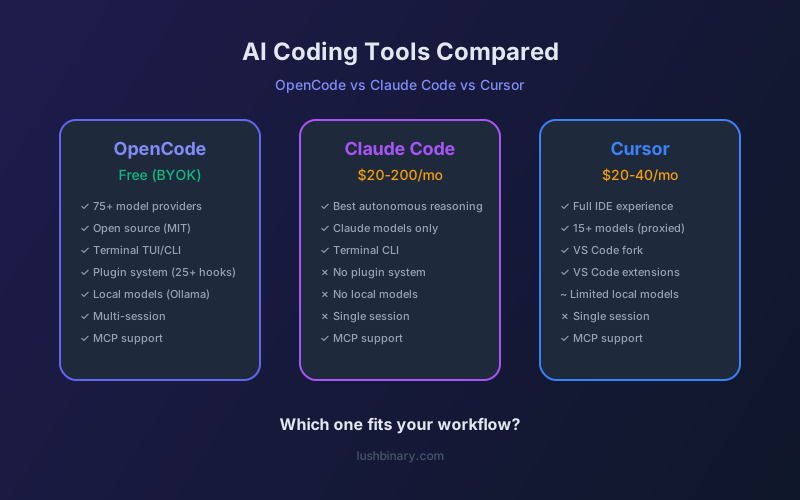
The AI coding tool landscape in 2026 has three clear frontrunners: OpenCode (free, open-source, 75+ models), Claude Code ($20/mo, Anthropic-exclusive), and Cursor ($20/mo, IDE-native). Each takes a fundamentally different approach - and the right choice depends on how you work, not which tool is "best."
OpenCode gives you a terminal-native agent with total model freedom. Claude Code delivers polished Anthropic-powered autonomy. Cursor wraps AI into a full IDE experience. This guide breaks down the trade-offs across pricing, model flexibility, edit reliability, and real-world workflows.
We've used all three extensively at Lushbinary across client projects. Here's what actually matters when choosing.
📑 What This Guide Covers
- Quick Comparison Table
- Pricing & Cost Analysis
- Model Flexibility & Provider Support
- Interface & Workflow
- Edit Reliability & Code Quality
- Extensibility: MCP, Plugins & Tools
- Privacy & Data Handling
- Best Tool by Use Case
- Can You Use All Three?
- Lushbinary's Recommendation
1Quick Comparison Table
| Feature | OpenCode | Claude Code | Cursor |
|---|---|---|---|
| Price | Free (BYOK) | $20/mo (Pro) | $20/mo (Pro) |
| Models | 75+ providers | Claude only | 15+ models |
| Interface | Terminal TUI/CLI | Terminal CLI | Full IDE (VS Code fork) |
| Open Source | Yes (MIT) | No | No |
| MCP Support | Yes | Yes | Yes |
| Local Models | Yes (Ollama) | No | Limited |
| Multi-Session | Yes | No | No |
| Plugin System | Yes (25+ hooks) | No | Extensions |
| LSP Integration | Yes | Yes | Yes (built-in) |
| Desktop App | Yes | No | Yes (is the app) |
2Pricing & Cost Analysis
The pricing models are fundamentally different:
- OpenCode: $0 for the tool. You pay only for API usage - typically $5-50/month depending on usage and model choice. With local models, the cost is literally zero.
- Claude Code: $20/month for Pro (includes usage limits), $100/month for Max (5x usage), $200/month for Max (unlimited). Locked to Anthropic models.
- Cursor: $20/month for Pro (500 fast requests), $40/month for Business. Includes access to multiple models but with request limits.
💰 Cost Reality Check
A heavy OpenCode user spending $30/month on API keys gets unlimited model choice and zero rate limits. The same usage on Claude Code Max costs $200/month with Anthropic-only models. For teams of 5+, the savings compound significantly.
3Model Flexibility & Provider Support
This is where OpenCode dominates. It supports every major provider and lets you switch models mid-conversation:
- OpenCode: Anthropic, OpenAI, Google, Groq, Fireworks, Together AI, OpenRouter, Azure, AWS Bedrock, Ollama, and any OpenAI-compatible endpoint. Switch with
/model. - Claude Code: Claude Sonnet 4 and Claude Opus 4.7 only. No third-party models. Anthropic's OAuth changes in early 2026 further tightened the ecosystem.
- Cursor: GPT-4o, Claude Sonnet, Gemini, and a growing list - but behind Cursor's proxy with request limits. No BYOK for most models.
For teams that need to use specific models for compliance reasons (e.g., AWS Bedrock for SOC 2, local models for air-gapped environments), OpenCode is the only viable option.
4Interface & Workflow
The interface choice reflects different development philosophies:
OpenCode
Terminal TUI with Bubble Tea. Beautiful, fast, keyboard-driven. Also available as desktop app and VS Code extension. Best for developers who live in the terminal.
Claude Code
Minimal CLI interface. No TUI, no GUI. Pure text in/text out. Relies on Claude's reasoning to drive complex multi-step workflows autonomously.
Cursor
Full VS Code fork with AI deeply integrated. Inline completions, chat panel, composer mode. Best for developers who want AI inside their editor.
5Edit Reliability & Code Quality
All three tools can read, write, and edit code. The differences are in how they handle complex multi-file changes:
- OpenCode: Uses a patch-based approach for edits. Minimal overhead makes it the fastest for straightforward requests. Quality depends on the model you choose.
- Claude Code: Excels at complex, multi-step reasoning tasks. Claude's extended thinking mode produces highly reliable edits for large refactors. The autonomous agent loop (plan → edit → test → fix) is best-in-class.
- Cursor: Inline completions are fast and accurate for small edits. Composer mode handles multi-file changes but can be slower on large codebases. The diff view makes reviewing changes easy.
In our experience, Claude Code produces the most reliable complex edits, OpenCode is fastest for simple tasks, and Cursor offers the best review experience thanks to its visual diff interface.
6Extensibility: MCP, Plugins & Tools
All three support MCP, but OpenCode's extensibility goes further:
- OpenCode: MCP servers + plugin system with 25+ lifecycle hooks + custom tools directory. You can intercept tool execution, add authentication, and modify behavior at every stage.
- Claude Code: MCP support and custom slash commands. No plugin system. Extensibility is limited to what Anthropic exposes.
- Cursor: VS Code extension ecosystem + MCP support. Thousands of existing extensions, but AI-specific customization is limited.
For teams building custom AI workflows - like automated code review pipelines or domain-specific coding assistants - OpenCode's plugin system is unmatched.
7Privacy & Data Handling
Privacy is a critical differentiator:
- OpenCode: No telemetry, no data storage. With Ollama, code never leaves your machine. Fully auditable (MIT source). Best for regulated industries.
- Claude Code: Code is sent to Anthropic's servers. Anthropic's privacy policy applies. No local model option.
- Cursor: Code is sent through Cursor's proxy servers. Privacy mode available but limits functionality. No self-hosted option.
8Best Tool by Use Case
| Use Case | Best Tool | Why |
|---|---|---|
| Budget-conscious teams | OpenCode | Free tool + BYOK = lowest total cost |
| Complex refactoring | Claude Code | Best autonomous reasoning loop |
| IDE-native workflow | Cursor | AI integrated into editor UX |
| Air-gapped / regulated | OpenCode | Only option with full local models |
| Multi-model strategy | OpenCode | 75+ providers, switch mid-session |
| Quick inline edits | Cursor | Tab completion is fastest for small changes |
| Custom AI pipelines | OpenCode | Plugin system with 25+ hooks |
| Solo developer | Any | All three work well for individual use |
9Can You Use All Three?
Yes - and many developers do. A common setup:
- Cursor for day-to-day coding with inline completions and quick edits
- Claude Code for complex multi-file refactors and autonomous agent tasks
- OpenCode for CI/CD integration, custom tool pipelines, and when you need a specific model
10Lushbinary's Recommendation
If you're starting fresh, try OpenCode first - it's free and gives you the most flexibility. If you find yourself wanting a tighter IDE experience, add Cursor. If you need the best autonomous agent for complex tasks, Claude Code Max is worth the investment.
At Lushbinary, we help teams adopt AI coding tools strategically - not just picking a tool, but building workflows that maximize developer productivity while controlling costs.
🚀 Free Consultation
Not sure which AI coding tool fits your team? Lushbinary helps engineering teams adopt AI tools strategically. We'll assess your workflow, recommend the right combination, and set up custom integrations — no obligation.
❓ Frequently Asked Questions
Is OpenCode better than Claude Code?
It depends on your priorities. OpenCode is better for model flexibility, cost control, and privacy. Claude Code is better for complex autonomous reasoning tasks powered by Anthropic's models.
Can I use OpenCode with Claude models?
Yes. OpenCode supports Anthropic as a provider. You can use Claude Sonnet 4, Claude Opus 4.7, and other Claude models with your own API key - often cheaper than a Claude Code subscription.
Which is cheapest for a team of 10 developers?
OpenCode is free (tool cost: $0). With BYOK API usage averaging $20-30/dev/month, a team of 10 spends ~$200-300/month total. Claude Code Pro for 10 devs costs $200/month. Cursor Pro costs $200/month.
Does Cursor support local models?
Cursor has limited local model support. OpenCode has full Ollama integration for running models like Qwen 3.6, Llama 4, and DeepSeek Coder entirely on your machine.
Can I migrate from Claude Code to OpenCode?
Yes. OpenCode reads the same AGENTS.md files for custom instructions. Your MCP server configurations need minor adjustments. The transition is straightforward for most workflows.
📚 Sources
Content was rephrased for compliance with licensing restrictions. Pricing and features sourced from official product pages as of April 2026. Pricing may change - always verify on vendor websites.
Need Help Choosing AI Coding Tools?
Lushbinary helps teams adopt the right AI tools for their workflow. Get a free assessment of your development stack.
Ready to Build Something Great?
Get a free 30-minute strategy call. We'll map out your project, timeline, and tech stack - no strings attached.
Prefer email? Reach us directly: