
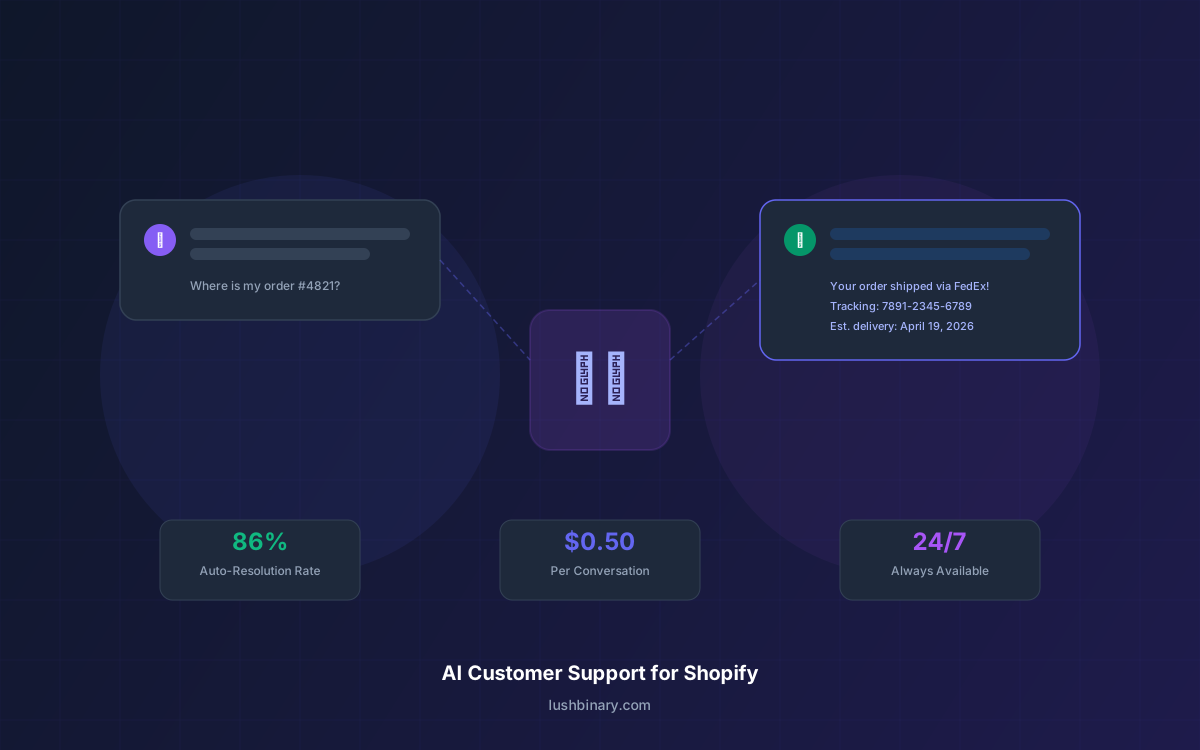
AI chatbots now resolve up to 86% of customer questions without human intervention, and e-commerce brands using autonomous AI agents report resolution rates between 76% and 92%. Meanwhile, a single human agent interaction costs roughly $6, while an AI chatbot handles the same query for about $0.50. For Shopify merchants processing hundreds or thousands of support tickets per month, the math is hard to ignore.
The problem is that most Shopify store owners don't know where to start. Should you install a plug-and-play chatbot app? Build a custom AI agent with the Shopify API? Use Shopify's own Sidekick? The options range from free Tidio widgets to $60K custom builds, and picking the wrong one means wasted money, frustrated customers, and support tickets that still pile up.
This guide breaks down every approach to adding an AI customer support agent to your Shopify store: off-the-shelf apps, custom-built agents, the Shopify APIs that power them, real cost comparisons, and how Lushbinary builds AI support systems that actually reduce your ticket volume.
📋 Table of Contents
- 1.Why Shopify Stores Need AI Customer Support in 2026
- 2.Shopify Sidekick vs Customer-Facing AI Agents
- 3.Off-the-Shelf AI Chatbots for Shopify: Top Options Compared
- 4.Building a Custom AI Support Agent with the Shopify API
- 5.System Architecture for a Custom Shopify AI Agent
- 6.Core Features Your AI Agent Should Handle
- 7.AI Model Selection: GPT-4o vs Claude vs Open-Source
- 8.Cost Comparison: Off-the-Shelf vs Custom AI Agent
- 9.Implementation Timeline & Development Phases
- 10.How Lushbinary Builds Shopify AI Support Agents
- 11.FAQ
1Why Shopify Stores Need AI Customer Support in 2026
E-commerce customer expectations have shifted dramatically. A 2026 Salesforce study found that 69% of consumers prefer chatbots for quick communication with brands, and 64% of agents with AI chatbots spend most of their time solving complex problems instead of answering repetitive questions. Shoppers expect instant responses — not within 24 hours, not within an hour, but within seconds.
For Shopify stores specifically, the support burden is predictable and repetitive. The vast majority of tickets fall into a handful of categories: "Where is my order?", "How do I return this?", "Do you have this in stock?", and "Can I change my shipping address?" These are exactly the kinds of queries an AI agent handles well — structured data lookups against the Shopify Admin API, policy-based responses, and simple transactional actions.
The ROI case is straightforward. According to industry data, AI customer service tools can handle 40–60% of support inquiries automatically, reducing response time from hours to seconds and saving 15–25 hours per week for most stores. AI chatbots deliver 88% customer satisfaction at $0.03–$0.20 per conversation, while live chat costs $4–$12 per interaction and requires staffing around the clock.
The highest-ROI AI agents for Shopify stores are customer service agents that deflect 60–75% of tickets by pulling live order data via the Shopify Admin API, shopping assistant agents that lift average order value (AOV) by 15–30% with personalized recommendations, and marketing agents that automate Klaviyo flows and recover 10–20% more abandoned carts.
2Shopify Sidekick vs Customer-Facing AI Agents
Before diving into solutions, it's important to understand what Shopify already offers. Shopify Sidekick is the platform's built-in AI assistant, launched in beta in 2023 and now available by default for all new stores as of 2026. But Sidekick is a merchant-facing tool, not a customer-facing one.
Sidekick helps store owners with content generation, data analysis, store management, and building Flow automations — all from within the Shopify admin. The Winter '26 Edition upgraded Sidekick significantly: it can now build apps, create workflows, and execute multi-step actions. Sidekick Pulse, a background analysis engine, continuously monitors your store and surfaces tailored recommendations.
However, Sidekick does not interact with your customers. It won't answer a shopper's question about their order status, process a return request, or recommend products in a chat widget on your storefront. For that, you need a separate AI customer support agent — either an off-the-shelf chatbot app or a custom-built solution.
💡 Key Distinction
Shopify Sidekick = AI for you (the merchant). AI customer support agent = AI for your customers. You need both, but they serve completely different purposes.
Shopify has also partnered with OpenAI for a native ChatGPT integration that lets customers buy products directly inside ChatGPT conversations via "Instant Checkout" with Shop Pay. This is a discovery and sales channel, not a support tool. It's great for product visibility but doesn't handle post-purchase support like order tracking, returns, or refunds.
3Off-the-Shelf AI Chatbots for Shopify: Top Options Compared
If you want to get an AI support agent running quickly without custom development, several Shopify app store chatbots offer solid AI capabilities. Here are the top options as of April 2026:
| Platform | Starting Price | AI Model | Best For |
|---|---|---|---|
| Gorgias | $10/mo (ticket-based) | Proprietary AI Agent | Shopify-native helpdesk + AI |
| Tidio | Free / $29/mo (Lyro AI) | Lyro AI | Small stores, best free tier |
| Zendesk | $55/agent/mo | Zendesk AI | Enterprise, multi-channel |
| Chatbase | $19/mo | GPT-4o / Claude | Custom RAG chatbot builder |
| Alhena AI | Custom pricing | Proprietary | High-volume Shopify stores |
| Custom Build | $15K–$60K dev cost | GPT-4o / Claude / open-source | Full control, deep Shopify API |
Gorgias: The Shopify-Native Helpdesk
Gorgias is a Shopify Premier Partner and the most deeply integrated helpdesk for Shopify stores. Unlike most competitors that charge per agent seat, Gorgias bills based on ticket volume — you can add unlimited support agents without increasing your subscription cost. Their AI Agent acts as both a support agent (handling order tracking, returns, refunds) and a shopping assistant (product recommendations, upselling, discount codes).
The AI Agent is built exclusively for Shopify stores, pulling data directly from your Shopify backend. Plans start at $10/month for 50 tickets, scaling to $750+/month for high-volume stores. The main drawback: costs can escalate quickly as ticket volume grows, and some merchants report their $360/month plan becoming a $960 bill after AI agent add-ons.
Tidio: Best Free Tier
Tidio offers a generous free plan with live chat and basic automation. Their Lyro AI add-on ($29/month) provides conversational AI that learns from your FAQ content and help center articles. It's the easiest entry point for small Shopify stores that want to test AI support without a big commitment.
The limitation is depth. Lyro works well for FAQ-style questions but doesn't have the deep Shopify API integration that Gorgias offers. It can't pull real-time order data or process returns natively — you'll need to set up integrations or use Tidio's automation flows for that.
When Off-the-Shelf Isn't Enough
Off-the-shelf chatbots work well for stores with standard support needs. But they hit a wall when you need: custom business logic (e.g., warranty claims that check purchase date and product category), multi-system integration (Shopify + ERP + warehouse management + CRM), brand-specific conversation flows that go beyond template responses, or full control over the AI model, prompts, and data pipeline. That's where a custom-built AI agent comes in.
4Building a Custom AI Support Agent with the Shopify API
A custom AI support agent connects directly to Shopify's APIs to access real-time store data, then uses a large language model (LLM) to understand customer queries and generate contextual responses. The key advantage over off-the-shelf tools is full control: you own the data pipeline, the conversation logic, the AI model selection, and the integration points.
Shopify offers two primary API architectures as of 2026: the REST Admin API and the GraphQL Admin API, with GraphQL being the preferred standard for new development. The latest API version is 2026-01, which introduced support for five concurrent bulk operations per shop (up from one previously).
Key Shopify APIs for AI Agents
- Admin API (GraphQL) — The backbone. Query orders, customers, products, inventory, and fulfillments. Use mutations to update orders, process refunds, and manage returns. The
Orderobject connects customer info, product details, payment processing, and fulfillment data. - Storefront API — Customer-facing product data, cart management, and checkout. Use this for product recommendations and pre-purchase queries. Supports unauthenticated access for public-facing chat widgets.
- Customer Account API — Access customer-specific order history and account data. Useful for authenticated support flows where the customer is logged in.
- Webhooks — Real-time event notifications for order creation, fulfillment updates, refund processing, and more. Essential for proactive support (e.g., notifying customers when their order ships).
⚠️ API Access Note
By default, only the last 60 days' worth of orders are accessible from the Order object in the GraphQL Admin API. To access older orders, your app needs the read_all_orders scope, which requires approval from Shopify.
How the Integration Works
The AI agent sits between your customer and Shopify's backend. When a customer asks "Where is my order #1234?", the agent:
- Parses the natural language query using an LLM (GPT-4o, Claude, etc.)
- Extracts the intent (
order_status) and entities (order_id: 1234) - Calls the Shopify Admin API:
query { order(id: "gid://shopify/Order/1234") { fulfillments { trackingInfo { number url } status } } } - Formats the API response into a natural language reply with the tracking number and link
- Falls back to a human agent if the query is too complex or the customer is frustrated
This is the same pattern used by tools like Gorgias under the hood — the difference is that with a custom build, you control every step.
5System Architecture for a Custom Shopify AI Agent
A production-grade AI support agent for Shopify involves several interconnected services. Here's the architecture we recommend at Lushbinary:
Component Breakdown
- Chat Widget — A lightweight JavaScript widget embedded on your Shopify storefront via a theme app extension or script tag. Supports web chat, with optional WhatsApp, Instagram DM, and email channels via webhook routing.
- API Gateway — Handles authentication, rate limiting, and request routing. Verifies customer identity for authenticated flows (logged-in users) and manages anonymous sessions for guest shoppers.
- AI Orchestrator — The brain. Uses an LLM with function calling to detect customer intent, route to the appropriate tool (Shopify API call, knowledge base lookup, or human handoff), and generate natural language responses.
- Knowledge Base (RAG) — Your FAQ content, return policies, shipping information, and product catalog embedded as vectors in a database (Pinecone, pgvector, or Weaviate). The AI retrieves relevant context before generating responses.
- Human Handoff — When the AI detects frustration, complex issues, or low confidence, it transfers the conversation to a human agent with full context (conversation history, customer data, order details).
This architecture scales from handling 100 conversations/day on a single Lambda function to thousands on ECS Fargate with auto-scaling. The key design principle: the AI agent should feel like a knowledgeable store employee, not a generic chatbot.
6Core Features Your AI Agent Should Handle
Not every AI feature is worth building. Based on real Shopify support data, here are the highest-impact capabilities ranked by ticket deflection potential:
Tier 1: Must-Have (Deflects 50–70% of Tickets)
Order Status & Tracking
Pull real-time fulfillment data, tracking numbers, and estimated delivery dates from the Shopify Admin API.
Return & Refund Initiation
Check return eligibility based on your policy, create return requests, and process refunds via API mutations.
FAQ & Policy Answers
RAG-powered responses from your shipping policy, return policy, sizing guides, and product care instructions.
Shipping Address Changes
Update unfulfilled order addresses via the orderUpdate mutation before the order ships.
Tier 2: High-Value (Lifts Revenue 10–30%)
Product Recommendations
Use the Storefront API + customer purchase history to suggest relevant products. Personalized recommendations lift AOV by 15-30%.
Abandoned Cart Recovery
Detect abandoned checkouts via webhooks and trigger AI-powered follow-up messages with personalized incentives.
Pre-Purchase Q&A
Answer product questions (sizing, compatibility, materials) using product metafields and your knowledge base.
Discount & Promo Application
Help customers apply discount codes, check eligibility, and suggest active promotions during the conversation.
Tier 3: Advanced (Differentiators)
Multi-Language Support
Serve international customers in their language using the LLM's native multilingual capabilities. No separate translation layer needed.
Proactive Notifications
Use Shopify webhooks to proactively notify customers about shipping delays, back-in-stock items, or price drops.
Sentiment-Based Escalation
Detect customer frustration in real-time and route to a human agent before the situation escalates.
Voice Support
Extend the AI agent to phone support using real-time speech-to-text and text-to-speech APIs for voice-first customers.
7AI Model Selection: GPT-4o vs Claude vs Open-Source
The LLM you choose for your AI agent directly impacts response quality, latency, and cost. Here's how the top options compare for Shopify customer support use cases as of April 2026:
| Model | Input / Output (per 1M tokens) | Best For | Latency |
|---|---|---|---|
| GPT-4o | $2.50 / $10.00 | Function calling, multimodal | Fast |
| GPT-4o Mini | $0.15 / $0.60 | High-volume, cost-sensitive | Very fast |
| Claude Sonnet 4.6 | $3.00 / $15.00 | Nuanced conversations, safety | Fast |
| Claude Haiku 4.5 | $0.80 / $4.00 | Fast responses, good quality | Very fast |
| Qwen 3.6 (self-hosted) | ~$0.05–$0.20 (compute) | Data privacy, no API costs | Depends on hardware |
For most Shopify stores, we recommend a tiered model approach:
- GPT-4o Mini or Claude Haiku for simple, high-volume queries (order status, FAQ lookups) — keeps costs under $0.01 per conversation
- GPT-4o or Claude Sonnet for complex queries requiring nuanced understanding (complaints, multi-step returns, product comparisons)
- Prompt caching to reduce costs by 50–90% on repeated system prompts and knowledge base context
A typical Shopify support conversation uses 500–1,500 tokens. At GPT-4o Mini rates ($0.15/$0.60 per million tokens), that's roughly $0.001 per conversation. Even at GPT-4o rates, a full conversation costs about $0.01–$0.03. Compare that to $4–$12 for a human agent interaction.
8Cost Comparison: Off-the-Shelf vs Custom AI Agent
Get Detailed Cost Breakdown
Fill in your details to unlock pricing and cost information.
9Implementation Timeline & Development Phases
Whether you go off-the-shelf or custom, here's what a realistic implementation looks like:
Off-the-Shelf (Gorgias / Tidio): 1–2 Weeks
- Day 1–2: Install the Shopify app, connect your store, configure basic settings
- Day 3–5: Train the AI on your FAQ content, return policy, and shipping information
- Day 6–8: Set up automation rules, human handoff triggers, and channel routing
- Day 9–14: Test with real conversations, refine responses, adjust confidence thresholds
Custom AI Agent: 4–8 Weeks
| Phase | Duration | Deliverables |
|---|---|---|
| 1. Discovery & Design | 1 week | Ticket audit, intent mapping, architecture design, API scope |
| 2. Core Agent Build | 2–3 weeks | LLM integration, Shopify API connectors, RAG knowledge base, chat widget |
| 3. Advanced Features | 1–2 weeks | Human handoff, multi-channel, analytics dashboard, escalation rules |
| 4. Testing & Launch | 1–2 weeks | Shadow mode testing, A/B vs human agents, prompt tuning, production deploy |
The most important phase is shadow mode testing: running the AI agent alongside your human support team for 1–2 weeks, comparing responses, and tuning the prompts and confidence thresholds before going live. This catches edge cases and builds confidence in the system before customers interact with it directly.
10How Lushbinary Builds Shopify AI Support Agents
At Lushbinary, we've built AI-powered support systems for e-commerce stores ranging from early-stage Shopify brands to high-volume Shopify Plus merchants. Our approach combines deep Shopify API expertise with production-grade AI engineering.
Here's what we deliver:
- Full Shopify API integration — We connect to the Admin API (GraphQL 2026-01), Storefront API, and webhooks for real-time order tracking, returns processing, inventory checks, and customer data access.
- Multi-model AI architecture — We use tiered model routing (GPT-4o Mini for simple queries, GPT-4o or Claude for complex ones) to keep costs low while maintaining high response quality.
- RAG-powered knowledge base — Your FAQ, policies, product catalog, and brand voice are embedded in a vector database so the AI gives accurate, on-brand answers — not generic chatbot responses.
- Human handoff with context — When the AI can't resolve an issue, it transfers to your team with the full conversation history, customer profile, and order details. No "please repeat your issue" moments.
- Analytics & continuous improvement — We build dashboards that track deflection rate, resolution time, customer satisfaction, and cost per conversation. The system gets smarter over time as we refine prompts and expand the knowledge base.
- AWS or Cloudflare hosting — We deploy on cost-optimized AWS infrastructure (ECS Fargate, Lambda, or Cloudflare Workers) depending on your scale and latency requirements.
🚀 Free Consultation
Want to add AI customer support to your Shopify store? Lushbinary specializes in custom AI agents for e-commerce. We'll audit your current support workflow, recommend the right approach (off-the-shelf or custom), and give you a realistic cost estimate — no obligation.
11FAQ
❓ Frequently Asked Questions
How much does an AI customer support agent cost for a Shopify store?
Off-the-shelf Shopify AI chatbots like Tidio and Gorgias range from $29-$750/month depending on ticket volume. A custom AI agent built with GPT-4o or Claude costs $0.50-$2 per conversation in API fees, plus $15K-$60K in development. Custom agents offer deeper Shopify integration and full brand control.
Can an AI chatbot handle Shopify order tracking and returns automatically?
Yes. AI agents connected to the Shopify Admin API (GraphQL version 2026-01) can pull real-time order status, tracking numbers, and fulfillment data. They can also initiate returns and refunds through the API, handling 60-80% of post-purchase support tickets without human intervention.
What is the best AI chatbot for Shopify in 2026?
For plug-and-play, Gorgias is the top choice for Shopify-native helpdesks with AI automation. Tidio offers the best free tier with its Lyro AI. For stores needing full customization, a custom-built agent using OpenAI GPT-4o or Anthropic Claude with the Shopify Storefront and Admin APIs provides the deepest integration and brand control.
How long does it take to add an AI support agent to a Shopify store?
Installing an off-the-shelf chatbot like Tidio or Gorgias takes 1-3 days including training on your FAQ content. A custom AI agent with Shopify API integration, order tracking, and returns automation typically takes 4-8 weeks to build and deploy, depending on complexity.
Does Shopify have a built-in AI assistant for customer support?
Shopify Sidekick is a built-in AI assistant, but it helps merchants manage their store (content generation, data analysis, Flow automations) - not customer-facing support. For customer support, you need a third-party chatbot app or a custom AI agent connected to your Shopify store data.
📚 Sources
- OpenAI API Pricing — GPT-4o and GPT-4o Mini token pricing
- Shopify Admin API (GraphQL 2026-01) — Order, Customer, and Fulfillment objects
- Shopify Blog: AI Chatbot Customer Service — Shopify's guide to AI chatbots for e-commerce
- Shopify Winter '26 Edition — Sidekick updates and platform enhancements
Content was rephrased for compliance with licensing restrictions. Pricing and feature data sourced from official vendor pages as of April 2026. Pricing and features may change — always verify on the vendor's website.
Ready to Add AI Support to Your Shopify Store?
Tell us about your store and support volume. We'll recommend the right AI approach and give you a realistic cost estimate.
Ready to Build Something Great?
Get a free 30-minute strategy call. We'll map out your project, timeline, and tech stack - no strings attached.
Prefer email? Reach us directly: