
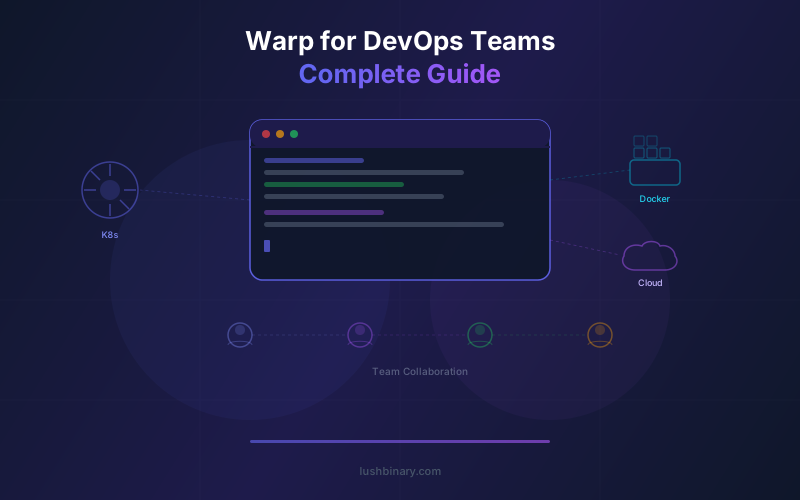
DevOps engineers live in the terminal. Deploying services, debugging Kubernetes clusters, investigating CI/CD failures, running Terraform plans, tailing logs across dozens of instances - the command line is where infrastructure work happens. Yet most DevOps teams still rely on terminals built decades ago, stitching together iTerm2, tmux, shell scripts, and tribal knowledge stored in Slack threads and outdated wikis.
Warp changes that equation. With 700,000+ users, an AI-native architecture, and a collaboration layer purpose-built for teams, Warp is the first terminal that treats DevOps as a team sport rather than a solo activity. Since open-sourcing under AGPL-3.0 in April 2026, Warp has become even more attractive for security-conscious infrastructure teams that need full code auditability.
This guide covers everything a DevOps team needs to evaluate, adopt, and get maximum value from Warp: Agent Mode for infrastructure operations, Warp Drive for shared runbooks, MCP integration for cloud providers, Oz cloud agents for automated operations, enterprise security features, and real-world workflow examples drawn from production environments.
📋 Table of Contents
- 1. Why DevOps Teams Need a Modern Terminal
- 2. Warp Agent Mode for Infrastructure Operations
- 3. Warp Drive: Shared Runbooks & Team Workflows
- 4. MCP Integration for Cloud Infrastructure
- 5. Oz Cloud Agents for Automated Operations
- 6. Security & Compliance for Enterprise DevOps
- 7. Warp vs Traditional DevOps Terminal Setups
- 8. Setting Up Warp for Your DevOps Team
- 9. Real-World DevOps Workflow Examples
- 10. Why Lushbinary for DevOps Tooling
1Why DevOps Teams Need a Modern Terminal
The traditional terminal was designed for individual operators running commands on a single machine. Modern DevOps looks nothing like that. Teams manage hundreds of microservices across multiple cloud providers, coordinate deployments through CI/CD pipelines, and respond to incidents that span distributed systems. The gap between what terminals offer and what DevOps teams need has never been wider.
The Problem with Traditional Terminals
- No AI assistance - when a kubectl command fails with a cryptic error, you alt-tab to a browser and search Stack Overflow. A modern terminal should explain the error and suggest the fix inline
- No collaboration - runbooks live in Confluence pages that go stale, deployment commands are buried in Slack threads, and new team members spend weeks collecting tribal knowledge from senior engineers
- No shared workflows - every engineer maintains their own shell aliases, scripts, and dotfiles. When someone leaves the team, their operational knowledge leaves with them
- No context awareness - traditional terminals don't know what project you're working on, what cloud provider you're targeting, or what environment you're deploying to. Every command starts from zero context
- No audit trail - for compliance-sensitive environments, there's no built-in way to track who ran what command, when, and what the output was
What a DevOps-Ready Terminal Looks Like
Warp addresses these gaps by combining a high-performance terminal emulator with AI, collaboration, and automation features that are purpose-built for team-based infrastructure work. With over 400 CLI tool completions built in, Warp understands the tools DevOps teams use daily: kubectl, terraform, aws, gcloud, docker, helm, ansible, and more.
💡 Key Insight
The shift from individual terminals to team-oriented terminal platforms mirrors what happened with text editors a decade ago. VS Code didn't win by being a better Vim - it won by adding collaboration, extensions, and integrated tooling. Warp is making the same play for the terminal.
2Warp Agent Mode for Infrastructure Operations
Agent Mode is where Warp transforms from a smart terminal into an autonomous infrastructure assistant. Instead of typing individual commands, you describe what you want to accomplish in natural language and Agent Mode handles the execution, error handling, and iteration. For DevOps teams, this is a force multiplier. Learn more in our complete Warp Agent Mode guide.
Kubernetes Operations with Agent Mode
Debugging Kubernetes issues typically involves a chain of commands: checking pod status, reading logs, describing events, inspecting resource limits, and examining network policies. Agent Mode handles this entire flow from a single prompt. You can ask it to "investigate why pods in the payment-service deployment keep crashing in the staging namespace" and it will run kubectl get pods, kubectl describe pod, kubectl logs, and follow the diagnostic trail until it identifies the root cause.
Terraform Workflows
Infrastructure-as-code workflows involve planning, reviewing diffs, applying changes, and verifying state. Agent Mode can run terraform plan, parse the output to highlight destructive changes, explain what each resource modification means, and wait for your approval before running terraform apply. When apply fails, it reads the error, suggests a fix to the HCL configuration, and re-runs the plan.
AWS CLI Operations
The AWS CLI has thousands of subcommands across hundreds of services. Even experienced engineers regularly look up syntax for less common operations. Agent Mode eliminates this friction. Ask it to "find all EC2 instances in us-east-1 that have been running for more than 30 days with no attached load balancer" and it constructs the correct aws ec2 describe-instances command with the appropriate filters and JMESPath queries.
- Multi-step execution - Agent Mode chains commands together, using the output of one as input for the next
- Error recovery - when a command fails, Agent Mode reads the error message, diagnoses the issue, and retries with a corrected command
- Context retention - Agent Mode remembers previous commands and their output within a session, so you can ask follow-up questions without repeating context
- Safety guardrails - destructive operations like kubectl delete or terraform destroy require explicit confirmation before execution
💡 DevOps Tip
Agent Mode works best when you provide specific context in your prompts. Instead of "check my cluster," try "check the health of all pods in the production namespace of the us-east-1 EKS cluster and flag any with restart counts above 5." The more context you give, the fewer iterations Agent Mode needs.
3Warp Drive: Shared Runbooks & Team Workflows
Warp Drive is the collaboration layer that turns individual terminal knowledge into team-wide operational capability. Think of it as a shared workspace where your team's runbooks, deployment commands, debugging procedures, and environment configurations live alongside the terminal where they're actually executed.
Parameterized Workflows
The most powerful Warp Drive feature for DevOps teams is parameterized workflows. Instead of saving static commands, you create templates with variable inputs. A deployment workflow might accept parameters for environment (staging, production), region (us-east-1, eu-west-1), service name, and image tag. Team members select the workflow, fill in the parameters, and execute with confidence that they're running the approved procedure.
Shared Notebooks
Warp Drive notebooks combine documentation with executable commands. An incident response notebook might include a description of the alert, the diagnostic commands to run, expected output patterns, and remediation steps. Unlike a Confluence page that goes stale, a Warp notebook is executable - team members run the commands directly from the notebook without copy-pasting.
Environment Variable Management
DevOps teams juggle environment variables across multiple contexts: AWS credentials for different accounts, Kubernetes contexts for different clusters, database connection strings for different environments. Warp Drive lets teams save and share environment variable sets that can be loaded with a single command. No more "which AWS profile do I use for the staging account?" questions in Slack.
- Team-wide command library - save frequently used commands with descriptions, tags, and usage notes so anyone on the team can find and run them
- Version-controlled workflows - track changes to shared workflows over time, with the ability to roll back to previous versions
- Access controls - restrict who can edit shared workflows versus who can only execute them, preventing accidental modifications to production procedures
- Onboarding accelerator - new team members get instant access to every operational procedure, debugging workflow, and deployment command the team has built
💡 Team Workflow
Start by migrating your team's most-used runbooks into Warp Drive. Focus on incident response procedures, deployment checklists, and common debugging flows first. These high-frequency workflows deliver the most immediate value and help build adoption across the team.
4MCP Integration for Cloud Infrastructure
The Model Context Protocol (MCP) is what transforms Warp's AI from a command suggestion engine into a context-aware infrastructure assistant. MCP allows Warp to connect directly to your cloud providers, databases, monitoring tools, and internal APIs so that AI responses are grounded in real-time data rather than static documentation. For a deep dive, see our Warp MCP integration guide.
Cloud Provider Connections
With MCP servers configured for AWS, GCP, or Azure, Warp's AI can query your actual infrastructure state. Instead of generating generic AWS CLI commands, it can list your real EC2 instances, check actual S3 bucket policies, and inspect live CloudFormation stack status. This eliminates the back-and-forth of running a command, reading the output, and asking the AI what it means.
Kubernetes Cluster Integration
An MCP server connected to your Kubernetes API gives Warp's AI direct visibility into cluster state. It can check pod health, read deployment configurations, inspect service endpoints, and review recent events without you manually running kubectl commands first. When you ask "why is the checkout service returning 503 errors," the AI can pull pod logs, check resource limits, and inspect ingress rules in a single flow.
Database and Monitoring Connections
MCP servers for PostgreSQL, MongoDB, Redis, and monitoring platforms like Datadog or Prometheus let Warp's AI correlate infrastructure issues with application data. During an incident, the AI can check database connection pool utilization, query slow query logs, and pull relevant metrics from your monitoring stack to build a complete picture of what went wrong.
- AWS MCP server - query EC2, S3, RDS, Lambda, CloudWatch, and IAM resources directly from Warp AI
- GCP MCP server - access Compute Engine, GKE, Cloud SQL, and Cloud Monitoring data
- Kubernetes MCP server - read pod status, deployments, services, configmaps, and cluster events
- Database MCP servers - run read-only queries against PostgreSQL, MongoDB, and Redis for diagnostic purposes
- Custom MCP servers - build MCP servers for internal APIs, deployment platforms, and proprietary tooling
💡 Security Note
Configure MCP servers with read-only credentials for production environments. The AI should be able to query infrastructure state for diagnostics but should not have write access to production resources. Use separate MCP configurations for staging and production with appropriate permission boundaries.
5Oz Cloud Agents for Automated Operations
Oz is Warp's open-source cloud agent orchestration platform, released under the MIT license. While Agent Mode runs in your local terminal session, Oz agents run in the cloud and can be triggered by cron schedules, webhooks, or external events. For DevOps teams, Oz turns Warp from a reactive tool into a proactive operations platform.
Cron-Triggered Health Checks
Configure Oz agents to run infrastructure health checks on a schedule. A daily agent might verify that all Kubernetes deployments have the expected replica count, check that SSL certificates are not expiring within 30 days, confirm that database backup jobs completed successfully, and validate that CloudWatch alarms are properly configured. Results are delivered to Slack, PagerDuty, or email with a summary of findings and recommended actions.
Webhook-Triggered Incident Response
Connect Oz agents to your alerting pipeline so they begin diagnostic work the moment an incident fires. When PagerDuty triggers a webhook, an Oz agent can immediately gather pod logs, check recent deployments, query error rates from your monitoring stack, and compile a diagnostic summary before the on-call engineer even opens their laptop. This reduces mean time to diagnosis from minutes to seconds.
Scaling and Concurrency
Warp's Max plan supports up to 40 concurrent cloud agents, allowing teams to run parallel operations across multiple clusters, regions, and environments. A large-scale deployment might trigger 10 agents simultaneously to verify service health across all regions after a global rollout.
- Scheduled compliance scans - run weekly agents that check IAM policies, security group rules, and encryption settings against your compliance baseline
- Cost monitoring agents - daily agents that track resource utilization, identify idle instances, and flag unexpected cost spikes before they hit your monthly bill
- Deployment verification - post-deployment agents that run smoke tests, check error rates, and validate that new versions are serving traffic correctly
- Drift detection - agents that compare actual infrastructure state against Terraform state files and flag any manual changes or configuration drift
💡 Oz Architecture
Oz is MIT-licensed and can be self-hosted for teams that need full control over agent execution. The architecture supports custom tool definitions, so you can extend agents with access to internal APIs, proprietary monitoring systems, and custom deployment pipelines.
6Security & Compliance for Enterprise DevOps
Enterprise DevOps teams operate under strict security and compliance requirements. Warp's Business and Enterprise plans include features specifically designed for regulated environments where audit trails, access controls, and data protection are non-negotiable.
Authentication and Access Control
- SSO integration - connect Warp to your identity provider (Okta, Azure AD, Google Workspace) for centralized authentication. No separate Warp credentials to manage
- SCIM provisioning - automatically provision and deprovision Warp accounts when team members join or leave your organization. No manual account management
- Per-directory permissions - control which Warp Drive folders and workflows are accessible to different teams or roles. Production runbooks can be restricted to senior engineers while staging workflows are available to the full team
Audit and Compliance
- Audit logs - track who accessed which workflows, when commands were executed, and what changes were made to shared resources. Essential for SOC 2, HIPAA, and PCI DSS compliance
- Redacted command history - automatically redact sensitive values like passwords, API keys, and tokens from command history and shared sessions. Prevents accidental exposure of credentials in team-visible contexts
- Data residency controls - for Enterprise plans, configure where Warp stores team data to meet regional compliance requirements like GDPR
Open-Source Auditability
Since Warp open-sourced its terminal client under AGPL-3.0 in April 2026, security teams can audit exactly what data the terminal collects, how it communicates with Warp's servers, and what happens during AI interactions. This level of transparency is rare among commercial developer tools and addresses the telemetry concerns that previously made some security-conscious teams hesitant to adopt Warp.
💡 Compliance Tip
For teams subject to SOC 2 or HIPAA requirements, combine Warp's audit logs with your existing SIEM solution. Export Warp audit events to Splunk, Datadog, or your preferred log aggregator to maintain a unified compliance trail across all developer tooling.
7Warp vs Traditional DevOps Terminal Setups
Most DevOps teams have cobbled together a terminal setup over years of incremental additions: a terminal emulator, a multiplexer, shell plugins, custom scripts, and various CLI tools. Here is how Warp compares to the two most common setups:
| Feature | Warp | iTerm2 + tmux | Ghostty + Scripts |
|---|---|---|---|
| AI Assistance | Built-in Agent Mode, inline AI, multi-model | None (requires external tools) | None (requires external tools) |
| Team Collaboration | Warp Drive: shared workflows, notebooks, env vars | Manual: shared dotfiles via Git repos | Manual: shared scripts via Git repos |
| CLI Completions | 400+ tools with contextual suggestions | Shell-dependent (zsh-autosuggestions) | Shell-dependent (fish, zsh plugins) |
| Cloud Agents | Oz: cron, webhook, up to 40 concurrent | None (build with cron + bash scripts) | None (build with cron + bash scripts) |
| MCP Integration | Native: AWS, GCP, K8s, databases | Not available | Not available |
| SSO / SCIM | Business and Enterprise plans | Not applicable | Not applicable |
| Audit Logs | Built-in with SIEM export | Manual: shell history + custom logging | Manual: shell history + custom logging |
| Block-Based Output | Yes - selectable, copyable, shareable blocks | No - continuous scroll | No - continuous scroll |
| Open Source | AGPL-3.0 (terminal), MIT (Oz) | GPLv2 (iTerm2), ISC (tmux) | MIT (Ghostty) |
| Pricing | Free / $18 / $180 / $45 per user | Free | Free |
| Setup Time | Minutes (download and sign in) | Hours (configure tmux, plugins, scripts) | Hours (configure shell, write scripts) |
The traditional setups are free and highly customizable, which matters for teams with strong opinions about their tooling. But the maintenance burden is real: keeping tmux configs in sync, updating shell plugins, maintaining custom scripts, and onboarding new engineers to a bespoke setup takes ongoing effort. Warp trades some customizability for a cohesive, maintained experience that works out of the box.
8Setting Up Warp for Your DevOps Team
Rolling out Warp across a DevOps team requires more than just downloading the app. Here is a step-by-step onboarding guide that covers installation, team configuration, and workflow migration.
Step 1: Choose Your Plan
Start with the Free tier for evaluation. Each team member gets 75 AI credits per month, which is enough to test Agent Mode, Warp Drive, and basic AI features. For a full team rollout, the Business plan at $45/user/month includes SSO, SCIM, audit logs, and centralized billing. Teams of 5-10 engineers typically find the Business plan cost-effective when factoring in time saved on onboarding and incident response.
Step 2: Install and Configure
- Download Warp from warp.dev for macOS, Linux, or Windows
- Create a team workspace and invite members via email or SSO
- Configure default shell (bash, zsh, or fish) and import existing shell configurations
- Set up keybindings - Warp supports custom keybindings and can import from iTerm2 or other terminals
- Enable block-based output mode (on by default) and configure output retention preferences
Step 3: Configure MCP Servers
Set up MCP connections for your team's infrastructure. At minimum, configure MCP servers for your primary cloud provider and Kubernetes clusters. Use read-only credentials for production environments and broader permissions for staging. Store MCP configurations in Warp Drive so all team members use the same connections.
Step 4: Migrate Runbooks to Warp Drive
Audit your existing runbooks in Confluence, Notion, or Google Docs. Identify the top 10-20 most frequently used procedures and convert them into Warp Drive workflows with parameterized inputs. Prioritize incident response procedures, deployment checklists, and common debugging flows. Tag workflows by service, environment, and severity level for easy discovery.
Step 5: Set Up Oz Agents
Start with two or three Oz agents for high-value automated checks: a daily infrastructure health check, a post-deployment verification agent, and a cost monitoring agent. Configure webhook triggers from your alerting system (PagerDuty, Opsgenie, or CloudWatch) so agents begin diagnostic work automatically when incidents fire.
Step 6: Establish Team Conventions
- Define a naming convention for Warp Drive workflows (e.g., service-name/action-type/environment)
- Set up folder structure in Warp Drive that mirrors your service architecture
- Create a "getting started" notebook for new team members that walks through common workflows
- Establish review processes for changes to production runbooks
- Schedule a weekly 15-minute session where team members share new workflows or Agent Mode techniques they discovered
💡 Adoption Tip
Don't mandate Warp for the entire team on day one. Start with 2-3 volunteers who are open to trying new tools. Let them build workflows, document wins, and become internal champions. Organic adoption driven by visible productivity gains is more sustainable than top-down mandates.
9Real-World DevOps Workflow Examples
Theory is useful, but DevOps teams need to see how Warp fits into their actual daily work. Here are five concrete workflow examples drawn from production environments.
Example 1: Kubernetes Pod Debugging
Scenario: A PagerDuty alert fires at 2 AM because the payment-service pods are crash-looping in production.
Traditional approach: SSH into a bastion host, run kubectl get pods to find the failing pods, kubectl describe pod to check events, kubectl logs to read error output, then manually correlate timestamps with recent deployments. This takes 10-15 minutes of context-switching between terminal and browser.
Warp approach: Open Warp and type into Agent Mode: "The payment-service pods are crash-looping in the production namespace. Check pod status, read the last 100 lines of logs from the most recent crashed pod, check if there was a deployment in the last 2 hours, and summarize what went wrong." Agent Mode runs all four commands, correlates the data, and reports that a config change deployed 45 minutes ago introduced an invalid environment variable. Total time: 2 minutes.
Example 2: CI/CD Pipeline Investigation
Scenario: The main branch CI pipeline has been failing for the last 3 builds, blocking all deployments.
Warp approach: Use Agent Mode to pull the last 3 build logs from your CI system (GitHub Actions, GitLab CI, or Jenkins), diff the failing step output against the last successful build, and identify the change that introduced the failure. With MCP connected to your Git provider, the AI can also check which commits landed between the last passing and first failing build, narrowing the investigation to specific changes.
Example 3: AWS Cost Audit
Scenario: Your AWS bill jumped 40% month-over-month and finance wants an explanation by end of day.
Warp approach: Ask Agent Mode to "pull the AWS Cost Explorer data for the last 60 days, break it down by service, identify the top 3 services with the largest cost increase, and for each one list the specific resources driving the increase." With an AWS MCP server configured, the AI can query Cost Explorer, cross- reference with EC2 instance lists, check for unattached EBS volumes, and identify NAT Gateway data transfer charges. The output is a structured summary you can forward directly to finance.
Example 4: Incident Response Coordination
Scenario: Multiple services are returning elevated error rates after a database migration.
Warp approach: Load the "post-migration verification" workflow from Warp Drive, which includes parameterized checks for database connection pool health, query latency percentiles, replication lag, and application error rates. Run the workflow with the production database endpoint as the parameter. The workflow executes each check in sequence, and Agent Mode summarizes the results: replication lag is 45 seconds (normally under 1 second), causing read replicas to serve stale data. The remediation step in the workflow suggests pausing read traffic to replicas until lag recovers.
Example 5: Infrastructure Drift Detection
Scenario: A quarterly compliance audit requires verification that all infrastructure matches its Terraform definitions.
Warp approach: Configure an Oz agent to run terraform plan across all your state files and report any resources where the actual state differs from the declared configuration. The agent runs nightly, compares plan output against a "zero drift" baseline, and posts a summary to your compliance Slack channel. When drift is detected, the agent includes the specific resource, the expected value, the actual value, and a suggested terraform import or manual fix command.
10Why Lushbinary for DevOps Tooling
🚀 Build Your DevOps Platform with Lushbinary
Lushbinary helps DevOps teams build custom tooling, integrate Warp into existing workflows, and develop internal platforms that multiply engineering productivity. Whether you need custom MCP servers for your infrastructure, Oz agent configurations for automated operations, or a full internal developer platform built around modern terminal workflows, our team has the infrastructure expertise to deliver.
- Custom MCP server development for internal APIs and proprietary infrastructure
- Oz agent configuration and deployment for automated health checks, compliance scans, and incident response
- Warp Drive workflow migration from existing runbooks, wikis, and documentation
- Internal developer platform design and implementation
- DevOps toolchain optimization and CI/CD pipeline architecture
We work with teams ranging from 5-person startups to enterprise platform engineering organizations. Reach out below to discuss your DevOps tooling needs.
Frequently Asked Questions
What makes Warp better than a traditional terminal for DevOps teams?
Warp provides AI-powered Agent Mode for multi-step infrastructure operations, Warp Drive for shared runbooks and parameterized workflows, MCP integration for connecting to cloud providers and databases, and Oz cloud agents for automated health checks and incident response. Traditional terminals like iTerm2 or Ghostty lack built-in AI assistance, team collaboration, and workflow sharing, forcing DevOps teams to rely on scattered scripts and tribal knowledge.
How does Warp Agent Mode help with DevOps workflows?
Agent Mode acts as an autonomous AI assistant that executes multi-step terminal workflows for infrastructure operations. It can run kubectl commands to debug Kubernetes pods, execute terraform plans with error correction, investigate CI/CD pipeline failures by reading logs and suggesting fixes, and chain AWS CLI commands for cost auditing. Agent Mode reads file context, iterates on errors, and maintains conversation history across commands.
What is Warp Drive and how do DevOps teams use it?
Warp Drive is a cloud-synced workspace where DevOps teams save and share parameterized commands, runbooks, environment variable sets, and interactive notebooks. Teams create reusable workflows like deployment checklists with variable inputs for environment, region, and service name. New team members get instant access to approved operational procedures instead of hunting through wikis or Slack history.
How much does Warp cost for a DevOps team?
Warp offers a Free tier with 75 AI credits per month, Build at $18/month with 1,500 credits, Max at $180/month with 18,000 credits and up to 40 concurrent cloud agents, and Business at $45/user/month with SSO, audit logs, and centralized billing. For a 10-person DevOps team, the Business plan costs $450/month or $5,400/year. The Free tier is sufficient for evaluation but most active DevOps engineers will need a paid plan.
Can Warp connect to AWS, GCP, and Kubernetes through MCP?
Yes. Warp supports the Model Context Protocol (MCP) which allows its AI to connect directly to cloud infrastructure providers, Kubernetes clusters, databases, and monitoring tools. DevOps teams can configure MCP servers for AWS, GCP, Azure, PostgreSQL, MongoDB, and other services so that Warp AI can query real-time infrastructure state, read logs, and suggest actions based on live data rather than static documentation.
Sources
- Warp Official Documentation - comprehensive guides for Agent Mode, Warp Drive, MCP, and team features
- Warp Agent Mode Documentation - detailed reference for Agent Mode capabilities and configuration
- Warp Drive Documentation - workflows, notebooks, and team collaboration features
- Warp GitHub Repository - open-source terminal client (AGPL-3.0)
- Oz GitHub Repository - cloud agent orchestration platform (MIT license)
- Warp MCP Integration Guide - configuring Model Context Protocol servers for cloud infrastructure
- Warp Pricing - current plan details and feature comparison
Content was rephrased for compliance with licensing restrictions. Feature details and pricing are based on publicly available documentation as of July 2025. Verify current pricing and feature availability on warp.dev.
📚 Related Guides
- Warp Open Source Developer Guide - contributing to Warp's AGPL-3.0 codebase
- Warp Agent Mode CLI Workflows Guide - deep dive into Agent Mode for complex CLI operations
- Warp MCP Integration Guide - connecting Warp to cloud providers, databases, and APIs via MCP
Ready to Build Something Great?
Get a free 30-minute strategy call. We'll map out your project, timeline, and tech stack - no strings attached.
Prefer email? Reach us directly: